Full Technical Guide
Poor cement silo discharge is often blamed on the aeration pads, but the pad is only one part of the fluidization system. A reliable diagnosis follows the complete air path—from blower to header, branch valves, piping and porous media—then checks whether the stored cement is actually capable of being aerated. Increasing pressure without finding the restriction can worsen dusting, channeling and unstable discharge.
This guide gives cement plant process and maintenance teams a practical sequence for troubleshooting cement silo aeration pads and poor discharge, including the symptoms that separate blocked media from air leaks, wet cement, outlet restrictions and downstream conveying problems.
What cement silo aeration pads actually do
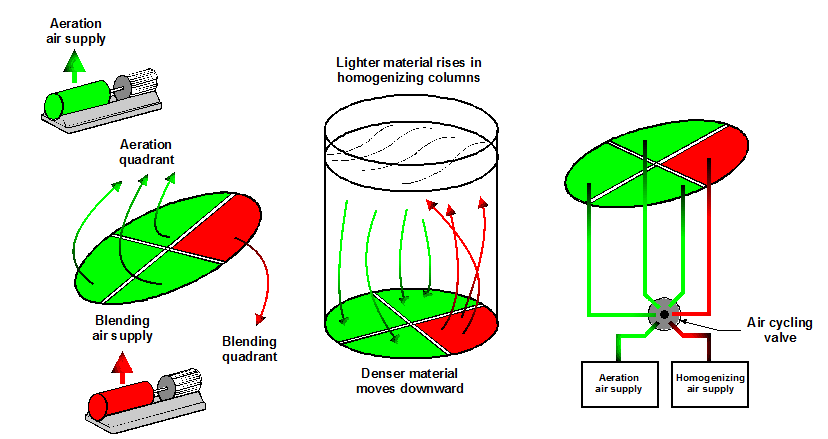
Aeration pads introduce low-pressure air through a porous surface beneath or beside stored powder. The objective is not to “blow” cement out of the silo. Air reduces particle-to-particle and particle-to-wall friction in the active discharge zone so dry, fine cement can move more readily toward the outlet.
The complete system normally includes a blower or other specified air source, intake filtration, distribution header, isolation or control valves, branch lines, flexible connections where required, and porous aeration elements. Some silos use several independently controlled zones so air is applied only where material needs to move.
Because designs differ substantially, there is no universal aeration pressure, flow rate, pad spacing or replacement interval that is safe to apply to every silo. Use the silo OEM design data, blower curve and aeration-media specification as the operating reference.
First question: is aeration really the cause of poor discharge?
Before changing blower settings or replacing pads, establish whether the failure follows the aeration system. Aeration is a strong suspect when one zone becomes inactive, discharge deteriorates gradually, branch airflow becomes unequal, or blower/header behavior changes from the plant’s established baseline.
Aeration is less likely to be the primary cause when cement has hardened after moisture ingress, the outlet is mechanically obstructed, a gate is not fully opening, a rotary feeder or screw conveyor is overloaded, or downstream transport cannot accept material.
| Observed symptom | Likely area to investigate first | Useful confirmation |
|---|---|---|
| All zones weak | Blower, filter, main header, common valve | Compare blower pressure/flow and motor load with normal baseline |
| One zone weak | Branch valve, hose, pipe restriction, pad | Compare branches under the same operating condition |
| High header pressure but poor flow | Restriction or blinded porous media | Isolate sections and locate where pressure drop develops |
| Low header pressure and poor flow | Air leak, blower problem, open bypass | Leak inspection plus blower performance check |
| Powder in an air line | Damaged media, failed seal or reverse material ingress | Isolate and inspect the affected branch |
| Good aeration readings but poor discharge | Material condition, outlet or downstream equipment | Inspect cement condition and discharge path |
Step-by-step cement silo aeration troubleshooting
1. Establish a safe operating condition
Silo work involves stored-energy, engulfment, dust and confined-space hazards. Do not enter a silo or open equipment containing stored material unless the plant’s isolation, lockout/tagout and confined-space procedures have been completed. Never stand beneath bridged material or attempt to collapse a suspected arch from an unsafe position. Troubleshooting should begin from external measurements wherever possible.
2. Check the cement condition
Aeration works on flowable dry powder; it is not a lump breaker. Investigate moisture ingress, condensation, long storage, hydrated crusts and hard deposits. If the product has set into cohesive masses, additional air may simply find channels around the obstruction.
Review recent events: Was wet material transferred into the silo? Was conveying air unusually humid? Has a roof hatch, filter housing or seal leaked? Did the problem begin after a long shutdown? Material history can prevent unnecessary pad replacement.
3. Verify the air source before blaming the pads
Confirm that the blower is running in its normal operating range. Inspect the inlet filter, drive condition, valves and obvious leaks. Compare discharge pressure, available airflow and motor current with the plant’s own healthy baseline and the manufacturer’s curve.
A dirty intake filter, slipping belt, wrong valve position or deteriorating blower can reduce delivered air to every aeration zone. Conversely, a blower operating against unusually high resistance may show elevated pressure while useful airflow falls.
4. Inspect the main header and common components
If every zone deteriorated at roughly the same time, look for a common cause. Check the main isolation valve, regulator if fitted, header leaks, blocked strainers or restrictions, and any common solenoid or control logic. A fault upstream of the branch manifold can mimic simultaneous pad failure.
5. Compare aeration zones
Zone-to-zone comparison is one of the most useful diagnostic methods because it avoids relying on a single absolute pressure number. Under comparable silo and valve conditions, record header pressure and the available branch pressure or flow indications. A weak branch beside healthy branches points downstream toward its valve, line, connection or aeration media.
Do not change several valve positions at once. Change one condition, observe the response, and record it. This preserves cause-and-effect evidence.
6. Check branch valves, hoses and piping
Confirm that each commanded valve actually opens. Solenoid indication alone does not prove that the internal valve is passing air. Look for kinked hoses, cement contamination, crushed pipework, fouled non-return valves and restrictions at fittings.
Where the system design allows safe isolation, comparing the behavior before and after a branch component can help locate a restriction. Any test pressure must remain within the rating of the installed equipment and the OEM procedure.
7. Find air leaks before increasing blower output
Air that escapes through a loose coupling, damaged hose, gasket or pad mounting interface never reaches the intended porous surface. Multiple small leaks can create poor aeration even while the blower appears healthy.
Inspect accessible joints and listen for leakage where plant safety rules permit. Repair the leak first and retest the discharge response. Increasing blower pressure to compensate for leakage wastes energy and can overload other parts of the system.
8. Evaluate the aeration pad or fabric
After upstream causes are eliminated, inspect the pad condition during a safe maintenance opportunity. Common failure modes include cement blinding, moisture-related hardening, tears, delamination, worn fabric, damaged seals and blocked air inlets.
A pad with intact media can still perform poorly if its surface is coated with hydrated cement. A torn pad may pass air too easily at one location instead of distributing it uniformly. This is why pressure alone cannot establish pad health: useful diagnosis considers both airflow behavior and actual powder movement.
9. Check the outlet and downstream system
If the aeration system behaves normally, move downstream. Confirm the outlet gate position, rotary valve or screw feeder condition, air slide performance, weigh hopper venting and receiving conveyor capacity. A restricted downstream machine can make a healthy silo look like a fluidization failure.
How to interpret pressure and airflow together
Pressure is resistance; airflow is delivery. Either measurement alone can mislead.
- Higher-than-normal pressure with lower useful flow: suspect a restriction, closed valve, blocked branch or blinded media.
- Lower-than-normal pressure with weak flow: suspect leakage, insufficient blower output or an unintended open path.
- Normal common-header behavior with one weak zone: localize the fault to that branch or pad.
- Normal air-system behavior with no improvement in material movement: investigate cement condition, silo geometry, outlet and downstream equipment.
Trend data is more valuable than an arbitrary universal limit. Record a healthy commissioning or post-maintenance baseline for each zone and compare future readings under similar operating conditions.
Blocked pad, damaged pad or wet cement?
| Condition | Typical evidence | Corrective direction |
|---|---|---|
| Blinded/blocked pad | Restricted branch behavior; low useful airflow after upstream path is proven clear | Inspect media and replace or service according to manufacturer guidance |
| Torn/damaged pad | Abnormal localized air escape, poor distribution, possible powder ingress into air side | Isolate and replace damaged media/seals |
| Wet or hardened cement | Crusts/lumps, history of water or condensation, little response to otherwise healthy aeration | Correct moisture source and remove hardened material by an approved safe method |
| Air leak | Low delivered pressure/flow, audible or detectable leakage at connections | Repair joints, hose, gasket or mounting leak and retest |
| Outlet restriction | Aeration response is normal but discharge remains constrained | Inspect gate, feeder and downstream path |
Common troubleshooting mistakes
Increasing air pressure immediately
This can hide the real fault. A blocked line remains blocked, a leak continues wasting air, and a damaged pad can distribute air even less uniformly. Use the specified operating envelope and diagnose resistance before adjusting the air source.
Replacing pads before checking valves and branches
Pad replacement is intrusive and may require silo entry. Prove the external air path first. A stuck valve or blocked hose can produce almost identical symptoms.
Using vibration or impact as a substitute for diagnosis
Uncontrolled hammering or improvised methods can damage equipment and expose personnel to stored-material hazards. Follow the plant’s approved blockage-clearing procedure and the silo manufacturer’s recommendations.
Ignoring downstream capacity
Silo discharge is a system. A full air slide, restricted rotary valve or poorly vented receiving vessel can limit transfer even when fluidization is healthy.
Preventive maintenance checklist
- Record blower pressure, airflow indication and motor load during known healthy operation.
- Maintain intake filters and blower drive components according to manufacturer instructions.
- Check branch valve operation and confirm command versus actual response.
- Inspect accessible piping, flexible connections and fittings for leakage or damage.
- Keep moisture out of conveying and aeration air systems as required by the plant design.
- Trend discharge time or throughput under comparable conditions rather than waiting for total blockage.
- Inspect pads, seals and mounting hardware during planned safe silo maintenance.
- Record which aeration zone is associated with each valve and branch so faults can be localized quickly.
- After maintenance, establish a new baseline and verify actual cement movement, not only instrument readings.
A practical diagnostic decision tree
- Is the cement dry and free of hardened deposits? If no, solve the material/moisture problem first.
- Are all aeration zones weak? If yes, check blower and common header. If no, compare individual branches.
- Does the affected branch receive air? If no, inspect valve, hose and piping.
- Is air leaking before the porous media? Repair leakage and retest.
- Is the upstream branch clear but pad flow remains abnormal? Inspect the pad/media and seals.
- Does aeration operate normally but discharge remain poor? Inspect the outlet, feeder, conveying system and receiving equipment.
When should a cement silo aeration pad be replaced?
Replace a pad when inspection or performance testing demonstrates permanent blinding, physical damage, failed sealing, loss of suitable permeability or another condition that cannot be restored within the manufacturer’s maintenance procedure. Do not use calendar age alone as the decision criterion. Service life depends on material, moisture exposure, operating duty, media construction and installation quality.
What information should maintenance record?
A useful troubleshooting record includes silo level, cement type, storage duration, discharge equipment status, blower readings, motor current, valve positions, zone-by-zone observations, weather or moisture events, recent maintenance and the actual response of material at the outlet. These records turn the next failure from guesswork into comparison.
Related Infinity for Cement Organization resources
For engineers building a broader troubleshooting library, the Infinity for Cement Organization technical resource package includes cement-process, maintenance, storage and equipment references. Explore the wider technical library at https://www.cementequipment.org/.
Related reading on the site includes the Raw Meal Silo: Design, Flow & Extraction Guide and Cement Storage, Shipping & Packing Guide. Although raw-meal and cement silos serve different process duties, these references provide useful context on bulk-powder storage and extraction systems.
Frequently asked questions
Should I increase aeration pressure when cement discharge slows?
Not automatically. First determine whether the problem is blower capacity, leakage, a branch restriction, blocked media, wet cement, the outlet or downstream conveying. Operate within the equipment manufacturer’s specified limits.
Can aeration pads break hardened cement?
No. Aeration helps suitable dry powder move by reducing friction and promoting fluidized flow. It is not intended to break hydrated or mechanically hardened cement masses.
Why does one side of the silo discharge while another remains stagnant?
Uneven zone airflow, a failed branch valve, a restriction, leakage, pad condition or local material compaction can produce asymmetric discharge. Compare zones systematically before changing the blower setting.
How often should silo aeration pads be replaced?
There is no reliable universal interval. Base replacement on condition, performance trend, contamination, damage and the aeration-media manufacturer’s guidance.
Conclusion
The fastest route to reliable cement silo discharge is a structured diagnosis, not maximum air pressure. Confirm material condition, verify the blower and common header, compare zones, inspect valves and branch lines, eliminate leaks, evaluate the porous media, and finally check the outlet and downstream conveying system. That sequence minimizes unnecessary pad replacement and makes the root cause visible.