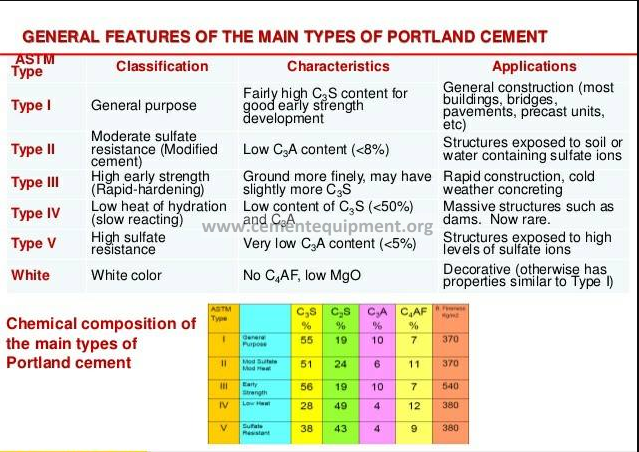
Portland-clinker behavior is governed mainly by C3S, C2S, C3A and C4AF. Together they control early versus later strength, heat evolution, setting behavior and sulfate sensitivity.
C3S, C2S, C3A and C4AF — quick engineering guide
| Compound | Main engineering effect |
|---|---|
| C3S (alite) | Major contributor to early strength; comparatively higher heat release. |
| C2S (belite) | Slower hydration; contributes more strongly to later-age strength. |
| C3A | Very reactive aluminate phase; important to setting control and sulfate-resistance behavior. |
| C4AF | Ferrite phase; contributes less to strength than silicates but matters in clinker chemistry and burnability. |
If your intent is product selection rather than clinker chemistry, use the dedicated Types of Cement guide; this page is intentionally focused on chemical composition and clinker phases.
How C3S, C2S, C3A and C4AF change cement performance
Portland cement is not a single chemical compound. It is produced by burning a controlled calcium-, silica-, alumina- and iron-bearing raw mix to clinker, then grinding the clinker with calcium sulfate. Cement chemist notation shortens CaO to C, SiO2 to S, Al2O3 to A and Fe2O3 to F. That is why the principal clinker phases are written C3S, C2S, C3A and C4AF.
| Phase | Cement-chemist formula | Plant / concrete implication | When to investigate |
|---|---|---|---|
| C3S — alite | 3CaO·SiO2 | Faster hydration, early strength and relatively high early heat. | Low early strength, abnormal free lime, burning/cooling changes or unexpected heat development. |
| C2S — belite | 2CaO·SiO2 | Slower hydration and stronger contribution at later ages. | Early/late strength balance shifts or clinker mineralogy changes. |
| C3A — aluminate | 3CaO·Al2O3 | Very reactive; strongly influences sulfate demand, early heat and sulfate resistance. | Setting abnormalities, sulfate-resistance requirements or gypsum/setting-control problems. |
| C4AF — ferrite | 4CaO·Al2O3·Fe2O3 | Important to the clinker melt/flux system and cement colour; smaller direct strength contribution. | Raw-mix iron/alumina balance, burnability or clinker-colour changes. |
A practical chemistry workflow for plant engineers
- Start with the oxide analysis. Review CaO, SiO2, Al2O3 and Fe2O3 together with SO3, MgO, alkalis and free lime.
- Calculate the control ratios. LSF, silica modulus and alumina modulus help explain the raw-mix/clinker chemistry before looking at phase estimates.
- Estimate the clinker phases. Use Bogue calculations as a screening and trending tool, not as a substitute for XRD or microscopy.
- Correlate chemistry with performance. Compare phase trends with 1-, 2-, 7- and 28-day strength, setting, heat, sulfate demand and kiln/cooler history.
- Investigate the process cause. If chemistry and performance diverge, check burnability, burning-zone conditions, free lime, clinker cooling, cement fineness and sulfate balance before changing the raw mix.
For the upstream process, continue to the cement raw-materials guide and cement manufacturing process. For clinker quality troubleshooting, use clinker quality and composition. For product-class selection, use Types of Cement. For calculation work, open the free cement-engineering calculators.
Next step: turn the chemistry into a plant decision
Use the formulas and calculators to check the numbers first, then move to clinker-quality or process troubleshooting. For the supporting books, manuals and Excel references, choose the package level that fits your work.
Frequently Asked Questions
What is C3S in cement?
C3S, or alite, is the clinker silicate phase that contributes strongly to early-age strength and releases heat relatively quickly during hydration.
What is C2S in cement?
C2S, or belite, hydrates more slowly than C3S and contributes more strongly to later-age strength with lower early heat release.
What do C3A and C4AF do in cement?
C3A is the highly reactive aluminate phase that strongly affects setting and sulfate response; C4AF is the ferrite phase and contributes less to strength than the silicates.
Need deeper cement references?
The library brings cement chemistry, quality, kiln/process, maintenance, training material and engineering calculation tools together in one organized reference collection. Choose Engineering Essentials — $99 or the Complete 931-File Package — $249. One-time payment, instant download.
Related overview
For a broader introduction, see Types of Cement. For deeper reference material, review the technical package.
Cement Formula — the composition in summary
Cement formula is shorthand for the oxide composition of the Portland clinker. The cement chemical
formula most laboratories work with is expressed in oxide terms:
CaO is normally the dominant oxide, followed by SiO2, with smaller Al2O3 and Fe2O3 fractions plus controlled SO3, MgO and alkalis. Exact ranges depend on cement type and specification. There is therefore no single molecular “formula of cement” comparable with H2O: engineers describe cement using oxide composition, clinker phases and control ratios.
The Bogue equations estimate potential C3S, C2S, C3A and C4AF from the chemical analysis. For the complete equation set and worked calculations, use the cement manufacturing formulas guide; use laboratory XRD or microscopy when actual mineralogical phase measurement is required.
Remember: the chemical formula of cement is not one molecule like H2O; it is an oxide recipe that
varies by brand and class. The table on this page, plus the LSF/SR/AR indexes, is how engineers compare whole plants.