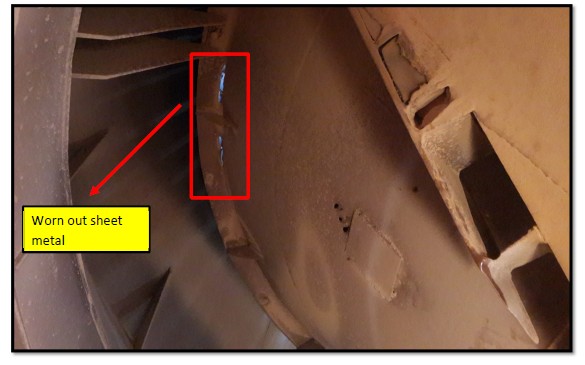
Quick answer
Partial blockage in a raw-mill reject cone can cause unstable reject flow, higher circulating load, pressure fluctuations and intermittent material surges. Diagnose cone/chute buildup, material moisture, reject transport condition, separator settings, air flow and whether the buildup forms at a repeatable low-velocity or impact zone. Do not treat every reject surge as a separator-control problem until the mechanical reject path is proven clear.
Problem / job
Raw-mill rejects become erratic, reject elevator/conveyor load surges, or pressure/process values oscillate despite stable fresh feed.
Evidence
Capture reject flow/load, mill/separator pressure, fresh feed, material moisture, reject-cone inspection findings, buildup location and downstream reject-path condition.
Decision
Separate mechanical buildup/blockage from separator setting, material-moisture changes, reject-conveyor restriction and instrumentation error.
Seven-step workflow
- Trend reject-conveyor/elevator current with mill and separator pressures to identify surging.
- Correlate the problem with raw-material moisture and product changes.
- Under full mill isolation, inspect the reject cone/chute for buildup and record exactly where it forms before cleaning.
- Check liners, ledges, worn surfaces and geometry that create low-velocity collection points.
- Verify the downstream reject conveyor/elevator is not backing material into the cone.
- Review separator speed/airflow only after confirming the physical reject path is open.
- After correction, run at representative feed and confirm reject flow and circuit pressures remain stable.
Decision table
Diagnostic decision matrix
| Evidence | Likely direction | Next check |
|---|---|---|
| Reject current surges then falls cyclically | Partial blockage and release | Reject cone/chute buildup |
| Problem worsens with wet raw material | Adhesion/flowability | Moisture and buildup zones |
| Cone clear but downstream elevator overloaded | Reject transport restriction | Elevator/conveyor path |
| Reject flow changes directly with separator settings | Classification/process effect | Separator operating point |
| Pressure signal fluctuates without reject-load change | Instrumentation/gas-path issue | Pressure measurement and airflow |
Acceptance criteria
Accept the raw-mill reject system when the cone and chute remain clear through representative operation, reject transport load is stable, circulating load and pressures no longer surge abnormally and separator adjustments produce predictable process response.
Safety note
Raw-mill and reject-system internal inspection requires full isolation, stored-material controls and the plant’s confined-space/hot-material procedures where applicable.
Field verification checklist
Before reopening the raw mill, document the reject-cone condition with photos and mark the exact elevation and side where material accumulates. Record raw-material moisture, fresh-feed rate, separator speed, reject-elevator current and mill differential pressure from the hour before the problem. After cleaning, compare those same variables at the same production target. If buildup returns at the same physical ledge or liner transition, the cause is likely geometry or surface condition rather than a one-time wet-feed event.
During the first production run, watch reject current for cyclic peaks, listen for material surging and inspect downstream transfer points for evidence that material is backing up. A stable cone should show predictable reject loading as separator settings change. Any intervention should preserve the intended reject path and avoid improvised internal modifications that could alter mill aerodynamics or create wear traps.
Minimum record for the maintenance history
- Raw-material moisture and feed rate.
- Separator speed and key pressure readings.
- Reject conveyor/elevator current trend.
- Buildup location, thickness and material character.
- Post-repair operating data at the same production rate.
How to separate buildup from a process-control problem
A useful discriminator is whether the reject disturbance follows a physical accumulation-and-release cycle. If reject conveyor or elevator current rises progressively, then drops sharply as material releases, inspect the cone and transfer geometry first. If reject load changes smoothly and predictably with separator speed or airflow while the cone remains clear, the problem is more likely process-side. If mill differential pressure moves but reject transport load does not, verify the pressure measurement and gas path before blaming the reject cone.
Moisture should be treated as a trigger, not automatically as the root cause. Wet raw material may expose an existing ledge, worn liner transition, poor chute angle or rough surface that was already close to its flowability limit. Record the exact buildup location before cleaning; recurrence at the same position is stronger evidence of a geometry or surface-condition problem than moisture alone.
Verification and return to service
Do not judge the repair only from a clean cone while the mill is stopped. Return the circuit to a representative operating point and compare the same variables collected before intervention: fresh-feed rate, raw-material moisture, separator speed, mill differential pressure and reject-transport current. Hold the operating point long enough to determine whether the previous accumulation-and-release cycle has disappeared. Inspect accessible downstream transfer points for renewed backup, and schedule a follow-up internal inspection at the plant’s next safe opportunity if the original buildup was severe or recurrent.
A successful correction should make reject behavior repeatable rather than merely lower. Changes in separator speed should produce understandable changes in reject load without unexplained cyclic surges. If the same cone location begins collecting material again, reopen the root-cause review around liner condition, ledges, rough surfaces, chute geometry and material flowability instead of repeatedly cleaning the symptom.
Common mistakes
- Changing separator settings before proving the reject path is mechanically clear.
- Cleaning the cone without documenting the exact buildup location and material condition.
- Calling moisture the root cause when it may only expose a worn or poorly shaped flow surface.
- Ignoring downstream elevator or conveyor restriction that can back material into the cone.
- Accepting the repair without comparing pre- and post-work trends at a similar production target.
Build a stronger cement maintenance library
The Infinity for Cement Organization technical package contains 900+ technical files. It is a one-time $249.99 purchase, with instant download immediately after payment and lifetime updates forever at no additional cost.