A vertical roller mill works by feeding material onto a rotating grinding table, pressing it with hydraulically loaded rollers, drying it with hot gas and classifying the lifted particles in a dynamic separator. Fine product leaves with the gas stream; coarse particles are returned to the table for another grinding pass.
This page owns the VRM working-principle/process intent. For a labelled component map, use the Vertical Roller Mill parts and diagram guide.
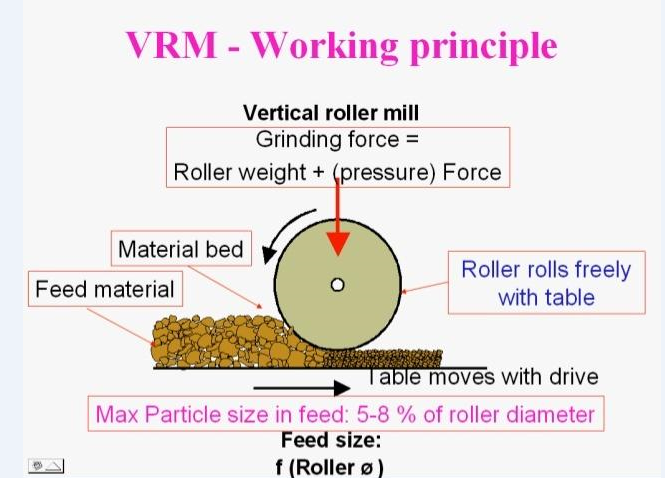
VRM working principle in 6 steps
- Feed enters the centre of the grinding table. A rotary feeder or chute delivers raw material or cement feed near the centre of the rotating table.
- The table moves material outward. Rotation creates centrifugal movement, spreading the feed toward the roller grinding tracks.
- Rollers compress the material bed. Hydraulic loading applies force through the rollers. The particles are reduced mainly by compression and shear inside the bed rather than by direct metal-to-metal contact.
- Hot gas dries and lifts the ground material. Gas enters around the table through the nozzle ring. It removes moisture and carries sufficiently light particles upward.
- The separator classifies the suspension. A dynamic separator allows fine product to leave the mill while rejecting coarse material back toward the grinding zone.
- Heavy rejects are returned. Material that falls through or cannot be pneumatically lifted enters the reject system and is recirculated or discharged depending on the circuit design.
The mill is therefore not only a grinder. It is a combined grinding + drying + conveying + classification system. Stable production requires these four functions to remain balanced at the same time.
1. Feed and material-bed formation
The grinding process begins with a stable feed. Material falls near the centre of the table and moves outward beneath the rollers. A continuous bed must form before the grinding force can be used efficiently.
If the bed becomes too thin, the rollers can lose the cushioning effect of the material and vibration may rise. If the bed is too thick, the mill can develop high internal circulation, increased differential pressure and poor grinding efficiency. Bed behaviour is influenced by feed rate, particle-size distribution, moisture, table condition, dam-ring height, grinding pressure and gas flow.
2. Grinding table and roller action
The table provides the moving grinding surface. Rollers press onto the material bed rather than intentionally contacting the table. Hydraulic cylinders and accumulators provide the grinding force while allowing controlled movement when the bed thickness changes or a disturbance passes through the grinding zone.
Grinding performance should therefore be evaluated as a system. Increasing hydraulic pressure does not automatically improve output if the feed is unstable, the table/roller profile is worn, the bed is unsuitable or the separator is already limiting the circuit.
3. Hot gas, drying and the nozzle ring
Hot process gas enters around the table through the nozzle ring. The gas has two major duties:
- Drying: evaporating moisture from the feed while it is being ground.
- Pneumatic transport: lifting ground particles from the table toward the classifier.
Gas velocity must be sufficient to carry the desired particle population without creating excessive pressure loss or unnecessary fan power. A worn or obstructed nozzle ring can disturb the gas distribution and may contribute to high rejects, unstable circulation or local bed problems.
4. Dynamic separator and coarse return
The dynamic separator determines which particles are fine enough to leave the mill. Coarse particles are rejected and fall back into the grinding circuit. Separator speed is therefore one of the main product-fineness controls, but it should never be considered in isolation: gas flow, feed rate, material grindability and internal circulation also affect the cut.
If product suddenly becomes coarse without an intentional process change, inspect separator condition and speed, internal deposits, grinding pressure, feed rate and gas flow before assuming that one component is responsible.
5. Rejects and internal circulation
Not every particle is carried to the separator. Heavy material, tramp metal or coarse particles can pass through the nozzle-ring area and enter the external reject circuit. A rising reject rate is a useful diagnostic signal rather than merely a housekeeping issue.
High rejects can indicate insufficient gas velocity, coarse feed, poor grinding, nozzle-ring problems, unsuitable dam-ring condition or a sudden material change. Evaluate rejects together with mill differential pressure, vibration, power, feed rate and fineness.
What controls a vertical roller mill?
| Process signal | What it helps indicate | When abnormal, inspect |
|---|---|---|
| Mill vibration | Grinding-bed stability and mechanical/process disturbances | Feed stability, bed thickness, hydraulic pressure, roller/table wear, foreign material |
| Differential pressure | Internal material loading and gas resistance | Feed, circulation, separator rejects, deposits, gas flow |
| Main motor power | Mechanical grinding load | Feed rate, grinding pressure, material properties, bed condition |
| Hydraulic pressure | Applied roller grinding force | Accumulators, cylinders, leakage, control stability |
| Outlet temperature | Drying balance and gas/heat condition | Feed moisture, hot-gas supply, gas flow, water injection where used |
| Reject quantity | Ability to grind and pneumatically lift material | Nozzle ring, gas velocity, feed size, bed and grinding pressure |
| Product fineness | Classification/grinding result | Separator speed, airflow, wear, circulation and feed rate |
Why VRM vibration happens
High vibration is usually a symptom of an unstable grinding system rather than a reason to change one control blindly. Common process causes include an excessively thin or irregular material bed, sudden feed changes, poor feed size distribution, inappropriate grinding pressure, table or roller wear, incorrect dam-ring condition, foreign material and unstable gas flow.
A useful troubleshooting sequence is to check the process in this order: feed stability → bed condition → vibration trend → hydraulic pressure → differential pressure → rejects → gas flow → roller/table condition. This prevents a mechanical inspection from being used to chase a process upset—or the reverse.
Dam ring and material retention
The dam ring helps retain material on the table long enough to create a stable grinding bed. Its optimum condition depends on the mill model, feed characteristics and wear state; there is no single correct height for every VRM. Evaluate any dam-ring adjustment against vibration, differential pressure, rejects, power and product quality. See the dedicated VRM dam-ring optimization guide.
VRM working principle vs ball mill
A VRM grinds material in a compressed bed and uses the same gas stream for drying and classification. A ball mill uses impact and attrition from grinding media inside a rotating shell and normally relies on a separate air/separator circuit for classification. The technologies therefore respond differently to feed moisture, circulating load, vibration, wear and process control. For a direct comparison, see Vertical Roller Mills vs Ball Mills.
VRM start-up logic: what must be stable first?
Exact start-up sequences vary by OEM and plant interlocks, so site procedures always take precedence. The process logic, however, is consistent: establish lubrication and hydraulic readiness, prove the gas/fan path and required auxiliaries, establish material feed and a stable bed, then bring the grinding system to the operating load while watching vibration, differential pressure, temperatures and rejects. Do not use generic internet RPM or pressure values as operating setpoints; those values are mill-model and process specific.
Quick diagnostic matrix
| Symptom | First technical checks |
|---|---|
| High vibration | Feed variation, bed thickness, hydraulic force, wear profile, foreign material |
| High differential pressure | Internal circulation, feed, gas path, separator rejects, deposits |
| High rejects | Nozzle-ring condition, gas velocity, feed size, grinding pressure |
| Coarse product | Separator speed/condition, grinding pressure, feed rate, wear |
| Low outlet temperature | Feed moisture, hot-gas availability, excessive feed or insufficient gas |