Kiln Operational Considerations: Full Guide
Operational consideration in cement manufacturing is the complete technical review of the control and optimization practices that keep a cement plant running at its optimum: the quality control and process control connection that runs from the quarry to the finish mill, the sampling and testing programs that verify the product, the process control strategies of the kiln and the mills, and the kiln chemistry of the raw mix design, including the lime saturation factor, the silica and alumina moduli, and their operating windows. During recent years, cement companies have come to realize the necessity and the applications of on-line control and optimization techniques and the enormity of the associated operational benefits during cement manufacturing: effective material processing, proportioning, and product characterization coupled with a controlled kiln operation, as attained by optimization and control techniques, are fast becoming the key to a stable, more efficient, and productive cement operation. The introduction of such optimization techniques has resulted in maximizing production and significantly reducing downtimes and refractory costs. This complete treatment covers the traditional methods and the advanced state-of-the-art technology employed at the various stages of manufacture in the modern cement plants, with the control loops, the statistical tools, and the operating windows explained in engineering detail.
1. The Connection Between Quality Control and Process Control
The organizing principle of the operational consideration is the connection between the quality control and the process control: from the quarry to the finish mill, the consistency of the quality is heavily dependent on the nature of the materials used and on how well each process is controlled. The quality control establishes what the product must be, and the process control establishes how the plant makes it, and the two functions are one system: the process measurements feed the quality decisions, and the quality results feed the process corrections.
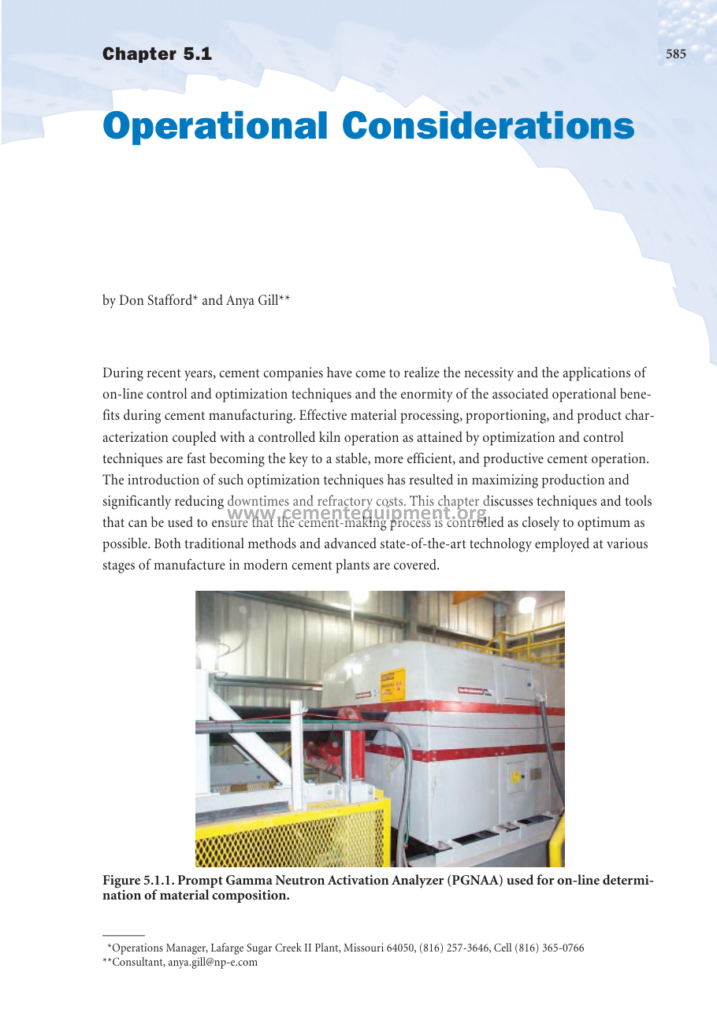
The operational chain begins at the quarry, where a detailed mining plan with adequate core drilling data is necessary to ensure that the major components will meet the raw mix requirements. The quarry is the first control point: the geology of the deposit, the bench planning, the blasting and the loading, and the stockpile management all determine the variability that the plant downstream must absorb. Where appropriate, the preblending of the raw materials is effected, which requires the accurate control of the component proportions, and the use of the advanced technology such as the Prompt Gamma Neutron Activation Analyzer (PGNAA), which measures the composition of the material stream on-line, is gaining ground as the instrument that holds the blend on target continuously.
Between the quarry and the silos, each process step is a control point with its own measurements and its own corrections: the crushing and the screening control the size, the raw mill controls the fineness and the composition, the homogenization silos control the uniformity, the kiln controls the burning, and the finish mill controls the product. The operational discipline of the plant is the discipline of these linked loops, and the chapter’s treatment of the plant is organized as the treatment of the loops.
2. The Raw Materials Quality Assurance
The quality assurance of the raw materials is the foundation of the operational control. In addition to the quarry sampling, a quality assurance program should be implemented for all raw materials brought into the plant, and a system such as the ISO 9000 series can be very useful for this purpose. The elements of the ISO 9000 approach include the purchasing, the inspection and the testing, and the control of the nonconforming product: all the necessary quality specifications should be defined in the purchase agreement, and it is best to put the responsibility of the quality assurance on the supplier, and then verify it with the spot checks of the plant’s own laboratory.
The raw materials of the cement plant, the limestone, the clay and the shale, the iron corrective, the sand or the bauxite, the gypsum, and the mineral constituents of the cement, each carry their own specifications: the limestone is specified by its calcium carbonate content, its magnesia, and its deleterious components, the clay by its silica, alumina, and iron, and the fluxing components, and the gypsum by its purity and its moisture. The acceptance testing of each incoming material against its specification is the first line of the quality control, and the stockpile management, the layering and the reclaiming, is the second: the raw materials are stored and blended so that the variation reaching the mill is minimized, and the preblending systems, where they exist, reduce the variation of the critical components by an order of magnitude.
The on-line analysis of the raw material streams, with the PGNAA or the X-ray fluorescence instruments on the conveyor lines, closes the loop of the raw materials control: the analyzer measures the composition of every ton of the material as it moves, the proportioning system corrects the feed rates of the components, and the raw mill receives a blended feed that holds the target chemistry continuously. The plants that operate this loop effectively run their kilns on a feed whose variability is a fraction of the variability of the quarry, and the stability of the whole process follows.
3. The Sampling and Testing Program
The sampling and testing program is the instrument by which the plant verifies its product, and the chapter presents the recommended sampling points and frequencies of the modern plant. Several sampling points in the cement manufacturing process are considered key for the good quality control and verification:
- The raw materials, sampled at the quarry and at the delivery points, with the frequency tied to the material and its variability: the quarry faces are sampled with the core drilling and the bench sampling, and the delivered materials are sampled per shipment or per lot.
- The raw mill feed and the raw meal, sampled continuously or at short intervals, with the composition and the fineness verified against the targets; the raw meal is the first product of the plant whose chemistry is controlled to the specification.
- The kiln feed and the kiln, sampled at the feed point and at the discharge, with the free lime of the clinker as the immediate measure of the burning, and the clinker composition and the physical properties verified on the daily composites.
- The cement, sampled at the mill outlet and at the dispatch silos, with the full suite of the chemical and the physical tests: the fineness, the setting time, the soundness, the sulfate, and the compressive strength of the mortar cubes at the standard ages.
The testing frequencies follow the process: the automated laboratories of the modern plants analyze the raw meal and the clinker at intervals of one to two hours, the cement composites are tested daily, and the full certification tests are performed at the frequency required by the standards. The quality checks come at the intervals described, or more frequently where the on-line analysis is used, and the statistical treatment of the results, through the Statistical Process Control, distinguishes the normal variability of the process from the deviations that require the correction.
4. The Statistical Process Control in the Cement Plant
The key quality parameters should be identified at each stage of the process: these are the ones that have a direct, statistically verified impact on the critical product characteristics of the finished cement. The decision-making tools such as the Statistical Process Control (SPC) are very useful in developing and implementing the operational strategies, because they convert the raw data of the laboratory into the knowledge of the process behavior.
The SPC discipline of the cement plant includes the standard instruments:
- The control charts, the X-bar and the range charts that plot the measured values of a parameter against the time, with the control limits computed from the process data; the chart reveals the excursions, the trends, and the shifts that the naked eye of the operator would miss.
- The process capability analysis, which compares the natural variability of the process with the specification limits, expressing the capability in the capability indices; a capable process runs well inside the specification, while an incapable process produces the out-of-spec product even at the average.
- The Pareto and the cause-effect analysis, which rank the sources of the problems and trace the effects to their causes, guiding the corrective actions of the plant.
The application of the SPC to the cement process is direct: the lime saturation factor of the raw meal is plotted and corrected against the control limits, the free lime of the clinker is charted against the burning conditions, and the strength of the cement is tracked against the fineness, the sulfate, and the clinker quality. The statistical view changes the management of the process, because it separates the signals from the noise: the operator corrects the deviations that the statistics mark as real, and leaves the normal variability alone, avoiding the over-correction that destabilizes the process.
5. The Process Control of the Kiln System
The kiln system is the heart of the operational control, and its control strategy is built around the process variables that the chapter reviews:
- The kiln feed rate, the primary throughput variable, which the control system holds steady and which the operator changes deliberately, because every change of the feed propagates through the kiln with a residence time of hours.
- The fuel rate and the burning zone temperature, controlled through the burner, the flame, and the kiln gas analysis, with the burning zone temperature inferred from the kiln camera, the shell scanner, and the NOx and the O2 of the kiln gas.
- The kiln speed and the material retention, which determine the residence time of the material in the burning zone and therefore the degree of the clinker formation.
- The secondary and the tertiary air, which control the combustion and the heat recovery from the cooler, and the precalciner fuel, which controls the calcination degree of the kiln feed.
- The ID fan and the draft, which control the gas flow and the pressure profile of the whole system, and with them the heat transfer and the dust circulation.
The control philosophy of the modern kiln is the cascade of the loops: the stable feed and fuel loops hold the process variables, the intermediate loops hold the temperatures and the pressures, and the top loop optimizes the production and the quality within the constraints. The advanced process control, the model-based controllers that the industry has adopted, calculates the optimum settings of the base loops from the process model and the measurements, and the operator supervises the optimization and intervenes on the exceptions. The result, measured in the plants that have implemented the systems, is the stabilization of the burning zone, the reduction of the fuel consumption, the increase of the production, and the extension of the refractory life, with the downtimes reduced accordingly.
6. The Kiln Chemistry and the Raw Mix Design
The operational control of the kiln rests on the chemistry of the raw mix, and the raw mix design is the first operational consideration of the plant. The clinker chemistry is fixed by the ratios of the major oxides of the kiln feed, and the three classical moduli define the design:
- The lime saturation factor (LSF), the ratio of the lime to the silica and the alumina and the iron of the mix, which measures how close the mix approaches the fully saturated clinker; the typical target ranges from 92 to 102, with the higher values giving the higher alite and the higher strength but the more difficult burning.
- The silica ratio or modulus (SM), the ratio of the silica to the alumina plus the iron, which controls the proportion of the liquid phase and the burnability; the typical window lies between 2.0 and 3.2, with the lower values giving more liquid and easier burning but a weaker clinker.
- The alumina ratio or modulus (AM), the ratio of the alumina to the iron, which controls the composition of the liquid phase, its viscosity, and the ferrite content; the typical window lies between 1.2 and 2.0, with the lower values giving the easier burning and the better coating and the higher values the higher early strength.
The operating windows of the moduli are the envelope within which the kiln runs stably: a mix with too high an LSF is difficult to burn, produces the high free lime, and wastes the fuel, while a mix with too low an LSF produces a weak clinker; a mix with too high a silica ratio burns with difficulty and forms the poorly coated kiln, while a mix with too low a ratio produces the sticky, high-liquid clinker that forms the rings and the snowmen. The raw mix design is therefore the balance of the burnability and the strength potential, and the chapter’s treatment of the operational consideration puts the moduli and their windows at the center of the kiln control: every correction of the process is a movement within the windows, and every excursion beyond them is an operational problem.
7. The Burnability and the Burning Control
The burnability of the raw mix, the ease with which it forms the clinker in the kiln, is the operational synthesis of the chemistry and the process. The burnability depends on the moduli, on the fineness of the raw meal, on the minor elements, and on the homogeneity of the feed, and it is measured in the laboratory by the free lime of the clinker produced under the standard burning conditions, or calculated from the chemistry by the empirical indices of the burnability. The plants express the burnability in the standard tests: the lime combination factor, which measures the fraction of the lime that has combined into the phases, and the free lime of the clinker, which measures the lime that has not combined.
The burning control holds the free lime within its target window, typically 0.5 to 1.5 percent for the well-burned clinker, and the control instruments are the burning zone temperature, the flame, and the kiln gas analysis. The oxygen and the carbon monoxide of the kiln gas are the immediate indicators of the combustion and the atmosphere: a well-controlled kiln operates with the oxygen between 1.5 and 3 percent and the CO minimal, and the reducing excursions, marked by the rising CO, are corrected immediately because the reducing atmosphere disturbs the iron chemistry, the sulfur retention, and the coating of the burning zone. The clinker quality is verified continuously: the free lime on the hourly samples, the composition on the daily composites, and the physical performance of the cement on the final product, and the loop of the burning control closes on the quality results.
8. The Grinding Control and the Finish Mill Operation
The finish mill operation is the final control stage of the plant, and its control variables determine the product as delivered to the market. The finish grinding controls the fineness and the particle size distribution of the cement, the sulfate content through the gypsum proportioning, the temperature of the product, and the quality of the blend where the cement is composed with the mineral constituents. The operational objectives of the finish mill control are the production rate, the product quality, and the energy consumption, and the three are in tension: the finer the product, the slower the mill and the higher the energy per ton, and the optimum is the fineness that meets the strength and the workability requirements at the minimum cost.
The control instrumentation of the finish mill includes the mill load measurements, the separator control, the product fineness measurement, and the temperature control, and the modern plants use the advanced control systems that hold the circuit at its optimum against the measured variables. The quality control of the cement verifies the fineness, the setting time, the soundness, and the strength, and the results close the loop: the fineness target is adjusted to hold the strength, the sulfate is proportioned to the optimum for the fineness and the clinker, and the blend proportions are corrected to the market specification. The operational consideration of the finish mill is therefore the management of the same loop that the chapter describes for the whole plant: the measurement, the correction, and the verification, repeated continuously.
9. The On-Line Analysis and the Process Instrumentation
The modern operational control rests on the on-line analysis and the process instrumentation, and the chapter reviews the instruments of the modern plant:
- The Prompt Gamma Neutron Activation Analyzer (PGNAA) on the raw material and the raw meal streams, which measures the full elemental composition of the moving material without sampling, enabling the continuous proportioning control of the raw mix.
- The X-ray fluorescence analyzers of the automated laboratory, which analyze the raw meal, the clinker, and the cement with the speed and the accuracy that the process control requires.
- The kiln gas analyzers, which measure the oxygen, the carbon monoxide, the NOx, and the SO2 of the kiln gas, the immediate indicators of the combustion and the atmosphere.
- The kiln camera and the shell scanner, which see the flame and the shell temperatures, the instruments of the burning zone control.
- The fineness and the particle size instruments of the finish mill, from the continuous Blaine-type measurements to the laser diffraction analyzers, which close the loop of the grinding control.
- The weighing and the proportioning systems, the belt scales and the loss-in-weight feeders, which hold the feed rates of the components to the targets of the mix.
The integration of these instruments in the distributed control system (DCS) is the technical foundation of the operational control: the measurements stream into the control room, the control loops hold the process, the advanced control optimizes the operation, and the laboratory data verify the product. The plants that have completed the integration operate with a stability and an efficiency that the manually operated plants cannot approach, and the chapter’s assessment of the operational benefits, the maximized production, the reduced downtimes, and the reduced refractory costs, is the measured record of that difference.
10. The Quality Parameters at Each Stage
The chapter’s recommendation is the identification of the key quality parameters at each stage of the process, the parameters with the statistically verified impact on the critical product characteristics. The practical list of the modern plant runs:
| Process stage | Key quality parameters | Control actions |
|---|---|---|
| Quarry and preblending | Composition of the limestone and the clay, the MgO, the deleterious components | Mining plan, blending, on-line analysis |
| Raw mill and homogenization | Raw meal chemistry (LSF, SM, AM), fineness, homogeneity | Proportioning correction, mill control |
| Kiln system | Free lime, clinker composition, sulfate, alkali, burning zone temperature | Fuel and air control, atmosphere control, feed stability |
| Clinker cooling and storage | Cooling rate, clinker temperature, reactivity | Cooler control, bed management |
| Finish mill | Fineness, particle size distribution, sulfate, temperature, blend proportions | Mill load and separator control, gypsum proportioning |
| Cement storage and dispatch | Setting time, soundness, strength, uniformity, moisture | Silo management, blending, certification testing |
The table is the operational map of the plant: at every stage the parameters are defined, the measurements are scheduled, and the control actions are assigned, and the quality of the finished cement is the integral of the stage controls. The identification of the key parameters, with the statistical verification of their impact, is the work that prevents the plant from measuring everything and controlling nothing: the effort is concentrated on the variables that matter.
11. The Optimization Techniques and Their Benefits
The optimization techniques of the modern plant are the subject of the chapter’s opening assessment, and their benefits are the record of the industry. The on-line control and optimization techniques, from the advanced process control of the kiln and the mills to the energy management systems and the production planning tools, deliver the benefits that the chapter enumerates:
- The maximization of the production, achieved by holding the process at the limits that the equipment and the quality allow, rather than at the conservative settings that the manual operation requires.
- The reduction of the downtimes, achieved by the stable operation that avoids the trips, the buildups, and the equipment failures, and by the predictive maintenance that catches the developing faults before they stop the plant.
- The reduction of the refractory costs, achieved by the stable burning zone temperature and the stable coating, which extend the refractory life by a substantial margin.
- The reduction of the energy consumption, achieved by the operation at the optimum of the fuel and the electrical demand.
- The improvement of the product quality and uniformity, achieved by the control of the raw mix and the burning within the narrow windows.
The implementation of the optimization is a project in its own right: the instrumentation must be reliable, the process models must be built and maintained, the control strategies must be tuned to the plant, and the operators must be trained to work with the systems. The chapter’s experience is that the successful implementations are those that proceed stepwise, with the measurement infrastructure first, the base control second, and the optimization third, and that the benefits accumulate in the same order.
12. The Operational Discipline and the People
Behind the instruments and the algorithms stands the operational discipline of the plant: the procedures, the shift communication, and the people. The quality and the process control of the cement plant are exercised by the operators, the laboratory staff, and the engineers, and the effectiveness of the systems depends on the training and the discipline of the organization. The chapter’s treatment reflects the practice of the industry: the control room operates on the shift logbooks and the standard procedures, the laboratory operates on the sampling schedules and the documented methods, and the engineering operates on the audits and the reviews that keep the systems current.
The operational considerations of the chapter include the organizational ones: the clear assignment of the responsibilities between the production, the quality, and the maintenance functions, the communication of the process changes between the shifts, and the review of the operating results against the targets. The plants that excel operationally are those that combine the technical systems with the organizational discipline, and the chapter’s message is that the control technology multiplies the effectiveness of a disciplined organization, but cannot replace it.
13. Frequently Asked Questions
What is the connection between the quality control and the process control?
The two are one system: the quality control defines what the product must be and verifies the results, while the process control makes the product and corrects the deviations; the measurements of the process feed the quality decisions, and the quality results feed the process corrections, from the quarry to the finish mill.
What is the PGNAA and what does it do in the plant?
The Prompt Gamma Neutron Activation Analyzer is an on-line analyzer that measures the full elemental composition of a moving material stream without sampling; in the raw materials and the raw meal service, it enables the continuous proportioning control of the raw mix, holding the blend on target ton by ton.
What are the typical windows of the LSF, the silica ratio, and the alumina ratio?
The lime saturation factor typically runs between 92 and 102, the silica ratio between 2.0 and 3.2, and the alumina ratio between 1.2 and 2.0, with the exact targets set by the raw materials, the burnability, and the strength class of the product; the windows define the envelope of the stable kiln operation.
How is the burning zone temperature controlled?
Through the fuel rate and the burner, verified by the kiln camera, the shell scanner, and the gas analysis; the operator and the advanced control hold the temperature so that the clinker forms completely with the free lime in the window of about 0.5 to 1.5 percent.
What is the Statistical Process Control in the cement plant?
The application of the control charts, the capability analysis, and the cause-effect tools to the process data, which separates the real deviations from the normal variability and guides the corrections; it is the instrument by which the plant manages its quality parameters statistically rather than by intuition.
Why is the oxygen of the kiln gas controlled so closely?
Because the atmosphere of the kiln determines the quality of the burning: a reducing atmosphere disturbs the iron chemistry, decomposes the clinker sulfates, and destabilizes the coating, while the excess oxygen wastes the fuel; the modern control holds the oxygen between about 1.5 and 3 percent with the CO minimal.
What are the benefits of the advanced process control?
The stabilization of the burning zone, the maximization of the production, the reduction of the fuel consumption, the extension of the refractory life, and the reduction of the downtimes, achieved by holding the process at its optimum against the measured variables instead of the conservative manual settings.
How often is the cement tested?
The raw meal and the clinker are analyzed at intervals of one to two hours in the automated laboratories, the cement composites are tested daily for the full chemical and physical suite, and the certification tests run at the frequency required by the product standards; the on-line analyzers extend the coverage continuously.
14. Summary
Operational consideration is the complete technical treatment of the control and the optimization of the cement plant: the connection between the quality control and the process control from the quarry to the finish mill, the raw materials quality assurance and the sampling and testing programs, the statistical process control, the process control of the kiln system, the kiln chemistry of the raw mix design with the LSF, the silica and the alumina moduli and their operating windows, the burning and the grinding control, the on-line analysis and the process instrumentation, the key quality parameters of each stage, and the optimization techniques with their measured benefits of the maximized production, the reduced downtimes, the reduced refractory costs, and the improved product uniformity. The chapter’s message is that the operational excellence of the cement plant is the product of the linked loops of measurement, correction, and verification, supported by the modern instrumentation and the advanced control, and exercised by a disciplined organization. This complete technical review is part of the Complete Cement Technical Package, the 931-file licensed library of cement manufacturing knowledge available from cementequipment.org.
Get this cement file + the full 931-file package
$249 — one-time purchase, instant download, lifetime access
This file is part of the Complete Cement Technical Package (931 files) available from cementequipment.org. Respective rights holders; library copy for the licensed single user.