Minor Elements in Cement Manufacturing
Minors Element in Cement Manufacturing is the complete technical review of the minor elements that accompany the major oxides of the cement process: magnesium, potassium, sodium, sulfur, chlorine, phosphorus, titanium, manganese, and the trace metals, their sources in the raw materials and the fuels, their behavior in the kiln system, and their effects on the clinker chemistry, the product quality, and the environment. The minor elements are derived from the raw materials and the fuels used in cement manufacture, for example, the limestone, the clay and the shale, and the coal; they also come from the widely used auxiliary materials such as the blast furnace slag, the fly ash, the iron oxide, the bauxite, and the spent catalysts; and a secondary but important source is the industrial wastes used for the supplementation of the primary fuel, including the petroleum coke, the used tires, the impregnated sawdust, the waste oils, the lubricants, the sewage sludge, the metal cutting fluids, and the waste solvents. This complete treatment covers the concentrations of the minor elements in the raw materials, the fuels, and the clinkers, the volatile cycles and the circulation phenomena of the kiln system, the effects of the elements on the formation and the morphology of the clinker phases, and the practical management of the minor element chemistry in the modern plant.
1. The Minor Elements and Their Sources
The minor elements of cement manufacture are the elements, other than the principal calcium, silicon, aluminum, and iron, that enter the kiln system with the raw materials, the fuels, and the auxiliary materials. Their concentrations are small, measured in tenths of a percent for the main minor elements and in parts per million for the trace metals, but their effects are disproportionately large: they modify the clinker formation, they drive the circulation phenomena of the kiln, they set limits on the raw material selection, and they determine the emission profile of the plant.
The typical minor elements of a cement raw meal, with their concentrations in weight percent, are magnesium at about 0.63, potassium at 0.47, sulfur at 0.13, sodium at 0.13, titanium at 0.10, manganese at 0.07, phosphorus at 0.04, and the smaller quantities of the chlorine, the fluorine, and the carbon, with the trace metals present in parts per million. The concentrations vary widely with the geology of the raw materials: a limestone may carry 0.2 to 12 parts per million of arsenic and 22 to 24 of zinc, while the clay and the shale carry substantially more, with chromium at 90 to 109 parts per million, vanadium at 98 to 170, and zinc at 59 to 115, and the auxiliary materials and the wastes widen the range further: the fly ash carries potassium at 3.36 percent and phosphorus at 1.60 percent, and the petroleum coke carries nickel at 208 parts per million and vanadium at 778.
The engineering significance of the sources is the management problem they create: the plant does not choose its minor elements, it chooses its raw materials and its fuels, and every choice imports a package of minor elements that the process must absorb, distribute, and discharge within the limits of the product and the environment.
2. Magnesium: The Periclase Problem and the Raw Material Limits
Magnesium is the most abundant of the minor elements and the one with the most direct product consequence. The magnesia of the raw materials enters the clinker, where part of it is accommodated in the clinker phases, in the alite, the belite, and the ferrite, and part of it remains as free periclase, the crystalline magnesium oxide that did not react into the phases. The periclase hydrates very slowly in the hardened concrete, and its hydration is expansive, so that a clinker with too much free periclase produces a cement that can expand destructively years after the casting. The product standards limit the magnesium oxide of the cement to 5 percent and, in many specifications, the magnesia of the clinker to the same order, and the plant must verify that its raw mix delivers a clinker within those limits.
Where the magnesia is high, the options of the plant are the selection of the low-magnesia quarry horizons, the blending of the high-magnesia stone with the low-magnesia material, and the use of the magnesia-bearing components in the mix only within the limits of the clinker target. The magnesium also matters for the auxiliary materials: although the blast furnace slag can be used up to 30 percent by weight, the level of its use may be restricted by its magnesium oxide content, particularly if the MgO level is already high in the raw materials, because the slag’s magnesia adds to the total that the clinker and the cement must carry.
In the kiln, the magnesia behaves as a mild flux: it lowers the liquid phase temperature and reduces the viscosity, which can improve the burnability of a difficult mix, but the benefit is incidental, and the control of the magnesia is exercised at the raw material selection stage rather than at the kiln.
3. The Alkalis: Potassium and Sodium
The alkalis, potassium and sodium, enter the kiln with the clay minerals and the feldspars of the raw materials, and with the fly ash and the auxiliary materials, and their behavior in the kiln is governed by their volatility. At the burning zone temperatures, part of the alkalis evaporates, and the alkaline vapor travels with the kiln gas into the preheater, where it condenses on the cooler meal and returns with the feed to the kiln. The result is the internal circulation loop that concentrates the alkalis in the kiln feed at levels several times their input concentration, and the distribution of the alkalis between the clinker, the dust, and the circulation is the object of the alkali balance of the plant.
The alkalis in the clinker enter principally as the alkali sulfates, potassium sulfate and sodium sulfate, and as the alkali-aluminate phases, and their effects on the product and the process are several:
- The setting and the strength behavior: the alkali sulfates dissolve rapidly in the mixing water, accelerate the early hydration, and can increase the early strength while affecting the setting time and, at high levels, the consistency and the workability of the concrete.
- The alkali-aggregate reaction: the alkalis released into the pore solution of the concrete can react with the reactive silica of certain aggregates, producing the expansive gel that cracks the concrete; the standards of the alkali-reactive regions require the low-alkali cements, and the plant must control the total alkali content of its product.
- The kiln operation: the alkali circulation loads the preheater dust, and at high concentrations the alkali sulfates and chlorides bind the dust into the buildups and the blockages of the preheater and the riser duct, so that the alkali input limits the raw material selection of the plant.
The management of the alkalis is exercised at three levels: the raw material selection and blending to hold the alkali input, the kiln bypass that discharges a portion of the alkali-laden gas and dust from the system, and the product control that verifies the alkali content of the cement against the specification. The plants in the alkali-reactive regions operate all three in combination.
4. Sulfur: The Dual Behavior of the Volatile Oxide
Sulfur enters the kiln with the raw materials, the clay minerals and the pyrite and the gypsum of the stone, and with the fuels, above all the coal and the petroleum coke, whose sulfur contents range from less than 1 percent to more than 6 percent. The behavior of the sulfur in the kiln is dual, depending on the form and the location: the sulfate sulfur of the raw materials decomposes only partially and enters the clinker as the alkali and the calcium sulfates, while the sulfur of the fuel oxidizes to the sulfur dioxide of the flame, and the SO2 either reacts with the meal, the alkalis, and the lime to form the sulfates, or leaves the kiln with the gas.
The distribution of the sulfur between the clinker and the gas is governed by the alkali-to-sulfur ratio of the system, the temperature profile, and the atmosphere. The sulfur that enters the clinker, principally as the alkali sulfates and the anhydrite, is subject to the product limits: the standards cap the sulfur trioxide of the cement at 3.5 to 4 percent, and the control of the clinker sulfate is part of the everyday quality control. The sulfur that enters the gas loads the circulation loop and the emission balance:
- The circulation: the sulfur dioxide of the kiln gas reacts with the alkalis of the meal to form the alkali sulfates, which condense in the preheater and return with the feed, concentrating the sulfur in the system and creating the conditions for the sulfur rings at the kiln inlet.
- The emissions: the sulfur dioxide that survives the reaction with the meal leaves the preheater in the gas, and the plants with high-sulfur fuels and low-alkali raw materials must install the SO2 abatement, typically the wet scrubber or the raw mill scrubbing, to meet the emission limits.
- The reducing conditions: in a reducing kiln atmosphere, the sulfate of the clinker decomposes and releases the sulfur as SO2 into the gas, which is why the oxygen control of the burning zone is also the control of the sulfur retention.
The sulfur management of the plant is the management of this dual system: the fuel selection, the raw mix alkali, the oxygen profile, and the abatement equipment are the variables that the operator holds.
5. Chlorine: The Preheater Blockage Element
Chlorine is the most volatile and, in its consequences, the most troublesome of the minor elements. The chlorine of the raw materials is generally low, but the chlorine of the fuels and the wastes is significant, and the alternative fuels, from the plastics to the sewage sludge, have made the chlorine input a central variable of the modern fuel selection. In the kiln, the chlorine evaporates almost completely at the burning zone temperatures, travels with the gas as the alkali and the calcium chlorides, and condenses in the upper stages of the preheater, where the temperature falls below the condensation point. The condensation binds the dust into the hard, compact buildups that block the cyclones, the riser ducts, and the preheater feed pipes, and the blockage of a cyclone is a kiln stop.
Because the kiln itself cannot expel the chlorine, the control of the chlorine is exercised by the kiln bypass: a portion of the kiln inlet gas, typically 3 to 10 percent, is drawn out of the system, cooled, dedusted, and discharged, carrying the chlorides with the bypass dust. The bypass rate is set by the chlorine input, and the plants firing the high-chlorine wastes operate the bypass continuously with the chloride analysis of the dust and the gas as the control measurements. The chlorine in the clinker and the cement is limited by the product standards to a maximum of about 0.1 percent, above which the reinforcement of the concrete is at risk, and the chloride balance of the plant is therefore a compliance question as much as an operational one.
6. Phosphorus: The Strength-Reducing Minor Element
Phosphorus, which enters the raw materials with the phosphate-bearing limestones and the clays, and with the auxiliary materials, is a minor element whose principal effect is on the strength of the clinker. The phosphorus oxide stabilizes the belite at the expense of the alite: it enters the alite structure and destabilizes it, so that a clinker with a high phosphorus content forms less alite and more belite, and the strength of the cement falls accordingly. The effect becomes significant at phosphorus pentoxide contents above about 0.3 percent of the clinker, and at 1 percent and above the strength loss is severe, so that the phosphate-bearing raw materials are either avoided, blended down, or used with the correction of the raw mix.
The phosphorus also affects the burnability and the setting: the high-phosphorus mixes burn with more difficulty, and the resulting clinker can exhibit an abnormal setting behavior. The management of the phosphorus is the management of the raw material selection, and the plants in the regions of the phosphate-rich geology carry the phosphorus as a permanent constraint on their quarry planning and their blending strategy.
7. Titanium, Manganese, and the Fluxing Minor Elements
Titanium and manganese are the minor elements whose effects on the burning are largely benign. The titanium, entering with the clays and the bauxite, is accommodated in the clinker phases without disturbing the formation, and the small quantities act as mild fluxes that can improve the burnability; the titanium is present in the typical raw meal at about 0.10 percent, and its principal significance is the limit it places on the use of the bauxite, which is reported to contain 2 to 8 percent titanium oxide, as the alumina corrective.
Manganese, entering with the iron ores and the manganese-bearing clays, is accommodated in the ferrite phase, where it substitutes for the iron, and its principal effect is the color of the clinker: the manganese darkens the product, which matters for the white cement, where the manganese and the iron are limited together to the levels that the color tolerates. The standard of the white cement expresses the combined limit as the iron oxide plus the manganese oxide below 0.8 percent.
Both elements illustrate the general rule of the minor elements: each is absorbed into the clinker phases in a characteristic way, and the effect of the absorption on the product defines the limit of the raw material. The phase chemistry of the minor elements, their partitioning between the alite, the belite, the aluminate, and the ferrite, and their influence on the morphology of the crystals, is the subject of the clinker microscopy, and the microscopy is the instrument by which the plant reads the consequences of its minor element chemistry.
8. The Trace Metals: Chromium, Vanadium, Nickel, and the Heavy Metals
The trace metals of the cement manufacture, present in parts per million, are the objects of the modern environmental attention. The iron ores frequently contain chromium, arsenic, cadmium, and thallium, the coals carry the range of the metals, and the alternative fuels add the metals of the waste streams, so that the trace metal balance of the plant is the sum of the raw material, the fuel, and the waste inputs. The behavior of the metals in the kiln follows their volatility: the non-volatile metals, the chromium, the nickel, the copper, the zinc, and the vanadium, are largely retained in the clinker, while the volatile metals, above all the mercury, the thallium, and the cadmium, circulate in the gas phase and condense in the cold end, and their emission control is the task of the gas cleaning equipment.
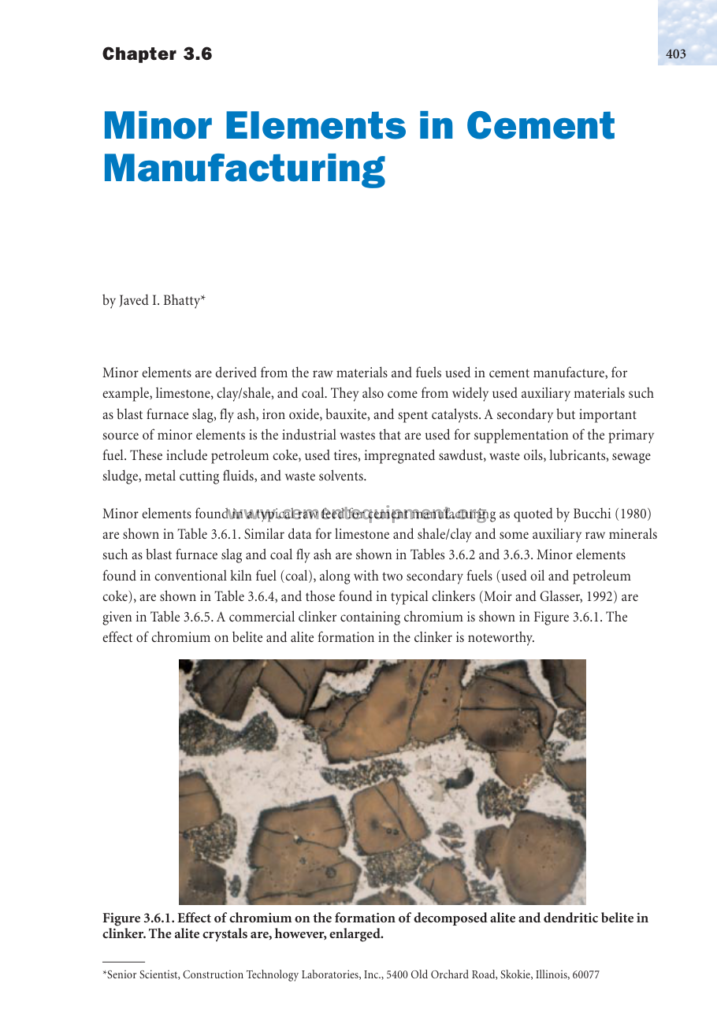
The trace metals in the clinker, at the concentrations of the typical products, are bound into the phases or the accessory minerals and do not affect the product performance; the chromium of the raw materials has been observed to affect the formation of the clinker phases, with the decomposed alite and the dendritic belite appearing in the chromium-bearing clinkers, but the effect at the usual concentrations is minor. The environmental significance of the metals is their emission: the leachable and the volatile fractions of the metals in the dust and the gas are regulated by the emission standards, and the plants monitor the metals of the dust and, for the volatile species, the stack emissions, with the mercury as the most demanding of the measurements.
9. The Mercury Cycle and the Emissions of the Volatile Metals
The mercury is the archetype of the volatile metal behavior. The mercury of the raw materials and the fuels evaporates completely in the kiln, and the mercury vapor travels with the gas into the preheater, where it condenses on the dust and the meal at the low temperatures of the cold end. The dust that carries the condensed mercury is collected in the bag filter or the electrostatic precipitator, and the question of the mercury management is the question of the dust handling: when the collected dust is returned to the kiln feed, the mercury returns with it, evaporates again, and recirculates, so that the mercury is never discharged. The removal of the mercury therefore requires the dedicated route: a portion of the dust is withdrawn from the circulation and treated, or the gas is passed through an adsorption step, and the plants with the strict mercury limits operate the mercury removal continuously.
The measurement of the mercury is itself a discipline: the mercury emissions are low, variable, and tied to the process conditions, and the continuous mercury monitors of the modern plants follow the emissions in real time. The thallium and the cadmium follow the same logic with lower volatility, and the volatile metal management of the modern plant is the combination of the input control, the circulation control, and the dedicated removal routes that the emission limits require.
10. The Circulation Phenomena: The Internal Loops of the Kiln System
The circulation phenomena of the kiln system are the unifying concept of the minor element chemistry. The volatile species, the alkalis, the sulfur, the chlorine, and the volatile metals, evaporate in the high-temperature zones and condense in the low-temperature zones, and because the condensed material returns with the feed, each species circulates internally at a concentration several times its input concentration. The circulation ratio, the ratio of the concentration in the kiln feed to the concentration in the fresh feed, is the measure of the phenomenon, and it depends on the condensation temperature of the species, the temperature profile of the system, and the dust collection and return scheme of the plant.
The consequences of the circulation are the phenomena that the operator knows:
- The buildups and the blockages of the preheater, caused by the condensation of the chlorides and, to a lesser degree, the sulfates on the dust at the cold end, which the plant combats with the bypass, the cleaning systems, and the control of the inputs.
- The rings of the kiln, caused by the sulfates and the alkalis binding the material into the annular deposits at the kiln inlet, and by the liquid-phase coating in the burning zone.
- The kiln feed variability, caused by the periodic shedding of the circulating material from the preheater, which destabilizes the burning and the clinker quality.
- The limitation of the raw materials and the fuels, because the circulation amplifies the inputs, so that a modest chlorine in the fuel can produce a chloride load that the preheater cannot tolerate.
The circulation is therefore the mechanism by which the minor elements of the inputs become the operational limits of the system, and the balance calculations of the plant, the alkali-sulfur-chlorine balances, are the quantitative form of the circulation management.
11. The Effects of the Minor Elements on the Clinker Formation
The effects of the minor elements on the clinker formation are the second face of their chemistry, beyond the circulation. Each element modifies the formation of the clinker phases in a characteristic way:
- The alkalis stabilize the belite and can destabilize the alite at high concentrations, while the alkali sulfates change the composition and the viscosity of the liquid phase.
- The magnesium stabilizes the alite, which is why the small magnesia contents are generally favorable for the burnability, while the excess appears as the periclase.
- The phosphorus destabilizes the alite and stabilizes the belite, reducing the strength potential of the clinker.
- The fluorine and the chloride act as the mineralizers, accelerating the formation of the alite at lower temperatures, with the chlorine also forming the alinite-like phases in the special chemistries.
- The sulfur acts as a flux and, in the form of the anhydrite, becomes a clinker phase in its own right, contributing the sulfate that the cement needs.
- The chromium and the vanadium modify the morphology of the alite and the belite crystals, with the effects documented in the clinker micrographs of the chromium-bearing clinkers.
- The titanium and the manganese are accommodated benignly in the phases, with the manganese coloring the clinker.
The balance of these effects determines the burnability of the raw mix, the formation of the phases, and the quality of the product, and the modern raw mix design includes the minor element chemistry explicitly: the targets of the mix are set not only for the lime saturation, the silica, and the alumina ratios, but for the alkali, the sulfate, the chloride, and the magnesia balances of the feed.
12. The Analytical and the Control Practice
The control of the minor elements rests on the analytical practice of the plant. The X-ray fluorescence analysis of the raw materials, the kiln feed, the clinker, and the cement provides the oxides of the principal minor elements, the magnesium, the potassium, the sodium, the sulfur, the phosphorus, the titanium, and the manganese, on every routine sample, and the wet chemistry and the specialized instruments extend the coverage to the chlorine, the fluorine, and the trace metals. The frequency of the trace metal analysis is lower, tied to the emission reporting and the fuel quality control, while the routine oxides are analyzed continuously through the automated laboratories and the on-line analyzers.
The control practice connects the analysis to the process:
- The raw mix design holds the minor element targets, and the blending and the proportioning correct the deviations of the quarry materials.
- The kiln feed analysis verifies the mix, and the alkali and the chloride balances are computed to anticipate the circulation loads.
- The clinker analysis verifies the product, with the free lime, the sulfate, the magnesia, and the alkali as the routine checks against the internal targets and the product standards.
- The fuel quality control verifies the fuel inputs, above all the sulfur, the chlorine, and the metals of the alternative fuels, and the waste acceptance criteria of the plant are written around those analyses.
- The emission monitoring verifies the discharges, with the SO2, the chloride, the dust, and the metals measured against the permit limits.
The minor element control is therefore a loop that runs from the input selection through the process to the product and the emissions, and the data of the loop are the raw material of the plant’s quality and environmental management.
13. The Minor Elements and the Modern Fuel Strategies
The modern fuel strategies have raised the stakes of the minor element management. The alternative fuels, which carry the chlorine, the sulfur, and the metals of the waste streams, have made the minor element balance a first-order constraint of the fuel selection, and the plants with the high substitution rates operate with the waste acceptance criteria that limit the chlorine, the sulfur, the mercury, and the other regulated elements of the accepted wastes. The petroleum coke, with its high sulfur and its vanadium and nickel, has made the sulfur management a permanent feature of the petcoke-firing plants, and the high-sulfur petcoke operations, such as the plant that fires 100 percent petcoke with 5 to 6 percent sulfur, demonstrate the full range of the management tools: the oxygen control, the alkali balance, the dust and the gas routing, and the product control that holds the cement sulfate within the standard.
The direction of the future is the tightening of the same balances: the raw materials of the decarbonized era, the calcined clays and the recycled materials, bring their own minor element packages; the carbon capture systems will concentrate the volatile elements in the capture residues; and the emission limits continue to tighten. The minor element chemistry, once the province of the specialist, is becoming a central discipline of the cement engineering, and the plants that master it are the plants that can run the fuels, the raw materials, and the products of the future.
14. Frequently Asked Questions
What are the minor elements of cement manufacturing?
The elements other than the principal calcium, silicon, aluminum, and iron that enter the kiln with the raw materials, the fuels, and the auxiliary materials: mainly magnesium, potassium, sodium, sulfur, chlorine, phosphorus, titanium, and manganese, plus the trace metals such as chromium, vanadium, nickel, lead, cadmium, and mercury.
Why is the magnesia limited in the cement?
Because the magnesia that remains as free periclase in the clinker hydrates very slowly and expansively in the hardened concrete, so the standards limit the magnesium oxide to 5 percent, and the raw materials and the auxiliary materials, including the slag, are selected within that limit.
What is the alkali circulation of the kiln?
The internal loop in which the alkalis evaporate in the burning zone, condense on the meal in the preheater, and return with the feed, concentrating at several times their input level; the circulation loads the dust, drives the buildups, and sets limits on the raw materials and the fuels.
Why does chlorine block the preheater?
Because the chlorides evaporate in the kiln and condense in the cold end of the preheater, binding the dust into hard buildups that block the cyclones and the riser ducts; the kiln cannot expel the chlorine, so the control requires the bypass and the management of the chloride inputs.
What is the effect of phosphorus on the clinker?
Phosphorus stabilizes the belite at the expense of the alite, reducing the strength of the clinker; the effect becomes significant above about 0.3 percent phosphorus pentoxide, so the phosphate-bearing raw materials are avoided, blended down, or corrected in the mix.
How is mercury emitted and controlled?
The mercury evaporates completely in the kiln, condenses on the dust in the cold end, and recirculates with the returned dust, so it cannot be discharged by the normal dust return; the control requires a dedicated removal route, with the continuous monitoring where the limits are strict.
Do the minor elements affect the clinker formation?
Yes, each element modifies the phase formation in a characteristic way: the magnesium and the fluorine can favor the alite, the phosphorus and the excess alkali favor the belite, the sulfur fluxes the liquid phase, and the chromium and the vanadium modify the crystal morphology, all of which is read in the clinker microscopy.
Why do the alternative fuels make the minor element management harder?
Because the waste streams carry the chlorine, the sulfur, and the metals in variable concentrations, so the fuel selection must be constrained by the minor element balances of the kiln, and the plants with high substitution rates operate with the waste acceptance criteria and the volatile management that the wastes demand.
15. Summary
Minors Element in Cement Manufacturing is the complete technical treatment of the minor element chemistry of the cement process: the sources of the elements in the raw materials, the fuels, and the auxiliary materials, the concentrations found in the raw meal, the raw materials, and the clinkers, the behavior of the alkalis, the sulfur, the chlorine, the phosphorus, the titanium, the manganese, and the trace metals in the kiln, the circulation phenomena that amplify the volatile species, the effects of the elements on the clinker formation and the product quality, and the analytical and the control practice that manages the balances. The chapter’s message is that the minor elements, though small in quantity, are decisive in the operation: they limit the raw materials and the fuels, they drive the buildups, the rings, and the blockages, they shape the product performance, and they determine the emission profile, and the plant that masters their chemistry holds the key to the fuel strategies and the raw materials of the modern industry. This complete technical review is part of the Complete Cement Technical Package, the 931-file licensed library of cement manufacturing knowledge available from cementequipment.org.
Get this cement file + the full 931-file package
$249 — one-time purchase, instant download, lifetime access
This file is part of the Complete Cement Technical Package (931 files) available from cementequipment.org. Respective rights holders; library copy for the licensed single user.