Innovative Cement: Low-Carbon Binders Guide
Innovative Cement is the complete technical review of the cements that go beyond the standard portland product: the low-energy cements, the belite-rich formulations, the alinite and calcium sulfoaluminate chemistries, the rapid-hardening and expansive specialties, and the modern low-carbon binders that are transforming the industry’s environmental position. While the production of portland cements and their blends with pozzolans and slags dominates commercial manufacturing, there exists a variety of innovative cements whose production is quite limited on a worldwide basis, divided into two main categories: low-energy cements and cements for specialty niche markets. The former includes the belite cements, which have received considerable attention worldwide, and the latter encompasses cements with such diverse properties as rapid hardening, expansive characteristics, low alkalinity, and compatibility with high temperatures and pressures. This complete treatment covers the strategies for reducing the energy of clinker formation, the use of fluxes and mineralizers, the stabilization of the reactive belite phases, the alinite and sulfoaluminate chemistries, the specialty cements of the niche markets, and the limestone calcined clay cements and the other low-carbon binders of the modern decarbonization era, with the chemistry and the processing of each family explained in engineering detail.
1. The Energy Problem of the Portland Clinker
The starting point of the innovative cement family is the energy problem of the portland clinker. The modern cyclone preheater dry process kilns have brought the energy consumption of clinker manufacture down to less than 3100 kilojoules per kilogram, about 740 kilocalories per kilogram, and this consumption has two irreducible components: the thermal energy needed for the calcination of the calcium carbonate, which is fixed by the chemistry of the decomposition, and the thermal energy needed to reach and hold the clinkering temperature of about 1450 degrees Celsius, at which the alite-forming reactions take place. Any further reduction of the energy demand must attack one of these two components, and the innovative cements are organized around the strategies of that attack.
Three strategies can be considered for the further energy reduction:
- Reduction of the burning temperature by the use of mineralizers and fluxes or other approaches, so that the clinker-forming reactions take place at lower temperatures and the kiln consumes less fuel.
- Reduction of the calcium carbonate content of the raw mix, so that the calcination demand, the largest chemical energy item of the process, is reduced in proportion to the lime that the mix no longer needs.
- Blending of the clinker with supplementary cementing materials, such as slag, fly ash, and the pozzolans, so that less clinker is manufactured per ton of cement in the first place.
Each strategy has its own family of innovative cements, and each family carries its own compromise between the energy saving, the performance of the product, and the practical difficulties of the manufacture.
2. Fluxes and Mineralizers: Lowering the Burning Temperature
The first strategy is the use of fluxes and mineralizers, the small additions that change the behavior of the clinker raw mix in the kiln. The distinction between the two is functional: a flux lowers the temperature at which the liquid phase of the clinker forms, so that the burning zone can operate at a lower temperature, while a mineralizer accelerates the formation of the desired clinker phases, so that the reactions reach completion more quickly at a given temperature. In practice the same compound often acts as both, and the terms are used interchangeably in much of the literature.
The classic additions are the fluorides, the sulfates, and the chlorides: calcium fluoride in the form of fluorspar, calcium sulfate in the form of gypsum or anhydrite, and the alkali sulfates and the chlorides. The mechanism of the fluxing action is the modification of the liquid phase: the flux lowers the melting point and the viscosity of the liquid, so that the lime and the silica dissolve into it and react more readily, and the mineralizing action accelerates the formation of the alite and the other phases through the intermediate compounds that the additions form with the clinker components. The reported reductions of the clinkering temperature with the fluxes and mineralizers range from about 100 to 200 degrees Celsius, bringing the burning zone into the range of 1300 to 1400 degrees where the alite formation can still proceed, and the practical benefit is the fuel saving and, in some cases, the increased production of the existing kiln.
The price of the additions is the process and the product side effects. The chlorides, the most effective fluxes, are also the most troublesome, because the chlorine circulates in the kiln system, condenses in the preheater, and can block the tower; the fluorides attack the refractory; and the sulfates add to the sulfur load of the system. The industrial practice is therefore cautious: the additions are dosed at the level that gives the maximum benefit without crossing the limits of the system, and the plants that use them monitor the volatile balances and the refractory condition continuously.
3. The Belite Cements: The Low-Energy Workhorse
The belite-rich cements are the most developed of the low-energy families. The belite, the dicalcium silicate phase of the clinker, forms at a lower temperature than the alite and requires less lime in the raw mix, so that a clinker rich in belite and poor in alite burns at a lower temperature and calcines less carbonate: the energy saving is roughly 10 to 15 percent of the thermal consumption, and the process emissions fall in proportion to the reduced lime of the mix. The problem of the belite cements has always been the reactivity: the stable form of the belite that forms during the normal cooling, the gamma phase, is almost inert, and even the reactive beta form develops strength slowly, so that the traditional belite cements have low early strength and are not accepted in the markets that demand rapid construction cycles.
The modern belite cement technology is the technology of making the belite reactive, and the chapter reviews the four routes that the research has established:
- Very rapid cooling to form the more reactive beta-belite and to retain it in its reactive state, with cooling rates investigated from 100 degrees per minute, the normal cooling, up to 3000 degrees per minute, the quenching in water.
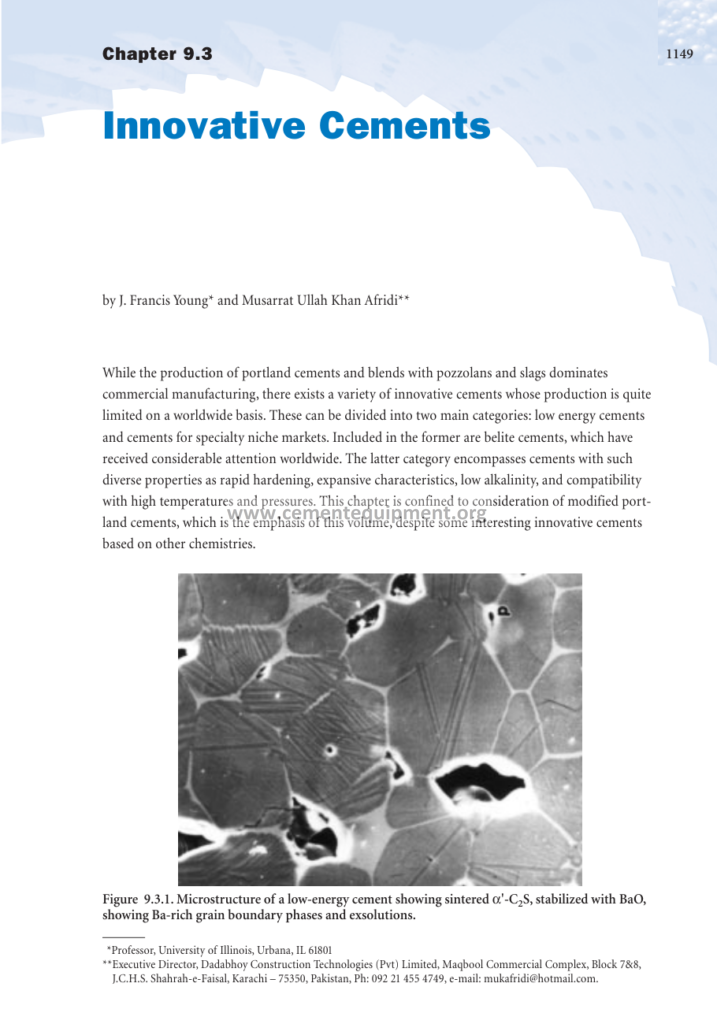
- Stabilization of the alpha-prime belite, the high-temperature polymorph that is the most reactive, by the incorporation of the stabilizing oxides into the structure, for example the barium oxide that stabilizes the alpha-prime phase in the low-energy cement microstructures documented in the literature.
- Formation of the highly reactive beta-belite at low temperature, through the use of the mineralizers that direct the clinker chemistry toward the reactive forms.
- The presence of sufficient amounts of highly reactive compounds, such as alite or the calcium sulfoaluminate, in the belite-rich clinker, to provide the adequate early strength that the belite itself cannot deliver.
The rapid cooling route has been shown to increase the reactivity of the belite and hence the rate of the strength development, with the effect most noticeable in the clinker compositions with a lime saturation factor in the range 78 to 83, and the resulting belite-rich cements reach acceptable 28-day strengths with a substantially reduced energy demand. The commercial penetration of the belite cements has been limited, however, by the strength performance of the standard products and by the market preference for the well-known portland behavior, and the family remains the reserve of the industry for the applications where the energy and the environmental savings justify the product adaptation.
4. The Alinite Cements: The Salt-Flux Chemistry
The alinite cements represent the most radical of the low-energy approaches: a clinker chemistry that forms at 1000 to 1100 degrees Celsius, several hundred degrees below the portland clinkering temperature, using a chloride-based salt flux. The alinite, a chlorosilicate closely related to the alite, has the approximate formula Ca21Mg(Si0.75Al0.25O4)8O4Cl2, or in the cement chemistry notation C21MS6A with the calcium chloride, and the chlorine ions partially replace the oxygen ions in the alite structure, with the magnesium essential to the structure.
The alinite cements were developed in the 1970s in the former Soviet Union using the special salt flux technology and have been used commercially, and their significance in the innovative cement landscape is the demonstration that the clinker chemistry can be radically redesigned: the raw mix, the burning temperature, and the product properties all differ from the portland family, and the energy saving of the low-temperature burning is compounded by the reduced calcination demand of the lower lime content. The problems of the alinite technology are the chlorine: the clinker retains a substantial chloride content, which must be managed in the product and in the kiln system, and the handling of the chloride-laden dust and the emissions requires the dedicated equipment of the chloride operation.
The interest of the alinite family for the modern industry is the lesson it carries rather than its commercial volume: the chloride flux chemistry demonstrated, decades ago, that the clinkering temperature can be reduced by several hundred degrees when the flux system is chosen deliberately, and the same logic underlies the modern attempts to reduce the energy of the clinker formation with the flux and mineralizer systems that the industry’s equipment can tolerate.
5. The Calcium Sulfoaluminate Cements: The Low-Carbon Specialty
The calcium sulfoaluminate cements, in which the clinker phase C4A3S, the ye’elimite, replaces the alite as the principal strength-developing phase, combine the advantages of the low burning temperature and the low lime content with a genuinely distinctive chemistry. The ye’elimite forms at about 1250 to 1300 degrees Celsius, the raw mix requires less limestone and more of the sulfate-bearing components, and the process emissions of the clinker are roughly 20 to 40 percent below the portland clinker, because less calcium carbonate is calcined. The hydration of the ye’elimite with the calcium sulfate produces the ettringite rapidly, which gives the sulfoaluminate cements their fast hardening and their high early strength, and the same chemistry is the basis of the expansive and the shrinkage-compensating cements, in which the controlled formation of the ettringite compensates for the drying shrinkage of the concrete.
The manufacture of the sulfoaluminate clinker requires a raw mix containing the calcium, the aluminum, and the sulfate, which is usually composed of limestone, bauxite or the high-alumina clays, and gypsum or anhydrite, and the burning must be controlled to form the ye’elimite rather than the alite. The cement finds its markets in the specialized applications: the fast-track construction where the rapid hardening shortens the construction cycle, the repair and the grouting works, the self-leveling floors, and the sulfate-resistant and the low-alkalinity environments. Its production is limited by the cost of the alumina-bearing raw materials, which are more expensive than the limestone and the clay of the portland mix, and by the market’s acceptance of a product whose chemistry and behavior differ from the portland standard.
6. The Specialty Cements of the Niche Markets
Beyond the low-energy families, the innovative cements include the specialties designed for the niche markets, and the chapter reviews the families that the market has established:
- Rapid-hardening cements, which develop their strength within hours rather than days, used in the emergency repairs, the prestressed concrete production, and the winter construction; they are made from the high-C3S clinkers, ground very fine, with the particle size distribution optimized for the rapid hydration.
- Expansive cements, which expand slightly during the hardening to compensate for the drying shrinkage of the concrete, and the shrinkage-compensating variants that prevent the cracking of the slabs and the pavements; the expansive phase is the ettringite formed in a controlled amount by the sulfoaluminate or the magnesia additions.
- Low-alkalinity cements, which reduce the alkali load of the concrete where the aggregates are alkali-reactive or where the environment demands a low-pH pore solution; the low-alkali portland cements and the high-slag and high-pozzolan formulations serve this market.
- Oil-well cements, compatible with the high temperatures and pressures of the deep wells, with the thickening time and the sulfate resistance specified for the well conditions; the API classes of the oil-well cements are manufactured with the coarsely ground clinkers of the controlled composition.
- White cements, made from the raw materials and the fuels that minimize the iron and the manganese oxides, with the burning in a reducing atmosphere to keep the iron in the colorless ferrous state, and the grinding with the special media to avoid the contamination.
Each specialty family is a modification of the portland chemistry tuned to a defined performance, and together they demonstrate the flexibility of the clinker system: the same oxides, arranged by the raw mix, the burning, and the grinding into the phase compositions that the market segments demand.
7. The Microstructure and the Performance of the Innovative Clinkers
The performance of the innovative cements is rooted in their microstructure, and the chapter documents the microstructures of the low-energy clinkers with the instruments of the cement microscopy: the sintered alpha-prime belite crystals stabilized with the barium oxide, showing the barium-rich grain boundary phases and the exsolutions, the decomposed alite and the dendritic belite formed in the presence of the chromium, and the fine-grained reactive belite of the rapidly cooled clinkers. The microstructure determines the reactivity because the hydration proceeds from the surfaces: the small crystals of the reactive polymorphs hydrate far more completely than the large, well-formed crystals of the stable phases, and the cooling regime that produces the fine, strained, high-energy crystals is the regime that produces the reactive clinker.
The practical consequence is that the innovative clinkers must be cooled and ground with the care that their reactivity demands. The rapid cooling of the belite-rich clinkers, the quenching that preserves the reactive phases, requires the efficient clinker cooler and the controlled handling, and the fine grinding that develops the strength of the slow-reacting belite requires the grinding circuits with the high-efficiency separators. The innovative cement technology is therefore a technology of the whole process chain, from the raw mix through the burning and the cooling to the finish mill, and not a simple change of the formulation.
8. The Modern Low-Carbon Binders: LC3 and the Calcined Clay Family
The modern era of the innovative cements is dominated by the limestone calcined clay cements, the LC3 family, which have moved from the research laboratory to the industrial scale within a remarkably short time. The principle of LC3 is the combination of the calcined clay and the limestone as the main constituents alongside the clinker: the calcined clay, produced by heating the abundant kaolinitic clays at 700 to 850 degrees Celsius, is a highly reactive pozzolana, and its combination with the finely ground limestone activates a chemistry in which the alumina of the clay and the carbonate of the limestone react with the clinker hydration products to form the carboaluminate phases that compensate for the dilution of the clinker.
The significance of the LC3 family for the industry is the conjunction of the four factors that the innovation needs:
- The availability: the kaolinitic clays are abundant on every continent, unlike the slag and the fly ash, whose supply is tied to the steel and the power industries, so that LC3 can be produced wherever the cement is needed.
- The clinker factor reduction: the LC3 formulations replace 30 to 50 percent of the clinker, cutting both the fuel and the process emissions of the cement in proportion.
- The performance: the optimized LC3 cements match the strength and the durability of the portland cements, including the resistance to the chloride ingress that matters for the marine and the coastal structures.
- The integration: the calcination of the clay can use the waste heat of the cement plant and the existing pyroprocessing equipment, so that the production of the calcined clay fits the plant’s own infrastructure.
The LC3 cements are the most important of the modern innovative cements because they address the scale of the industry: a technology that reduces the clinker factor by 40 percent across the world’s fleet removes more CO2 than any niche product could, and the standards and the demonstration projects of the major producing countries are carrying the family toward the mainstream.
9. The Other Novel Binder Chemistries
Beyond the LC3 family, the research of the low-carbon binders continues across the chemistries:
- The reactive magnesia cements, which combine the magnesium oxide with the portland components, absorbing CO2 during the hardening and offering a carbon-negative potential in the applications where the carbonation can be promoted.
- The alkali-activated and geopolymer binders, produced by the activation of the aluminosilicate materials, such as the slag, the fly ash, and the metakaolin, with the alkaline solutions; these binders can be nearly clinker-free, but their standardization, their durability record, and their supply chains remain under development.
- The belite-ye’elimite-ferrite and the belite-ye’elimite binders, the low-lime combinations that merge the belite and the sulfoaluminate chemistries to balance the early strength and the low energy.
- The carbonated concrete products, in which the calcium silicate phases are cured in a CO2 atmosphere to produce the calcium carbonate-bonded materials, a route that permanently stores the CO2 in the product.
The common thread of these families is the replacement of the lime burden of the clinker: every ton of calcium carbonate not calcined saves the process CO2 and the calcination fuel, and the novel binders are, at bottom, the chemistries that deliver the strength and the durability with less lime. Their penetration of the market is governed by the standards, the cost, and the performance records, and the realistic expectation is that the portland family, in its blended and calcined-clay forms, will continue to dominate while the novel chemistries occupy the niches where their specific properties are decisive.
10. The Standards and the Market Acceptance
The market acceptance of the innovative cements is governed by the standards, and the standards have been the gatekeepers of the innovation. The EN 197 and the ASTM systems recognize the portland types, the blended types with the slag, the pozzolana, the fly ash, and the limestone, and the specialty classes of the white, the rapid-hardening, and the sulfate-resisting cements, but the novel chemistries require either the new standard classes or the demonstration of the conformity within the existing framework. The LC3 cements have entered the standards of several countries as the recognized blended classes, and the sulfoaluminate and the belite products are covered by the emerging standards of the low-carbon cement family, while the alkali-activated binders await the harmonized specification that their heterogeneous chemistry makes difficult to write.
The market acceptance is also a matter of the engineering confidence: the contractors, the consultants, and the owners specify the cements whose behavior they know, and the innovative cements must accumulate the field record that builds that confidence. The demonstration projects, the long-term durability studies, and the published performance data are the instruments of the acceptance, and the families that have accumulated the record, the rapid-hardening and the expansive cements above all, have entered the mainstream practice, while the newer families continue the accumulation.
11. The Energy and the CO2 Balance of the Innovative Cements
The energy and the CO2 balances of the innovative cements are the quantification of their reason to exist. The comparison of the clinkers shows the scale of the differences:
| Cement family | Clinkering temperature, °C | Relative process CO2 of the clinker | Principal strength phase |
|---|---|---|---|
| Portland clinker | 1450 | Reference (100%) | Alite |
| Belite-rich clinker | 1300 – 1400 | About 90% | Reactive belite |
| Calcium sulfoaluminate | 1250 – 1300 | 60 – 80% | Ye’elimite |
| Alinite | 1000 – 1100 | About 80% | Alinite |
| LC3 cement (40% clinker) | 1450 (clinker) | About 55 – 65% per ton of cement | Alite + carboaluminates |
The table makes the strategic picture clear: the largest reductions of the CO2 per ton of cement come from the reduction of the clinker factor, because the clinker carries both the calcination emissions and the fuel emissions, and the LC3 family, which reduces the clinker factor while retaining the portland performance, is the innovation with the greatest aggregate potential. The low-temperature clinkers contribute by reducing the fuel and the calcination per ton of clinker, and their niche role is the products and the regions where their specific properties and their local raw materials give them the advantage.
12. The Processing Challenges of the Innovative Cements
Each innovative family brings its own processing challenges, and the review of the families is incomplete without them:
- The belite-rich clinkers demand the controlled rapid cooling, which requires the efficient coolers and the careful material handling, and their fine grinding demands the efficient classification to develop the strength.
- The sulfoaluminate clinkers demand the precise control of the raw mix, because the formation of the ye’elimite competes with the alite formation, and the burning must hold the sulfate in the clinker rather than driving it into the gas.
- The alinite and the chloride-fluxed clinkers demand the chloride management of the whole system, from the dust to the emissions, and the equipment of the chloride operation is specialized.
- The calcined clay of the LC3 family demands the controlled calcination of the clay, the activation of the kaolinite without the overburning that destroys the reactivity, and the separate grinding or co-grinding that produces the required fineness.
The processing challenges explain why the innovative cements have remained limited in production despite their attractions: the portland process is robust, forgiving, and universal, and every deviation from it must be paid for in the process control and the equipment. The families that have entered the mainstream, the LC3 and the sulfoaluminate specialties, are those whose processing cost the industry has learned to manage.
13. The Future of the Innovative Cements
The future of the innovative cements is tied to the decarbonization agenda of the industry. The roadmap of the industry’s CO2 reduction assigns the clinker factor reduction a share of the savings comparable to the efficiency and the fuels measures, and the technologies of that share are the innovative cements: the LC3 family in the mainstream, the low-temperature clinkers in the regions and the applications where their raw materials are available, and the novel binders in the niches where their properties are decisive. The research pipeline continues to develop the chemistries, the standards continue to admit the products that demonstrate their performance, and the market continues to accept the products whose record accumulates.
The engineering lesson of the innovative cements is the lesson of the whole chapter: the clinker chemistry is a design variable, not a given. The raw mix, the burning, the cooling, and the grinding can be arranged to produce a wide range of phase compositions and product properties, and the energy, the CO2, and the cost of the product follow from those arrangements. The industry that masters the design variable is the industry that can answer the demands of the markets and the environment, and the innovative cements are the demonstration of that mastery.
14. Frequently Asked Questions
What are the two main categories of the innovative cements?
The low-energy cements, which reduce the energy and the CO2 of the clinker formation, such as the belite-rich, the alinite, and the sulfoaluminate cements, and the specialty cements for the niche markets, such as the rapid-hardening, the expansive, the low-alkalinity, and the oil-well cements.
How do the fluxes and mineralizers reduce the burning temperature?
A flux lowers the temperature at which the liquid phase of the clinker forms, and a mineralizer accelerates the formation of the clinker phases, so that the reactions reach completion at a lower temperature; the reported reductions range from about 100 to 200 degrees Celsius, with the fluorides, the sulfates, and the chlorides as the classic additions.
Why is the belite cement less reactive than the portland cement?
Because the stable form of the belite, the gamma phase, is almost inert, and even the reactive beta form hydrates slowly; the modern belite technology makes the belite reactive by rapid cooling, by the stabilization of the alpha-prime polymorph, and by the presence of the reactive compounds that provide the early strength.
What is the alinite cement?
It is a chlorosilicate clinker, closely related to the alite, with the approximate formula Ca21Mg(Si0.75Al0.25O4)8O4Cl2, formed at 1000 to 1100 degrees Celsius with a chloride salt flux; it was developed in the 1970s in the former Soviet Union and demonstrates the radical redesign of the clinker chemistry.
What is LC3 cement?
Limestone calcined clay cement, a blend of the clinker with the calcined clay and the limestone, in which the alumina of the clay and the carbonate of the limestone form the carboaluminate phases that compensate for the dilution of the clinker; it replaces 30 to 50 percent of the clinker while matching the portland performance.
What are the expansive cements used for?
They expand slightly during the hardening to compensate for the drying shrinkage of the concrete, and the shrinkage-compensating variants prevent the cracking of the slabs and the pavements; the expansion is produced by the controlled formation of the ettringite.
Why does the sulfoaluminate clinker emit less CO2 than the portland clinker?
Because its raw mix requires less limestone and more of the sulfate-bearing components, so that less calcium carbonate is calcined, and its burning temperature is lower; the process emissions are roughly 20 to 40 percent below the portland clinker.
Will the novel binders replace the portland cement?
Not in the foreseeable future: the portland family, in its blended and calcined-clay forms, will continue to dominate because of its robustness, its universal raw materials, and its accepted standards, while the novel binders occupy the niches where their specific properties and their carbon performance are decisive.
15. Summary
Innovative Cement is the complete technical review of the cements beyond the standard portland product: the low-energy families of the belite-rich, the alinite, and the calcium sulfoaluminate chemistries, the specialty cements of the rapid-hardening, the expansive, the low-alkalinity, the oil-well, and the white products, the microstructures and the processing that determine their performance, and the modern low-carbon binders, above all the limestone calcined clay cements, that are carrying the industry toward the decarbonized product range. The chapter’s message is that the clinker chemistry is a design variable: the energy, the CO2, and the cost of the cement follow from the arrangement of the raw mix, the burning, the cooling, and the grinding, and the innovative cements are the demonstration of the possibilities that the arrangement offers. This complete technical review is part of the Complete Cement Technical Package, the 931-file licensed library of cement manufacturing knowledge available from cementequipment.org.
Get this cement file + the full 931-file package
$249 — one-time purchase, instant download, lifetime access
This file is part of the Complete Cement Technical Package (931 files) available from cementequipment.org. Respective rights holders; library copy for the licensed single user.