Innovations In Cement Manufacturing: Complete Guide & Downlo
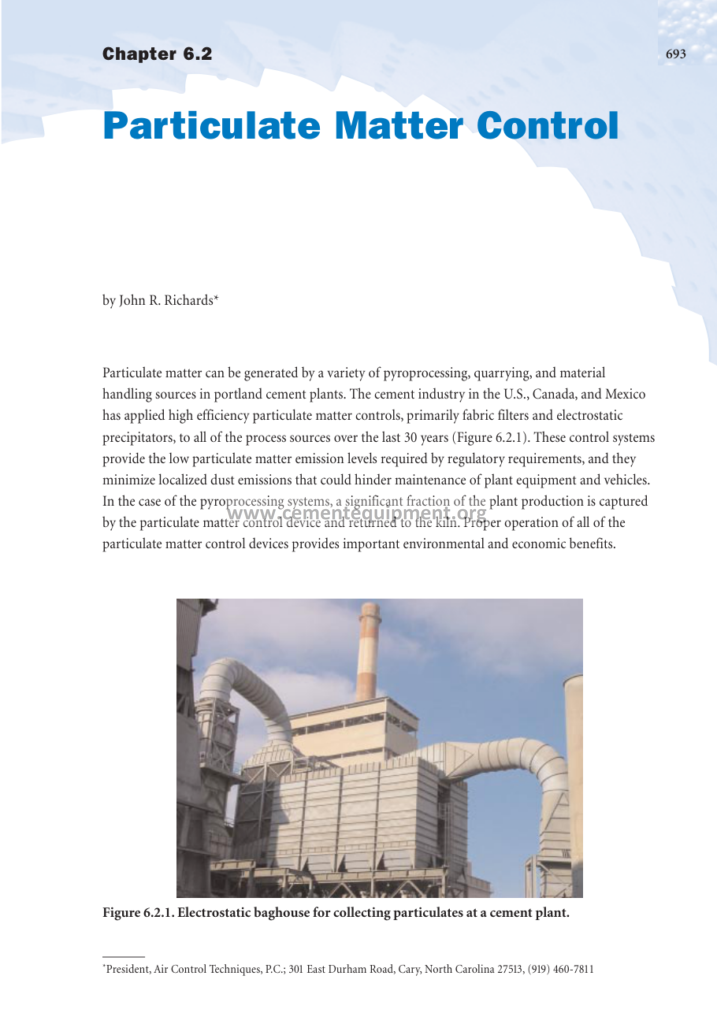
Particulate matter can be generated by a variety of pyroprocessing, quarrying, and material handling sources in portland cement plants, and Chapter 6.2 of the Innovations in Cement Manufacturing series establishes the scale of the control problem at once: the cement industry in the United States, Canada, and Mexico has applied high efficiency particulate matter controls, primarily fabric filters and electrostatic precipitators, to all of the process sources over the last 30 years, and these control systems provide the low particulate matter emission levels required by regulatory requirements, and they minimize localized dust emissions that could hinder maintenance of plant equipment and vehicles. This article expands the original chapter into a complete technical package covering the sources and the quantities of the dust generated in the cement process, the physical collection mechanisms of the particulate control devices, the electrostatic precipitator in engineering depth, the fabric filter (baghouse) in engineering depth, the comparison and selection of the technologies by application, the operation and maintenance practice that keeps them performing, and the innovations of the modern era that have driven the industry’s particulate emissions to levels once thought unreachable.
The purpose of this article is to give the process engineer, the environmental specialist, and the maintenance planner a complete working command of particulate matter control in the cement plant: where the dust comes from and how much it weighs in the plant’s balances, how the electrostatic precipitator collects the particles and what governs its efficiency and its failures, how the baghouse collects the particles and how its media and its cleaning design decide its life, how the two technologies compare for the kiln, the mills, the coolers, and the material handling points, and how the operations and the maintenance disciplines keep these systems compliant, available, and affordable.
1. The Dust Sources of the Cement Plant
The cement process generates dust at nearly every point, and the sources divide naturally into three families. The pyroprocessing family is the largest: the preheater tower, the kiln, the cooler, and the coal mill evolve process gases whose dust loads are measured in tens of grams per cubic meter, and their control devices, the kiln baghouse or the electrostatic precipitator, handle the greatest tonnage of the plant’s dust collection. The quarry and the material handling family covers the crushers, the conveyors, the transfer points, the stockpiles, and the silo vents, whose dusty streams are smaller but far more numerous, and whose control devices, the compact baghouses and the cartridge filters, must be reliable enough to run in the most neglected corners of the plant.
The third family is the fugitive family, the dust that never enters a duct: the wind-blown fines of the stockpiles, the spillage carry-back of the conveyors, the truck traffic of the quarry and the yards, and the leaks of the equipment enclosures. The fugitive dust is the public face of the plant’s environmental performance, the dust that settles on the neighbors’ cars and the workers’ shirts, and its control is a discipline of housekeeping, enclosure, and suppression rather than of collection devices, though the collection devices of the material handling points take their share.
The quantities involved anchor the environmental economics of the industry. The kiln system of a 5,000-tonne-per-day line, burning a dusty raw material, may present its dust collector with a gas stream of 500,000 to 1,000,000 cubic meters per hour, carrying 20 to 60 tonnes of dust per day at typical inlet loads, of which the collector must reject all but a few kilograms. The collected dust, the cement kiln dust of the next chapter, is a material stream in its own right, returned to the process or managed as a by-product, and the tonnage of the dust collection systems is therefore part of the plant’s mass balance, not a waste-disposal afterthought.
The regulatory context completes the picture: the emission limits of the modern era, expressed in the European directive values and the North American permit conditions, require outlet concentrations of particulate matter well below 20 mg/Nm3, and in many jurisdictions below 10 mg/Nm3 on the kiln and the mills, with opacity monitors and continuous emission measurement systems verifying the compliance continuously. The technologies of this chapter, the electrostatic precipitators and the fabric filters, have been refined precisely to meet and to beat these limits, and their selection, operation, and maintenance are the environmental core of the cement plant.
2. The Physics of Particle Collection
The collection of a particle from a gas stream is the business of a small set of physical mechanisms, and the engineer’s command of the devices begins with the mechanisms. The electrostatic precipitator collects by charging: the particles pass through a corona discharge, where the gas ions attach to them, and the charged particles are then driven to the collecting electrode by the electric field and held there until the rapping releases them. The collection efficiency of the precipitator follows the Deutsch equation, which expresses the fundamental exponential relationship between the efficiency, the collecting area, the migration velocity of the particles, and the gas flow: efficiency rises steeply with the collector area and the migration velocity, and demands the fourth and fifth particles of a 99.9 percent demand many times the area of the first ninety-nine.
The fabric filter collects by the physical mechanisms of the cake: the gas passes through a woven or felted fabric, and the particles are separated by the inertial impaction of the larger particles, the interception of the intermediate particles, the diffusion capture of the sub-micron particles, and the sieving action of the dust cake that builds on the fabric surface. The essential insight of the fabric filter is that the cake, not the fabric, does most of the collecting: the fabric is the substrate that holds the cake, and the filter operates at its highest efficiency, and its steepest efficiency curve, precisely when the cake is fully formed, so the cleaning cycle that removes the cake is a deliberate compromise between the pressure drop and the collection efficiency.
Two derived quantities govern the practical design of every collector. The filtration velocity of the baghouse, the ratio of the gas flow to the fabric area, expressed in meters per minute, decides its size and its emission level: the modern kiln baghouses operate at velocities below 1.0 m/min, the compact application baghouses at 1 to 2 m/min, and the pulse-jet machines at 1 to 1.5 m/min, with the higher velocities exacting proportionally higher pressure drops and shorter bag lives. The specific collecting area of the precipitator, the ratio of the collecting plate area to the gas flow, expressed in square meters per cubic meter per second, decides its efficiency and its cost, with the modern kiln precipitators designed to specific areas of 40 to 60 m2 per m3/s to reach the deep-efficiency targets.
The particle size and the resistivity of the dust join the design: the sub-micron particles are the hardest to collect by every mechanism, and their fraction in the cement process dusts, particularly at the kiln where the condensation of the volatiles creates the finest aerosols, sets the practical efficiency ceiling of every device. The resistivity of the dust, the electrical property of the dust layer on the collecting plates of the precipitator, governs that device’s behavior completely, as the next section shows, and its control, through the gas conditioning, is the central art of the modern precipitator operation.
3. The Electrostatic Precipitator: Design and Operation
The electrostatic precipitator collects the particles of the kiln gas through the electrically driven migration described above, and its geometry is the classic wire-and-plate geometry: a row of discharge wires, at high negative voltage, hangs between parallel collecting plates, and the gas flows horizontally between them. The discharge wires emit the corona, a faint blue discharge in which the gas ions stream toward the plates, charging the dust particles that pass; the charged particles migrate to the plates, where they deposit as a dust layer; and the rapping hammers, striking the plates and the wires on a cycle, dislodge the layer into the hoppers below.
The voltage is the precipitator’s life force, and its supply is engineered hardware: the transformer-rectifier sets of the modern units, with their automatic voltage control, maintain the maximum stable voltage at the brink of the spark-over, because the collection efficiency climbs steeply with the voltage and the current, and because the duty cycle between the sparks must be managed, the sparks cleaning the wires but costing collection time. The control of the rapping is the second operational art: the rate and the intensity of the rapping balance the removal of the dust layer against its re-entrainment, for a rapping that is too strong or too frequent re-suspends the collected dust into the gas stream, and the modern systems tune the rapping intensity and frequency section by section, by the observed emission and the hopper loads.
The resistivity of the dust governs whether the precipitator can work at all, and the cement kiln dusts present the full range of the problem. The dust of the moderate-alkali, moderate-sulfur kilns has a resistivity in the favorable range, a few 10 to the 10 ohm-centimeters, where the layer conducts the charge away fast enough to keep the field stable; the high-resistivity dust, typical of the kilns burning clean fuels on refractory-hardened raw materials, accumulates charge on the layer surface, creates the back-corona that turns the layer into a secondary discharge electrode, and collapses the collection efficiency; and the low-resistivity dust, easily conductive, loses its charge to the plate and re-entrains. The treatment of the high-resistivity dust is gas conditioning: the injection of a small flow of water vapor or, historically, of sulfur trioxide, lowers the resistivity into the favorable window, at the cost of new chemistry and new corrosion risks.
The modern precipitators have refined every element of the classical machine. The discharge electrodes are the improved rigid frames and the tubular electrodes, less sensitive to misalignment and vibration than the old weighted wires; the collecting plates carry the deep-pocket profiles that stiffen the plate and channel the gas; the gas distribution at the inlet, through the perforated baffle screens, is engineered so that every duct of the field carries its designed share; and the rapping systems have moved to the impulse rapping with the individually controlled intensity. Where the classical precipitator reached 99.0 to 99.5 percent, the modern machines, with their larger specific collecting areas and their refined control, reach 99.9 percent and beyond, at the 20 and 10 mg/Nm3 levels that the modern permits demand.
4. The Fabric Filter: Media, Design, and Cleaning
The fabric filter, the baghouse, collects the particles on a filter medium, and its modern form in the cement industry is the pulse-jet baghouse: a casing divided into compartments, containing the bags with their cages, through which the gas flows from the dirty side to the clean side, with the dust cake on the bags, and the bags cleaned on-line or off-line by the pulse of compressed air through the venturi nozzles above each bag, the shock wave flexing the fabric and releasing the cake into the hoppers below.
The filter medium is the heart of the baghouse, and its selection is the subject of a whole engineering practice. The fibers of the cement service face the processes’ heat, the alkalies, the sulfur compounds, and the moisture: the glass fiber with the ePTFE membrane and the finishes serves the high-temperature kiln and the preheater services up to 250°C and beyond; the aramid (poly-meta-phenylene isophthalamide) fibers serve the medium-temperature services with their excellent resistance to the abrasion and the chemical attack; the polyimide (P84) fibers, with their lobed cross-section that multiplies the surface area, serve the fine dust services; and the polyester and the acrylic fibers serve the cool, dry application points. The media are manufactured as the needle felts, with the density tuned to the dust, and the newer products add the membrane laminates, the fine ePTFE film on the felt surface, whose surface filtration releases the cake so cleanly that the efficiency and the bag life both improve.
The cleaning is designed against the cake behavior: the on-line cleaning, in which the compartments are pulsed while the filter operates, suits the continuous processes of the cement plant, while the off-line cleaning, in which each compartment is isolated and cleaned while its neighbors carry the load, gives the deeper cleaning that the sticky and the moisture-sensitive dusts need. The cleaning control of the modern baghouses is differential-pressure based: the pressure drop across the bags, the sum of the fabric resistance and the cake resistance, is held in its operating band by the pulse timers and the differential pressure controllers, cleaning more when the cake thickens (the filter drives itself harder) and resting the bags when the gas is clean, and the modern systems add the optical and the acoustic instruments that measure the emission of each compartment continuously.
The baghouse case design completes the system: the inlet gas distribution, with its baffles and its turning vanes, protects the bags from the scouring of the high-velocity streams; the hoppers, with their steep angles and their aeration, discharge the collected dust without bridging; the casing is insulated and the heated compartments protect against the condensation that would blind the bags with the wet cake; and the safety equipment, the explosion relief panels, the fire protection, and the CO detection, protects the machine from the events that the cement process can generate, particularly where the coal mill and the kiln gases are involved.
5. The Kiln Application: The Precipitator versus the Baghouse
The kiln dust collector is the crown of the plant’s particulate control, and its selection, the precipitator versus the baghouse, is one of the classic equipment decisions of the industry, decided by the gas conditions, the dust properties, the space, the energy, and the regulatory trajectory. The electrostatic precipitator historically dominated the kiln application, because it tolerated the high temperatures and the large gas volumes with a modest pressure drop and a moderate power demand, and because the kiln dusts of the moderate process presented it with favorable resistivities; its cost came in the space, the collecting areas of the deep-efficiency designs, and in the sensitivity of its efficiency to the dust resistivity and to the process chemistry.
The baghouse has steadily taken over the kiln application as its media have matured, because its efficiency is not hostage to the electrical properties of the dust: the membrane felts collect the sub-micron aerosols that escape the best precipitators, the emission levels of the modern kiln baghouses are the lowest achieved in the industry, and the machine’s behavior is stolid, its efficiency essentially constant from the first day to the bag change. The costs of the baghouse are the pressure drop, higher than the precipitator’s, the compressed air, the bag life under the alkali and the temperature attack, and the sensitivity of the media to the condensation events, which the modern plants answer with the fully insulated, heat-traced casings and the careful preheating of the filter before the process starts.
The comparison is sharpened by the process details. The kiln gas at the preheater exit arrives at 280 to 360°C in the no-raw-mill mode and at 100 to 180°C through the raw mill, and the collector must handle both regimes: the baghouse media are selected for the maximum temperature, the glass membrane felts above 200°C; the precipitator cares less about the temperature but suffers the resistivity shift between the regimes, particularly in the raw-mill-off mode when the gas carries the alkalies in the vapor phase and the dust arrives at the high temperatures. The coal mill and the air-pollution control of the modern plants, with their demands for the lowest emissions at all conditions, have pushed the majority of the new kiln installations to the baghouse.
The environment of the comparison is completed by the total cost: the precipitator’s capital cost per cubic meter rises steeply with the efficiency demanded, the baghouse’s rises gently; the precipitator’s energy is dominated by the transformer losses and the rapping, the baghouse’s by the fan’s pressure drop and the compressed air; and the maintenance of the precipitator, the electrodes, the rappers, and the high-voltage equipment, is an electrician’s discipline, while the baghouse’s is the changing and the inspection of the bags. The modern industry’s answer has been increasingly the baghouse for the new kilns, and the precipitator for the rehabilitation of the existing installations, and the choice is made plant by plant on the numbers that the measurement and the permit define.
6. The Compact Applications: Mills, Coolers, and Material Handling
Below the kiln, the plant’s dust collectors are the compact machines that serve the mills, the coolers, the packers, and the material handling points, and their design discipline is different: they must be small, cheap, reliable, and forgotten, because the plant’s attention is elsewhere. The mill application collects the mill exhausts, whose gas is laden with the ground material, the cement and the raw meal, and whose collectors, the pulse-jet baghouses with the polyester or the acrylic felts, return the collected product to the mill circuit; the cooler collectors handle the cooler exhaust air, coarser and hotter, with the woven or felted bags sized for the abrasive duty; and the packer and the transfer point collectors are the small cartridge and bag machines whose every leak is immediately visible in the packaging area.
The material handling collectors of the modern plant are numerous enough to be a maintenance population in their own right, and their engineering has converged on the standardized machines, the compact pulse-jet baghouses with the vertical bags and the hoppers integrated, delivered in the series that the suppliers catalogue. Their duty is the ventilation of the transfer points, the silo vents, and the conveying enclosures, with the airflows from a few thousand to a few hundred thousand cubic meters per hour, and their reliability requirement is absolute, because a failed vent filter in a silo overflows the silo through its own roof and a failed transfer collector turns its corner of the plant into a dust waterfall.
The design of the compact machines follows the same physics as the kiln machines with the priorities reversed: the filtration velocity is higher, 1 to 1.5 m/min on the standard felts, the margins are thinner, and the maintenance is expected to be the simple scheduled change of the consumables, the bags, the cartridges, the valves, and the diaphragms. The innovations of the compact family have been the standardization and the digitization: the machine-integrated controllers with the differential-pressure and the emission monitoring, the pulse valves with the diagnostic wear indication, and the remote monitoring that brings the forgotten collectors of the plant onto the screens of the central control room.
The application discipline of the compact collectors is the discipline of the dust capture itself: the extraction hoods and the enclosures that bring the dust into the collector must be designed as diligently as the collector, because a hood that misses its dust is a collector that cannot help. The hood sizing rule of the industry, the capture velocity of 0.5 to 1 m/s at the opening of the hoods, the enclosure of the transfer points with the sealing curtains, and the balancing of the extraction with the conveying air, are the everyday engineering of the dust control that keeps the working environment of the plant clean, and their quality is visible in the air of every department.
7. Operation and Maintenance of the Collection Systems
The operating discipline of the dust collection systems is the continuous assurance that the machines collect what the permits require, and it rests on the measurement, the process integration, and the maintenance scheduling. The measurement instruments of the collectors, the opacity monitors of the kiln and the mill stacks and the particulate mass monitors of the newer installations, are the permit instruments of the plant: their calibration and their validity govern the compliance documentation, and their readings are watched continuously by the operators and the environmental staff. The differential-pressure instruments of the filters and the secondary voltage and current of the precipitators are the operating instruments, the gauges of the machines’ health, whose trends carry the early warnings of every failure mode.
The process integration of the collectors is the operational art of the kiln section: the kiln collector operates across the modes of the line, the raw-mill-on, the raw-mill-off, with the gas volumes, the temperatures, and the dust loads changing within minutes, and the collector must be protected through the transitions, the bypass or the conditioning of the gas, the preheating of the filter before the hot gas arrives, and the adjustment of the collecting parameters to the new dust. The plant’s operational procedures own these transitions, and the operators’ training drills them, because the damaged filter of a transition, the blinded bags or the back-corona of an abrupt regime, costs the plant weeks of reduced emission control.
The maintenance schedules of the collection equipment are among the most detailed of the plant, because the machines present many small consumables: the bags and the cages of the baghouses, with their inspection and replacement cycles measured in years but tracked bag by bag; the pulse valves, the diaphragms, and the nozzles of the cleaning systems, replaced on their wear cycles; the electrodes, the rappers, and the transformer-rectifier units of the precipitators, with their high-voltage inspection disciplines; and the hoppers, the screw conveyors, and the rotary valves of the ash discharge trains, whose reliability the whole system depends on. The maintenance of the collectors is supported by the stores of the consumables, the documented replacement procedures, and the condition data that the modern monitoring streams into the maintenance systems.
The failure modes of the collection systems are a catalogue of the industry’s experience, and the operator’s handbook of the discipline lists them with their signatures: the sudden emission rise of the baghouse signal a burst or a leaking bag, located by the compartment testing and the light-stick testing of the outlets; the rising differential pressure with the clean gas signals the cake blinding, from the condensation, the chemical attack, or the membrane damage; the falling secondary voltage of the precipitator signals the electrode problems, the misalignment, the dust build-up on the wires, or the back-corona; and the hopper plugging, the valve jamming, and the screw seizure announce themselves through the level and the current alarms. Each signature maps to its corrective action, and the discipline of responding to the signatures in hours rather than in weeks is what keeps the compliance records clean.
8. Comparing the Collection Technologies
The following table consolidates the comparison of the two collection technologies and the compact family across the service conditions of the cement plant, giving the selection engineer the essential numbers and characteristics:
| Characteristic | Electrostatic precipitator | Pulse-jet baghouse | Compact baghouses / cartridges |
| Principal cement service | Kiln, some coal mills | Kiln, raw mill, finish mills, coolers | Transfer points, silo vents, packers |
| Collection mechanism | Corona charging and field migration | Filtration on cake and fabric | Filtration on felts or cartridges |
| Efficiency at sub-micron sizes | Good, dust-dependent | Excellent, membrane felts | Good |
| Key operating variable | Dust resistivity, voltage | Differential pressure, temperature | Differential pressure |
| Pressure drop, kPa | 0.2–0.5 | 1.5–2.5 | 1.0–2.0 |
| Maximum gas temperature | Limited by dust properties, >400°C possible | Media-dependent, to ~260°C | 60–120°C typical |
| Typical outlet emissions | 10–30 mg/Nm3 | <10 mg/Nm3 | <10 mg/Nm3 |
| Main consumables | Electrodes, rappers, T/R sets | Bags, cages, pulse valves | Bags or cartridges |
| Main hazards | Back-corona, resistivity excursions | Condensation, fire, bag attack | Neglect in remote locations |
The table’s message is the chapter’s message: the technologies are not rivals but complementary instruments of a single emission-control strategy. The precipitator serves the high-volume, high-temperature services where its pressure-drop economy and its tolerance of the heat outweigh its sensitivity to the dust; the baghouse serves everything that demands the deepest efficiency and the independence from the dust’s electrical behavior; and the compact machines carry the numerous and unattended duty points of the plant. The modern plants frequently operate all three families, each selected by the service, and their emission budgets are set accordingly.
9. Innovations and the Future of Particulate Control
The particulate control of the cement industry has advanced with the tightening of the limits, and the innovations of the modern era are the innovations of the deep reduction. The filter media have been the most productive front: the ePTFE membrane felts, the blended fiber felts, and the wider temperature windows have carried the baghouse to the 5 to 10 mg/Nm3 territory at the kiln and the mills, and the development of the fluorinated and the ceramic media is opening the high-temperature filtration that would eliminate the quenching of the hot gases. The hybrid collectors, combining the charging of the precipitator with the filtration of the fabric, have demonstrated the capture of the finest aerosols at lower pressure drops than either parent technology, and their trials in the cement service are among the most watched developments of the discipline.
The instrumentation and the control of the collectors have followed the deep-reduction path: the continuous particulate monitors of the modern plants, using the light-scattering and the electrical-charge techniques, provide the mass or the relative emission in real time, and the baghouse cleaning and the precipitator rapping are now controlled by the emission signals themselves, cleaning when the emission rises rather than on a blind timer, a technique whose emission floor and bag-life gain are both documented. The predictive maintenance analytics of the collectors, watching the differential pressure, the valve wear, and the emission trends, schedule the interventions before the failures, and the digital twin models of the baghouse pressure and the precipitator migration velocity are moving into the service of the engineering departments.
The regulatory trajectory completes the picture of the future: the limits are moving toward the 5 mg/Nm3 region on the principal sources, the fugitive dust is being regulated through the neighborhood and the deposition standards, and the industrial emissions directives are folding the particulate control into the integrated environmental permits that govern the total performance of the plant. The technologies of this chapter have demonstrated the headroom: the plants that apply the best available techniques of the modern era, the membrane baghouses on the kiln, the engineered compact collectors everywhere, the monitoring and the management systems, achieve the emissions that the future limits anticipate, at costs that the industrial economics can sustain.
10. The Environmental and Economic Context
The particulate control of the cement plant stands in the full environmental economics of the industry, and its context is double-sided. On the collection side, the dust captured by the devices is a resource of the plant: the kiln dust returns to the raw feed circuit where the alkalies permit, the mill dust returns to the products, and the total dust recovered, typically 0.5 to 2 percent of the clinker production at the kiln and several times that in the material handling, is part of the plant’s mass balance and its yield. The collected dust of the kiln that cannot return, the cement kiln dust of the next chapter, is the by-product whose management the plant must engineer, and the particulate control therefore feeds the two streams, the process stream and the by-product stream, whose balances the environmental management owns.
On the cost side, the particulate control is a permanent line of the plant’s operating and capital budgets: the energy of the collectors, the fan power of the pressure drops and the compressed air of the cleaning, is a measurable fraction of the plant’s electrical demand; the consumables of the baghouses, the bags and the cartridges, are replaced on their cycles measured in millions of bags across the industry; and the maintenance of the precipitators and the filters is a permanent population of the maintenance workload. The economics of the emission reduction are the economics of the equipment design and the operating discipline: the right machine, well operated, collects at the permit level all its life at the lowest total cost, while the wrong machine, or the neglected one, spends its life in the replacement cycles and the compliance incidents that the industry’s expense records quantify.
The environmental context closes with the public dimension: the particulate emission of the cement plant is the most visible of its impacts, the plume at the kiln stack, the dust on the neighboring streets, and the settled dust on the surrounding land, and the industry’s record of the deep reduction has been the foundation of its acceptance by the communities. The chapters of the Innovations series treat the other emissions in their own places; this chapter’s subject, the particulate control of the process sources, is the one whose engineering the public sees first and whose compliance the permits audit hardest, and its discipline is therefore both an environmental and a commercial necessity.
Frequently Asked Questions
Why do cement plants need high-efficiency particulate control on every process source?
Because the process generates dust at nearly every point, from the kiln and the mills to the crushers, the conveyors, and the transfer points, and the regulatory requirements of the modern era demand outlet concentrations of 10 to 20 mg/Nm3 or lower on the principal sources. The two technology families of the chapter, the electrostatic precipitators and the fabric filters, provide those levels, and they also minimize the localized dust that would otherwise hinder the maintenance of the equipment and the visibility of the plant.
What physical mechanisms collect the particles?
The precipitator charges the particles in a corona discharge and migrates them to the collecting plates by the electric field; the baghouse filters them through the dust cake and the fabric, using inertial impaction for the large particles, interception for the intermediate ones, and diffusion capture for the sub-micron ones. The two central design quantities are the specific collecting area of the precipitator and the filtration velocity of the baghouse.
Why does the dust resistivity decide whether an electrostatic precipitator works?
Because the collected dust layer on the plates must discharge its charge: with high-resistivity dust, the layer holds its charge, the field collapses in back-corona, and the collection efficiency falls dramatically; with low-resistivity dust, the charge leaks away and the dust re-entrains. The favorable window around 10 to the 10 ohm-centimeters is maintained by gas conditioning where the natural dust is outside it.
What makes the pulse-jet baghouse the standard for new kiln installations?
Its efficiency does not depend on the electrical properties of the dust: the membrane felts capture even the sub-micron aerosols that escape the best precipitators, the outlet emissions are the lowest achieved in the industry, and the behavior is stable from day one to the bag change. Its costs are the higher pressure drop, the compressed air, and the bag life, managed by the media selection and the insulation of the casing.
How do the kiln collectors survive the process modes, like raw mill off?
The collectors operate across the regimes of the line: when the raw mill is off, the kiln gas arrives hot and volatile-laden, and the collector must be protected through the transitions by preheating the filter before the hot gas arrives, conditioning or bypassing where designed, and adjusting the collecting parameters. These transitions are operated under written procedures and rehearsed in training, because a damaged collector in a transition costs weeks of reduced control.
What is the typical life of baghouse bags in cement service?
It depends on the service: the application-point polyester bags commonly last four to six years, the kiln membrane felts two to four years depending on the temperature and the alkali attack, and the coal and the high-temperature services shorter. The life is managed by the media selection, the cleaning discipline, the insulation against condensation, and the condition data, and the bags are tracked and replaced bag by bag rather than wholesale.
Final Summary
Chapter 6.2 of Innovations in Cement Manufacturing covers the control of particulate matter from the cement process sources, and this article has expanded the chapter into a complete technical package. The article established the sources and the quantities of the dust, the physical mechanisms of the collection, and the two central design quantities, and it then developed the electrostatic precipitator in engineering depth, its charging, its collecting, its rapping, and its resistivity problem, and the fabric filter in equal depth, its media, its cleaning, its casing, and its safety systems.
The application core covered the kiln collector decision, the comparison of the precipitator and the baghouse across the regime of the line, the compact collectors of the mills and the material handling points, and the operation, the maintenance, and the transition disciplines that keep the systems compliant and available, consolidated in the comparison table that the selection engineer can use directly. The article closed with the innovations of the deep reduction, the membrane media, the hybrid collectors, and the emission-driven control, and with the environmental and economic context in which the particulate control of the plant is operated.
The conclusion of the chapter is that the high-efficiency particulate matter controls of the cement industry, applied over the last 30 years to every process source in the United States, Canada, and Mexico and around the world, constitute one of the great engineering accomplishments of the process industries: the discharges of the dustiest of industries have been reduced to levels measured in milligrams, the working environment of the plants has been transformed, and the technical headroom of the present equipment, demonstrated in the membrane baghouses and the monitored collectors, will carry the emissions further down the curve that the future limits will draw.
Get this cement file + the full 931-file package
$249.99 — one-time purchase, instant download, lifetime access
This file is part of the Complete Cement Technical Package (931 files) available from cementequipment.org. Respective rights holders; library copy for the licensed single user.