Innovations In Cement Manufacturing: Complete Guide & Downlo
As raw feed travels through the portland cement kiln system, particulates of the raw materials, partially processed feed, and components of the final product are entrained in the combustion gases flowing countercurrent to the feed, and Chapter 6.3 of the Innovations in Cement Manufacturing series defines the subject of the chapter precisely: these particulates and the combustion gas precipitates are collected in the particulate matter control device, the PMCD, and they are collectively referred to as cement kiln dust, or CKD. The description of the PMCDs’ operation and maintenance is presented in Chapter 6.2, Particulate Matter Control, while this chapter details the CKD characteristics and management practices. This article expands the original chapter into a complete technical package covering the origin and the quantity of the dust, its chemical and physical character and how the kiln system and the fuels shape them, the internal cycles of the volatiles that the dust embodies, the management options from return to the process through beneficial reuse to disposal, the regulatory framework of the by-product, and the design and operating practices that the modern plants apply to their CKD streams.
The purpose of this article is to give the process engineer, the environmental manager, and the plant operator a complete working command of cement kiln dust: how the dust forms, what it contains, and why no two plants’ dust is the same; how the volatiles, the alkalies, the sulfates, and the chlorides cycle through the kiln system and concentrate in the dust; how the plant decides between the return of the dust to the process, its use as a raw material or a cementitious component, its application in the beneficial uses of the market, and its disposal in the engineered landfill; and how the regulatory classifications of the dust, from the exempt material to the managed waste, govern every one of those decisions.
1. The Origin of Cement Kiln Dust
The cement kiln system is a counterflow machine: the raw meal descends through the preheater and the kiln toward the burning zone, while the combustion gases and the process gases ascend toward the top of the tower, and at every step the gas stream carries a load of solids that the meal, the partially processed feed, and the clinker product contribute. The limestone and the clay of the raw meal abrade and fluidize in the cyclones and the risers; the calcined meal and the clinker dust are entrained in the kiln’s high-velocity gas at its inlet; and the burning zone’s volatilized alkalies, sulfates, and chlorides condense as fine aerosols as the gas cools on its way up the tower. The sum of all these solids that reaches the particulate matter control device is the cement kiln dust.
The quantity of the dust is a major process number of the kiln line. The dust generation of the modern preheater-precalciner kiln, with its well-designed cyclones and its stable operation, is typically 1 to 3 percent of the clinker production, expressed as the mass collected per tonne of clinker; the older long dry and the wet kilns generated far more, 5 to 10 percent and up, because their gas velocities and their lack of the staged collection loaded their PMCDs with several times the modern dust mass. The plant’s dust stream is thus both a quality problem, its composition constrains its return, and a mass balance element, its tonnage enters the plant’s yield accounts.
The composition of the dust is its defining characteristic, and it is far from uniform. The dust of a preheater line contains the mineral fractions of the raw meal, the calcium carbonate, the clay minerals, the quartz, and the iron minerals, in proportions reflecting the partial calcination that the meal experienced before the dust was entrained; it contains the partially processed material of the kiln inlet, the calcined meal and the early clinker minerals; it contains the condensed precipitates, the alkali sulfates, the chlorides, and the free lime; and, in the alkal-rich kiln systems, it carries the concentrations of the volatile compounds that the process developers call the alkali, sulfur, and chlorine load. The same plant will produce dust of different compositions in its different operating modes, the raw-mill-on and the raw-mill-off regimes, and across the seasons of its raw materials and its fuels.
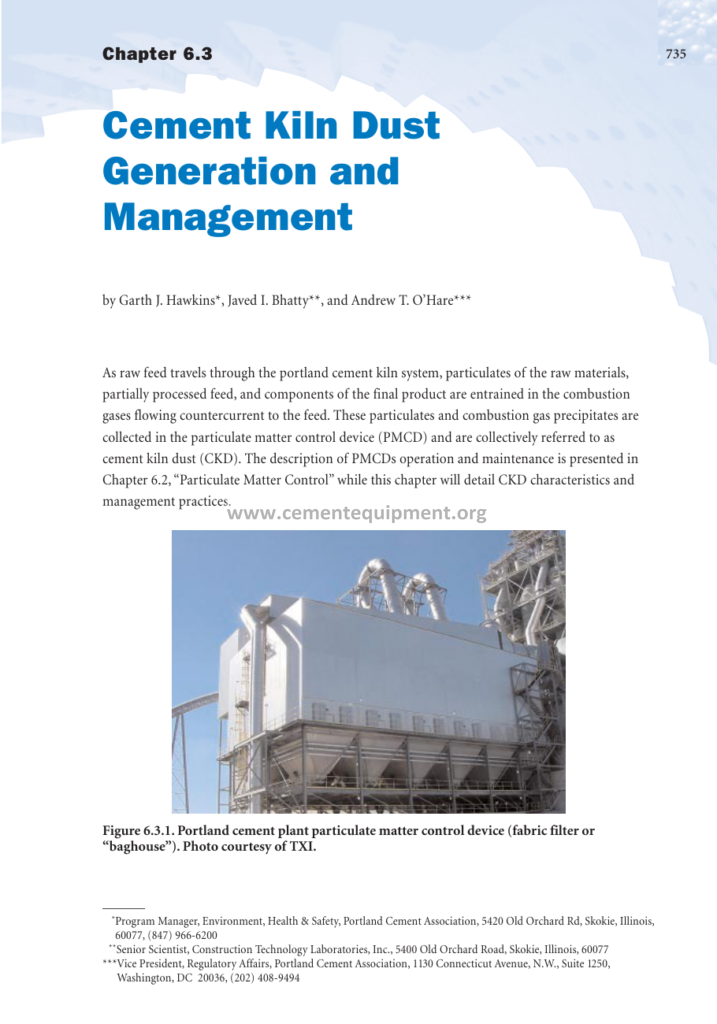
The capture point completes the picture: the dust is collected in the PMCD of the kiln, the baghouse or the electrostatic precipitator of the previous chapter, and the dust of that collector, with its fine particle size and its high specific surface, is the classic CKD. Its physical form, the dry, powdery, easily fluidized material whose fineness is the finest of the entire process, is itself a management consideration, because handling a powder whose particles average well below 10 microns, whose surfaces carry the alkalies and the chlorides, and whose alkalinity burns on contact with moisture, requires the equipment and the discipline that the handling sections of this article describe.
2. The Chemistry of Cement Kiln Dust
The chemical character of the CKD is understood through the oxides, the mineral phases, and the volatile compounds, and each tells the engineer something different. The oxide composition, expressed as calcium oxide, silicon dioxide, aluminum oxide, iron oxide, and the minor oxides, mirrors the raw feed’s composition adjusted for the calcination: the calcium oxide content, typically 40 to 55 percent in the dust of the modern kilns, includes the calcite of the uncalcined meal, the free lime of the partially calcined material, and the combined lime of the early clinker phases. The carbonate carbon dioxide content, the LOI of the dust, is the sensitive quality index, because the dust of the modern preheater is significantly decarbonate, its LOI typically in the range of 10 to 20 percent, while the dust of the older systems carried 25 to 35 percent carbonate carbon dioxide.
The volatile compounds are the most consequential constituents of the dust, and their chemistry governs the entire management question. The potassium and the sodium of the raw materials and the fuels return in the dust as the alkali sulfates and, to a lesser extent, the alkali chlorides and the carbonates: the potassium sulfate, with its melting point near 1,070°C, and the potassium chloride, even more volatile, condense in the upper tower, concentrate in the collected dust, and limit the dust’s return to the process, because the returned alkali re-volatilizes and circulates. The sulfur enters the dust as the sulfates of the calcium and the alkalies, and its balance with the alkalies decides whether the circulating compounds form the low-melting sulfates that ring the preheater or the higher-melting forms that pass through.
The dust’s alkaline character completes its chemical portrait: the free lime and the alkali compounds give the CKD its high pH, in the range of 11 to 13 when mixed with water, and its corrosivity; the chloride content, where the raw materials or the fuels carry chlorine, gives it the sticky, condensation-prone character that attacks both the tower and the collector; and the trace metals, the lead, the cadmium, the thallium, and the others, concentrate in the finest dust fractions to levels that can exceed the raw materials’ content by orders of magnitude, because the volatile metals follow the gas stream and condense with the finest particles. The dust of the modern kilns is therefore not simply dirty raw meal: it is a concentrate of the process’s volatile chemistry, and every management decision starts from a full characterization of that chemistry.
3. The Circulation Cycles and the Dust as a Process Signal
The volatiles of the kiln system do not pass through once; they circulate: the alkali compounds and the chlorides volatilize in the burning zone, travel with the gas to the cooler sections of the tower, condense on the meal and the dust, and return with the dust and the meal to the burning zone, where they volatilize again. The steady-state concentrations of the circulating compounds are set by the balance between the input, the raw materials and the fuels, and the outputs, the clinker, the bypass gases, and the dust; and the dust, as the collector of the condensed volatiles, is the visible instrument of the circulation. The rising alkali content of the collected dust, or the rising chloride concentration, is the earliest signal of the circulation building toward the ring formation and the tower blockages, and the plant’s dust monitoring is therefore part of the pyroprocessing control.
The return of the dust to the process is the first management question, and the circulation chemistry decides its answer. The dust whose alkali and chloride contents are low enough can be returned to the kiln feed, the raw mill, or the preheater, recovering its carbonate and its lime values; the dust of the high-alkali or the high-chloride regime cannot be returned without feeding the very circulation that produced it, and it must be bled from the system. The plants’ practice is a continuous balance: the kiln feed’s alkali budget, the accepted clinker alkali limit, and the bypass rate are set against the dust composition, and the return rate of the cleansed streams, the dedusting returns and the bypass dust, is tuned to hold the system’s circulation inside its window.
The bypass is the circulation’s bleed valve, and its relation to the dust is intimate. The kiln bypass removes a share of the kiln inlet gas, with its volatile load, before it can condense in the tower, and the bypass gas carries the bypass dust, the collected residue of that share, whose alkalis, sulfates, and chlorides are the most concentrated of the plant’s dusts. The bypass dust typifies the management problem of the chapter: it is high in the very compounds that limit its process use, and its quantities, whether small in the low-volatile plants or substantial in the high-chloride ones, must be managed to an outlet, the beneficial use or the disposal, that the next sections describe.
The operational lesson of the circulation is that the dust is not a waste but a signal: its composition and its quantity measure the volatile balance of the kiln system, and the plants that monitor their dust streams continuously, analyzing them on the laboratory’s schedule and watching the trends, know the state of the circulation days before the rings and the blockages would announce it. The chapters of the series on the preheater and the process control meet the dust at exactly this point, as the operational instrument and the management problem that the kiln system’s volatile chemistry presents.
4. The Return of the Dust to the Process
The return of the collected dust to the process is the first and the most economical management option, and the practice has two main paths. The direct return delivers the collector’s dust to the kiln feed system, the raw mill, or the preheater riser, through the pneumatic and the mechanical conveying, and it is the practice of the plants whose dust composition permits it: the dust joins the raw meal, its carbonate heats and calcines a second time, and its lime values and its fluxing alkalis, within the limits, participate in the clinker. The return location matters, because the dust returned to the preheater top passes through the cyclone train and its fine particles re-entrain readily, while the return to the raw mill blends the dust into the meal stream; the high-alkali dust is often returned to the kiln inlet, where its volatilized alkali reports directly to the circulation rather than to the clinker.
The direct return has its process costs, and the plants weigh them against the disposal cost it avoids. The returned dust adds to the gas circulation, the fine particles ride the gas stream and enlarge the dust load of the tower and the collector; the returned alkalis feed the circulation and raise the clinker’s alkali content toward its limit; and the returned chloride, where present, drives the tower toward its deposit problems. The modern practice therefore pairs the return with the bleed: the cleansed stream, the bulk of the dust, returns to the process, while the concentrated stream, the bypass dust or a designed fraction of the collected dust, leaves the system, and the split between the return and the bleed is tuned to the daily chemistry.
The return path’s equipment is the dust handling discipline of the preceding chapters: the collected dust, fine, alkaline, and easily fluidized, moves through the enclosed screw conveyors, the air slides, and the pneumatic lines, with the aeration and the venting that the powder demands, and the return circuits of the modern plants are instrumented, weighed, and interlocked so that the return rate is known and the circuits cannot spill. The dust return is also an energy question: every tonne of returned dust re-calcines its carbonate and re-heats its mass, and the returned dust’s thermal duties are part of the kiln system’s heat balance, which is why the plants with the large dust loads weigh the return against the specific fuel consumption the return costs.
5. CKD in Cement and Concrete: The Cementitious Use
The second management option, the use of the CKD as a cementitious material, converts the dust from a process stream into a product, and its technical basis is the dust’s lime chemistry. The CKD, with its free lime, its partially calcined phases, and its alkali sulfates, is a weak cementitious material in its own right: mixed with water, its free lime hydrates and the alkali compounds react, and the compacted dust develops moderate strength. The engineering uses draw on exactly this behavior, in the soil stabilization, the road base construction, and the waste solidification applications that the beneficial-use section describes.
In the cement itself, the CKD has a limited but real place. The dust can be interground or blended into the Portland cement within the limits that the standards set, because the cement’s alkali content is regulated, and the CKD’s alkalis, its LOI, and its free lime constrain the addition; the blended cements of the modern era, the Portland-limestone and the Portland-composite cements, accommodate the calcined materials more generously, and the industry’s practice of the cementitious use of the collected materials has grown with the blended-cement standards. The dust’s fine particle size and its alkali activation contribute to the early hydration, and the quality engineers have learned to use the dust as one component of the cement’s fine fractions rather than as an arbitrary additive.
The concrete side of the cementitious use is the market’s question: the concrete specifications and the durability requirements decide whether a CKD-bearing cement can serve a market, and the plants that market the CKD-bearing products document their compliance with the standards, the setting, the strength, the soundness, and the durability, exactly as for their ordinary cements. The cementitious use of the CKD is therefore a quality-managed practice, not a waste-unloading practice, and its economics follow the quality: the CKD that meets the product limits earns the cement’s price, while the CKD that does not falls to the beneficial uses and the disposal of the next sections.
The innovation record of the cementitious use has been the progressive refinement of the blends and the activation: the alkali-activation research of the modern era, the intergrinding of the CKD with the slag and the fly ash, and the treatment of the dust, the washing and the dechlorination processes that several plants have developed, have expanded the quality window in which the CKD can serve as a cementitious material, and the trajectory of the field is toward the complete valorization of the dust streams that the environmental economics of the future will demand.
6. Beneficial Uses of Cement Kiln Dust
Beyond the cement, the CKD serves a market of beneficial uses whose common thread is the dust’s high pH and its lime content. The soil stabilization is the largest use: the CKD mixed into the subgrade soils of the roads and the building sites, at 5 to 10 percent by weight, raises the soil’s pH, exchanges the ions, and produces the compacted, load-bearing stabilized layer that the geotechnical engineers design, and the practice is established across the North American road programs. The agricultural use, the application of the dust as a liming agent on the acidic soils, draws on its alkaline value, within the limits that its trace metal and its alkali contents allow, and its use in the waste treatment, the neutralization of the acidic wastes and the solidification of the sludges, completes the set.
The engineering character of the beneficial uses requires the quality management that every market demands: the soil stabilization customers specify the dust’s fineness, its free lime, and its alkali content, and the plants’ quality departments analyze and certify the shipped dust exactly as they would a cement; the agricultural customers verify the metal contents against the land-application limits; and the waste-treatment customers document the leaching behavior of the treated products. The beneficial-use market is therefore not a disposal outlet but a product market, and its volumes and its prices, modest beside the cement’s, are real lines of the plant’s environmental balance sheet.
The beneficial uses have the decisive advantage, in the environmental and the economic frames, of converting the dust stream into a revenue and avoiding the disposal cost; their disadvantages are the market’s demand, the seasonality, and the geography. The plants in the regions with the active road programs and the agricultural base place substantial shares of their CKD into the beneficial uses, while the plants in the remote or the saturated markets rely on the disposal, and the management of the plant is the management of the mix: the return to the process, the cementitious use, the beneficial uses, and the disposal, balanced against the compositions, the markets, and the permits of the specific site and the specific year.
7. Disposal of Cement Kiln Dust
For the share of the dust that cannot return to the process and cannot reach a market, the disposal in the engineered landfill is the management option, and its engineering is a chapter of the environmental practice in its own right. The fundamental requirement of the CKD disposal is the control of the leachate: the alkaline dust, wetted by the rain, generates a highly alkaline leachate, and the landfill must contain that leachate, manage it, and monitor the groundwater around the site, exactly as the waste landfills of the chemical industry do, with the liner systems, the leachate collection, and the groundwater monitoring wells that the permits require.
The landfill design follows the waste-engineering standards: the site selection and the hydrogeological characterization, the liner system, the composite clay and geomembrane liners of the modern designs, the leachate collection and the treatment, the final cover and the drainage, and the long-term monitoring and the closure plans. The sub-category of the CKD landfills, the dedicated dry-dust disposal sites and the slurry-disposal operations of the wet systems, have their own designs: the dry disposal compacts and covers the dust in the cells, while the slurry disposal, the practice of the older and the water-rich plants, pumps the dust-water slurry into the impoundments, whose water management and whose eventual closure are permanent obligations of the site.
The handling of the dust to the landfill repeats the dust’s central difficulty: it is fine, alkaline, and dusty, and it cannot be loaded loose without creating a fugitive-dust plume on the haul road and in the pit. The conditioning of the dust, the moistening to 15 to 25 percent moisture in the pug mills and the conditioning mixers, produces the damp, non-dusting, handleable material that the trucks and the landfill machinery can move, and the modern disposal trains are precisely that: the conditioned dust, loaded and hauled in the covered vehicles, spread and compacted in the cells, and covered to the closure sequence.
The disposal economics complete the chapter’s frame: the disposal carries the conditioning, the transport, the landfill operation, the leachate management, and the closure costs, and its magnitude, multiplied by the dust tonnage over the plant’s life, is the measure of the pressure that drives the return and the beneficial-use routes. The regulatory frame of the disposal is treated in the next section, and its evolution, the tightening of the landfill standards and the classification of the dust, has steadily raised the relative weight of the management options that keep the dust out of the landfill altogether.
8. The Regulatory Frame: Classification and Management Obligations
The regulatory classification of the CKD has been one of the defining questions of the chapter’s field, because the classification decides the entire management program. In the United States, the long-standing federal position has treated the cement kiln dust with the special status that the industry’s process and its recycling practice earned: the Environmental Protection Agency’s determinations, under the relevant statutes, have classified the CKD as a non-hazardous by-product requiring the management under the tailored rules rather than as a hazardous waste, on the basis that the dust is recycled or managed in the engineered facilities rather than discarded in the uncontrolled manner. The state programs implement the classification with their own permits, and the North American industry’s dust management is conducted under the state solid-waste and the environmental permits that the plants hold.
The exemption philosophy rests on the recycling practice: the CKD is generated, captured, and returned to the process as a matter of the plant’s design, and the management facilities, the storage, the handling, and the landfills, are engineered to the environmental standards. The regulatory question that the plants face is therefore not whether the dust is dangerous, it is whether the specific dust of the specific plant, with its trace metal and its alkali concentrations, meets the classification’s conditions, and the plants’ environmental programs include the periodic characterization of the dust streams against the classification criteria, the leachate testing where the disposal is involved, and the management documentation that the permits and the audits demand.
The international frame parallels the American one with its own instruments: the European waste legislation classifies and manages the CKD under the waste codes and the non-hazardous categories, wherever the recycling within the process does not exempt it; the industrial emissions directives regulate the dust’s capture through the emission limits of the preceding chapter; and the transboundary and the export rules apply to the dusts that the plants trade for the beneficial uses. The regulatory trajectory everywhere is toward the tightened management of the by-products, the landfill restrictions, the recycling expectations, and the full documentation, and the plants that manage their CKD streams to the best practice of the chapter, measured, characterized, returned or marketed, and finally landfilled only under the full engineering, are the plants whose permits renew smoothly.
9. Management Practice: Characterization, Options, and the Plant Program
The management practice of the CKD in the modern plant is a designed program, and its opening step is the characterization: the plant’s laboratory, on the daily schedule of the collector’s operation, analyzes the dust’s chemical composition, its LOI, its alkali, sulfate, and chloride contents, its fineness, and its leachate behavior, and the environmental department maintains the rolling record of the dust’s quality against the process regimes and the raw material changes. The characterization is what makes every subsequent decision, the return rate, the blend quality, and the disposal classification, defensible, and the plants with the strongest CKD programs are the plants whose characterization is continuous, not occasional.
The options of the program, the return, the cementitious use, the beneficial uses, and the disposal, are balanced by the plant’s specific numbers: the composition of the dust, the alkali budget of the kiln feed, the market’s demand for the by-products, the landfill’s remaining capacity and its costs, and the regulatory conditions of the permits. The plants’ experience shows the balance shifting with the era: the modern dry-process plants, with their low dust generation and their low-volatile fuels, return the bulk of their dust to the process and place the remainder in the beneficial uses, while the plants with the high-chloride raw materials and the bypass streams manage a permanent bleed to the disposal or the treatment.
The operational management of the handling is the discipline that the chapters on conveying and the particulate control describe, applied to the dust’s full difficulty: the enclosed systems, the aeration and the venting that the fine alkaline powder demands, the moisture and the conditioning management of the stored dust, and the safety practice, the respiratory and the skin protection of the workers who handle the dust, the containment of the spills, and the clean-up procedures that neutralize the alkaline material. The workers’ exposure to the respirable dust, one of the industry’s defined occupational risks, is managed under the occupational exposure programs that the modern plants operate with the same rigor as their process controls.
10. A Typical CKD Balance
The following table presents a typical material balance and composition frame for the cement kiln dust of a modern preheater-precalciner line, with the ranges that the engineer uses for planning, and the comparison with the older kiln systems that the chapter’s perspective includes:
| Parameter | Modern preheater-precalciner kiln | Older long wet/dry kiln | Bypass dust (high-volatile regime) |
| Dust generation, % of clinker | 1–3 | 5–10 and up | 0.5–3 (bypass rate dependent) |
| Particle size, mass median | 2–10 microns | 5–15 microns | 2–6 microns |
| CaO content, % | 40–55 | 35–48 | 35–50 |
| LOI, % | 10–20 | 25–35 | 5–15 |
| Alkali as equivalent Na2O, % | 0.5–3 | 1–4 | 5–20 |
| Chloride, % | 0.05–1 | 0.1–1.5 | 1–10 |
| pH of wetted dust | 11–13 | 11–13 | 11–13 |
The table teaches the chapter’s core distinctions: the modern kilns generate far less dust than the older ones, the modern dust is finer and more decarbonate, and the bypass dust of the high-volatile regimes is the concentrated outlier, whose alkali and chloride contents, one to two orders of magnitude above the main stream, define its separate management path. The engineer reads the table as the planning frame of the CKD program: the composition frame decides the return eligibility, the quantities decide the handling and the storage, and the outliers decide the treatment and the disposal requirements.
11. Innovations in CKD Management
The management of the cement kiln dust has absorbed the innovations of the era, and the trajectory of the field is the valorization of the streams that the waste era simply exiled to the landfill. The process-level innovations have reduced the dust at the source: the improved cyclone separation and the modern tower design of the preceding chapters, the stable flame and the reduced gas velocities of the modern kilns, and the low-alkali and the low-chloride fuel strategies, have cut the dust generation and its volatile load, and the kiln bypass refinements have given the plants the precise bleed control that keeps the returnable dust returnable.
The treatment innovations have expanded the options of the concentrated dusts: the water-washing and the dechlorination processes, in which the bypass dust is leached and the chlorides are removed as a manageable brine, recover the cleaned solid for the process return and the cementitious use; the alkali-sulfate recovery processes, producing the industrial potassium sulfate from the rich dusts, are operated by the plants that the market geography rewards; and the pelletization and the conditioning technologies have made the dusts handleable and shippable for the beneficial uses at the distances that the markets require.
The digital innovations have completed the management toolbox: the on-line and the laboratory characterization of the dust streams, fed into the process databases, give the operators the real-time picture of the circulation and the return decisions; the environmental management systems track the dust’s fate, the returned, the marketed, and the landfilled tonnages, against the permits and the budgets; and the analytics of the dust quality against the process variables, the fuels, the raw materials, and the operating modes, guide the raw material and the fuel selection toward the low-dust, low-volatile regimes. The chapter’s field, once the quiet corner of the environmental department, has become an integrated, data-driven practice of the modern plant.
Frequently Asked Questions
What exactly is cement kiln dust?
It is everything the kiln gas stream carries to the particulate matter control device: entrained raw meal and partially processed feed, clinker dust from the kiln inlet, and the condensed precipitates of the volatile compounds, the alkali sulfates, the chlorides, and the free lime. Its composition, finer and more alkaline than the raw meal, is shaped by the raw materials, the fuels, and the operating regime of the line.
Why can’t all the dust simply be returned to the kiln?
Because the dust concentrates the volatiles: returning it feeds the alkali, sulfur, and chloride circulation, raising the clinker’s alkali content toward its limit and driving the tower toward its deposit and ring problems. The plant returns the cleansed share and bleeds the concentrated share, through the bypass and the designed bleed, to hold the circulation inside its window.
How much dust does a modern kiln generate?
Typically 1 to 3 percent of the clinker production, against 5 to 10 percent and more for the older long kilns, thanks to the efficient cyclone trains, the stable operation, and the lower gas velocities of the modern preheater-precalciner lines. The dust mass is a permanent element of the plant’s mass balance, not a disposal afterthought.
Is CKD a hazardous waste?
In the United States it is regulated as a non-hazardous by-product under the tailored federal and state rules, on the basis of the industry’s recycling and its engineered management, and the international regimes parallel this with their waste codes and their non-hazardous categories. The classification carries conditions, and the plants must characterize their dust, manage it under their permits, and document its fate.
What are the beneficial uses of CKD?
The largest is soil stabilization for roads and building sites, using the dust’s lime content and its alkaline chemistry; agriculture uses it as a liming agent on acidic soils; and waste treatment uses it for neutralization and solidification. Each use is a quality-managed market, with the plants certifying the dust’s fineness, lime, alkali, and metal contents against the customers’ and the regulators’ requirements.
Why must CKD be conditioned before disposal?
Because it is a fine, alkaline, easily fluidized powder that would dust explosively on any open handling. The conditioning, moistening to 15 to 25 percent water in the pug mills, produces a damp, handleable material for the covered transport and the landfill, and the landfill itself is engineered with liners and leachate management because the wetted dust generates a strongly alkaline leachate.
Final Summary
Chapter 6.3 of Innovations in Cement Manufacturing details the characteristics and the management of the cement kiln dust, and this article has expanded the chapter into a complete technical package. The article established the origin of the dust in the entrainment and the precipitation of the kiln gas stream, its quantities across the kiln generations, and its chemistry, the oxides, the carbonates, the free lime, the volatile sulfates and chlorides, and the trace metals, that define its character and its management. The process dimension treated the circulation cycles that concentrate the volatiles in the dust, the return of the cleansed dust to the process, and the bleed of the concentrated streams through the bypass.
The management dimension covered the full option ladder of the chapter: the cementitious use of the dust in the cement and the concrete, the beneficial uses of the soil stabilization, the liming, and the waste treatment, the engineered disposal with its conditioning, its liners, and its leachate management, and the regulatory frame of the classification and the permits under which all of it is conducted, consolidated in the balance and composition table that the planner can use directly. The article closed with the innovations of the valorization, the dechlorination and the recovery processes, and the digital management of the dust streams.
The conclusion of the chapter is that the cement kiln dust, once the industry’s unsolved environmental problem, has become its managed by-product: generated in ever-smaller quantities by the modern kilns, characterized continuously, returned to the process within the chemistry that permits it, marketed where the uses reward it, and landfilled only under the full engineering and the regulatory discipline. The management practice of the CKD is thus the model of the modern by-product economy of the cement industry, and its innovations, the source reduction, the treatment, and the valorization, will continue to convert the dust of the process from a liability into a resource.
Get this cement file + the full 931-file package
$249.99 — one-time purchase, instant download, lifetime access
This file is part of the Complete Cement Technical Package (931 files) available from cementequipment.org. Respective rights holders; library copy for the licensed single user.