Future Trends in Cement Manufacturing
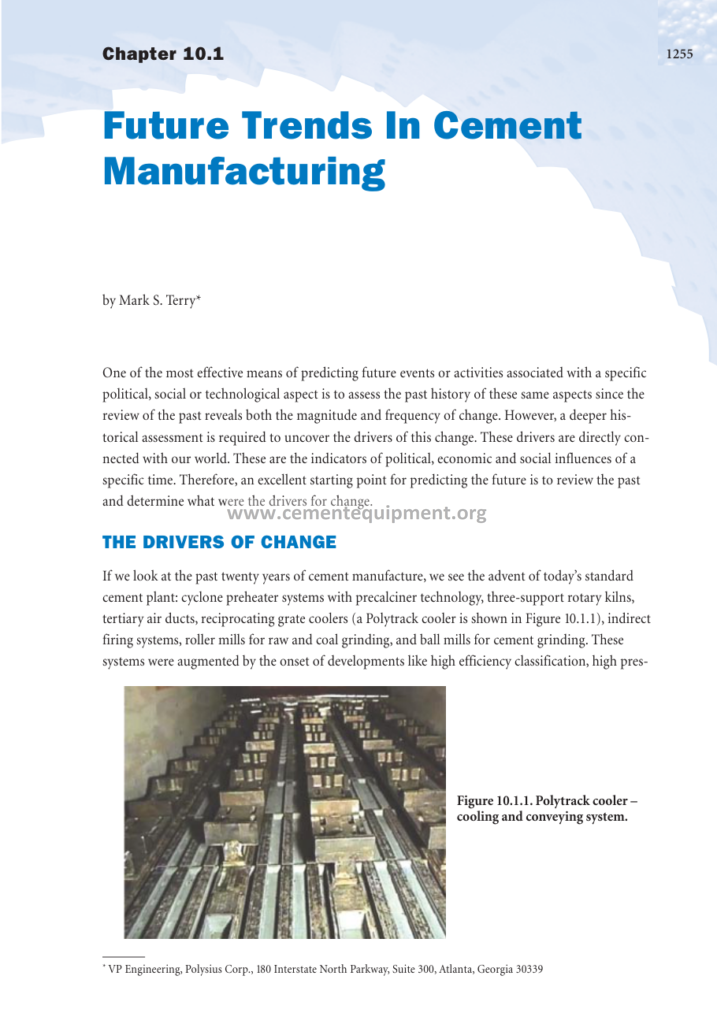
Future trends in cement manufacturing are the subject of this complete technical review, which examines where the industry is going by first understanding where it has been and what forces drive its change. One of the most effective means of predicting future events associated with a specific technological aspect is to assess the past history of that aspect, since the review of the past reveals both the magnitude and the frequency of change, and a deeper historical assessment uncovers the drivers of that change, the political, economic, and social influences of each era. The past twenty years of cement manufacture brought the standard plant of today: cyclone preheater systems with precalciner technology, three-support rotary kilns, tertiary air ducts, reciprocating grate coolers, indirect firing systems, roller mills for raw and coal grinding, and ball mills for cement grinding, augmented by high-efficiency classification, high-pressure grinding rolls, and five and six stage preheaters. The future extends that trajectory with the decarbonization agenda: carbon capture, utilization, and storage, hydrogen and other low-carbon fuels, electric and hybrid kiln concepts, and the digital transformation of the plant through process modeling, advanced control, and the digital twin. This article reviews the drivers of change, the equipment developments, the environmental agenda, the alternative fuel expansion, the energy and cost pressures, and the technologies that will define the cement plant of the coming decades.
1. The Drivers of Change in Cement Manufacturing
The history of cement technology is the history of its drivers: the economic pressure to reduce cost, the engineering pressure to increase reliability and capacity, the environmental pressure to reduce emissions, and the social pressure of the markets and the regulators. The chapter’s method is to identify these drivers in the past and to project them into the future, because the drivers of the past twenty years have not disappeared, and the coming decades will be shaped by the same forces operating with greater intensity.
In the period reviewed, the standard plant of the industry crystallized around a remarkably stable architecture: the five-stage cyclone preheater with precalciner, the rotary kiln with three supports, the reciprocating grate cooler, and the vertical roller mills for raw and coal grinding, with the ball mill retained for cement grinding. The innovations of the period were refinements of that architecture: high-efficiency classifiers, high-pressure grinding rolls, six-stage preheaters, and the progressive extension of alternative fuel firing. The stability of the architecture is itself a fact of engineering history: the preheater-precalciner dry process won the competition against the wet and semi-wet processes, and no challenger has displaced it in the half century since.
The drivers for the future are now dominated by one overriding force: carbon. The cement industry is responsible for roughly 7 to 8 percent of global anthropogenic CO2 emissions, about half from the fuel and half from the calcination reaction, and the decarbonization commitments of the industry, the regulators, and the markets have made the reduction of the carbon intensity of cement the central engineering problem of the next decades. The other drivers, cost, reliability, and labor, continue to operate, but they increasingly operate within the carbon constraint.
2. The Equipment Trajectory: From the Standard Plant to the Digital Plant
The equipment developments of the industry follow a recognizable trajectory: each generation of machines is larger, more efficient, and more instrumented than the last. The kilns of the standard plant reached capacities of 5000 to 12000 tons per day, the preheaters gained stages, the coolers gained control zones, and the mills gained classification efficiency. The future equipment trajectory continues along three axes:
- Scale and efficiency: the largest lines continue to push the economies of scale, while the retrofits of the existing fleet capture the efficiency gains of each new generation of components.
- Electrification: the substitution of mechanical and pneumatic systems by electric drives, with variable speed control everywhere, and the electrification of the heat supply itself in the long term.
- Instrumentation and autonomy: the measurement density of the plant increases, the control systems become predictive, and the operator’s role shifts from manual control to supervision and optimization.
The chapter notes that the future will rely on developments in equipment designs to augment or replace existing systems, from on-line monitoring to gearless kiln advancements. The gearless or direct-drive kiln, driven by a ring motor around the kiln shell, eliminates the girth gear, the pinion, and the mechanical transmission, improving the reliability and the control of the kiln rotation; the linear coolers and the modular preheater designs continue the same logic of simplification and control.
3. The Carbon Challenge: Emissions and the Decarbonization Roadmap
The environmental agenda has moved from the local pollutants of the twentieth century, dust, SO2, NOx, and the trace metals, to the global pollutant of the twenty-first, carbon dioxide. The roadmap of the industry’s decarbonization rests on five pillars, and the future trends of the industry are largely the future trends of these pillars:
- Energy efficiency, the first pillar, continues to reduce the fuel consumed per ton of clinker, with the best plants already below 3000 megajoules per ton and the retrofits of the older fleet capturing the same gains.
- Clinker factor reduction, the substitution of clinker by slag, pozzolana, fly ash, and limestone in the cement, reduces both the fuel and the process emissions per ton of cement, and the standards have widened the allowable substitution ranges.
- Alternative fuels and biomass, which replace fossil carbon with waste-derived and biogenic carbon, moving the industry toward carbon neutrality of the fuel part of its emissions.
- Alternative cements and binders, the low-carbon clinker chemistries and the supplementary materials that reduce the lime burden of the raw mix.
- Carbon capture, utilization, and storage (CCUS), the industrial-scale capture of the CO2 of the kiln gas, which is the only route that can address the process emissions of calcination and the residual fuel emissions together.
The first three pillars are mature and deployed; the fourth is in the demonstration stage; the fifth is the frontier, with full-scale capture plants operating in Europe and North America and the regulatory and economic frameworks for the captured CO2 being built around the world.
4. Carbon Capture, Utilization, and Storage
Carbon capture is the technology that determines the long-term future of the industry, because the process emissions of calcination cannot be avoided by any change of fuel or efficiency. The capture routes under development for cement plants are:
- Post-combustion capture with amine solvents or other absorbents, which scrubs the CO2 from the kiln gas after combustion; this is the most mature route and the first to be deployed at commercial scale, with the penalty of a substantial energy demand for the solvent regeneration.
- Oxy-fuel combustion, in which the kiln is fired with oxygen instead of air, producing a flue gas of nearly pure CO2 that can be conditioned and compressed directly; the route concentrates the CO2 at the source but requires an oxygen plant and the redesign of the kiln gas system.
- Calcium looping, in which the CO2 of the kiln gas is captured by a calcium oxide loop, and the spent sorbent is recycled into the cement raw meal, integrating the capture process with the plant’s own chemistry.
- Direct separation and the other novel routes, including the integration of the capture with the raw meal calcination, in which the calciner is designed to produce a pure CO2 stream.
The captured CO2 must then be transported and utilized or stored: utilized in the production of synthetic fuels, chemicals, and aggregates, where the utilization markets are growing but limited, and stored in geological formations, where the capacity is adequate but the infrastructure is being built. The economics of capture, at 50 to 120 dollars per ton of CO2 for the cement applications of today, are the object of intense development, and the regulatory instruments, from carbon pricing to the product standards for low-carbon cement, are being designed to close the gap.
5. Hydrogen and the Low-Carbon Fuels
The fuel side of the future is the gradual substitution of fossil carbon by hydrogen and by the biogenic and waste-derived fuels. Hydrogen is the fuel of the fully decarbonized plant: it burns to water, with no CO2, and its flame temperature and combustion characteristics can be adapted to the kiln burner. The challenges are the production, the transport, and the storage of the hydrogen, and its combustion behavior: the hydrogen flame is shorter, hotter, and less luminous than the hydrocarbon flame, which changes the heat transfer to the clinker and the formation of NOx, and the burner design and the flame control must be adapted accordingly.
In the near term, the fuel mix of the industry moves through the intermediate steps: higher shares of biomass and waste-derived fuels, the co-firing of hydrogen and the gaseous fuels, and the use of the synthetic fuels produced from captured carbon and green hydrogen, the e-fuels that are carbon-neutral on a life-cycle basis. The chapter’s view is that the fuel flexibility of the modern plant is itself the bridge: the burner and the fuel system of the coming decades must accept a mix that changes with the availability and the price of each fuel, from coal and petcoke through the wastes to hydrogen and the synthetic gases.
6. The Electric Kiln and the Electrification of Heat
Beyond the fuel substitution lies the structural option of electrifying the heat supply itself. The electric kiln concepts under development use electrical energy to supply part or all of the heat of calcination: the electrified calciner, in which the raw meal is calcined in an electrically heated fluidized or entrained bed, is the most advanced of the concepts, because the calcination step, which carries roughly 60 percent of the thermal energy of the process, can be decarbonized by renewable electricity without redesigning the whole kiln. The clinker burning itself, at 1450 degrees Celsius, is more demanding: the electrically heated kiln requires the transfer of heat into the material bed by radiation and conduction from electric heating elements, with a large electrical input and a careful thermal design.
The economics of the electric kiln depend on the price and the carbon intensity of the electricity. Where renewable electricity is cheap and abundant, the electrified calciner can already compete with fossil fuel on a carbon-adjusted basis, and the first industrial demonstrations are operating. The full electrification of the kiln remains a frontier project, but the trajectory is clear: the cement plant of the long term is an electric plant, powered by the grid of the renewable era, with the kiln system redesigned around the electrical input.
7. The Digital Twin and Process Simulation
The digital transformation of the plant is the equipment trend with the widest reach. The digital twin of the cement plant is a live mathematical model of the process, fed by the plant’s real-time measurements, that simulates the behavior of the system ahead of the operation: the operator can test a change of fuel, a change of mix, or a change of kiln settings on the twin before touching the plant, and the twin learns from the plant’s data as it accumulates.
The components of the digital plant are:
- Advanced process control, the model-based controllers that hold the kiln, the precalciner, and the mills at their optimum against the measured variables, replacing the manual correction loops of the earlier era.
- Process simulation and optimization, the offline models of the kiln chemistry, the heat balance, and the grinding circuits, used for the design and the continuous optimization of the operation.
- Predictive maintenance, the analysis of the vibration, temperature, and wear data of the equipment to predict the failures before they occur and to plan the maintenance around the production schedule.
- Quality prediction, the models that predict the clinker and cement quality from the raw material and process data, allowing the quality to be steered rather than corrected after the fact.
- The plant data platform, the integrated information system that holds the production, quality, energy, and maintenance data of the plant in one place, the foundation of all the analyses above.
The chapter’s original treatment of the future, written before the full flowering of the digital era, saw the beginning of this trajectory in the automation and control systems of the period; the digital twin is the maturity of that vision, and it is now a standard component of the modern plant’s equipment list.
8. The Alternative Fuel Expansion: Waste as a Strategic Resource
The future trends of the fuel side include the continued expansion of the alternative fuel use, driven by the double benefit of cost and carbon. The waste streams of the economy, from municipal solid waste to the industrial by-products, are increasingly recognized as a strategic resource for the cement industry, which can absorb them in the kiln at high temperature with the recovery of both the energy and the mineral content. The trends in this area:
- Higher substitution rates, with the leading plants approaching 90 to 100 percent of the thermal energy from waste-derived and biogenic fuels.
- Wider waste acceptance, with the dedicated preparation and feeding technologies for each waste stream, from the liquid wastes through the shredded solids to the sewage sludge and the agricultural residues.
- Carbon accounting of the fuels, with the biogenic share of the waste fuel counted separately from the fossil share, and the emission reports distinguishing the two.
- Integration with the regional waste policy, with the cement plants becoming part of the waste management infrastructure of their regions, and the substitution rate regulated as an instrument of the circular economy.
The limits remain the chemistry and the emissions: the chlorine and the heavy metals of the wastes constrain the substitution, and the plants with the highest substitution rates are those that have invested in the analysis, the feeding, and the process control that the waste streams demand.
9. Raw Material and Binder Innovation
On the product side, the future belongs to the reduction of the clinker factor and the development of the low-carbon binders. The clinker factor of the world’s cement is falling as the standards admit more slag, pozzolana, fly ash, and limestone into the cement, and the trend continues with the adoption of the limestone calcined clay cements, the LC3 family that combines calcined clay and limestone to replace a substantial share of the clinker at competitive strength and durability. The calcined clay route is particularly significant for the future because clays are abundant everywhere, the calcination of the clay can be integrated with the cement plant’s own heat, and the combination of the clay and the limestone activates a chemistry that compensates for the strength loss of the substitution.
Beyond the blended cements, the novel binder chemistries under development include the calcium sulfoaluminate cements with lower calcination temperature and lower process emissions, the belite-rich cements with reduced burning temperature, the reactive magnesia cements, and the geopolymer and alkali-activated binders based on industrial aluminosilicates. Each of these carries its own compromise between the performance, the durability, the standards recognition, and the production cost, and the realistic expectation is that the portland cement family, in its blended and calcined-clay forms, will remain the structural backbone of the industry, with the novel binders occupying the niches where their properties are decisive.
10. The Labor and Skills Dimension
The future trends of the industry include the changing shape of its workforce. The automation and the digital systems of the plant reduce the number of operators required for the routine control tasks, while increasing the demand for the skills that the systems require: process engineers, data analysts, control engineers, and the technicians who maintain the instrumentation. The chapter notes that the quality and quantity of qualified labor enters the reliability equation of the plant, and the industry’s response is the training of its people in the new tools, the redesign of the control room around the new roles, and the attraction of the new generation of engineers to the industry.
The future plant is operated from a control room that looks more like the cockpit of a modern process industry than the panel boards of the past: the operators supervise the automated control, intervene on the exceptions, and use the predictive tools to plan the operation ahead. The maintenance organization shifts from the scheduled overhaul to the condition-based intervention driven by the monitoring data, and the engineering organization shifts from the reactive problem-solving to the continuous optimization of the process and the energy.
11. The Market and Regulatory Framework
The future of the industry is shaped by the framework in which it sells: the standards, the carbon regulation, and the market demand. The product standards are moving toward the declaration of the environmental performance of the cement, with the environmental product declarations and the carbon thresholds entering the procurement specifications of the large infrastructure clients. The carbon regulation, from the emissions trading systems to the carbon border adjustment mechanisms, prices the carbon content of the cement and of the imported cement, and the producers are responding with the verified reduction of their carbon intensity and the certification of their low-carbon products.
The demand side of the future is the urbanization and the infrastructure of the developing world, where the growth of the cement demand continues, and the renovation and the low-carbon construction of the developed world, where the demand is more stable and the specifications are more demanding. The industry that serves both markets will run a fleet of mixed vintages, with the new capacity built to the standards of the future and the old capacity retrofitted within the limits of its design, and the portfolio management of that fleet is the strategic task of the industry’s leadership.
12. The Plant of the Future: A Synthesis
Putting the trends together, the cement plant of the future takes shape: a large dry process line with a six-stage preheater, an electrified or partially electrified calciner, a kiln fired with a flexible mix of fuels that includes a high share of waste-derived and biogenic fuels and, progressively, hydrogen; a waste heat recovery system that covers part of the electrical demand; a carbon capture plant that removes the CO2 of the kiln gas for storage or utilization; a grinding section that produces cements of low clinker factor, including the calcined clay cements; and a digital platform that simulates, optimizes, and predicts the operation of the whole. The architecture of the pyroprocess remains recognizable: the rotary kiln and the preheater system are not replaced but transformed, and the transformation is the content of the engineering of the coming decades.
The chapter’s original analysis closed with the observation that the industry’s rate of change has been and will be driven by the interplay of the economic, the environmental, and the social forces, and that the plants that prosper are those that anticipate the changes and position their systems for them. The same conclusion holds for the future: the trends reviewed here are not predictions of a single future but the description of the forces at work, and the engineering choices of each plant, each region, and each company will determine the path that the industry actually takes.
13. The Regional Dimension of the Future
The future trends of the industry are not uniform across the world, and the chapter’s historical method, which ties each era’s technology to its drivers, applies with equal force to the geography of the industry. The cement industries of the regions are at different points of the same trajectory: the developing regions are building the standard plant of the past twenty years, while the developed regions are retrofitting that standard plant for the carbon age, and the technology transfer between the regions is one of the constant features of the industry’s history.
In the regions of rapid urbanization, the future is the construction of large new capacity: modern dry process lines with preheater and precalciner, vertical roller mills, and the full instrumentation of the contemporary plant, built to the specifications of the global equipment suppliers. The new capacity of these regions is increasingly designed with the future in mind: alternative fuel preparation systems, waste heat recovery, and the foundations for the later addition of carbon capture are entering the design briefs of the new lines, so that the plants built today can be decarbonized tomorrow without a fundamental rebuild.
In the regions of mature markets, the future is the transformation of the existing fleet. The plants of these regions are being retrofitted with the measures of the energy and carbon programs: the substitution of the older preheater stages, the modernization of the coolers and the burners, the expansion of the alternative fuel systems, the installation of the waste heat power plants, and the progressive introduction of the carbon capture units. The retrofit path is constrained by the design margins of the original plants, and the engineering task is the extraction of the maximum decarbonization from each line within those margins, which is why the process modeling and the digital twin have their most immediate application in the retrofit programs.
Two further regional forces shape the future. The first is the availability of the raw materials and the fuels: the clays for the calcined clay cements, the biomass and the waste streams for the alternative fuels, the renewable electricity for the electrification, and the geological formations for the storage of the captured carbon, each of which is distributed unevenly around the world and will shape the mix of the decarbonization measures adopted in each region. The second is the regulatory environment: the carbon pricing and the product standards of the importing markets reach into the exporting regions through the trade, and the producers of the world are converging on the same environmental reporting and the same low-carbon specifications even where their local regulation is less demanding. The result is a world industry that moves on the same trajectory at different speeds, with the knowledge and the technology flowing from the leaders to the followers as it always has.
14. Frequently Asked Questions
What is the biggest driver of future trends in cement?
The decarbonization agenda: the cement industry must reduce its carbon dioxide emissions, which are about half fuel-derived and half process-derived from calcination, and this requirement now shapes the equipment, the fuels, the products, and the regulation of the industry.
Can the cement industry reach net zero emissions?
On the roadmap of the industry, yes: the combination of energy efficiency, clinker factor reduction, alternative and biogenic fuels, and carbon capture can remove the net emissions, with the carbon capture of the process CO2 as the indispensable element, since the calcination emissions cannot be avoided by any other means.
What is the electrified calciner?
It is a calcination step that uses electrical heat instead of fuel combustion to decompose the limestone of the raw meal; because calcination carries roughly 60 percent of the thermal energy of the process, its electrification with renewable electricity removes the largest part of the fuel carbon of the plant.
What is a digital twin in the cement plant?
A live mathematical model of the process fed by the plant’s real-time measurements, which simulates the behavior of the system and allows the operators and the engineers to test changes and to optimize the operation without disturbing the plant; it is the centerpiece of the digital transformation.
Will the rotary kiln disappear in the future?
No: the rotary kiln remains the core of the clinker burning, and the future concepts modify the system around it, electrifying the calcination, changing the fuels, and capturing the CO2, but the rotary kiln itself continues in service, improved and instrumented.
What is LC3 cement?
Limestone calcined clay cement, a blend of clinker with calcined clay and limestone that replaces a substantial share of the clinker at competitive strength and durability; it is significant for the future because clays are abundant and its chemistry compensates for the strength loss of the substitution.
How does hydrogen burn in a cement kiln?
Hydrogen burns to water with no CO2, but its flame is shorter, hotter, and less luminous than a hydrocarbon flame, which changes the heat transfer and the NOx formation; the burners and the flame control must be adapted to manage these differences.
What limits the alternative fuel substitution rate?
The chlorine and the heavy metal content of the wastes, the emission limits, and the reliability of the waste supply and feeding; the leading plants reach substitution rates of 90 to 100 percent with dedicated preparation, feeding, and process control systems.
15. Summary
Future trends in cement manufacturing are the projection of the forces that have always driven the industry: the cost of production, the reliability of the equipment, the availability of the labor, and the demands of the environment and the society. The review of the past shows the industry converging on the standard dry process plant, and the review of the future shows that plant being transformed by the carbon constraint: the electrification of the heat, the expansion of the alternative and biogenic fuels, the hydrogen and the synthetic fuels, the low-clinker and calcined-clay cements, the digital twin and the advanced control, and the carbon capture that closes the process emission loop. The plant of the coming decades is recognizable from the plant of today, but it is cleaner, more electric, more digital, and more efficient, and the engineering of that transformation is the agenda of the industry’s future. This complete technical review is part of the Complete Cement Technical Package, the 931-file licensed library of cement manufacturing knowledge available from cementequipment.org.
Get this cement file + the full 931-file package
$249 — one-time purchase, instant download, lifetime access
This file is part of the Complete Cement Technical Package (931 files) available from cementequipment.org. Respective rights holders; library copy for the licensed single user.