Cement Kiln Fuel Selection: Complete Guide
Fuel selection and use is the engineering discipline that determines the cost, the reliability, and the environmental performance of the cement kiln system. The fuel is the energy carrier of the clinker-making process, fired in the main burner of the rotary kiln and in the precalciner, and secondarily in the dryers of the raw materials and the additives and in hot gas generators, and the appropriate selection and use of the fuel has always been, and still is, a matter of great concern for the cement industry. The current fierce competition in the cement market and the high impact of the fuel cost item on the final price of the product are making companies look for the most economic mix to fire in their kilns, and this search must be carried out with due attention to the quality of the clinker and to the environmental performance of the plant. This complete technical review covers the classification of fuels, the physical and chemical characteristics that govern combustion, the principal fuels of the industry from coal and petroleum coke to natural gas and the alternative fuels, the combustion phenomena in the kiln flame, the design of the firing system, and the operational practice that ties fuel selection to clinker quality and emission control.
1. The Fuel Function in the Cement Process
In the cement process, the fuel performs a task that no other input can perform: it supplies the heat that drives the endothermic reactions of clinker formation. The raw meal must be heated to 1400 to 1500 degrees Celsius, and the combination of drying, preheating, calcination, and clinker sintering consumes roughly 3000 to 3600 megajoules of thermal energy per ton of clinker in a modern dry process plant. The fuel is fired almost entirely in two locations: the main burner at the discharge end of the rotary kiln, where it provides the heat for the sintering zone, and the precalciner burner, where 50 to 65 percent of the total fuel is burned in suspension to calcine the meal before it enters the kiln.
Secondary uses of fuel in the plant include the hot gas generators used when the raw mill or the coal mill cannot operate on kiln exhaust gas alone, and the dryers of additives such as slag, pozzolana, and gypsum. Each use places its own requirements on the fuel: the kiln burner needs a stable, well-shaped flame with the required luminosity and momentum, the precalciner needs a fuel that burns out completely in the short residence time of the vessel, and the dryers need a heat source that can be controlled at moderate temperatures.
The economic weight of the fuel is enormous. Fuel typically accounts for 25 to 35 percent of the cash production cost of cement, and a difference of only a few dollars per gigajoule between the cheapest and the most expensive available fuel translates into dollars per ton of product. The chapter’s core message is that fuel selection is a system problem: the fuel must be evaluated not only by its price per unit of heat, but by everything that its use implies for the process chemistry, the combustion equipment, the emissions, and the product quality.
2. The Classification of Fuels
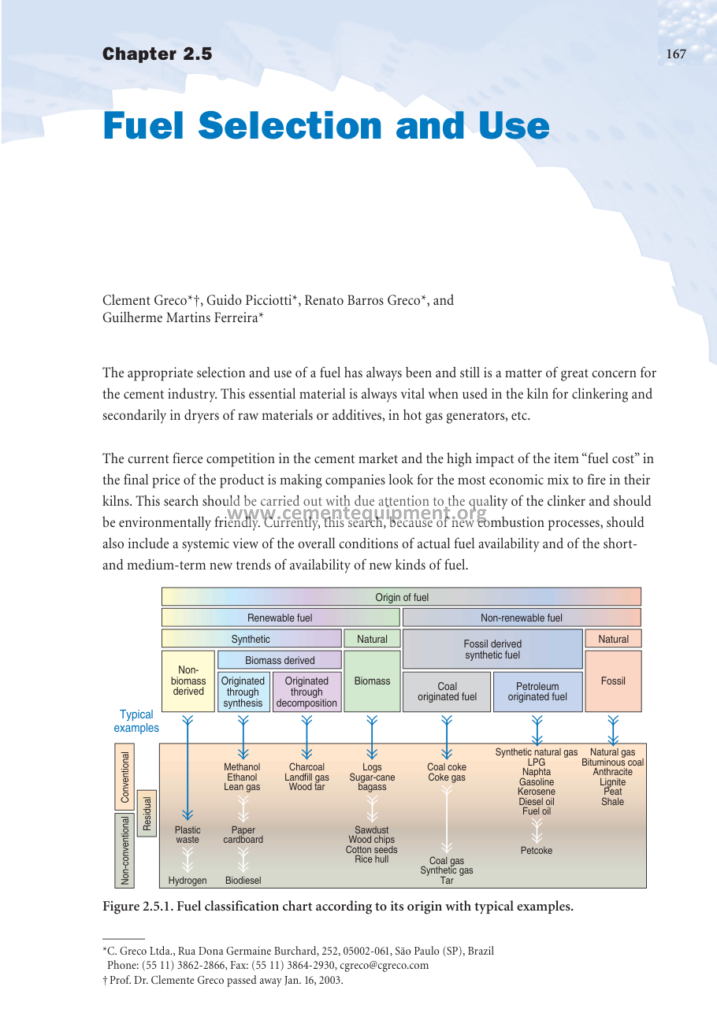
Fuels are classified by their origin and by the way they are traditionally used in the industry. The classification tree distinguishes first between renewable and non-renewable fuels, and then between the natural and the derived forms of each:
- Renewable fuels include the biomass-originated fuels: wood logs, wood chips, sawdust, sugar-cane bagasse, rice husks, and the agricultural residues that are harvested in cycles shorter than human lifetimes, plus the derived products such as charcoal and the liquid fuels produced from biomass.
- Non-renewable fuels include the fossil fuels: coal in its ranks from lignite and sub-bituminous to bituminous and anthracite, petroleum in its products from fuel oil and diesel to naphtha and kerosene, and natural gas, plus the derived products such as petroleum coke, coke oven gas, and the refinery gases.
- Synthetic fuels occupy the middle ground: methanol, ethanol, synthetic natural gas, and the lean gases produced by gasification and synthesis, which are derived from either biomass or fossil sources by industrial processes.
The practical value of the classification is that it organizes the availability question: renewable fuels are available in volumes tied to the agricultural and forestry cycles of the region, while fossil fuels are traded commodities with global price formation, and the plant’s fuel strategy must map its available options onto its procurement possibilities. The chapter notes that the traditional energy matrix of the world has shifted over decades from biomass toward fossil fuels and, in the cement industry specifically, from the more expensive liquid and gaseous fuels toward solid fuels, with coal and petroleum coke dominating the modern kiln market.
3. The Physical Characteristics of Fuels
The physical characteristics of a fuel govern its handling, its storage, its milling, and its combustion, and the chapter reviews each characteristic with its engineering significance:
- Density: the mass per unit volume of the fuel determines the storage and conveying volumes, and for liquids and gases it is a primary specification in the purchase contract; for liquids the density is commonly expressed as specific gravity relative to water, and in some countries in degrees API, related to the specific gravity by the formula API = (141.5/SG) – 131.5.
- Viscosity: the resistance of a liquid to flow controls the atomization and the pumping of the liquid fuels; fuel oils must be heated to reduce their viscosity to the range required by the burners, and the temperature-viscosity behavior of each fuel is a basic design datum of the firing system.
- Flammability limits: the range of concentrations of a gaseous fuel mixed with air in which combustion can self-sustain, expressed as the lower and upper flammability limits; the limits define the safe operating envelope of gas burners and the ventilation requirements of the milling and storage areas.
- Flash point: the lowest temperature at which a liquid gives off enough vapor to form an ignitable mixture with air; the flash point classifies the fire hazard of the liquid fuels and dictates the storage and handling precautions.
- Moisture content: the water held by a solid fuel affects its calorific value, its grindability, and its combustion, and must be accounted for in the heat balance and controlled in the coal mill.
- Ash content and ash fusion: the mineral residue left by combustion can deposit on the kiln surfaces and interact with the clinker chemistry, and the ash fusion temperature of a solid fuel influences the risk of slagging and the flame behavior.
- Particle size and grindability: for the solid fuels, the fineness to which the fuel can be ground economically controls the combustion rate, and the grindability index of the fuel is a design datum of the coal mill.
Each of these characteristics varies from fuel to fuel, and the practical consequence is that the firing system must be designed around the characteristics of the fuel or fuels that the plant will actually use, not around an idealized fuel.
4. The Chemical Characteristics of Fuels
The chemical composition of a fuel determines its heat release, its combustion products, and its interaction with the clinker chemistry. The most important chemical quantities are:
- Calorific value, the heat released by complete combustion of a unit mass or volume of the fuel, expressed as the higher heating value (including the latent heat of the water vapor in the products) and the lower heating value (excluding it); the difference matters for the heat balance because the kiln system discharges the flue gas at temperatures above the condensation point, so the lower heating value is the effective figure for the process.
- Ultimate analysis, the carbon, hydrogen, oxygen, nitrogen, and sulfur content of the fuel, which determines the combustion air requirement, the flue gas volume and composition, and the SO2 emission potential; a high-sulfur fuel such as petroleum coke requires a sulfur management strategy in the kiln system.
- Proximate analysis for the solid fuels: moisture, volatile matter, fixed carbon, and ash, which governs the combustion behavior; the volatile matter drives the gas-phase part of the flame, while the fixed carbon burns more slowly on the surface of the particles.
- Ash composition, the oxides of the mineral residue, which may be incorporated into the clinker, shifting the raw mix chemistry; the ash of a coal fired at high rates is a raw material input that the mix design must anticipate.
- Trace elements, including chlorine and the heavy metals, which pass into the kiln gas and the clinker and must be managed within the emission limits and the product specifications.
The chemical characteristics explain why the fuels of the industry are not interchangeable at the burner: a switch of fuel changes the flame temperature, the gas volume, the ash input, the sulfur input, and the emissions, and every change must be evaluated across the whole system.
5. The Principal Fuels of the Cement Industry
The chapter surveys the principal fuels of the industry with their typical characteristics and their position in the market:
| Fuel | Typical lower heating value | Main characteristics and uses |
|---|---|---|
| Bituminous coal | 25 – 32 MJ/kg | The traditional kiln fuel; medium ash, medium volatile matter, widely available, easily ground and fired |
| Petroleum coke | 30 – 36 MJ/kg | Low volatile matter, high carbon, high sulfur; needs fine grinding and high-temperature combustion; the cheapest fuel in many markets |
| Lignite and sub-bituminous coal | 8 – 20 MJ/kg | High moisture, low rank; used in local markets where the fuel is mined on site |
| Anthracite | 30 – 36 MJ/kg | Very low volatile matter; requires co-firing or specially designed burners |
| Fuel oil and heavy oils | 40 – 42 MJ/kg | Easy combustion and control; historically the swing fuel, now used mainly in plants without coal |
| Natural gas | 34 – 38 MJ/Nm³ | Clean combustion, no ash, excellent flame control; priced by contract and by market |
| Alternative fuels | 10 – 30 MJ/kg | Tires, solvents, plastics, biomass, sewage sludge; waste-derived heat at reduced cost |
The choice between these fuels is decided by availability and price, but constrained by the process: the kiln system must be able to burn the fuel completely within its residence time and temperature profile, the raw mix must absorb the fuel ash without losing the target moduli, and the emission control equipment must handle the combustion products.
6. Coal and Petroleum Coke: The Solid Fuel Workhorses
Coal has been the workhorse fuel of the cement industry since the early twentieth century, and petroleum coke has joined it as the low-cost fuel of the modern era. Both fuels are ground to a fine powder in the coal mill and fired through the burner with primary air, and their combustion has two stages: the devolatilization of the volatile matter, which burns rapidly in the gas phase and forms the luminous envelope of the flame, and the combustion of the fixed carbon, which proceeds more slowly on and within the particle.
Petroleum coke differs from coal in ways that matter greatly to the kiln operator. Its volatile matter is very low, typically 8 to 12 percent against 25 to 35 percent for a bituminous coal, which makes the ignition more difficult and demands higher flame temperatures and finer grinding to achieve complete burnout. Its sulfur content is high, often 3 to 6 percent, which elevates the SO2 in the kiln gas and loads the sulfur circulation of the system. Its ash is low, typically 0.5 to 1 percent, which is favorable for the clinker chemistry, and its calorific value is high, which reduces the tonnage handled per unit of heat. The plants that fire petcoke successfully operate with very fine fuel, typically 1 to 2 percent residue on the 90 micrometer sieve, high secondary air temperatures, and careful control of the oxygen at the kiln inlet.
For coal, the grindability and the ash content are the controlling purchase specifications. The Hardgrove grindability index of the coal determines the mill capacity, and the ash content and its composition enter the raw mix calculations, because 1 percent of ash in the fuel at typical firing rates contributes a measurable fraction of the clinker mass. The chapter emphasizes that the fuel specification must be written jointly by the purchasing and the process departments, because the cheapest coal on the market may be the most expensive to burn when its ash, moisture, and grindability are fully accounted.
7. Natural Gas and the Liquid Fuels
Natural gas occupies a special position in the fuel matrix because its combustion is clean and complete: no ash enters the clinker, no sulfur is introduced, and the flame can be shaped and controlled with an ease that solid fuels cannot match. The flame of natural gas is short and luminous with the appropriate burner design, and the gas is fired in the kiln and the precalciner through specially designed burners with careful control of the gas-air mixing. The price of natural gas has historically been higher per unit of heat than coal in most markets, and its use has therefore been confined to regions with abundant local production or to plants whose process requires the clean fuel, such as white cement plants, where the ash of a solid fuel would compromise the color of the product.
The liquid fuels, from light diesel to the heavy fuel oils, combine ease of handling with the cleanliness of a refined product. The heavy oils must be heated to reduce their viscosity for atomization, and the burner atomizes the oil into a fine spray that evaporates and burns in the gas phase. The sulfur content of the heavy fuels varies with the source crude, and the vanadium and nickel contents are a consideration for the refractories and the emission limits. The liquid fuels are the classic swing fuels of the industry: they can be stored in tanks, fired at any rate, and switched quickly, which makes them the reserve of flexibility in a plant whose solid fuel supply may be interrupted.
From the standpoint of fuel selection, the ranking is economic: the plant burns the cheapest fuel that its system can burn reliably within the environmental limits, and it keeps the more expensive fuels for the periods when the economics or the constraints change. The flexibility of the firing system, with the ability to switch between fuels and to co-fire them, is therefore itself a commercial asset.
8. The Alternative Fuels: Waste as an Energy Resource
The modern chapter of fuel selection is the rise of the alternative fuels, the waste-derived materials that replace fossil heat in the kiln. The cement kiln is a uniquely suited combustion device for waste because it operates at gas temperatures of 1800 to 2000 degrees Celsius in the flame, with residence times of seconds, and with an alkaline environment that absorbs many of the combustion products into the clinker and the dust. The alternative fuels in industrial use include:
- Used tires, whole or shredded, with a calorific value of about 25 to 30 MJ/kg including the steel, which remains in the clinker as iron oxide and is incorporated into the raw mix.
- Waste solvents and waste oils, liquid wastes with calorific values of 20 to 35 MJ/kg, fired through the main burner or the calciner burner with dedicated injection systems.
- Plastics and refuse-derived fuel, with calorific values of 20 to 35 MJ/kg, fired in the precalciner where the high temperature and the residence time guarantee burnout.
- Biomass, from agricultural residues to wood waste and sewage sludge, the renewable component of the alternative fuel mix, with calorific values of 10 to 20 MJ/kg depending on moisture.
- Meat and bone meal, paper rejects, and other production wastes, each with its own handling and combustion requirements.
The substitution rate is the fraction of the thermal energy supplied by the alternative fuels, and modern plants achieve 40 to 80 percent substitution with well-designed feeding systems and process control. The limits of the substitution rate are set by the process chemistry, above all the chlorine balance, because the chlorine of the wastes circulates in the kiln system and can block the preheater, and by the emission limits for the trace elements that the wastes carry.
9. Combustion Phenomena in the Kiln Flame
The combustion of the fuel in the kiln takes place in a flame whose characteristics must match the requirements of the clinker process. The flame must deliver the heat to the burning zone at the temperature and the shape that the clinker formation demands: a flame too short concentrates the heat and overheats the refractory at the nose, a flame too long pushes the heat toward the kiln inlet and leaves the burning zone cold, and a flame that impinges on the refractory coating strips the protection from the lining.
The key phenomena are mixing, ignition, and burnout. The fuel and the combustion air mix in the burner zone, the primary air and the fuel jet create the recirculation zones that stabilize the flame, and the secondary air from the cooler supplies the bulk of the combustion oxygen. For a solid fuel, the burnout depends on the fineness and the temperature history of the particles; for a liquid fuel, on the atomization and the evaporation; for a gas, on the mixing rate. The completeness of the combustion is measured by the residual CO and the oxygen at the kiln inlet, and the efficient plant operates with an oxygen content of 1.5 to 3 percent and minimal CO.
The flame also interacts with the clinker chemistry. The oxidizing or reducing character of the kiln atmosphere determines the oxidation state of the iron in the clinker and, with it, the burnability and the color of the product; a reducing atmosphere creates the conditions for sulfur rings and for the destabilization of the burning zone. The control of the flame is therefore the control of the clinker, and the modern operator watches the flame with the kiln camera, the shell scanner, and the gas analysis as the primary instruments.
10. The Firing System and the Burner
The firing system of a modern kiln comprises the fuel preparation, the fuel feeding, the burner, and the control instrumentation. For the solid fuels, the coal mill grinds and dries the fuel with the hot gases drawn from the kiln or the cooler, and the pneumatic conveying system transports the pulverized fuel to the burner, with the fine coal stored in small day bins to limit the risk of fire and explosion. For the liquid fuels, the system includes the heated storage tanks, the pumps, and the burner’s atomization nozzles; for the gas, the pressure reduction, the metering, and the burner manifold.
The burner of the rotary kiln is the most sophisticated element of the firing system. The multi-channel burner of the modern kiln produces a jet with carefully controlled axial and swirling momentum, using primary air flows that can carry the fuel, the swirl air, and the shaping air, so that the flame can be lengthened, shortened, and centered at will by the operator. The design targets are:
- Stable ignition and flame anchoring at all firing rates, including the low rates during start-up.
- Complete combustion within the kiln length, with low CO and reasonable oxygen.
- Flame shape matched to the burning zone length, protecting the refractory and the coating.
- Flexibility to burn the fuel mix of the moment, from 100 percent coal to high substitution with alternative fuels.
- Low primary air consumption, so that the secondary air carries the maximum heat into the flame.
The burner is supported by the instrumentation of the flame: the kiln camera, the flame scanner, the shell scanner, and the gas analysis at the kiln inlet and the preheater, and the control room holds the flame as the central object of the pyroprocess control.
11. Fuel Storage, Handling, and Safety
Every fuel brings a safety and handling discipline of its own, and the chapter reviews the storage and handling systems as integral parts of the fuel selection decision:
- Coal storage: the open or covered stockpiles must be managed to limit self-heating, dust, and spontaneous combustion, with temperature monitoring and compaction or ventilation as the situation requires; the coal mill and the silo systems are operated with inerting and explosion protection where the dust risk demands it.
- Petroleum coke storage: petcoke is less reactive than coal in storage, but its handling dust is abrasive and its low volatile matter makes it difficult to ignite in the mill; the mill must be operated with the hot gas temperature carefully controlled.
- Liquid fuel storage: the tanks, bunds, and transfer systems follow the regulations of the flammable liquids, with the flash point of the fuel determining the temperature class of the electrical equipment.
- Alternative fuel handling: the reception, shredding, and feeding of the wastes is a logistics operation in its own right, with the odor, dust, and fire risks of each waste stream managed by dedicated systems.
The safety record of the fuel systems is one of the hardest-won lessons of the industry, and the chapter’s treatment reflects the practice: every transfer of a fuel is an interface where the control of dust, temperature, and ignition must be engineered, not improvised.
12. Fuel and Clinker Chemistry: The Ash and Sulfur Interface
The fuel and the clinker meet through two channels: the ash, which enters the clinker mass, and the sulfur, which enters both the clinker and the gas. The raw mix design must account for the ash: the oxides of the fuel ash, principally silica, alumina, iron, and lime, are blended into the kiln feed, and a change of fuel with a different ash content and composition requires a correction of the mix proportions to hold the target moduli. The modern plants monitor the ash input continuously and adjust the mix accordingly, so that the clinker composition is independent of the fuel quality.
The sulfur interface is more complex. The sulfur of the fuel oxidizes to SO2 in the flame, and the SO2 reacts in the system with the alkalis of the raw meal to form alkali sulfates, which condense and recirculate, and with the lime to form calcium sulfate, which enters the clinker. The distribution of the sulfur between the clinker and the gas depends on the alkali-to-sulfur ratio, the temperature profile, and the atmosphere of the kiln. A high-sulfur fuel such as petcoke increases the sulfur input, raises the SO3 content of the clinker, and loads the circulation loop, and the plant manages the balance by the oxygen control, the bypass, and the raw mix proportioning, always keeping the clinker SO3 and the cement SO3 within the limits of the product standard.
13. Fuel and Emissions: The Environmental Interface
The emissions of the kiln system follow the chemistry of the fuel. The carbon dioxide emission is proportional to the carbon content of the fuel and the heat consumed; the SO2 emission follows the sulfur that is not retained in the clinker; the NOx follows the flame temperature, the nitrogen content of the fuel, and the combustion staging; the particulate emission follows the ash and the collection efficiency; and the trace elements follow the composition of the fuel and the raw materials. Each emission has its control strategy, and the fuel selection must respect the operating permit of the plant.
For the alternative fuels, the emission question is decisive for the substitution rate. The wastes carry chlorine, which forms hydrogen chloride in the gas and can condense as alkali chloride, and heavy metals, of which the volatile ones, mercury, thallium, and cadmium, condense in the cooler parts of the system and require continuous monitoring where their levels are significant. The modern kiln systems with high substitution rates are equipped with continuous emission monitoring, and the fuel quality control of the wastes is a formal part of the plant’s quality management.
14. Fuel Economics: The Optimization Problem
At the end of the technical analysis stands the economic problem: the plant must choose, day by day, the fuel mix that minimizes the cost of heat subject to the constraints of the process, the product, the emissions, and the supply contracts. The optimization considers the delivered price per gigajoule of each fuel, the handling and preparation costs, the effect on the production rate and the clinker quality, the cost of the emission control, and the security of supply. The result is usually a base fuel at high utilization and a set of marginal fuels that enter the mix when their relative price or the availability situation favors them.
The chapter emphasizes that the economic evaluation must be done on a system basis. The apparent price of an alternative fuel, for example, must be netted against its preparation cost, its quality variability, and its effect on the process before the true cost of the heat is known; the price of a high-sulfur petcoke must be netted against the sulfur management cost; and the price of a cheap high-ash coal must be netted against the ash correction of the raw mix. The fuel strategy is therefore a permanent engineering task, reviewed continuously as the prices and the availability of the fuels move.
15. Frequently Asked Questions
What is the best fuel for a cement kiln?
There is no absolute best fuel: the choice depends on the local availability, the delivered price per gigajoule, the characteristics of the kiln system, and the environmental constraints. Coal and petroleum coke are the standard base fuels because of their low cost, natural gas is preferred where clean combustion matters, and the alternative fuels reduce both cost and fossil carbon where their supply is organized.
Why is petroleum coke so widely used despite its high sulfur?
Because it is often the cheapest fuel per unit of heat on the market, and because its low ash and high calorific value are favorable for the process. The sulfur is managed by the kiln system chemistry: the oxygen control, the alkali balance, and, where needed, the bypass keep the clinker sulfate and the emissions within limits.
What is the difference between higher and lower heating value?
The higher heating value includes the latent heat of the water vapor in the combustion products, while the lower heating value excludes it. Because the kiln system discharges its flue gas above the condensation temperature, the lower heating value is the effective figure for the process heat balance.
What limits the substitution rate of alternative fuels?
The process chemistry, above all the chlorine balance, which can block the preheater through chloride condensation, the emission limits for the trace elements, and the reliability of the waste supply and feeding systems. Modern plants routinely achieve 40 to 80 percent substitution.
Why must the coal ash be considered in the raw mix?
Because the ash is incorporated into the clinker and shifts its composition; a plant firing high-ash coal must correct the raw meal to hold the target lime saturation, silica, and alumina ratios, and a change of fuel quality requires a proportional correction of the mix.
What is the primary air in a kiln burner?
The primary air is the air that enters with the fuel through the burner, carrying the pulverized fuel and shaping the flame; the secondary air enters from the cooler and supplies the bulk of the combustion oxygen. Low primary air is favored because it lets the hot secondary air deliver more heat to the flame.
How does the flame affect the clinker quality?
The flame determines the temperature and the atmosphere of the burning zone: its shape controls the burning zone length, its temperature drives the clinker reactions, and its reducing or oxidizing character changes the iron oxidation state, the burnability, and the color of the clinker.
Are the alternative fuels safe in the kiln?
Yes, with the correct systems: the wastes are received, prepared, and fed through dedicated handling lines with the fire, dust, and odor risks controlled, and the kiln’s high temperature and residence time destroy the organic fraction completely, which is the basis of the regulatory approval of the practice.
16. Summary
Fuel selection and use is the engineering system that connects the energy market to the clinker process: the classification of the fuels, their physical and chemical characteristics, the principal fuels of the industry from coal and petroleum coke to gas and the waste-derived fuels, the combustion phenomena of the kiln flame, the design of the firing system, the storage and safety discipline, and the interfaces of the fuel with the clinker chemistry, the emissions, and the economics of the plant. The chapter’s conclusion is that the fuel strategy is a permanent optimization problem, solved with the tools of process engineering and procurement, and that the plants which manage it best combine the lowest delivered cost of heat with the stable production of quality clinker. This complete technical review is part of the Complete Cement Technical Package, the 931-file licensed library of cement manufacturing knowledge available from cementequipment.org.
Get this cement file + the full 931-file package
$249.99 — one-time purchase, instant download, lifetime access
This file is part of the Complete Cement Technical Package (931 files) available from cementequipment.org. Respective rights holders; library copy for the licensed single user.