Cement Manufacturing History: Full Perspective
Historical perspective on cement manufacturing is the complete technical review of how the industry that builds the modern world came to be: from the lime and gypsum mortars of the ancient civilizations, through the discovery of the hydraulic cements, to the invention of portland cement and the evolution of the process from the shaft kiln to the modern dry process plant. The use of cements as hydraulic binders goes back thousands of years, with archeological evidence showing a form of concrete in the floors of huts in Serbia dating to about 5600 B.C. and similar floors in northwest China dating to about 3000 B.C., and the written record of the cementing arts runs from the lime kilns of the ancients, described in the earliest technical literature, through the experiments of John Smeaton at the Eddystone Lighthouse, the patents of Joseph Aspdin, and the industrial development of the rotary kiln, the wet and the dry processes, the Lepol grate, and the suspension preheater. For the modern engineer, the history is not decoration: it explains the persistence of the process, the chemistry that was fixed a century ago, and the equipment that evolved around it, and it gives the present its context.
1. The Beginnings: Lime and the Ancient Binders
The story of cement begins with lime. The earliest hydraulic binders known to archeology are the lime plasters and mortars of the ancient civilizations: in ancient Egypt, gypsum mortars and plasters were used for construction, and the cementing material that joined the stone blocks of the pyramids at Giza around 2500 B.C. is among the earliest documented uses of a mineral binder; in the Minoan civilization on Crete, lime plasters were the basis for the decorative paintings in the palace of Knossos; and the Greeks used lime plaster for the surface decoration of their temples and for the preparation of mortars. In the earliest periods, mud, clay, and lime were sometimes employed to fill the spaces between the broken stones of foundations and crude walls, and although these materials had adhesive properties, they were usually not sufficient to bind the whole into a sound monolithic mass.
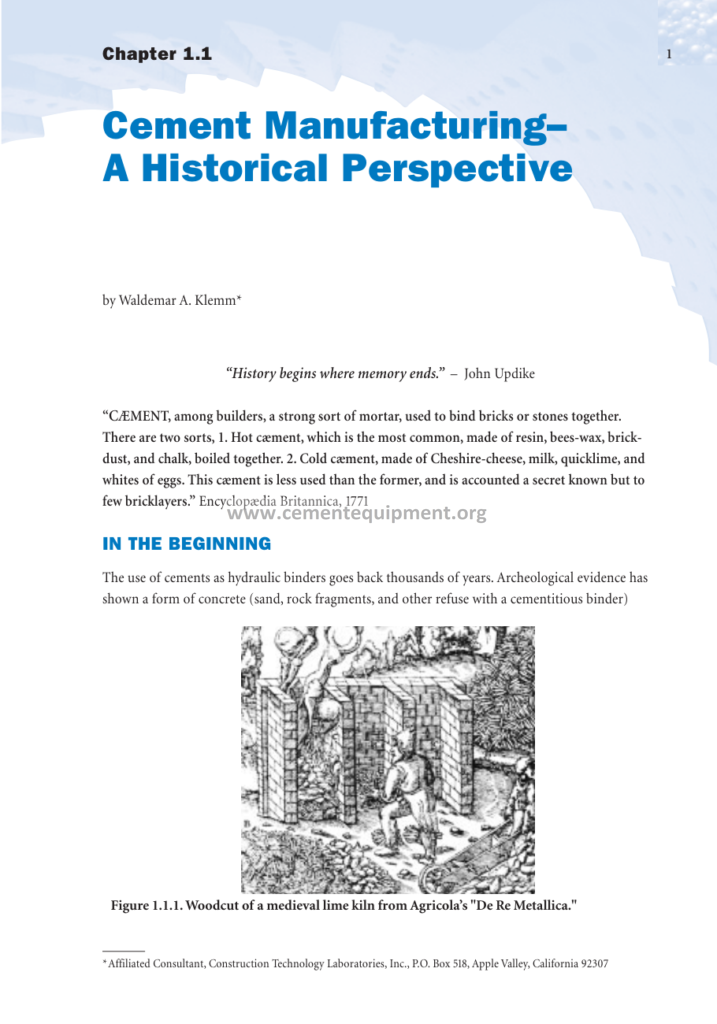
The process of burning limestone to produce the quicklime was simple and ancient. The kiln, essentially a stone structure of the kind shown in the woodcuts of Agricola’s De Re Metallica, was filled with good white stone of uniform quality, and the fire was kept burning day and night until the stones farthest from the fire were completely calcined; a reduction in the smoke exiting the top of the kiln signaled that the calcination was nearly complete. The quicklime was then reacted with water to produce the slaked lime that was mixed into the mortars. The chemical understanding of the process was absent, but the empirical art was well developed, and Pliny the Elder, who died in A.D. 79 during the eruption of Mount Vesuvius, wrote of the marvelous property of quicklime, that the stone, after being subjected to fire, should ignite on the application of water.
The critical step toward the modern cement was the discovery of the pozzolanic reaction. The builders of the Roman era found that lime mixed with a volcanic ash from the region of Pozzuoli, called pozzolana, and with the volcanic tuff known as tarras or trass, hardened even under water, producing the hydraulic mortars that made possible the aqueducts, the harbors, and the great public works of Rome. The Romans did not understand the chemistry, but they understood the empirical rule, and the pozzolanic tradition survived the fall of the empire, passed down through the medieval builders who knew that some limes and some sands produced mortars that set under water and others did not.
2. The Medieval and Renaissance Era of the Lime Burner
The medieval era preserved the lime-burning art within the craft traditions. The lime kilns of the period, of which Agricola’s woodcut gives the classic image, were operated by the lime burners, who controlled the process by the smoke, the color of the stone, and the touch of the product. The Encyclopaedia Britannica of 1771 still defined cement in the words that reflect the confusion of the era, describing the hot cement made of resin, bees-wax, brick-dust, and chalk, and the cold cement made of Cheshire-cheese, milk, quicklime, and the whites of eggs, with the author of the entry accounting the latter “a secret known but to few bricklayers.” The definition is a reminder that the term cement, in the language of the period, covered a wide range of adhesive compounds, and that the mineral cement we know today had not yet been distinguished from the others.
What the medieval and renaissance builders did possess, however, was a growing body of empirical knowledge about the hydraulic limes. The builders of the waterworks of the Low Countries and of Venice had discovered that certain limes, burned from the impure limestones that contained clay, set under water, and the Dutch tarras, the ground volcanic tuff imported from the Rhine region, was the standard additive for the best underwater mortars. The experiments of the era, conducted by engineers who had to build lighthouses, locks, and harbor walls, accumulated the observations that a scientific theory would later organize, and the stage was set for the systematic investigation of the eighteenth century.
3. Smeaton and the Eddystone Lighthouse
The turning point of the history is the work of John Smeaton, the civil engineer who built the third Eddystone Lighthouse on the rocks off the coast of Cornwall and whose experiments on the mortars of the structure mark the beginning of the scientific study of cement. Smeaton needed a mortar that would set and harden under the sea, and he set about testing the available limes and pozzolans with a method that was genuinely experimental: he burned the limestones at his disposal, slaked them, mixed each with water and rolled it into a ball of about 50 millimeters in diameter, and when each ball had stiffened, stored it in a pot filled with water to be examined at later intervals. He also mixed a quantity of tarras into some of the lime pastes, following the common composition of the best water-works practice: two measures of slaked lime in dry powder mixed with one measure of Dutch tarras, beaten together to a paste.
Smeaton’s experiments produced two results of lasting importance. The first was the discovery that the best hydraulic limes were burned from the limestones that contained a proportion of clay: the impure limestones, which had been regarded as inferior for ordinary building purposes, were precisely the ones that produced mortars capable of setting under water. The second was the confirmation that the addition of the pozzolanic material transformed a lime that would not set under water into one that would. Smeaton did not understand the chemistry of what he observed, and the clay-bearing limestones and the pozzolans would wait another century for their explanation, but his systematic method made him the father of the modern investigation of the hydraulic cements, and his name is recorded in every history of the industry.
It is worth dwelling on what Smeaton’s method established, because it defines the engineering tradition that the history follows. The quality of a cement cannot be judged by appearance or by tradition; it must be tested under the conditions of service, in water, at intervals, and the results must be recorded. The mortar cube tests, the soundness tests, and the setting time tests of the modern laboratory are the direct descendants of Smeaton’s balls of lime paste in pots of water, and the standardization of the testing methods, which the history traces through the nineteenth century, is the institutional form of the same idea.
4. Vicat, Parker, and the Search for the Artificial Cement
The years around 1800 saw the discovery of the cements that could be made by burning clay-bearing limestones at higher temperatures, and the names of the period mark the milestones. James Parker, in 1796, took out a patent for a cement made by burning nodules of argillaceous limestone, found on the shores of the Isle of Sheppey, at a temperature high enough to partly vitrify them; the product, known as Roman cement, set quickly and found wide use in the marine works of the era, and its name, which had nothing to do with the cements of ancient Rome, testified to the respect in which the ancient name was held. The Roman cements of the early nineteenth century, burned from natural deposits of clay-bearing limestone, were the first of the artificial hydraulic cements, and their success demonstrated that a controlled burning process could produce a binder of reliable quality.
Louis Vicat, the French engineer, brought the systematic science to the new field. Vicat studied the calcination of the argillaceous limestones, established the proportions of lime and clay that produce the hydraulic cements, and in his published work of 1818 described the process of combining lime and clay by artificial proportioning, so that a cement could be made from materials that did not occur together in nature. Vicat also developed the test methods of the new art, including the needle test for the setting time and the tests of the hydraulic properties of the mortars, and his name survives in the Vicat apparatus that is still the standard instrument for the measurement of the setting time of cement. The distinction that Vicat drew, between the limes that set by the carbonation of the slaked lime and the cements that set by the hydration of the burned compounds, is the distinction that organizes the whole chemistry of the binder.
The period also produced the first theories of the cement chemistry, among them the attempts of the French chemists to analyze the burned products and to explain the hardening. The debates of the era, between those who held that the hardening was caused by the formation of crystalline compounds and those who held it to be a gelation, were settled only in the twentieth century with the instruments of the modern physical chemistry, but the empirical base of the industry was laid in these years, and the demand for the new cements grew with the canals, the railways, and the harbors of the industrial revolution.
5. Aspdin and the Invention of Portland Cement
The name that the history of cement must carry is that of Joseph Aspdin, the Leeds bricklayer who took out a patent in 1824 for a cement that he called portland cement, so named because its color was said to resemble the stone quarried at Portland in Dorset. Aspdin’s patent described the process of burning an artificial mixture of limestone and clay to a temperature below the vitrification point, and the grinding of the product with the ashes; the patent is the legal birth of the name, although the industrial practice of the period remained close to the Roman cement process, and the question of what exactly Aspdin burned and at what temperature has exercised the historians of the industry ever since.
What is beyond dispute is that the product that carried the name through the nineteenth century was developed into an industrial reality by a generation of manufacturers, above all by the family of Aspdin himself, by William Johnson, and by Isaac Charles Johnson, whose work at the Swancombe works in Kent established the practice of burning the raw mixture at a temperature high enough to produce the clinker with the characteristic nodular structure, and of grinding that clinker with a proportion of gypsum to control the setting. The burning of the artificial raw meal to the point of incipient fusion, and the use of the resulting clinker, were the steps that distinguished the portland cement from the Roman cements, and by the middle of the nineteenth century the portland cement industry was established in England, from which it spread to the continent and to the world.
The mid-nineteenth century also produced the first attempts at the scientific control of the process. The analysis of the raw materials, the proportioning of the mix by calculation, and the first systematic study of the relation between the composition of the raw meal and the quality of the cement appear in the technical literature of the 1850s and 1860s, and the tests of the product, the soundness tests, the tensile and compressive strength tests, and the fineness tests, were codified in the national specifications of the later decades. The industry that the twentieth century inherited was already recognizable: a raw mix of limestone and clay, a burning to the clinker, and a grinding of the clinker with gypsum, with the quality controlled by testing.
6. The Chemistry Comes of Age: Le Chatelier and the Modern Understanding
If the nineteenth century was the era of the empirical industry, the years around 1900 were the era of its scientific foundations. Henri Le Chatelier, the French chemist whose name is carried by the soundness test that bears it, published his study of the constitution of portland cement, identifying the principal compounds of the clinker and explaining the hydration reactions that produce the hardening. The Le Chatelier soundness test, which measures the expansion of a pat of cement in boiling water, was developed to detect the presence of free lime in the clinker, the excess of unslaked lime that would expand destructively in the hardened mortar, and the test remains to this day the standard guard of the product quality.
The same period saw the work of the German chemist Wilhelm Michaelis on the constitution and the hydration of the cement, and the beginning of the long series of investigations that established the phase composition of the clinker: the tricalcium silicate, the dicalcium silicate, the tricalcium aluminate, and the tetracalcium aluminoferrite, the four principal compounds that the modern Bogue calculation derives from the oxide analysis of the clinker. The understanding of the hydration products, the calcium silicate hydrate gels that form the binding mass of the hardened paste, followed in the twentieth century with the instruments of the X-ray diffraction and the electron microscopy.
For the industry, the scientific understanding translated into the control of the process: the calculation of the raw mix proportions to achieve the target compound composition, the control of the burning temperature to form the desired phases, the control of the cooling to preserve them, and the control of the sulfate content to regulate the setting and the strength. The modern cement chemist works with the tools that the history built, and the history of the chemistry is the history of the industry’s control over its own process.
7. The Kilns: From the Shaft Kiln to the Rotary Kiln
The history of the burning equipment is the history of the thermal efficiency of the industry. The earliest cements were burned in the shaft kilns, in which the raw mixture was loaded in alternate layers with the fuel and burned batchwise, with the product raked out at the bottom; the shaft kilns of the nineteenth century were improved into the continuous shaft kilns with a regulated air supply, which remained the standard of the industry in many regions well into the twentieth century. The shaft kiln, however, carried two fundamental limitations: the temperature distribution in the shaft was uneven, so that the quality of the product varied from the center to the wall, and the heat exchange between the fuel and the load was inefficient, so that the thermal consumption remained high.
The decisive step was the invention of the rotary kiln, patented in England in the 1880s and developed by Thomas Edison in America and by the German and Danish manufacturers into the industrial machine of the modern era. The rotary kiln is an inclined rotating cylinder, lined with refractory, in which the raw meal slowly travels down the shell while the flame at the lower end raises the charge to the clinkering temperature; the rotation continuously exposes fresh material to the flame and the hot gas, the temperature distribution is far more uniform than in the shaft, and the heat exchange between the gas and the charge can be controlled by the internals of the kiln and the velocity of the gas.
The rotary kiln made possible the large-scale production of uniform clinker, and with it the growth of the industry into the scale of the twentieth century. The early rotary kilns, fired with coal dust injected with the primary air, were wet process machines, handling the slurry of the raw materials; the wet process was the standard of the first half of the century, and the largest wet kilns reached lengths of 150 to 200 meters and capacities of 1000 tons per day or more.
8. The Wet Process: The Standard of the Early Century
In the wet process, the raw materials are ground with a large proportion of water, typically 30 to 40 percent, into a slurry that can be pumped and blended with a homogeneity that the dry grinding of the period could not match. The slurry was stored in the slurry basins, blended and corrected with the addition of the components needed to hold the target composition, and fed to the kiln, where the water had to be evaporated before the calcination could begin. The thermal penalty of the wet process was enormous: the evaporation of the water consumed roughly 500 to 700 megajoules per ton of clinker more than the dry process, so that the wet kilns burned at 5500 to 7000 megajoules per ton of clinker, and the length of the kiln was dominated by the drying and the preheating zones, in which the chains hung to improve the heat exchange with the slurry.
The wet process nevertheless dominated the industry for three reasons that the history records fairly. The first was the homogenization: the slurry mixing basins achieved a uniformity of the kiln feed that the dry blending methods could not, and the quality of the clinker benefited accordingly. The second was the handling: the slurry could be pumped and proportioned with the simple equipment of the era. The third was the grinding: the wet grinding of the raw materials was more efficient and less dusty than the dry grinding, and the mills of the wet process were simpler in their operation. The wet process plants of the era were the largest and the most reliable of the industry, and the conversion of the world’s fleet from wet to dry, which the energy statistics of the later twentieth century document, was a long campaign fought against these advantages.
9. The Dry Process and the Intermediates: Semidry, Lepol, and the Dry Long Kilns
The dry process, in which the raw materials are ground dry to a fine meal, eliminated the water penalty, and the industry developed its intermediates as the equipment of the era allowed. The dry long kiln, the direct dry counterpart of the wet kiln, burned at perhaps 4200 to 5000 megajoules per ton of clinker, already a substantial improvement over the wet process, but its thermal performance was still limited by the recovery of the heat from the kiln gas, and the industry sought the means to recover that heat more completely.
The semidry process combined the dry grinding of the meal with the formation of nodules by the addition of about 12 percent water, and burned the nodules on the Lepol grate: the Lepol kiln, developed by the German engineer Otto Lellep and named for the firm that built it, used a traveling grate on which the moist nodules were preheated by the kiln exhaust gas before they entered the rotary kiln itself. The Lepol grate recovered the heat of the kiln gas that the dry long kiln wasted, and the Lepol kilns of the mid-century burned at about 3500 to 4000 megajoules per ton of clinker, while their nodule feed gave the material bed a permeability that the pulverized meal could not provide. The Lepol system was the first of the heat-recovery preheating systems, and the immediate ancestor of the suspension preheater that followed it.
The semidry and the dry processes carried their own problems, which the history records with the same honesty: the drying of the raw materials, if it required a separate dryer fired with its own fuel, consumed part of the saving; the dust losses of the dry plants, before the dust collection of the later era, were severe; and the homogenization of the dry meal demanded the blending silos that the industry developed in the same period. The evolution of the process, however, was set: the industry moved down the thermal curve, from the wet kiln through the Lepol and the dry long kiln toward the suspension preheater that completed the revolution.
10. The Suspension Preheater and the Precalciner
The suspension preheater, developed in the 1950s and brought to full maturity by the German and Danish manufacturers, completed the heat recovery that the Lepol grate had begun. In the cyclone preheater tower, the dry meal is carried upward by the kiln gas through a series of cyclone stages, in each of which the meal is separated from the gas and fed to the next stage, so that the meal and the gas exchange heat in countercurrent: the meal leaves the tower preheated to 800 to 900 degrees Celsius and largely calcined, and the gas leaves the tower at 280 to 350 degrees Celsius, its heat largely extracted. The suspension of the meal in the gas, with the enormous surface area of the fine particles, gives a heat exchange efficiency that no packed or nodule bed could match, and the four, five, and six stage towers of the modern plants deliver the thermal consumptions of 3000 to 3300 megajoules per ton of clinker that are the benchmark of the industry.
The precalciner, introduced in the 1970s, added the second burner: a portion of the fuel, typically 50 to 65 percent, is fired in a vessel between the preheater and the kiln, in which the preheated meal is calcined in suspension before it enters the kiln. The precalciner removes the calcination from the kiln, so that the kiln is free to concentrate on the clinker formation, and the capacity of a given kiln shell increases by 60 to 100 percent, while the kiln feed is calcined at 90 to 95 percent before it reaches the burning zone. The precalciner also added a new degree of freedom to the process control: the kiln and the calciner can be fired and controlled independently, and the system can absorb the alternative fuels and the low-grade fuels whose combustion in the precalciner’s long residence time and high temperature is complete.
The combination of the cyclone preheater and the precalciner fixed the architecture of the modern plant, and the history of the process evolution closes with it: the wet kilns of the early century, the Lepol grates and the dry long kilns of the middle, and the preheater-precalciner dry process of the modern era, with its thermal consumption one half to one third of the wet process, its capacities an order of magnitude larger, and its control an order of magnitude finer.
11. The Grinding Technology in Historical Perspective
The history of the grinding side of the industry runs parallel to the history of the kiln. The early cement was ground in the simple mills of the period, and the first tube mills, the rotating cylinders charged with steel balls, appeared in the late nineteenth century and became the standard of the industry. The tube mill was developed through the twentieth century: the compartment mills with different charge sizes along the shell, the closed circuits with the air separators that returned the oversize to the mill, and the progressive refinement of the liners, the grinding media, and the mill ventilation. The energy consumption of the finish grinding, 30 to 40 kilowatt-hours per ton of cement, is the largest electrical item of the plant, and the history of the grinding equipment is largely the history of the attempts to reduce it.
The modern era brought the high-pressure grinding roll, the vertical roller mill, and the high-efficiency separators: the roller mills, which grind by pressure rather than by impact, consume 20 to 40 percent less energy than the ball mills for the same duty, and the high-efficiency separators improved both the energy and the particle size distribution of the product. The history of the cement grinding is the history of the same logic as the kiln: the equipment of each generation recovered more of the input energy into useful product, and the modern grinding circuits deliver a product of controlled fineness and particle size distribution at an energy consumption that the early mills could not approach.
12. The Lessons of the History for the Modern Engineer
The history of cement manufacturing carries the lessons that the modern engineer applies. The first is the persistence of the chemistry: the reactions of the clinker formation were fixed by the nature of the materials, and the innovations of two centuries have been innovations of the equipment and the control around that chemistry, not of the chemistry itself. The second is the direction of the technical evolution: every step of the process history moved the industry toward the recovery of the heat and the energy that the process wastes, and the modern efficiency measures are the continuation of the same direction. The third is the importance of the testing and the control: from Smeaton’s balls of lime paste to the automated laboratories of the modern plant, the quality of the product has been secured by the systematic testing under the conditions of service, and the standard test methods of the industry are the direct descendants of the instruments of the early investigators.
The history also carries the warning that the industry’s present is not its end: the lime and the pozzolana of the ancients, the portland cement of Aspdin, the wet kilns and the dry processes of the industrial era, and the preheater plants of today are the stages of a continuous evolution, and the decarbonization agenda of the present is the next stage of the same history. The engineer who knows the history knows the direction of the change, and the historical perspective is therefore not an ornament but an instrument of the technical judgment.
13. Frequently Asked Questions
Who invented portland cement?
Joseph Aspdin, a Leeds bricklayer, took out the patent in 1824 for a cement burned from an artificial mixture of limestone and clay, which he named portland cement for its resemblance to the Portland stone; the industrial product was developed by the manufacturers of the following decades, notably the Johnson family at Swancombe.
What is the significance of John Smeaton in the history of cement?
Smeaton’s experiments for the Eddystone Lighthouse established the systematic testing of the hydraulic mortars, discovered that the best hydraulic limes are burned from the clay-bearing limestones, and demonstrated the value of the pozzolanic additions; his method is the foundation of the modern cement testing.
Why is the Le Chatelier soundness test named after a French chemist?
Henri Le Chatelier developed the study of the constitution of portland cement at the turn of the twentieth century and devised the boiling test for the detection of the free lime in the clinker; the test that bears his name is still the standard guard of the dimensional stability of the cement.
What is the difference between the wet and the dry process?
In the wet process the raw materials are ground with 30 to 40 percent water into a slurry, and the kiln must evaporate the water before calcination, consuming 500 to 700 megajoules per ton more; in the dry process the meal is ground dry, and the modern dry kilns burn at 3000 to 3300 megajoules per ton of clinker.
What is the Lepol grate?
The Lepol grate is a traveling grate on which the nodulized feed of the semidry process is preheated by the kiln exhaust gas before entering the rotary kiln; it was the first of the heat-recovery preheating systems and the ancestor of the cyclone preheater.
When was the rotary kiln invented?
The rotary kiln was patented in England in the 1880s and developed into an industrial machine by Thomas Edison and the German and Danish manufacturers around the turn of the twentieth century; it replaced the shaft kiln as the standard burning equipment of the industry.
What did the precalciner change?
The precalciner moved the calcination out of the kiln into a separate vessel fired with 50 to 65 percent of the fuel, increasing the capacity of the kiln shell by 60 to 100 percent and adding a new degree of freedom to the process control; it completed the architecture of the modern plant.
Why does the history matter to a modern cement engineer?
Because the chemistry of the clinker has been fixed for a century, and the equipment and the control have evolved around it in a continuous direction: the recovery of the wasted heat and energy. The knowledge of that evolution gives the engineer the context and the direction of the present innovations, including the decarbonization programs of today.
14. Summary
The historical perspective on cement manufacturing traces the industry from the lime plasters of the ancients, through the pozzolanic mortars of Rome, the experiments of Smeaton, the patents of Parker and Aspdin, and the scientific foundations of Le Chatelier and his contemporaries, to the industrial evolution of the process: the shaft kilns, the rotary kilns, the wet process, the Lepol grates, the dry long kilns, and the modern suspension preheater and precalciner plants. The history explains the persistence of the clinker chemistry, the direction of the equipment evolution toward the recovery of the heat and the energy, and the centrality of the testing and the control, and it places the present decarbonization agenda in its context as the next stage of a continuous technical evolution. This complete technical review is part of the Complete Cement Technical Package, the 931-file licensed library of cement manufacturing knowledge available from cementequipment.org.
Get this cement file + the full 931-file package
$249.99 — one-time purchase, instant download, lifetime access
This file is part of the Complete Cement Technical Package (931 files) available from cementequipment.org. Respective rights holders; library copy for the licensed single user.