CCR Control Room: Cement Plant Operation Guide
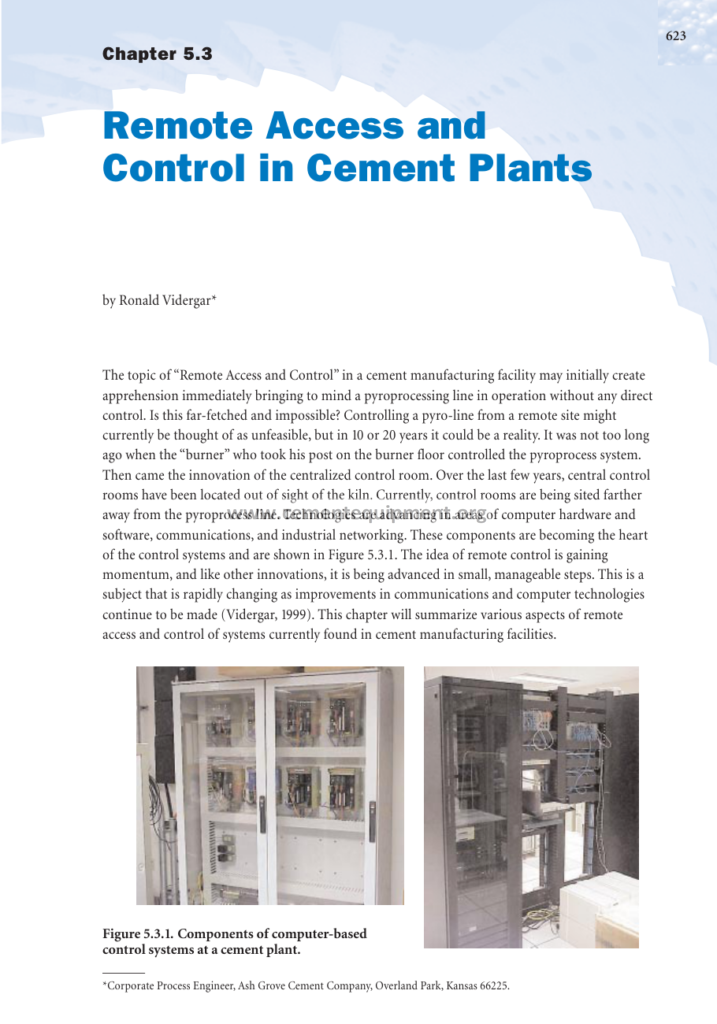
CCR stands for Central Control Room, the nerve centre of a modern cement plant: the building from which the operators, seated in front of the control system workstations, supervise and operate the entire production line, from the rock arriving in the crusher to the cement loading of the trucks. In a plant built before the digital era, a hundred operators walked the plant reading local gauges and turning hand wheels; in the modern plant the same line is run by a handful of control-room operators watching the distributed control system (DCS), which collects thousands of measurements, runs the control loops and the interlocks, and displays the state of every machine on ergonomic alarm-managed screens. The CCR is therefore not simply a room with computers: it is the operational brain of the plant, where the real-time information from the field, the quality results of the laboratory, the energy meters and the production plan converge into the decisions of the shift, and where the daily key performance indicators (KPIs) of availability, production, quality, energy and cost are born. This guide explains the architecture of the central control room, the DCS and its displays, the role and the formation of the operators, the alarm and the shift-handover discipline, the KPIs that the room manages, and the modern transformation of the concept with the advanced process control and the digital tools, giving the operations team the complete competency of this decisive workplace.
1. The Concept and the Role of the Central Control Room
The central control room concentrates the operation of the plant in one place where the supervision is continuous, the response is fast and the information is complete. Its role is fourfold. The first is supervision: the operator sees the state of the whole process at a glance, follows the trends, and detects the beginning of a deviation before it becomes an upset. The second is operation: from the workstations the operator starts and stops the equipment, changes the set points, opens and closes the dampers, and executes every sequence that the field permits, in coordination with the field operators who execute the manual actions and the inspections. The third is protection: the interlocks and the safety systems of the plant terminate the hazardous states automatically, and the control room is the point where the protective actions are understood, acknowledged and investigated. The fourth is optimisation and reporting: the control room is where the shift performs up to the targets, records the deviations, and passes to the management the numbers of the shift that become the plant KPIs.
Because the cement line is continuous, the control room is staffed 24 hours a day, seven days a week, in a rotating shift system, typically of three or four shifts. The design of the room follows human-factors engineering: the layout gives each operator an unobstructed view of the main screens and of the process-status wall, the lighting avoids glare on the monitors, the noise is controlled so that the alarms are audible, and the position of the supervisor allows him to see the whole team. The room is the home of the shift culture: here the operators speak the same language, the handover happens, the morning meetings review the night, and the decisions of the day are announced. A well-run CCR is recognisable by its order, its discipline and its calm, even during the upsets, and this calm is not luck but the product of the training, the procedures and the tools.
2. The Architecture of the DCS: The Nervous System of the Room
The distributed control system is the technical backbone of the central control room. Its architecture separates the functions by levels. At the field level, thousands of sensors and actuators are connected to the remote I/O cabinets through the hardened fieldbus and the cable trays; at the controller level, the DCS nodes execute the scan, the interlock logic, the PID loops and the sequences, each controller responsible for an area of the plant (the kiln, the raw mill, the finish mill, the packing) and communicating with its neighbours and with the servers over the redundant network. At the supervisory level, the redundant servers hold the database of the configuration, the real-time data, the alarms and the historical data; the operator workstations and the engineer workstations connect to the servers, as do the advanced process control computers and the external systems (the LIMS of the laboratory, the motor control centre, the ERP). The system is duplicated where the safety demands it: the network is redundant, the servers are redundant, the controllers have dual CPUs and the fieldbuses are doubled, so that a single failure never loses the control of the plant.
The communication with the field devices has evolved from the classical hardwired signals to the standard fieldbuses (Profibus DP and PA, Foundation Fieldbus, HART on the 4–20 mA loops, and the industrial Ethernet of the modern installations), which carry the diagnostic data of each instrument in addition to its measurement. The integration of the high-voltage motor control centres allows the control room to operate the large drives remotely with the full fault reporting. The cyber-secure design of the network (segmented zones, firewalls, the defence of the OT layer against the IT threats) is now a standard chapter of the DCS engineering, because the control room that was once isolated is now connected to the corporate and the cloud systems, and the protection of that connection is a part of the operational reliability. The DCS vendor and the maintenance group together maintain the version control, the configuration backup and the recovery plans, because the system is the memory of the process and its integrity is non-negotiable.
3. The Operator: The Human at the Centre
For all the automation, the operator remains the decisive element of the central control room. The modern operator is an industrial process specialist: he knows the process physics (the calcination, the combustion, the grinding), the equipment (the crushers, the mills, the kiln, the filters), the control philosophy and the emergency procedures, and he can read a trend the way a doctor reads a vital chart. His tasks in a shift include the planned operations (start-ups, product changes, maintenance isolations), the supervision of the continuous process (the kiln temperature, the mill filling, the filter differential pressure), the response to the alarms and the abnormal events, the optimisation of the set points within the authorisation limits, and the complete, exact communication with the field operators, the maintenance and the management.
The formation of the operator has become a formal curriculum. The modern plants train their operators on high-fidelity simulators, which reproduce the behaviour of the kiln, the preheater and the mills with the same dynamics as the DCS of the plant: the trainee learns the start-up of a cold kiln, the handling of a preheater blockage, the response to a bag-filter trip, in a safe environment where mistakes cost no production. The operator qualification includes the theoretical courses, the simulator examinations, the supervised time with a mentor in the real room, and the periodic refresher and requalification, especially after the major modifications of the process. The skilled operator is among the most valuable people of the plant: his decisions over a year decide tens of millions of dollars of fuel, electricity, product and damage, and the plants that invest in the operator formation are visibly the plants that run smoothly.
4. The Displays and the Human-Machine Interface
The human-machine interface (HMI) is the window of the operator onto the process, and its design follows the ISA-101 philosophy: it must be simple, situation-aware and alarm-managed. The display system is organised hierarchically. The overview display shows the entire production line as a single schematic with the main flow paths and the status of each area; the area displays show the detailed schematics of each process section (the crusher, the raw mill, the kiln, the preheater, the cooler, the finish mill, the packing), with the live values, the equipment states (running, stopped, faulted, in maintenance) and the control modes (auto, manual, cascade); the loop displays show the individual control loops with their set point, the process value and the output; and the group displays show the alarms, the trends, the interlock status and the batch or sequence histories. The navigation must let the operator reach any point of the process in one or two clicks, because in an upset every second counts.
The design principles of the good HMI are firm: the information density is matched to the task (the operator must not read a text document on the screen), the normal state is quiet (no blinking, no red everywhere), the alarms are reserved for the deviations that demand the operator attention, the trends are instantly available for the diagnosis, and the navigation is consistent across all the areas. The systems in the modern room add the large-format wall displays for the shared status, the dedicated overviews of the critical parameters (the burning zone, the emissions, the mill vibration) and the replication of the key screens on the supervisor and the shift-leader stations. The discipline of the screen change management is the counterpart: every modification of the displays is documented, tested and communicated, so that the operator never meets a surprise in the interface during an operation.
5. Alarms: The Alarm Philosophy and the Alarm Flood
The alarm system is the safety net of the control room, and its management is one of the most audited subjects of the industry. An alarm is a signal that informs the operator of a state that requires his attention or action; it is not a record of the normal conditions, and it is not a replacement for the control. The alarm philosophy defines the priority (emergency, high, medium, low), the set point and the deadband of every alarm, the acknowledgement procedure, and the response of the operator to each priority. The number of alarms is the key performance: a well-managed system should present an operator with of the order of a dozen alarms per day per operator, not thousands; when the system floods (hundreds of alarms in minutes, the classic alarm flood of an upset), the operator cannot distinguish the cause from the effect, and the response degrades exactly when it matters.
The cure of the alarm flood is a structured rationalisation: every alarm is reviewed for its value, its set point is checked against the process limits, the redundant and the chattering alarms are eliminated or grouped, the stale alarms (conditions that no longer exist) are cleared, and the new alarms are designed with the philosophy from the start. The industry standard for the alarm management, the ISA-18.2 / IEC 62682, describes the complete life cycle: the philosophy, the performance monitoring, the rationalisation, the detailed design, the implementation, the training and the operation. The plants that have carried out this rationalisation typically reduce their alarm rate by more than 90%, and the operators report a qualitative change in their ability to manage the upsets; the auditor also checks the alarm records, because the alarm rate is a recognised indicator of the plant safety culture.
6. The Shift, the Handover and the Communication
The continuous operation of the cement plant is organised in shifts, and the central control room is the pivot of the shift change. The professional shift handover is structured: the outgoing operator prepares a written and verbal handover that covers the state of the process (what is running, what is bypassed, what is in maintenance), the alarms and the deviations of the shift, the ongoing operations (a mill start-up, a cooler repair, a silo change), the planned activities of the next shift, and the open risks, always in the same format so that nothing is lost. The modern handover tools add the electronic logbook, in which every event of the shift is recorded with the timestamp and the operator, and the shift report, which summarises the production, the stops and their reasons, the quality and the energy figures, and the main events. The handover is also the moment when the tacit knowledge of the departing team (the feel for a particular mill, the known weakness of a valve) is transferred, and a plant that takes the handover seriously is a plant that does not repeat its mistakes twice.
The communication inside the shift and with the field is equally formalised. The operator speaks with the field crew by radio, and the language of the plant defines precise terms (the equipment names, the state words such as running, stopped, isolated, prepared), so that a verbal order cannot be misread. The permits of the confined space and the lock-out, and the isolation orders for the maintenance, are executed in the control room: the operator gives the permission, the field confirms the isolation, and the interlock proves the state before the work starts. The communication with the laboratory completes the loop: the lab results of the raw meal, the clinker and the cement are entered by the LIMS and appear on the operator screens together with the limits, and the quality engineer’s recommendations reach the room as set-point guidance. The entire structure, the handover, the radio language, the permit system and the lab link, exists so that the information travels fast and without distortion, which is the first duty of a control room.
7. The KPIs of the Control Room: What Is Measured and Managed
The central control room is where the plant KPIs are born, and their management is the core of the operational excellence. The KPI set of a typical plant is:
| KPI | Definition | Measured in the CCR | Typical target |
|---|---|---|---|
| Availability | Operating hours / calendar hours | Kiln and mill running hours, stops and reasons | >90–95% |
| Heat consumption | MJ per tonne of clinker | Fuel flows, kiln feed, production | Modern lines 2900–3200 MJ/t |
| Electrical consumption | kWh per tonne of cement | Power meters of the drives | 90–120 kWh/t cement |
| Production rate | Tonnes per hour of clinker and cement | Belt weighers, production flow | Against the plan |
| Clinker quality | Free lime, % C3S, strength | Process indicators plus the lab | Free lime 0.5–1.5% |
| Burning-zone stability | Variability of the zone temperature / NOx | Advanced control and trends | Low standard deviation |
| Emissions | Dust, NOx, SO2 (mg/Nm³) | Continuous emission monitors | Below the permit |
| Trips and incidents | Number and duration of the unscheduled stops | Event records, stop reports | Trend downward |
These KPIs are not only reported; they are operated. The control room displays the rolling 24-hour value of each KPI, compares it with the target and the reference, and the shift works against them: the specific heat is influenced by the operators’ choices of the excess air and the fuel mix, the availability by their skill in preventing the trip conditions, and the quality by their holding of the burning zone. The morning production review of the plant reads the KPI numbers of the night shift with the shift report, and the monthly report reviews the trends month by month. The KPIs therefore close the loop between the plant strategy and the operator’s minute-by-minute choices, and the design of the KPI system, its units, its comparability and its fairness, is one of the management tasks that most shape the behaviour of the room.
8. The Advanced Control at the Heart of the Modern CCR
In the modern installations the central control room hosts the advanced process control (APC) as a standard tool, not a research project. The APC computer sits beside the DCS: it reads the measurements from the DCS, computes the optimised set points with its models (the fuzzy logic, the model predictive control, the neural networks described in the automation guide), and writes those set points back to the DCS loops, which execute them. The operators retain the authority: the APC operates in the allowed modes, the operator can switch a loop back to manual, and the APC is equipped with the safety constraints (the high CO cutback, the oxygen floor, the fuel limit) that keep its actions inside the safe envelope. The room display shows what the APC is doing and why, so that the operator is always able to diagnose, challenge and override.
The benefit of the APC, measured in the certified performance tests, is a substantial reduction of the heat consumption (typically 1.5 to 3%), an increase of the production at the same quality, a reduction of the quality variability and a higher share of the alternative fuels, because the controller absorbs the disturbances that the heterogeneous fuel creates. The operator workload changes: instead of the permanent manual nursing of the burning zone, the operator supervises the controller, and his time is freed for the planning, the maintenance coordination and the quality management. The successful installation is not measured by the delivery of the software but by the operator adoption: the plants in which the operators trust and use the APC keep the gains, and those in which the operators switch it off lose them, which is why the training and the continuous tuning are inseparable from the installation.
9. Incident Response, Upsets and the Recovery of the Line
The moments that define a central control room are the upsets: a preheater blockage, a bag-filter trip, a mill motor protection, a fuel failure, a power dip. The response to an upset follows a disciplined sequence that the operator applies from training and procedure. First, the recognition: the flood of alarms is sieved by the operator’s trained eye to the initiating event. Second, the stabilisation: the fuel is cut and the safeties are allowed to act; the priority is the protection of the equipment and the people, not the production. Third, the diagnosis: the operator reviews the trends and the events, calls the field to inspect, and identifies the cause. Fourth, the recovery: the reset, the re-start of the affected equipment according to the approved start-up procedure, and the restoration of the normal operating point. Fifth, the lesson: the incident is documented in the event report with the timelines, the causes and the corrective actions, and the report feeds the reliability program.
The recovery procedures are among the most valuable documents of the plant, and they are kept living: after every event, the procedure is reviewed and improved, and the simulators allow the crew to rehearse the most demanding recoveries (the cold start-up, the preheater clearing, the cooler restart) until they are second nature. The analysis of the events uses the classic tools of the reliability: the Pareto of the stop causes, the root-cause analysis of the major events, and the trend of the mean time between failures and the mean time to repair. The goal of the discipline is not to avoid all events (that is impossible) but to make the events rare, short, safe and instructive, and the central control room, with its records and its procedures, is exactly the place where this improvement cycle lives.
10. Training, Certification and the Simulator
The competency of the control room team is built and maintained by a formal training system. The foundation is the technical formation of the operators: the process courses (the chemistry of the raw mix and the clinker, the combustion, the grinding), the equipment courses, and the control courses (the loops, the interlocks, the HMI, the alarms). The practical formation uses the operator training simulator, which is the modern standard: a simulator that reproduces the DCS screens and the process model of the plant, in which the trainees run the line under the supervision of an instructor and the exercises are scripted from the real events of the plant history. The certification examines the theory and the practice, and the operators are re-qualified periodically and after any significant change. The supervisor and the shift leader receive additionally the leadership formation, the safety leadership, and the management of the shift performance.
The investment in the simulation returns directly: a new operator who has practised the cold start-up a hundred times on the simulator reaches the level of a veteran in the room in months instead of years, and an experienced crew that rehearses the emergency procedures before every major maintenance event approaches the shutdown and the restart with confidence. The simulator also serves the engineering: the process changes (a new preheater stage, a new burner, a new fuel) are tested on the model before the modification, and the new operating procedures are validated in the simulator before they are applied. The training record, the certification cards and the simulator hours are part of the auditable documentation of the plant, and the regulator and the insurer see them as evidence of the operational competence of the company.
11. The Digital CCR: Connectivity, Analytics and the Operator of the Future
The central control room of the modern decade is being connected to the rest of the enterprise and to the ecosystem of the digital tools, and its role is expanding. The data historian of the room feeds the plant management system, the energy reporting and the cloud analytics; the machine-learning models trained on the historical data detect the abnormal patterns before the alarms (a vibration trend that anticipates a bearing failure, a flow trend that anticipates a blockage), and the predictive maintenance platform turns the room into the early-warning system of the reliability department. The remote support and the vendor co-browsing allow the specialist to see the same screens as the operator and to support the diagnosis from anywhere in the world. The technology does not replace the room; it amplifies it, and the operator of the future is increasingly a supervisor and a data user whose time is spent on the exceptions, the planning and the coordination.
The transition must be managed with care: the reliability of the connection, the cyber-security of the cloud, the quality of the data and the change management of the crew are the conditions of the benefit, and a digital tool that the operators distrust is a liability, not an asset. The plants that succeed treat the digital CCR as an evolution of the same disciplined room: the same procedures, the same alarm philosophy, the same operator formation, now with more information, more support and more prediction available. The result is a control room that runs the plant closer to its limits, with fewer surprises and more clarity, which is exactly what the economics and the safety of the modern cement company demand.
12. Frequently Asked Questions
How many operators run a modern cement line?
A modern 5000 t/d line is typically run by three to six control-room operators per shift (the kiln, the raw mill, the finish mill and the logistics functions), plus the field crew; the exact staffing depends on the automation level and the configuration of the plant.
What is the difference between the sequence and the supervisor in the CCR?
The DCS executes the sequences (the ordered start and stop of the equipment) and the loops automatically; the supervisor and the shift leader watch the KPI targets, approve the plans, manage the communications and take the decisions that the automatic systems cannot take.
How important is the alarm management for the safety?
It is central: a flood of meaningless alarms hides the true event and leaves the operator without the capacity to react; the rationalised alarm system, with its priorities and its low flood rate, is one of the most effective and cheapest safety improvements available.
Can the operators run the plant entirely from the room?
Yes for the routine operation, and the isolations for the maintenance are always executed with the field confirmation; the operator relies on the field crew for the inspections, the manual operations and the verification of the physical state that the instruments cannot see.
What KPIs does the control room manage every day?
Availability, heat and electrical consumption, production rates, clinker quality (free lime, burning-zone stability), emissions compliance, and the number and duration of the trips; these are computed on the rolling 24-hour basis and reviewed daily and monthly.
Why are the simulators used for the operator training?
Because the simulator lets the trainee practice the start-ups, the upsets and the emergencies safely and repeatedly, reproducing the exact screens and dynamics of the plant; the result is a faster, more complete formation at a fraction of the cost and the risk of learning on the live line.
Is the advanced process control replacing the operator?
No: it replaces the repetitive, stressful manual nursing of the burning zone and frees the operator for the supervision, the planning and the coordination, always with the operator in authority to override; the operator skill and the operator formation remain more valuable than ever.
13. Summary and Conclusion
The central control room is the operational brain of the modern cement plant: the place where the DCS, the thousands of instruments, the control loops, the alarms, the quality results and the production plan converge into the decisions of a small, highly trained team, supported by the advanced control and increasingly connected to the digital analytics of the plant. Its excellence rests on four pillars that the professional must master together: the discipline of the information (the reliable, redundant DCS and the human-factors-designed interfaces), the discipline of the people (the formed, certified and involved operators), the discipline of the process (the alarms, the handovers, the procedures and the incident response), and the discipline of the numbers (the KPIs that steer the shift toward availability, efficiency, quality and safety). The rooms that combine the four are the rooms whose plants are the most stable, the most efficient and the most profitable, and the engineer or the manager who builds and runs such a room has mastered one of the decisive competencies of the cement industry: the art of converting the huge, fast, continuous and unforgiving factory into a calm, clear and controlled flow.
Get this cement file + the full 931-file package
$249.99 — one-time purchase, instant download, lifetime access
This file is part of the Complete Cement Technical Package (931 files) available from cementequipment.org. Respective rights holders; library copy for the licensed single user.