Blended Cement: Types, Properties & Standards
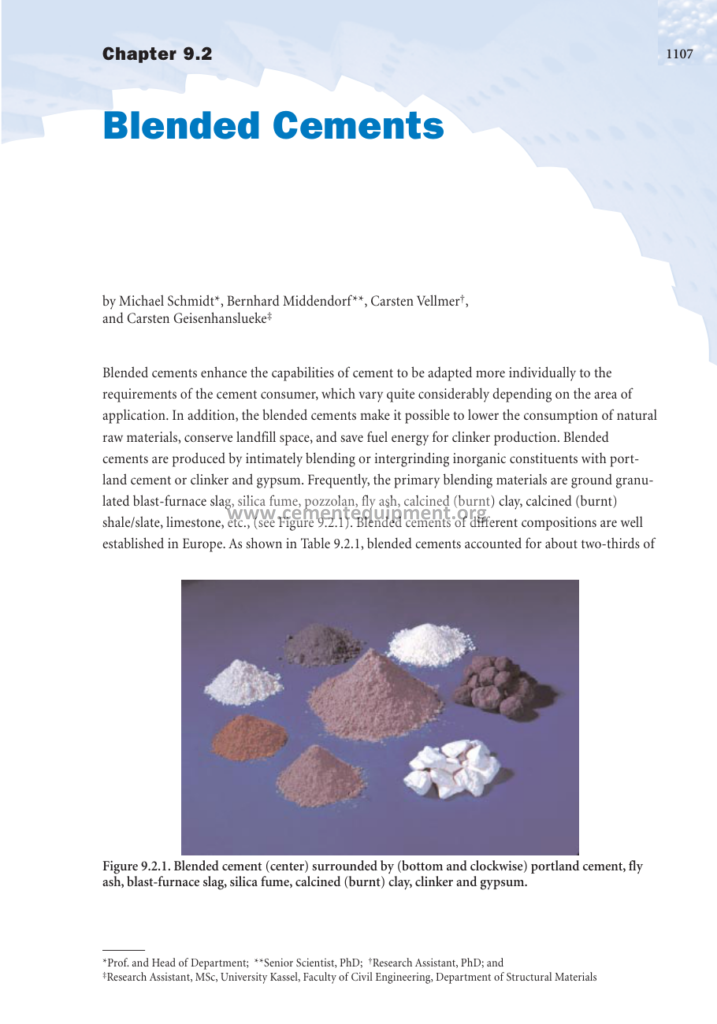
Blended cement is the family of hydraulic cements in which a proportion of the portland clinker is replaced by one or more supplementary cementitious materials, the classical additions being ground granulated blastfurnace slag, fly ash, limestone filler and natural or calcined pozzolana. The concept is as old as the recognition that the volcanic ash of Pozzuoli hardened with lime, but it became the dominant technology of the modern industry because it answers simultaneously three pressures: the economic pressure to reduce the cost of cement (clinker is the expensive ingredient), the technical pressure to improve certain concrete properties (heat of hydration, sulphate resistance, long-term strength, workability), and the environmental pressure to reduce the carbon dioxide and the energy footprint of cement (roughly one tonne of CO2 is emitted per tonne of clinker). Today, blended cements account for the majority of the cement sold in the world, defined and certified by the standards, principally EN 197-1 in Europe with its CEM II to CEM V types, ASTM C595 and C1157 in North America, and a wide family of national specifications. This guide explains the chemistry of the additions, the engineering of their production, the resulting properties of the product and its concrete, the standards that govern it and the modern low-carbon revolution of the concept, giving the professional the complete picture of the product family that now defines the face of the industry.
1. The Idea of Blending: Why Replace Clinker at All
Portland clinker is a superb hydraulic binder, but it is expensive to make: its production consumes roughly 3.0 to 3.6 GJ of thermal energy per tonne, releases about 530 to 540 kg of process CO2 from the decarbonation of the limestone plus 250 to 300 kg from the fuel, and demands a precise raw mix, high temperatures and a long residence time in the kiln. Every tonne of clinker replaced by a material that contributes to the hydration without needing the kiln saves that energy and that emission, which is why the clinker factor (the ratio of clinker to cement) is today one of the most scrutinised numbers of the industry. But the replacement is only legitimate if the resulting product still meets the performance standards of the concrete, and the art of blending is exactly this: the right addition, at the right dosage, ground to the right fineness, giving a product whose strength, durability and usability remain within the specification.
The two great families of additions differ in their reaction. The latent-hydraulic materials (slag) hydrate by themselves in the presence of an activator, which the portland clinker provides. The pozzolanic materials (fly ash, natural pozzolana, calcined clay) do not hydrate alone but react with the calcium hydroxide released by the cement hydration to form the same calcium silicate hydrate gel that carries the strength. The inert or physical additions (limestone filler, prepared quartz) contribute by the packing and the nucleation of the hydration rather than by a reaction of their own. The most effective products combine two families in ternary blends, and the modern standards are built to certify all of these combinations.
2. The Additions One by One: Slag, Fly Ash, Limestone, Pozzolana and Silica Fume
Each addition brings its own chemistry and its own rules:
- Ground granulated blastfurnace slag (GGBS or slag): the glassy by-product of iron production, granulated by rapid water quenching of the molten slag and ground to cement fineness. Its composition is roughly 38–45% CaO, 32–40% SiO2, 7–14% Al2O3 and 5–10% MgO, and its latent-hydraulic activity depends on the glass content (the quenching), the fineness and the basicity. Slag significantly slows the early strength but raises the long-term strength, reduces the heat of hydration and gives an outstanding resistance to sulphate and chloride attack. The dosage in EN 197-1 ranges from 6% to 95%, giving CEM II/A-S, CEM II/B-S, and the CEM III family;
- Siliceous fly ash: the fine, spherical dust captured from the coal-fired power plant flue gas, composed mainly of SiO2 and Al2O3, with a pozzolanic reaction that is slower but continuous. Its spherical particles improve the workability of the fresh concrete and reduce the water demand, and it lowers the heat and the permeability over time; used at 6–35% in CEM II/A-V and CEM II/B-V;
- Limestone filler: finely ground natural calcium carbonate, largely physically active: it fills the interstices between the cement grains, improves the particle packing, and through the reaction with the aluminate forms calcium carboaluminate hydrate that enhances the early strength of the composite; used at 6–20% in CEM II/A-LL and CEM II/B-LL, and as a component of the modern LC3 blends;
- Natural and calcined pozzolana: volcanic tuff, pumice and diatomite (natural), and calcined clays such as metakaolin (artificial); the calcined clays are the fastest-growing addition because clay deposits are abundant worldwide and their calcination is moderate; metakaolin is highly reactive and permits high clinker replacement;
- Silica fume (microsilica): an extremely fine by-product of ferrosilicon, used at 5–10% for high-performance concrete, giving very high strength and impermeability but also a higher water demand that requires superplasticisers;
- Other additions: natural stone fillers, burnt shale (clay shale calcined), and in some regions sugar-cane bagasse ash and rice-husk ash with high reactive silica.
The practical consequence is that the addition selection is a local decision: the plant uses the by-products of its region, and the entire economics of the blended cement industry, the position of the silos and the supply contracts, are built around the reliable availability of these materials.
3. The Chemistry of the Blended Reactions
The hydration of a blended cement is a two-front process. The portland fraction hydrates as usual: the alite and the belite form the calcium silicate hydrate (C-S-H) gel and release calcium hydroxide (portlandite), while the aluminate and the sulfate form the ettringite and the monosulfate. The addition fraction enters the same picture differently for each family:
- The latent-hydraulic reaction (slag): in the alkaline environment created by the portlandite and the alkalis, the glass network of the slag is attacked, the slag hydrates and forms additional C-S-H with a low calcium to silicon ratio; the microstructure becomes denser, the portlandite is partially consumed, and the paste is less permeable and more resistant to the aggressive ions;
- The pozzolanic reaction (fly ash, pozzolana, metakaolin): the reactive silica and alumina of the addition dissolve in the alkaline pore solution and combine with the portlandite to form the C-S-H and the calcium aluminate hydrates; this reaction is slow, so the strength contribution appears at 28 days and beyond, and it consumes the portlandite that otherwise weakens the resistance to the sulfate and the chloride penetration;
- The physical effect (limestone, fine quartz): the fine particles act as nucleation sites that accelerate the early hydration of the alite, and they physically fill the voids, refining the pore structure; in the presence of alumina and sulfate, the limestone forms carboaluminate hydrates that partially replace the monosulfate and enhance the early strength of the paste;
- The synergetic effect (ternary blends): combinations such as limestone plus calcined clay, or slag plus fly ash, exploit the complementary dosing: the calcined clay consumes the portlandite while the limestone reacts with the alumina released by the clay, producing an optimised microstructure with a high clinker replacement and full engineering performance, the chemistry at the heart of the LC3 technology.
The microstructure of the blended paste is therefore different from that of a pure portland cement: the portlandite is partly consumed, the C-S-H has a lower Ca/Si ratio, the pore structure is refined over time and the permeability to chlorides and sulphates falls. This is why the durability performance of the well-designed blends is often better than that of the pure cement, not worse, in spite of a later development of the mechanical strength.
4. Properties of the Blended Cement: Strength, Heat, Durability and Workability
The technical properties of a blended cement are the sum of its composition, its fineness and its curing, and the experienced engineer reads them as follows. The early strength (1 and 2 days) is usually lower than for the pure portland because the addition fraction contributes little at that age; the late strength (28 days and beyond) is equal or higher, because the pozzolanic and latent-hydraulic reactions mature slowly and the denser microstructure sustains growth. The heat of hydration is reduced substantially, which makes the blends the standard choice for the mass concrete of dams and large foundations where the thermal gradients would crack a pure cement. The sulphate and chloride resistance improves with the dosage of slag, fly ash and pozzolana, because both the dilution of the C3A and the consumption of the portlandite reduce the attack. The workability improves with the spherical fly ash and the fine filler, and the water demand is usually reduced, while the metakaolin and the silica fume have the opposite effect and need superplasticisers.
The carbonation is the property that demands the most attention: a blend with a high addition level has a lower alkalinity reserve, and the carbonation front can advance faster in the dry, surface-exposed concrete, increasing the corrosion risk of the reinforcement if the cover is not dimensioned for it. The design codes and the standards accordingly treat the high-blend products with specific profiling, and the modern EPD-verified data of each product give the designer the exact values. The setting is generally delayed by the slag and the pozzolana and slightly accelerated by the fine limestone, and the fineness of the product is chosen so that the required strength class is reached at the specified ages; the plants therefore intergrind or separately blend to the exact particle size distribution of each marketed product.
5. The Standards: EN 197-1, ASTM C595 and C1157, and the National Systems
The blended cements are certified by the standards of the market, and the engineer must be fluent in the two reference frameworks. In EN 197-1 the main types are:
- CEM II — Portland-composite cement: clinker 65–94%, with one single addition of slag (S), silica fume (D), pozzolana (P, natural or Q, calcined), fly ash (V siliceous or W calcareous), burnt shale (T) or limestone (L or LL), each in the A (6–20%) and B (21–35%) variants, or with a mixture of additions (M);
- CEM III — Blastfurnace cement: slag 36–95%, in the A, B and C variants;
- CEM IV — Pozzolanic cement: pozzolana 11–55%, in the A and B variants;
- CEM V — Composite cement: a combination of slag with pozzolana or fly ash, 36–80%, in the A and B variants.
In ASTM C595, the blended hydraulic cements are identified by letter codes: IS (portland blast-furnace slag cement), IP (portland-pozzolan), IL (portland-limestone, with a note when the limestone is more than 5% and up to 15%), IT (ternary blended) and I(SM) (slag modified), each with the option of the S or P exposure designations (moderate or high sulphate resistance) and the optional low-heat, moderate-heat and low-alkali limits. The ASTM C1157 performance specification defines the products by what they must achieve rather than by what they contain: the types GU (general use), HE (high early strength), MS (moderate sulfate resistance), HS (high sulfate resistance), MH (moderate heat), LH (low heat), plus the (PM) pozzolan-modified and (SM) slag-modified performance options. The national standards (British BS EN 197-1, Indian IS 1489 and IS 455 for the fly ash and slag cements, the Chinese GB 175 with its common and composite types, the Gulf and African harmonisations) follow one of the two philosophies, and the export plant produces against the exact requirement of its destination market.
6. Manufacturing the Blended Product: Intergrinding versus Separate Grinding
The production of a blended cement is a decision of comminution strategy. Two principal routes exist, with their sub-cases:
- Intergrinding: the clinker, the gypsum and the addition are ground together in the same mill, which is the simplest and most common route. The different grindability of the components means that the soft material (limestone, slag) is ground finer than the hard clinker, and the product is a homogeneous blend with a single particle size distribution; the drawback is that the individual fractions cannot be optimised independently, and the finest material (often the softer component) can coat the grinding media and reduce the mill efficiency, a phenomenon that the grinding aids and the mill internal design mitigate;
- Separate grinding and blending: the clinker and the addition are ground in separate mills, each to its optimum fineness, and then blended homogeneously in the cement silo by a mass-blending system. This route costs more, but it allows the optimum of each component: the slag can be ground coarser or finer than the clinker as the reactivity demands, and the plant can produce many products from the same two silos by changing only the blending ratio, which is why the modern multi-product plants favour this route for their high-blend product families.
The blending technology itself is exacting: the proportion is held by belt feeders or loss-in-weight feeders, the homogeneity is verified by continuous sampling and the fineness of the blend by the on-line particle size analyser, and the silo is discharged with the recirculation that keeps the product uniform. The sulfate balance is especially delicate in the blends: the additions react with the sulfate and the aluminate, so the gypsum optimum shifts, and the plant adjusts the SO3 of the product by laboratory trials (the optimum sulfate set at the maximum strength development). The moisture and the temperature of the additions must also be controlled: a wet slag cannot be interground without drying, and a hot cement must be cooled before the storage to avoid the loss of the strength and the lumping of the product.
7. Quality Control and Testing of Blended Cement
The quality system of a blended cement verifies both the composition and the performance. The composition is controlled by the continuous analysis of the addition (its oxide content, its glass content for the slag, its loss on ignition for the fly ash and the limestone) and by the mass balance of the dosing; the performance is controlled by the complete physical test battery: the fineness (Blaine and the 45 µm residue), the setting time, the soundness, the compressive strength of the standard mortar at 2, 7 and 28 days, the heat of hydration by the calorimeter for the low-heat products, and the durability indicators such as the sulfate expansion and the chloride penetration where the product is marketed on its durability profile. Every compliant product carries its certificate of analysis with the declared values and the standard that it meets.
The statistical treatment is the same as for any cement: the plant computes the capability indices of the strength, sets its production targets so that the probability of a non-conforming result is negligible, and uses the control charts to steer the mill. The special value of the blends is that the strength is a function of the ratio and the fineness of the two components, so the control can use the strategies of both the process (fineness, separator) and the composition (ratio, addition dosage), and the most advanced plants use the on-line particle size and the continuous XRF to close the loop: the mill feed and the blending ratio are adjusted automatically so that the product properties stay inside the box while the addition is pushed to the economic maximum. This is the modern optimisation of the clinker factor, executed daily, and it is why the blends are where the quality and the economics of the cement plant meet most intensively.
8. Applications: Where Each Blend Proves Its Value
Above the table of properties, the blends are matched to their applications:
- General construction: CEM II/A-LL 42.5 N is the workhorse of the European general market, used for foundations, columns, slabs and all the structural concrete where the moderate early strength is sufficient;
- Precast and ready-mix: the R-grade blends and the CEM II with the higher clinker ratio are used where the early formwork stripping matters, while the fly-ash blends improve the pumping and the finish;
- Mass concrete and dams: the CEM III with the high slag or the fly-ash-rich CEM IV/V, chosen for their low heat and their long-term strength, avoiding the thermal cracking of the large pours;
- Marine, sewerage and aggressive water: the high-slag CEM III/B and the CEM IV products resist the chloride and the sulphate penetration, protecting the reinforcement to the north of the world and to the tropical coastlines alike;
- Ground granulated slag or fly ash as separate additions: in many markets the SCM is sold separately and combined with the OPC in the concrete mixer, which gives the producer the flexibility to tailor the binder to the pour each day;
- Repair and high performance: the silica-fume blends and the metakaolin products for the repair mortars, the high-strength columns and the decks that demand impermeability and abrasion resistance.
| Addition | Typical dosage (EN 197-1) | Main effect on the properties | Recurring applications |
|---|---|---|---|
| Slag (GGBS) | 6–95% | Late strength, low heat, sulphate and chloride resistance | Mass concrete, marine, sewerage |
| Siliceous fly ash | 6–35% | Workability, low heat, late strength, durability | Ready-mix, dams, foundations |
| Limestone filler | 6–20% | Packing, early strength, cost reduction | General construction, mortar, plaster |
| Natural pozzolana | 11–55% | Durability, low heat, sulphate resistance | Marine, hydraulic works, mass concrete |
| Calcined clay (metakaolin) | Typical 15–30% (LC3) | High reactivity, chloride resistance, low clinker factor | General and durable concrete |
| Silica fume | 5–10% | Very high strength, impermeability | High-performance concrete, repair |
The selection discipline is professional: the mix designer, the codes and the exposure class together decide the binder, and the cement producer supports the decision with the full technical data sheet and the documented trial data of each product.
9. The Environmental Revolution: CO2, Clinker Factor and the LC3 Family
The blended cement is the principal instrument of the decarbonisation of the industry, and its use is accelerating under the carbon regulation. The logic is quantitative: replacing 30% of the clinker of a CEM I with slag or fly ash reduces the CO2 per tonne of cement by roughly 25 to 30%, and every further percentage point of the clinker factor reduction subtracts real emissions for which the plant pays under the emission trading systems. The more ambitious products push the factor toward and below 50% clinker: the CEM III/C with up to 95% slag, the CEM IV with the high pozzolana, and the celebrated LC3 (limestone calcined clay cement) which combines about 50% clinker, 30% calcined clay, 15% limestone and 5% gypsum, reaching a CO2 reduction of about 40% with a reactive, durable product made from abundant clays. The performance-specification movement (C1157 and its national equivalents) supports this trend by allowing the binder to be optimised for the structure rather than for a fixed recipe, shifting the competition of the industry from the composition to the demonstrated performance.
The engineering caution remains: the durability of the new blends must be verified for every exposure, and the research of the last decade has produced the data that certify the LC3 and the high-limestone products in the aggressive environments, including their performance in the field. The EPD (environmental product declaration) has become the marketing document of the blends: the certified life-cycle numbers of each product, issued under the international PCRs, are now demanded by the green tenders, and the blended product with the lowest documented footprint wins the public contracts. The combination of the carbon price, the cement-product regulation and the green procurement is therefore welding the commercial advantage to the clinker factor, and the producers who have mastered the blends and their certification are structurally the winners of the transformation.
10. The Production Economics and the Market of Blended Cements
The economics of a blended cement are decided at the interface between the pyro line and the finish mill, and the margin of each tonne hangs on the addition price, the addition handling cost and the clinker cost. The clinker is the scarce resource of the plant: its production is limited by the kiln, and the market buys the plant’s clinker capacity at the full cost of the fuel, the maintenance and the emission allowance. When the plant adds 20% of limestone filler to produce a CEM II, the same kiln produces the clinker for a larger volume of cement, and the added margin is the difference between the price of the blended product and the marginal cost of the filler, grinding and packaging. This is why the production planners of the modern companies maximise the addition in each strength class up to exactly the point at which the certified 28-day strength and the other specified properties are still safely met; the remaining margin of strength above the specification becomes, in effect, the budget of the operation.
The market structure reinforces this logic. In the bulk segments (ready-mix, precast, infrastructure), the competition is on price per certified tonne, and the EPD and the carbon content are increasingly part of the tender; in the bagged segment (retail, small contractors, rural markets), the brand, the strength class on the bag and the logistics dominate, and the blended products allow the producer to serve both segments from the same asset base. The supply side of the additions is the strategic risk: the local availability of the slag (tied to the steel plants), of the fly ash (tied to the coal power stations, whose share is declining) and of the natural pozzolana (tied to the geology of the region) determines which blends the plant can actually make, and the producers build long-term offtake contracts, stock management and, increasingly, their own calcination lines for the clay because the clay is available everywhere. The producer that reads these four variables, the clinker capacity, the addition price, the certified specification and the market demand, is the producer that turns the blended cement from a technical product into a sustained source of margin, which is why the product mix strategy of the cement company is among the most valuable decisions made in its executive offices.
11. Frequently Asked Questions
Is blended cement as strong as ordinary portland cement?
Yes, at the specified ages: the blends reach their declared strength class, and in the long term (90 days and more) they often exceed the pure product, because the pozzolanic and latent-hydraulic reactions continue for months; the trade-off is only that the early strength (1–2 days) is lower in the high-blend products.
Why is blended cement cheaper than CEM I?
Because the clinker, the most expensive ingredient (with its fuel, its kiln and its CO2 cost), is partly replaced by the cheap, often by-product additions; the saving is passed to the buyer, so the blended product offers a lower price per tonne at equal certified performance.
What is the difference between slag, fly ash and pozzolana?
Slag is a latent-hydraulic glass that reacts with the alkaline environment; fly ash is a pozzolanic by-product of the coal combustion; pozzolana is a natural or calcined siliceous material with the same pozzolanic reaction; both of the latter consume the portlandite instead of producing it.
Can I use blended cement in aggressive seawater environments?
Yes, and in fact the high-slag (CEM III) and the high-pozzolana (CEM IV) products are the best choice for the marine and the chloride-bearing environments, because the dense microstructure and the consumed portlandite reduce the chloride penetration and the consequent corrosion of the steel.
Does blending reduce the heat of hydration?
Yes, substantially: the slag, the fly ash and the pozzolana dilute the C3S and the C3A that generate the heat, so the blends are the standard binders of the mass concrete where the thermal gradients must be minimised to avoid cracking.
What is LC3 cement?
LC3 is the limestone calcined clay cement combining roughly 50% ground clinker, 30% calcined clay, 15% limestone and 5% gypsum; the calcined clay gives a high reactivity and the limestone reacts with the released alumina, together permitting about 40% CO2 reduction with performance comparable to the ordinary portland cement.
How is the composition of a blended cement verified in the plant?
By the continuous control of both the addition quality (XRF, glass content, loss on ignition) and the dosing ratio (belt feeders with the mass balances), plus the full performance testing of the certified product; the composition is declared on the certificate of every batch.
12. Summary and Conclusion
Blended cement is the product family on which the modern industry rests: clinker partly replaced by slag, fly ash, limestone, natural and calcined pozzolana and silica fume, each with its own reaction and its own benefits, certified by the standards (EN 197-1 with the CEM II to CEM V, ASTM C595 and C1157, and the national systems), produced by intergrinding or by separate grinding and mass blending, controlled by a quality system that balances composition, fineness and performance, and applied across the entire range of construction, from the general building concrete to the mass dams, the marine structures and the high-performance repair works. The blends reduce cost, improve the durability in the aggressive environments and cut the carbon footprint proportionally to the clinker replaced, and their acceleration under the carbon regulation and the performance movement is the central transformation of the industry. The professional who understands the chemistry of the reactions, the physics of the fineness, the standards of the markets and the economics of the clinker factor is the professional who will design the products, optimise the plants and win the markets of the decarbonising construction world.
Get this cement file + the full 931-file package
$249.99 — one-time purchase, instant download, lifetime access
This file is part of the Complete Cement Technical Package (931 files) available from cementequipment.org. Respective rights holders; library copy for the licensed single user.