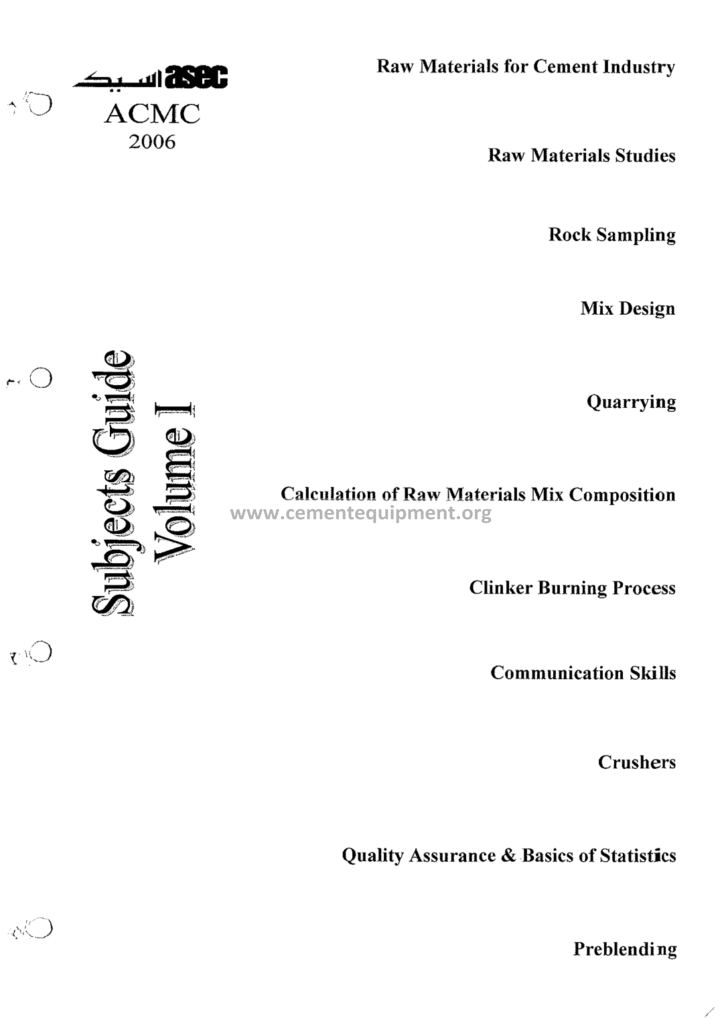
Cement Course Volume 1: Subjects Guide
The Vol.1 subjects guide is the reader’s map of the first volume of the cement package: the document that lists the courses, the subjects and the sequence of the first volume: from the raw materials and the quarry to the raw grinding, the burning and the cement grinding: the guide tells the reader what the volume contains, how the subjects connect and where the reader should start: the index that turns the file collection into the structured course.
The Complete Cement Technical Package (931 files including the books, the courses, the Excel tools and the presentations: $249.99 one-time: instant download via the PayPal payment) includes the Vol.1 subjects guide as the navigation layer of the first volume: the article walks the guide: the structure of the volume, the subject modules, the learning paths for the different professional groups, the depth indications and the links between the subjects: the reader who follows the guide builds the complete picture of the cement process in the logical order: the same order the industry’s training programs follow.
The volumes of the package divide the cement knowledge into the learnable units: the Volume 1 concentrates on the process chain of the plant: the materials, the preparation, the burning, the grinding and the quality control: the subjects guide is the document that the new engineer reads first and the experienced one consults when he navigates the library: this article summarizes the guide faithfully so the reader knows exactly what the volume offers and how to use it.
1. The Structure of Volume 1: The Modules of the Process
The Vol.1 guide organizes the content into the process modules that mirror the flow of the cement plant:
- Module A — the raw materials and the quarry: the geology of the limestone, the clay and the correctives, the sampling, the quarry planning, the blasting and the crushing: the subjects of the plant’s front end;
- Module B — the raw material preparation: the pre-homogenization, the raw grinding, the drying, the mixing and the homogenization: the chain that produces the kiln feed;
- Module C — the burning process: the preheater, the kiln, the cooler, the fuels, the burning chemistry, the heat balance and the kiln operation: the thermal heart of the volume;
- Module D — the cement grinding and the quality: the finish mills, the separators, the gypsum, the cement types, the quality control and the standards: the back end of the process;
- Module E — the support engineering: the fans, the compressors, the conveyors, the instrumentation, the electrical drives and the maintenance: the disciplines that keep the process running.
The module structure is the didactic choice of the volume: each subject appears once, at its logical position in the process chain, and the guide’s table of contents lets the reader see the whole landscape before the first page: the file reproduces the full table of contents with the subject codes so the reader locates any file of the volume in seconds.
2. The Subject Map: The Courses Inside the Volume
The guide lists the principal courses of the volume, and the file summarizes their scope and their length:
| Course | Module | Audience | Depth level |
|---|---|---|---|
| Raw materials and their assessment | A | Quarry and quality staff | 2 of 4 |
| Crushers and the coarse reduction | A | Operations and design | 2 of 4 |
| Raw grinding systems (ball, roller, vertical) | B | Process and operations | 3 of 4 |
| Homogenization of the raw meal | B | Process engineers | 3 of 4 |
| Clinker burning and the kiln systems | C | Process, operations, management | 3 of 4 |
| Fuels and the combustion | C | Process engineers | 2 of 4 |
| Finish grinding and the separators | D | Process and operations | 3 of 4 |
| Cement quality and the standards | D | Quality, laboratory, management | 2 of 4 |
| Fans, gas handling and the dedusting | E | Mechanical and process | 2 of 4 |
| Maintenance and the reliability | E | Maintenance staff | 2 of 4 |
The depth levels of the table (1 to 4) mark the presumed background: the level 1 courses for the newcomers and the non-technical staff, the level 2 for the operators and the technicians, the level 3 for the engineers and the level 4 for the specialists: the guide’s advice is honest: the reader starts at the level 2 introductions of his module and deepens with the practice: the table of the volume lets the reader plan his year of study.
3. The Learning Path of the New Process Engineer
The guide’s most valuable pages are the recommended reading paths for the professional roles, and the first path is the new process engineer:
- The first month: the raw materials assessment, the flow sheet of the plant, the process instrumentation basics: the reading of the volume’s flow diagrams: the vocabulary of the process;
- The second month: the crushers and the raw grinding: the walk of the front end with the operating manuals: the daily reports of the raw side;
- The third month: the burning module: the preheater and the kiln systems, the heat balance exercises: the shifts in the control room to connect the theory and the operation;
- The fourth month: the finish grinding and the separators: the mill balance exercises, the separator curves: the cement quality connections;
- The fifth month: the quality module with the standards: the sampling, the testing, the cement types: the laboratory rotation;
- The sixth month: the support engineering review: the fans, the instrumentation, the maintenance basics: the self-assessment exercises of the volume: the entry to the level 3 courses.
The six-month path of the file is the structure that the plants use to onboard the graduate engineers: the volume’s self-tests at the end of each course give the newcomer the measurable checkpoints: the guide advises the mentor system: the young engineer studies the module, verifies on the live plant and presents the module summary to the senior: the learning loop of the industry, formalized by the volume.
| Role | Modules to study | Depth target | Checkpoint |
|---|---|---|---|
| New process engineer | A → E in order | Level 3 core courses | Module summaries to the mentor |
| Operator | Operation courses of B, C, D | Level 2 | Monthly operator tests |
| Quality team | A sampling, D quality, statistics | Level 2 – 3 | Laboratory practical rotation |
| Manager | Overview path (all modules) | Level 1 – 2 | Process presentation quarterly |
4. The Learning Path of the Operator and the Shift Team
The operator path of the guide is built around the control room and the machine floor:
- The process basics: the flow sheets, the equipment names, the instrument readings: the “what does this line measure” exercises of the volume;
- The operation courses: the raw mill operation, the kiln operation, the finish mill operation: the handles, the gauges and the setpoints of each machine: the normal ranges and the alarm actions;
- The upset scenarios: the blockages, the trips, the quality deviations: the response procedures that the volume teaches: the drills the shifts run;
- The quality awareness: the free lime, the fineness, the residues: what the product tests mean for the operation: the operator as the first quality inspector;
- The safety and the permits: the confined-space, the LOTO and the hot-work disciplines: the volume’s safety modules with the checklists: the permanent part of the operator’s education.
The operator path of the guide is short in the reading hours and long in the practice: the volume recommends the 30-minute daily study habit and the monthly operator tests: the plants that follow the path see the reduction of the process deviations and the trip frequencies: the operator knowledge, the quiet insurance of the plant: the guide makes the insurance policy explicit and payable in the study time.
5. The Learning Path of the Quality Control Team
The quality team of the plant follows the path that connects the laboratory and the process:
- The sampling fundamentals: the representativeness, the sampling frequencies and the sample preparation: the statistical basis of the quality control: the volume’s sampling courses;
- The testing methods: the XRF, the fineness, the setting time, the soundness, the strength: the standard methods (EN 196, ASTM C150 and C114) with the worked examples: the laboratory procedures of the volume;
- The process linkages: the kiln feed chemistry to the clinker quality, the clinker to the cement: the quality fingerprints of the process changes: the troubleshooting from the laboratory side;
- The statistical control: the control charts, the capability indices (the Cpk of the cement properties), the standardization of the product: the quality management modules of the volume;
- The cement standards: the EN 197-1, the ASTM C150, the local specifications: the conformity assessments, the certificates and the audits: the compliance knowledge of the modern quality department.
The quality path of the guide is the professional curriculum of the laboratory staff: the volume’s exercises reproduce the real plant reports (the daily XRF prints, the strength certificates) and the learner practices on the realistic documents: the guide’s assessment matrix lets the laboratory manager verify the team’s readiness level by level: the quality competence, measured and managed.
6. The Depth of the Subjects: The Quantitative Content of the Volume
The subjects guide also documents the quantitative character of each course so the reader knows the arithmetic level of the material:
- The raw materials module: the oxide calculations, the mix modules, the quarry tonnage planning: the spreadsheet exercises with the real analyses;
- The grinding modules: the Bond calculations, the mill power and the dimensions, the separator curves and the circulating loads: the numerical tools of the volume;
- The burning module: the heat balance, the fuel calculations, the kiln residence and the free-lime statistics: the burning numbers of the modern practice;
- The quality module: the statistics of the tests, the control charts, the strength development curves: the quantitative quality of the modern laboratory;
- The support modules: the fan laws, the conveyor tension calcs, the motor sizing: the engineering arithmetic of the plant services.
The guide is explicit about the mathematics: the volume uses the arithmetic of the percentages, the ratios, the linear equations and the elementary statistics: no higher mathematics beyond the reach of the technician with the calculator: the spreadsheet tools of the package carry the heavier computations: the guide’s promise: the numerical cement engineering, accessible and practiced.
7. The Connections Between the Subjects: The Process Chain View
The single most important message of the subjects guide is the chain connection: every subject depends on the previous one:
- The quarry to the mix: the quarry chemistry feeds the mix calculation: the guide connects the raw material courses to the raw mix course explicitly: the reader revisits the chemistry with the process view;
- The mix to the burning: the modules of the mix decide the burnability of the kiln: the burning courses reference the mix modules and the free-lime consequences;
- The burning to the grinding: the clinker quality (the alite content, the crystal size, the grindability) decides the finish-mill performance: the grinding courses read the clinker microscopy;
- The grinding to the quality: the cement fineness, the particle size distribution and the sulfate balance decide the product tests: the quality courses close the loop back to the process;
- The quality to the process control: the product trends inform the daily process corrections: the loop of the plant runs continuous: the volume’s courses each teach their node of the loop: the guide teaches the loop itself.
The chain-view diagram of the guide is the most-referenced page of the volume in the plants: the engineers pin it in the control rooms: the one-page picture of the whole process with the subject references of each node: the mental model that turns the individual courses into the integrated engineering: the process chain, the spine of the volume.
8. The Self-Assessment: The Tests and the Exercises of the Volume
The guide’s navigation also includes the assessment instruments of the volume:
- The module end-tests: 20 to 40 questions per course, the multiple-choice and the numerical problems: the answer keys with the explanations: the pass mark of 70% recommended by the guide;
- The case exercises: the realistic problems of the plant (a mill performance drop, a free-lime trend, a separator change): the case method of the volume: the learner solves with the course material;
- The calculation workbooks: the spreadsheet templates with the solved examples: the learner repeats the exercise with his own numbers: the numerical fluency of the profession;
- The plant projects: the guided studies (a mass balance of the raw section, a heat balance of the kiln, a cost comparison of the grinding circuits): the capstone tasks that the plants assign to their trainees: the project reports, the final certificate of the volume’s course.
The assessment map of the guide tells the reader what success looks like: not the passive reading but the completed exercises, the passed tests and the finished projects: the guide’s honest statement: the certificate of completion is the workbook with the solved problems: the volume’s self-assessment, the learner’s own proof.
9. The Use of the Guide in the Plant Training Programs
The subjects guide was designed for the plant-training use, and the file documents the standard applications:
- The onboarding program: the new hires follow the module A to E path with the nominated mentors: the six-month and the twelve-month checkpoints: the HR training records built from the guide’s checklists;
- The operator qualification: the module tests before the independent shift work: the requalification annually: the certified operators of the plants: the guide as the syllabus of the operator school;
- The cross-training: the raw operators trained on the burning module, the quality staff on the operation: the flexing of the workforce: the guide’s paths for the second discipline;
- The refreshment courses: the experienced staff returns to the module after the process changes or the incidents: the incident-driven retraining of the plants: the guide’s structure supports the targeted reviews;
- The management overview: the condensed path of the guide for the managers: the process understanding without the deep numerical practice: the management module of the volume: the decision-makers who speak the process language.
The training applications of the file include the timetable templates, the progress tracking forms and the management reporting formats: the guide is not only the reader’s map but the training department’s syllabus: the volume, run as the structured school the industry needs: the plants that adopt the system report the faster onboarding and the fewer operational deviations.
10. The Relationship of Volume 1 to the Rest of the Package
The guide closes with the honest positioning of the volume inside the 931-file package:
- Volume 1: the process chain courses: the foundation of the package: the place where every reader starts;
- Volume 2 and the advanced volumes: the deep-dive subjects: the kiln mechanics, the refractories, the advanced process control, the project engineering: the next level after the Volume 1 mastery;
- The books of the package: the classical texts (the chemistry of cement, the kiln handbooks, the mill engineering) as the reference layer: the guide points the reader to the book for each subject: the deep reference of each module;
- The Excel tools: the calculators of the package (the mix solver, the heat balance, the separator calculations) referenced by the guide at the exact course positions: the tools, the companions of the theory;
- The presentations and the drawings: the visual layer: the flow diagrams, the equipment cutaways and the slide decks of the courses: the guide’s section references locate the visual material for each subject: the complete learning package, navigated.
The positioning text of the guide is the map of the whole 931-file library from the Volume 1 vantage: the reader who finishes the first volume knows exactly where the deeper knowledge lives and how to reach it: the package, structured as the knowledge pyramid with the Volume 1 at the base: this subjects guide, the pyramid’s entrance.
11. The Time Budget and the Study Calendar of the Volume
The guide also gives the practical time planning of the volume, and the file reproduces the study calendar that the plants and the individuals use:
- The total volume budget: the complete module-by-module study with the exercises requires 200 to 400 hours: the six-month intensive plan at 10 to 15 hours per week and the twelve-month plan at 5 to 8: the realistic calendar of the working engineer: the guide’s honest arithmetic, so the reader plans the year, not the dream;
- The per-module hours: the raw materials module 20 to 30 hours, the raw crushing and the grinding 40 to 60, the burning 50 to 70, the finish grinding 40 to 60, the quality 30 to 40 and the support engineering 30 to 50: the hour table of the file lets the reader allocate the study time proportionally to the professional need;
- The weekly rhythm: the two or three study sessions of 60 to 90 minutes: the 30-minute review of the previous session before the new material: the end-of-week exercise consolidation: the spaced repetition of the file’s planner: the learning science applied to the cement knowledge;
- The plant-scheduled formats: the in-house training weeks (the 4 to 6 blocks of 5 days per year), the shift-friendly e-learning rotation and the blended programs with the mentor presentations: the training calendar templates of the guide, ready for the HR departments;
- The completion tracking: the module progress sheets and the test-score registers: the monthly review of the learner’s progress with the mentor: the certificate of the completed modules, issued by the plant’s training system: the study time, accounted like the production time.
The calendar chapter is the planning layer of the guide: the study schedule is the instrument that converts the intent into the completion: the file’s templates (the hours table, the weekly planner, the progress register) are the management tools of the learning process: the volume’s knowledge, delivered on a schedule the engineer can keep.
12. The Glossary and the Quick References of the Guide
The guide closes with the reference instruments that the readers keep at the desk for the daily navigation:
- The glossary of the volume: the 300+ terms of the cement process (LSF, SR, AR, Bogue, Tromp, Blaine, residue, the circulating load, the kiln feed, the calciner, the bypass): each term with its one-sentence definition and its module reference: the dictionary of the profession, at the volume’s back;
- The formula sheet: the modules, the Bogue equations, the Bond equation and the conversion factors collected on the two pages: the arithmetic of the whole volume, summarized: the quick-sheet that the engineers print and pin above the desk;
- The units and the conversions: the metric-imperial conversions (the kWh/t and the MJ/t, the kcal/kg, the short and the metric tons, the micron-inch equivalents): the unit disciplines of the international reports: the conversion tables of the package, practiced;
- The index of the figures and the tables: the navigational index of the module figures (the flow sheets, the zone diagrams, the Tromp curve, the mill sections): the reader locates any diagram of the volume in seconds: the visual navigation of the learning material;
- The subject code map: the codes of the individual files inside the modules: the reader moves from the guide straight to the file of the course: the map of the 931-file package at the volume level: the guide’s final service: the complete navigation of the library, one document.
The reference chapter of the file is the daily desk instrument: the glossary, the formulas and the conversions serve the reader long after the courses are completed: the guide of the volume is not only the entrance but the permanent companion: the cement knowledge, navigable for the whole professional career: the subjects guide, complete.
13. The Guide as the Documentation Standard of the Plant
The subjects guide also serves the documentation life of the plant itself, and the file describes the applications that go beyond the individual study:
- The standard of the shift handover documents: the module terminology and the process vocabulary of the guide standardize the operators’ logbooks, the shift reports and the handover checklists: the plant that names its parameters with the guide’s vocabulary eliminates the confusion of the local jargon: the common language of the control room, enforced by the guide;
- The maintenance documentation maps: the equipment-based modules (the crushers, the mills, the separators, the fans) referenced in the maintenance files and the work orders: the maintenance staff reads the operating principles with the guide’s pages at hand: the maintenance and the process documentation, unified by the same map;
- The incident-investigation references: the process deviations and the incidents investigated with the module references (the kiln upset to the burning module, the quality deviation to the quality module): the investigation reports cite the guide’s chapters: the corrective actions, anchored in the documented knowledge: the learning loop of the incidents, closed by the guide;
- The onboarding checklists of the departments: the HR and the department heads use the module checklists as the job-readiness criteria: the probation reviews evaluate the completed modules and the passed tests: the hiring-to-competence pipeline of the plant, structured by the guide’s syllabus;
- The continuous-improvement references: the energy audits, the capacity studies and the quality campaigns cite the volume’s calculation chapters: the improvement projects of the plant stand on the same documented foundations: the guide, the documentation spine of the plant’s technical life.
The documentation applications of the file show the guide’s role beyond the classroom: the subjects guide is the standard vocabulary and the reference architecture of the whole plant’s technical communication: the plants that adopt the guide run their reports, their training and their investigations on the same framework: the knowledge, organized once and used everywhere: the guide, the company memory made navigable.
14. The Frequently Asked Questions
Who is the Vol.1 subjects guide written for?
For everyone who uses the package: the new engineers follow the reading paths, the operators follow the operation courses, the quality teams follow the laboratory path, the trainers use the syllabi and the managers use the overview path: the guide is the single document that directs each reader to his appropriate sequence: the entry of the whole volume.
Does the guide replace the courses themselves?
No: the guide is the navigation layer, not the content: it describes the scope, the depth and the sequence of each course: the reader still studies the course files: the guide answers the three questions (what is here, where do I start, how deep do I go) and sends the reader to the material: the map, not the territory.
Should I read the subjects in the order 1 to N?
Not necessarily: the guide’s modules follow the process chain (materials to quality), and that order suits the newcomers: the experienced readers enter at their module: the guide’s paths differ for the engineers, the operators and the quality people: the order of the reading follows the role: the recommendation of the guide for each role is explicit.
How long does the full Volume 1 study take?
The guide’s honest estimate: 200 to 400 study hours for the complete module-by-module study with the exercises, spread over 6 to 12 months in the plant routine: the operators complete the target paths in 60 to 120 hours: the speed depends on the professional background and the practice time: the volume’s paths are planned for the realistic plant calendar.
Is Volume 1 enough for the plant process engineer?
The Volume 1 gives the complete process foundation: the engineer who masters the volume operates the plant, runs the calculations and speaks the quality language: the advanced subjects (the kiln mechanics, the control systems, the project engineering) live in the later volumes and the books of the package: the guide points the way: the foundation first, the specialization next.
15. Conclusion
The Vol.1 subjects guide is the entrance hall of the cement knowledge package: the module map, the course scopes, the reading paths for the roles, the assessments and the connections: the document that turns the file collection into the structured curriculum: the reader who starts with the guide starts correctly: the reader who follows the guide finishes the first volume complete: the process chain of the cement plant, fully studied: the professional’s structured entry into the industry’s knowledge.
The Complete Cement Technical Package includes the Vol.1 subjects guide with the complete maps and the learning paths together with the 931 files of the library: the one-time $249.99 purchase, the instant download and the lifetime access: the cement knowledge of the industry, navigated: the professional’s library, at the hand.
Get this Vol.1 subjects guide file + the full 931-file package
$249.99 — one-time purchase, instant download, lifetime access
This file is part of the Complete Cement Technical Package (931 files) available from cementequipment.org. Respective rights holders; library copy for the licensed single user.