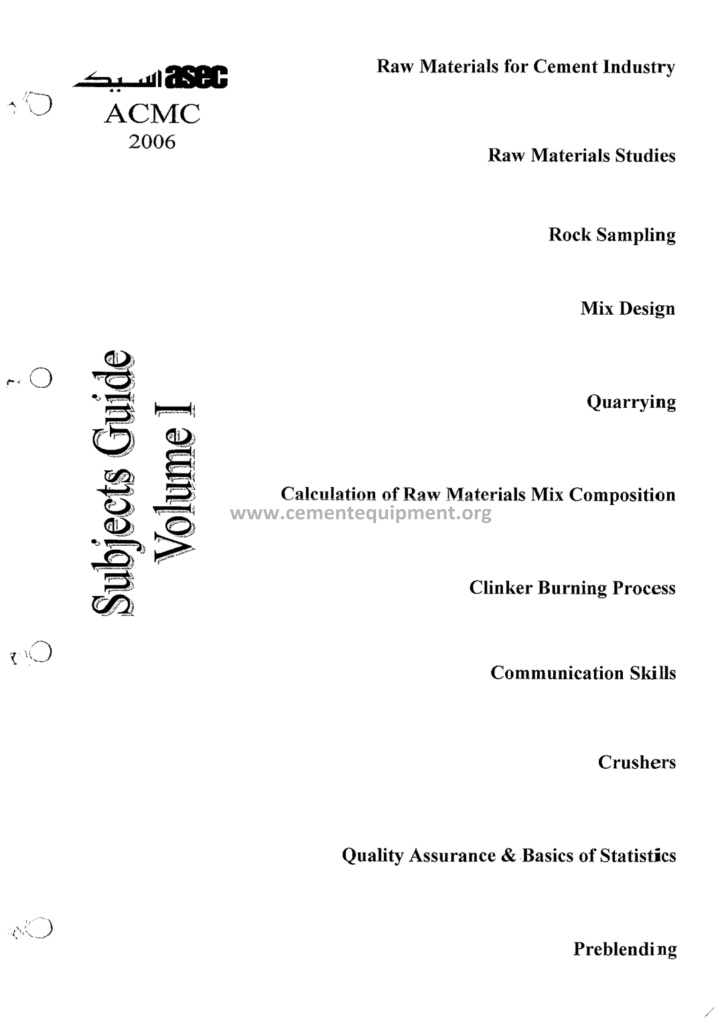
Acmc Vol: Complete Technical Guide
ACMC Vol.1 is the applied-chemistry-and-mathematics course of the first cement volume: the file that takes the quantitative core of the cement process and teaches it through the worked applications: the oxide calculation, the mix design, the mass balance, the heat balance, the mill calculations, the statistics of the quality control: the course where the numbers of the cement industry are practiced, not just read: the calculator’s volume of the package.
The Complete Cement Technical Package (931 files including the books, the courses, the Excel tools and the presentations: $249.99 one-time: instant download via the PayPal payment) includes the ACMC Vol.1 course with its worked examples, the exercise sets and the companion spreadsheets: the article walks the course: the structure of the volume, the chapters, the mathematical methods, the solved cases and the self-study plan: the reader finishes with the complete list of the quantitative skills the course develops and the practical examples that anchor each skill.
The quantitative methods of the cement process are the invisible professional capital of the industry: the same handful of calculations reappear in the daily reports, the monthly audits and the annual projects: the oxides, the modules, the balances, the curves: the ACMC course collects these methods into one applied curriculum: this guide presents the volume exactly as the plant engineers use it: chapter by chapter, method by method, example by example.
1. The Architecture of the ACMC Vol.1: The Chapters and the Methods
The course of the volume is organized into the chapters that follow the calculation flow of the plant:
- Chapter 1 — the oxide chemistry arithmetic: the percentages, the conversions, the loss-on-ignition recalculations, the oxide balancing: the foundation arithmetic of the whole course;
- Chapter 2 — the mix design calculations: the modules, the blending of the components, the corrections, the Bogue phases: the cement chemistry in the numbers;
- Chapter 3 — the process mass balances: the raw section balances, the circulating loads, the mill balances, the separator returns: the accounting of the tons;
- Chapter 4 — the thermal and the energy calculations: the heat balances of the kiln and the cooler, the fuel calculations, the specific consumption indices: the accounting of the megajoules;
- Chapter 5 — the grinding calculations: the Bond work index, the mill power, the dimensions, the ball charge: the arithmetic of the size reduction;
- Chapter 6 — the statistics of the quality control: the averages, the standard deviations, the control charts, the capability: the numbers of the product assurance;
- Chapter 7 — the integrated case studies: the full plant problems that combine the chapters: the capstone exercises of the course.
The chapter architecture follows the process order of the plant: the reader climbs from the single oxide to the whole plant balance: the course statement of the volume is clear: the mathematics of the cement plant is the arithmetic of the percentages and the balances, disciplined and practiced: the chapters of the ACMC volume make the discipline systematic.
2. Chapter 1: The Oxide Arithmetic of the Cement Chemistry
The first chapter builds the calculation habits that the rest of the course uses:
- The percentage arithmetic: the composition of the mixtures as the weighted averages: the 70% limestone and the 30% clay recalculations: the errors of the careless rounding, avoided;
- The LOI conversion: the raw oxides to the ignited basis: the raw meal with the 35.2% LOI recalculated to the 100% clinker basis: the conversion factor 100 / (100 − LOI) = 1.543: the practice problems of the chapter with the real analyses;
- The equivalent calculations: the Na2O equivalent (Na2O + 0.658 × K2O), the CaO from the CaCO3 and the reverse: the unit disciplines of the chemistry laboratory;
- The oxide balancing: the target clinker oxides from the mix and the ash: the verification of the sums (the total oxides plus the LOI equal 100%): the closure checks that catch the analytical errors;
- The worked sets: 30 practice problems with the solutions: the chapter closes with the self-test of 20 questions: the pass threshold of 80%: the foundation of the course, verified before the ascent.
The chapter’s teaching method is the course’s signature: each method introduced with the worked example, followed by the graded practice and closed with the self-test: the learner does not pass to the next chapter without the passing mark: the ACMC course, built for the real competence: the chapter workbook accompanies the file as the Excel template.
3. Chapter 2: The Mix Design Calculations in the Applied Form
The mix design chapter applies the chemistry of the raw materials in the full numerical scope:
- The module calculations: the LSF = 100 × CaO / (2.8 × SiO2 + 1.18 × Al2O3 + 0.65 × Fe2O3), the SR = SiO2 / (Al2O3 + Fe2O3), the AR = Al2O3 / Fe2O3: the worked calculations on the typical analyses: the targets and the bands of the modern practice;
- The two-component blending: the algebraic solution of the limestone-clay mix for the target LSF: the worked example with the limestone 52.0% CaO and the clay 2.5%: the mix of 78% and 22%: the verification loop;
- The multi-component correction: the sand and the iron corrective: the system of the equations solved for the four components: the complete example with the LSF, the SR and the AR targets: the setpoints of the four weigh feeders as the result;
- The Bogue phases: the C3S, C2S, C3A and the C4AF from the ignited oxides: the potential composition of the clinker: the strength-tendency reading of the Bogue results;
- The ash and the moisture corrections: the coal ash absorbed in the clinker, the wet doses from the dry recipe: the plant-realistic problems of the chapter: the corrections that the daily shift runs.
The chapter’s case problems mirror the plant reality: the quarry seams change, the target LSF tightens and the corrective dosing must follow: the ACMC exercise set contains the twelve realistic blending problems with the solution spreadsheets: the learner who completes the set solves any recipe question of the plant: the mix calculation, applied.
4. Chapter 3: The Mass Balances of the Process
The mass balance chapter teaches the accounting of the tons through the equipment:
- The single-unit balance: the input equals the output plus the accumulation: the raw mill balance with the feed, the product, the recycle and the vent loss: the closure of the balances;
- The circulating load: the closed-circuit grinding: the separator feed to the product ratio: the circulating load of 150 to 400% in the typical circuits: the calculation from the sieve residues: the classic formula of the fineness balance;
- The raw section balance: the quarry to the kiln feed: the moisture, the LOI and the storage accounts: the monthly raw-section audit: the reconciliation of the weighed and the analytical quantities;
- The kiln system balance: the feed, the clinker, the dust, the loss: the kiln dust recirculation balances: the clinker factor verification: the 1.53 to 1.56 tons of dry feed per ton of clinker: the check with the plant data;
- The cement balance: the clinker, the gypsum and the additions: the finished cement mass balance: the dispatch and the inventory accounts: the product-side closure of the plant.
The chapter’s audit cases are the real management exercises: the plant reconciles the monthly production accounts with the mass balance closing errors below 1 to 2%: the course’s balance templates, used in the plant audits, identify the accounting leaks (the dust losses, the weigh-scale drifts, the moisture misreporting): the mass balance, the honesty instrument of the plant: the ACMC chapter teaches the instrument completely.
5. Chapter 4: The Thermal and the Energy Calculations
The thermal chapter brings the megajoules into the balanced accounts:
| Case | Method | Typical result in the course example |
|---|---|---|
| Kiln heat balance | The fuel heat in, the theoretical reactions, the gas out, the shell losses | 3,150 MJ/t clinker, balanced within 2% |
| Cooler heat recovery | The clinker enthalpy to the secondary air | 65 – 75% recovery, 700 – 900 °C secondary air |
| Fuel consumption conversion | The MJ/t to the kg coal/t and the kcal/kg | 3,150 MJ/t ≈ 87 kg coal/t at 28 MJ/kg LHV |
| Preheater efficiency | The gas heat to the meal | 63% (5-stage), 68% (6-stage) |
| CO2 accounting | The carbonate CO2 plus the fuel CO2 | 540 kg/t from the carbonate + the fuel part |
The chapter’s balance spreadsheet (included) inputs the measured data of the plant and produces the complete heat balance report: the course exercises the reader on the three sample plants (the wet, the long dry and the 5-stage preheater) so the contrasts of the fuel consumption (5,900 vs 3,150 MJ/t) become the visceral numbers: the energy calculations, the honest mirror of the plant’s thermal performance.
6. Chapter 5: The Grinding Calculations and the Separators
The grinding chapter of the volume applies the comminution mathematics to the mill systems:
- The Bond work index applications: W = 10 × Wi / √P − 10 × Wi / √F: the clinker example with the Wi 13.5 and the product 90 microns: W = 11.6 kWh/t: the power of the finish mill from the tonnage: the worked design loop;
- The mill dimensions and the power: the mill diameter, the length, the speed (the 70 to 75% of the critical), the ball charge and the power draw: the empirical design relations with the worked examples: the dimensioning of the 4.2 x 13.5 m finish mill of the course;
- The ball charge calculations: the ball size distribution by the Bond size formula, the charge weight from the volume and the density: the wear compensation additions: the charge audit exercise;
- The separator calculations: the Tromp curve and the bypass: the cut size, the sharpness, the imperfection: the circulating load from the residues: the classification performance numbers of the course;
- The specific power numbers: the finish grinding at 30 to 40 kWh/t (the closed circuit) with the fineness of the Blaine 3,500 cm²/g: the raw grinding at 20 to 30 kWh/t: the grinding as the largest electricity consumer of the plant: the calculations that size and audit the consumer.
The chapter closes with the complete mill-audit case: the measured residues, the circulating load, the Tromp analysis and the power: the learner reconstructs the audit report line by line: the report format of the course is the report format of the industry’s consultants: the grinding audit, taught completely: the mill numbers of the plant, calculated and understood.
7. Chapter 6: The Statistics of the Quality Control
The statistics chapter gives the quality laboratory its numerical instruments:
- The descriptive statistics: the mean, the median, the standard deviation and the range: the 28-day strength series of the course: the calculation of the s (standard deviation) and the coefficient of variation: the CV of the well-run plants below 3% for the 28-day strength;
- The control charts: the X-bar and the R charts for the daily fineness and the free lime: the control limits at the 3-sigma: the run rules of the shifts: the chart construction exercises of the chapter;
- The process capability: the Cp and the Cpk against the specification limits: the cement fineness Cpk of 1.3 to 1.7 in the good plants: the capability computation with the course’s template: the product assurance numbers;
- The sampling statistics: the sampling frequencies, the composite samples, the representativeness: the standard errors of the laboratory results: the confidence intervals of the reports;
- The correlation tools: the fineness vs the strength, the free lime vs the LSF: the regression exercises of the chapter: the predictive pairs that the quality department uses daily.
The statistics chapter is the most often-reprinted module of the ACMC volume in the plant classrooms: the laboratory managers use its charts and its capability templates for the monthly quality reports: the statistics of the cement laboratory, no longer the mystery of the specialists: the chapter’s Excel companion performs every calculation of the exercises.
8. Chapter 7: The Integrated Case Studies
The final chapter of the ACMC volume binds the methods into the complete plant investigations:
- The case of the rising free lime: the mix chemistry, the kiln temperature logs and the feed residues combined: the diagnosis through the chapters 2, 4 and 6: the correction recipe: the full case report;
- The case of the mill capacity drop: the separator curve, the circulating load and the ball charge audit: the root cause (the worn separator blades raising the bypass) found by the numbers: the improvement quantified: the 8% capacity gain of the case;
- The case of the fuel consumption rise: the heat balance, the cooler air, the shell temperatures: the audit path through the chapter 4: the 0.3 MJ/t leakage found in the cooler sealing: the annual saving of the case;
- The case of the new cement type: the mix calculation, the clinker targets and the finish grind plan: the launch of the blended product from the chemistry to the dispatch: the project document of the case;
- The capstone project: the reader selects his own plant problem and produces the complete analysis with the volume’s methods: the submitted report, the course’s certificate: the applied mastery, demonstrated.
The case studies are the examinations of the course: each case with its data files, its expected method path and its grading rubric: the learner who solves the five cases solves the professional problems of the plant: the ACMC philosophy, stated plainly: the numbers of the cement plant, practiced on the realistic problems until the confidence arrives.
9. The Companion Tools of the ACMC Volume
The course is supported by the exact calculation tools that the package includes:
- The oxide and the mix calculator: the six-component recipe solver with the module targets and the Bogue output: the chapter 2 companion;
- The mass balance workbook: the raw section, the mill circuits and the cement accounts: the chapter 3 companion: the monthly audit template;
- The heat balance spreadsheet: the kiln input-output with the automatic closure check: the chapter 4 companion: the annual audit tool;
- The grinding audit workbook: the residues, the Tromp curves and the power: the chapter 5 companion: the mill report generator;
- The statistics template: the control charts, the capability and the regressions: the chapter 6 companion: the monthly quality report tool;
- The case data packs: the raw data of the five case studies with the solution sheets (locked for the self-testing, opened for the verification): the course examinations, ready.
The tools are the practical layer of the course: the reader practices the manual arithmetic in the chapters and then performs the same calculations on the live plant data with the spreadsheets: the pairing of the hand and the tool: the professional practice of the cement numbers, complete: the ACMC volume, the applied mathematics of the cement plant, fully equipped.
10. The Self-Study Plan of the Course
The ACMC volume suggests the realistic study schedule that the users follow:
| Week | Chapter | Study hours | Checkpoint |
|---|---|---|---|
| 1 – 2 | Oxide arithmetic | 8 – 10 | Self-test 80% |
| 3 – 4 | Mix design | 10 – 12 | Blending problems complete |
| 5 – 6 | Mass balances | 10 – 12 | Balance templates closed |
| 7 – 8 | Thermal calculations | 10 – 14 | Heat balance report done |
| 9 – 10 | Grinding calculations | 10 – 14 | Mill audit case done |
| 11 – 12 | Statistics | 8 – 10 | Control charts built |
| 13 – 16 | Case studies + capstone | 15 – 20 | Project report submitted |
The plan totals 70 to 95 study hours over the 16 weeks: the pace of the working engineer with the two evenings per week: the volume’s realistic promise: the complete applied mathematics of the cement process in the single course: the plants schedule the course for their rising engineers, the individuals schedule it for themselves: the plan of the file is the roadmap of the professional development.
11. The Applications in the Daily Plant Work: The Course in the Routine
The ACMC methods are the same numbers the plant works with daily, and the file dedicates the section to the daily applications that the graduates of the course carry into their shifts:
- The morning recipe review: the daily XRF of the kiln feed and the module calculations: the process engineer runs the mix solver before the shift starts: the recipe corrections sent to the weigh feeders: the morning routine of the raw side, executed with the chapter 2 methods: the calculations of the course, live in the control room;
- The mill performance watch: the circulating load from the daily residues, the separator trends and the power per ton: the process engineer compares the mill’s numbers against the audit baselines: the deviations flagged before they cost the production: the grinding arithmetic of the chapter 5, applied every day;
- The monthly mass balance: the raw section and the cement accounts reconciled with the balance spreadsheets: the closing errors above 1 to 2% investigated: the weigh-scale drifts and the dust losses found by the numbers: the accounting honesty of the chapter 3, institutionalized in the monthly reports;
- The quality reports: the control charts and the capability indices of the laboratory: the monthly quality presentation with the Cpk numbers and the trend analyses: the statistics of the chapter 6, the professional voice of the quality department in the management meetings;
- The improvement projects: the energy audits, the capacity studies and the process trials designed and evaluated with the course’s methods: the before-and-after numbers of every improvement: the project reports written with the case-study templates: the course, the toolbox of the continuous improvement;
- The shift reports of the process engineers: the daily kiln and mill summaries with the specific consumptions, the residues and the balances: the numbers of the report, computed with the course’s formulas: the engineer’s daily output, professional by construction;
- The off-spec investigations: the out-of-limit cement and clinker results investigated with the statistical and the balance tools: the root-cause analyses of the temperature, the chemistry and the fineness data: the corrective action reports, supported by the quantitative evidence: the quality problems of the plant, solved with the course’s instruments;
- The new-engineer onboarding assignments: the graduating engineers complete the case studies as their first work assignments: the process department reviews the reports with the volume’s grading rubric: the fast professional grounding of the newly hired: the HR pipeline of the plant, fed by the course.
The applications section of the file makes the return on the study time concrete: the course’s methods are not textbook exercises but the working instruments of the professional routine: the plants that train their engineers with the ACMC volume find the improvement proposals supported by the numbers the course taught: the applied mathematics, applied indeed.
12. The Example Catalogue: The Numbers Exercised in the Volume
The ACMC course is built around its worked examples, and the file catalogues the full set of the numerical exercises so the reader knows the training coverage of each method:
- The oxide conversions: 14 worked conversions of the raw analyses: the LOI recalculations, the equivalent-alkali computations, the carbonate-to-oxide transformations: each with the intermediate steps and the closure checks: the foundation exercises of the chapter 1;
- The mix recipes: 12 blending cases: the two-component solutions, the three-component corrections and the four-component setpoint calculations with the target LSF, SR and AR combinations: the recipe of the plant, reproduced in the exercise forms: the solved spreadsheets with the sensitivity tables of the sand and the iron doses;
- The balance audits: 8 mass and heat balance cases: the raw section reconciliation, the mill circulating loads and the kiln heat closure: each with the given data tables and the expected closure tolerances: the audit arithmetic of the chapters 3 and 4, exercised with the real report formats;
- The mill and the separator series: 10 grinding cases: the Bond power problems, the mill dimension checks and the Tromp curves with the bypass and the sharpness extractions: the recorded parameters of the typical finish mills: the grinding numbers of the chapter 5, practiced on the plant-like data;
- The statistical sets: 6 full statistical problems with the strength series and the fineness series: the charts, the capability and the regressions: the quality reports reproduced: the statistics of the chapter 6, exercised on the laboratory’s own numbers;
- The closing catalog summary: the index table of all the exercises with their chapters, their difficulty ratings and their solution-sheet references: the reader tracks the completed problems against the complete set: the practice audit of the course: the catalogue, the training map of the numerical volume.
The example catalogue of the file is the practice inventory of the course: the complete set of the numbers the cement engineer must handle: the reader who completes the inventory has practiced every method of the volume on the realistic data: the catalogue turns the study plan into the measurable completion schedule: the numerical confidence of the course, built exercise by exercise.
The progression of the exercises is deliberate: the first problems of each chapter are the guided repetitions of the worked examples, the middle ones the modified-parameter variations and the final ones the open problems without the solution hints: the graduated difficulty trains the independent solving: the reader who reaches the open problems without the hints stands ready for the plant’s own open questions: the file’s grading notes suggest the passing criteria for each level: the catalogue, the systematic practice of the cement arithmetic, complete from the first guided repetition to the last open challenge.
13. The Frequently Asked Questions
What does ACMC stand for in the volume?
The course title abbreviates the Applied Chemistry and Mathematics of Cement: the numerical companion course of the first volume: the chapters cover the oxide arithmetic, the mix design, the mass and the heat balances, the grinding calculations and the quality statistics: the course where the cement process is calculated, not only described.
Do I need a university mathematics background?
No: the volume uses the arithmetic, the elementary algebra, the ratios and the basic statistics: everything is taught from the start with the worked examples: the workbook exercises build the fluency: the honest requirement is the calculator and the patience: the course’s foundation chapter ensures the level of every entrant.
Are the spreadsheets included with the course?
Yes: every chapter has its companion Excel tool in the package, and the case-study data packs come with the solution files: the learner practices on the live tools while studying: the 931 files of the package include the complete set: the calculations of the course, executed with the professional instruments.
How does the ACMC compare with the course of the plant training?
The ACMC is the quantitative layer of the same package: the courses teach the process for the operation, the ACMC teaches the process for the calculation: the two complement: the plants schedule the operation courses for the operators and the ACMC for the engineers, the quality staff and the rising supervisors: the numerical competence, the second language of the profession.
Can I use the methods of the volume in the daily plant work immediately?
Yes: the methods are the standard calculations of the daily reports, the monthly audits and the annual studies: the mix recipe, the mass balance, the heat balance and the mill audit are the regular instruments of the plant: the course’s case reports serve as the templates of the professional reports: the competence transfers on the first day of the practice.
14. Conclusion
The ACMC Vol.1 is the applied numbers course of the cement knowledge: the oxide arithmetic, the mix design, the balances, the grinding mathematics and the quality statistics, practiced on the realistic problems of the plant: the complete quantitative curriculum of the cement process: the engineer who completes the course carries the calculator’s confidence: the plant that trains with the volume audits itself with the same confidence: the mathematics of the cement, applied and mastered.
The Complete Cement Technical Package includes the ACMC Vol.1 with the chapters, the workbooks and the companion spreadsheets: the one-time $249.99 purchase, the instant download and the lifetime access: the 931 files of the library: the applied cement mathematics, at the hand of the professional.
Get this ACMC Vol.1 file + the full 931-file package
$249.99 — one-time purchase, instant download, lifetime access
This file is part of the Complete Cement Technical Package (931 files) available from cementequipment.org. Respective rights holders; library copy for the licensed single user.