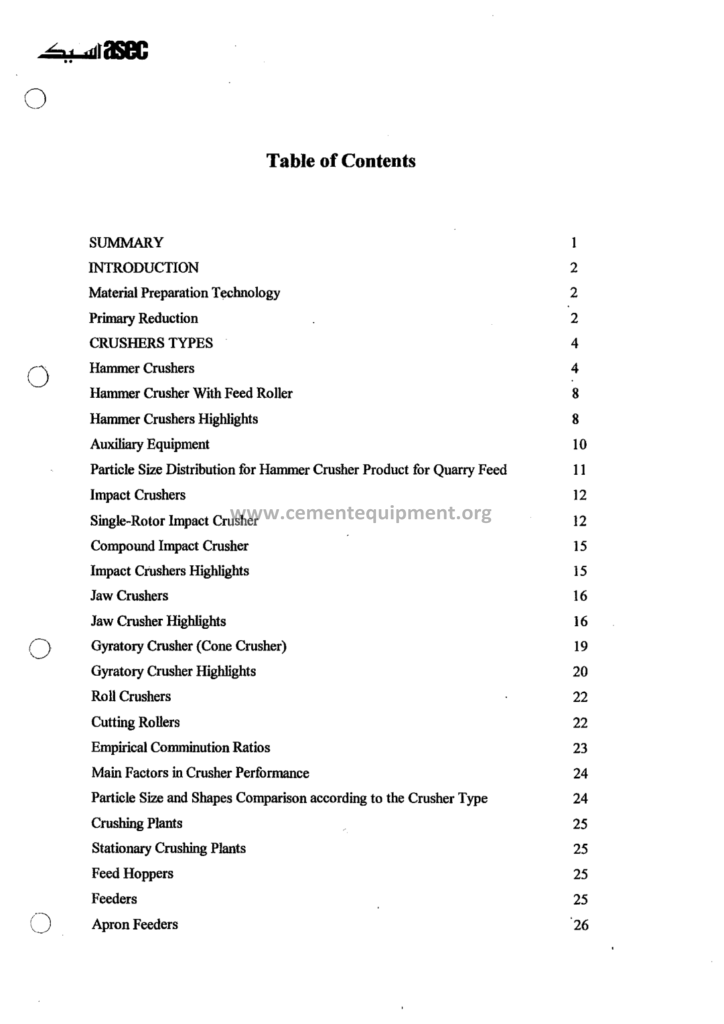
Crushers: Complete Technical Guide
The crushers of the cement plant are the first machines of the size-reduction chain: the machines that take the quarry rock of 1,000 to 1,500 mm top size and reduce it to the 25 to 100 mm feed of the raw mill: without the crusher, no raw mill, no kiln and no cement: the crusher handles the largest tonnage of the plant (1.5 to 1.7 tons of raw material per ton of cement), absorbs the harshest impact of the quarry and decides the availability of the whole crushing section: the first line of the process.
The Complete Cement Technical Package (931 files including the books, the courses, the Excel tools and the presentations: $249.99 one-time: instant download via the PayPal payment) includes this crushers guide with the machine catalogues, the sizing spreadsheets and the maintenance schedules: the article walks the file: the crushing theory, the machine families, the selection criteria, the sizing calculations, the circuits, the operation, the wear and the economics: the reader finishes with the complete decision path of the crushing section: the same path the project engineer runs when the plant is designed or revamped.
The crushing section is cheap in the capital terms but decisive in the operating terms: the crusher power consumption is 0.4 to 1.5 kWh per ton of raw material, the wear parts cost 0.05 to 0.25 US dollars per ton, and the downtime of the crusher stops the raw mill: the numbers are small per ton and enormous per year: the correct crusher selection and the disciplined operation are worth millions over the plant life: this guide quantifies each decision.
1. The Comminution of the Coarse: The Crushing Theory the Engineer Needs
The crushing section of the file opens with the theory that the designers use: the energy laws and the reduction concepts:
- The reduction ratio: the ratio of the 80% feed size to the 80% product size: the coarse crushing ratios of the jaw and the gyratory crushers 4:1 to 8:1, the secondary cone crushers 5:1 to 8:1 and the impact crushers up to 20:1 (in the single pass the limestone impact crusher crushes to the mill feed directly);
- The energy laws: the Rittinger (the energy proportional to the new surface), the Kick (the energy proportional to the volume reduction) and the Bond (the energy proportional to the square root of the size): the Bond law governs the crushing calculations: W = 10 × Wi × (1/√P − 1/√F) in the kilowatt-hours per ton: the Wi of the limestone 8 to 12 kWh/t: the crushing office uses the Bond for the mill sizing and the practical power figures for the crushers;
- The compressive strength: the uniaxial compressive strength of the limestone 80 to 150 MPa (the granites 150 to 300 MPa): the abrasiveness (the quartz content) and the clay content (the stickiness) join the strength in the selection: the impact crushers love the soft abrasive-free limestone and fear the quartz;
- The feed characteristics: the bulk density of the quarry rock 1,500 to 1,800 kg/m³, the moisture 2 to 8% and the clay fines: the crusher must handle the wet sticky materials in many quarries: the choice of the machine and its design clearances follow the feed spec.
The theory section of the file is compact and practical: the concepts that appear in every supplier quotation and every design memo: the engineer who reads the theory reads the quotations with the eyes of the process expert: the reduction ratio, the Wi and the abrasiveness are the three words of the crusher conversation.
2. The Crusher Families of the Cement Plant
The cement plant uses a limited family of crushers, and the file presents them with their domains, their capacities and their consumptions:
| Machine | Typical capacity (t/h) | Feed top size (mm) | Product (mm) | Power (kWh/t) |
|---|---|---|---|---|
| Jaw crusher (primary) | 200 – 1,500 | 1,000 – 1,500 | 150 – 300 | 0.3 – 0.8 |
| Gyratory crusher (primary) | 1,000 – 6,000 | 1,200 – 1,800 | 150 – 250 | 0.3 – 0.7 |
| Cone crusher (secondary/tertiary) | 150 – 1,000 | 150 – 300 | 20 – 60 | 0.5 – 1.2 |
| Impact crusher (single/double rotor) | 200 – 2,500 | 800 – 1,500 | 25 – 80 | 0.5 – 1.5 |
| Hammer crusher (single shaft) | 100 – 2,200 | 600 – 1,200 | 0 – 30 | 0.6 – 1.8 |
| Roller crusher (sizers) | 200 – 4,000 | 600 – 1,500 | 50 – 200 | 0.3 – 0.6 |
Each family has its territory: the jaw and the gyratory for the hard row rock of the primary stage, the cone for the secondary hard rock, the impact and the hammer for the soft abrasive-free limestone (the typical raw material of the cement plants), the sizers for the sticky and the wet materials: the table is the first filter of the selection: the file then deepens each machine with the construction details and the operating limits.
3. The Selection Criteria: The Ten Questions of the Crusher Choice
The selection of the crusher is decided by the fixed set of questions, and the file formalizes them into the decision procedure of the package:
- 1. What is the hardness and the abrasiveness of the rock? The compressive strength, the quartz content and the Ai (abrasion index): the impact machines below 100 MPa and the low abrasion: the compression machines (jaw, gyratory, cone) above;
- 2. What is the stickiness and the moisture? The clay content above 5 to 8% favors the sizers and the jaw openings with the wide gaps: the impact crushers choke on the sticky clay; the hammer crushers with the washing capability exist for the wet quarries;
- 3. What is the feed top size and the tonnage? The jaw for the modest tonnages, the gyratory for the giant quarries, the sizer for the sticky rows: the feeder and the surge hopper sizing follow the same tonnage;
- 4. What product size does the raw mill need? The single-stage hammer or impact at 0 to 30 or 0 to 75 mm, or the two-stage jaw/cone at 60 to 100 mm: the fewer the stages, the cheaper the circuit;
- 5. What is the required availability? The hammer crusher is the fastest to repair (the rotor replacement overnight); the gyratory demands the heavy lifting equipment: the plant maintenance culture counts in the choice;
- 6. What is the dust and the noise budget? The impact machines generate the more dust and noise: the enclosure, the dedusting and the acoustic treatment enter the budget;
- 7. What does the feed variation look like? The quarry benches vary in the hardness: the crusher must absorb the peaks: the capacity margin of 10 to 20% is the standard practice;
- 8. What is the availability of the spare parts and the service? The local support decides the choice between the suppliers of equal technical merit;
- 9. What is the capital and the operating cost? The impact/hammer machines cost 30 to 50% less per ton of capacity than the gyratory circuits but wear faster: the total cost of ownership, computed over the plant life;
- 10. What does the downstream processes demand? The raw mill, the blending bed and the homogenization accept the crushed material: the top size and the fines content of the crusher product shape the raw mill efficiency.
The ten questions are the skeleton of the selection matrix of the file: each criterion scored and weighted for the specific plant: the matrix template of the Excel tool ranks the machines objectively: the two-day selection workshop of the project team, systematized into the one-page matrix: the decision document of the crusher project.
4. The Sizing Calculation: From the Tonnage to the Motor
The sizing of the crusher follows the standard procedure of the file:
- The design tonnage: the clinker production times the raw factor (1.5 to 1.7 tons of raw per ton of clinker) plus the margin: the plant of 5,000 t/day clinker needs 7,500 to 8,500 t/day of crushed material: the crusher duty of 300 to 400 t/h with the 12 to 18 hours of the daily crushing shifts;
- The feed size: set by the quarry blasting: the modern quarries deliver 1,000 to 1,400 mm top size at the face: the dumping pit and the apron feeder sized for the trucks of 50 to 100 tons;
- The product size: the d95 (95% passing) of 60 to 90 mm for the two-stage circuits or 25 to 35 mm for the single-stage hammer: the raw mill balance and the residence of the mill decide the target;
- The capacity check: the manufacturers’ capacity curves at the given feed size, the closed-side setting (for the cones) and the ore density correction: the usable capacity of the selected machine against the duty plus the 10 to 20% margin: the verification loop of the file;
- The drive power: the installed motor 1.1 to 1.3 times the Bond-calculated requirement: the example of the file: the 800 t/h hammer crusher for the limestone Wi 10 with the reduction from 1,200 to 30 mm: W = 10 × 10 × (1/√30000 − 1/√1200000) = 0.53 kWh/t: the mill power 425 kW plus the margin: the installed motor of 600 to 800 kW: the quote verification of the file.
The sizing section includes the worked spreadsheet example with the complete inputs and the outputs so the reader can reproduce the calculation: the Excel tool of the package automates the loop: the engineer enters the tonnage and the sizes and receives the recommended machine family, the capacity check and the power: the crusher sizing in the minutes instead of the days.
5. The Crushing Circuits: The Single Stage and the Two Stages
The crushers are arranged in the circuit configurations, and the file compares the three common layouts of the cement plants:
- The single-stage impact/hammer circuit: the quarry rock to the mill feed in one machine: 0 to 30 or 0 to 75 mm in one pass: the simplest, the cheapest and the most common in the soft-limestone plants of the world: the limitations: the clay and the quartz problems, the higher specific wear;
- The two-stage jaw/cone circuit: the jaw to 200 mm, the cone to 60 mm: the robust option for the hard rock and the abrasive materials: the higher capital, the lower wear per ton, the additional conveyors and the surge bins;
- The primary crusher + the secondary impact: the hybrid for the medium rocks: the jaw absorbs the row rock, the impact refines to the mill feed: the flexibility of the two machines with the finishing quality of the impact: the common solution of the hard-limestone plants with the moderate quartz;
- The mobile and the semi-mobile configurations: the crusher following the quarry face, the reduced haulage: the breaking economics: the haulage of 20 to 40 meters of elevation is the most expensive transport in the plant: the tertiary crushers and the in-pit crushing save 10 to 30% of the quarry transport cost;
The circuit comparison table of the file carries the capital, the operating costs and the typical availabilities of each option: the decision of the crushing section belongs to the overall economics of the quarry-to-mill route: the file ranks the options with the net-present-value analysis of the package: the circuit, chosen by the numbers.
6. The Feeders and the Surge: The Machinery Around the Crusher
The crusher performs only as the feeding system serves it, and the file covers the complete equipment ring around the machine:
- The dump hopper and the apron feeder: the hopper capacity of the 1.5 to 2 truck loads (100 to 150 tons typical), the apron feeder with the speed control matching the crusher intake: the VFD drives on the heavy feeders: the throttling function of the circuit;
- The vibrating grizzly: the scalping of the fines below the crusher setting: the grizzly removes 5 to 15% of the feed as the fines and protects the crusher from the plugging at the start: the grizzly bar spacing of 60 to 120 mm;
- The magnetic separator and the metal detectors: the protection against the excavator teeth and the drilling steel: the metal detector stops the feeder belt and the magnet removes the ferrous metal: the protection chain that saves the rotors and the mantles from the catastrophic damage;
- The surge and the buffer: the storage between the crusher and the raw mill: the crushed stockpile or the silo with the capacity of the 8 to 24 hours of the mill consumption: the decoupling of the quarry shift from the mill shift: the stability of the mill feed, engineered by the storage;
- The dedusting: the bag filter on the crusher building with the capture hoods at the discharge points: the emission compliance of the crushing section: the 10 to 30 mg/Nm³ limits and the workplace dust below 1.5 mg/m³: the dust control of the file includes the collection, the transport and the return of the collected dust to the process.
The ring equipment is the half of the crusher installation cost: the file budgets the complete station (hopper, feeder, grizzly, crusher, dedusting, building) so the project planner sees the total picture: the crusher is never bought alone: the station is bought: the complete-station approach of the package saves the projects from the classic budget underruns.
7. The Operation of the Crusher: The Rules of the Shift
The operating disciplines of the crushing section decide the wear, the availability and the product: the file lists the operator’s rules:
- The steady feed: the crusher hates the surges: the feed rate held at the design value with the feeder control: the overload protection (the current limit, the oil pressure) set and tested: the steady-state operation extends the life of every component;
- The gap and the setting discipline: the closed-side setting measured daily (the lead wire or the laser measure) on the cones: the hammer and the impact liners checked weekly: the product size is the weekly sieve test: the top size and the fines follow the setting;
- The lubrication: the bearing temperatures (the alarms at 70 to 80 °C), the oil analysis monthly (the particle count and the water), the grease schedule of the pivots: the lubrication log the doctor’s record of the machine;
- The zero-raising of the product quality: the visual inspections every two hours: the product size check at the conveyors: the sticky material first sign at the chutes: the operator’s rounds with the checklist: the rounds of the file recorded on the mobile forms;
- The start-stop sequence: the crusher starts empty after the downstream belt starts, and stops after the feed is cleared: the interlock order from the downstream to the upstream: the plugged-chute responses: the safety isolation of the energy: the LOTO procedures of the file apply to the crusher as to any machine of the plant.
The operation section of the file includes the shift handover template and the daily log format: the disciplines that the best plants run: the operator of the crushing station is the first guardian of the raw meal availability: the guide trains the guardian.
8. The Wear and the Maintenance of the Crushers: The Cost of the Stone
The wear parts are the largest consumable of the crushing section, and the file quantifies the maintenance economics:
| Part | Material | Typical life | Cost share |
|---|---|---|---|
| Hammer / blow bar | High-chrome, Mn-steel, martensitic | 200 – 600 hours (impact) | 30 – 40% |
| Jaw plate (fixed/moving) | Mn 12 – 18% | 3,000 – 12,000 hours | 10 – 15% |
| Cone mantle / concave | Mn steel | 1,500 – 5,000 hours | 15 – 20% |
| Impact liners / breaker plates | High-chrome iron | 400 – 1,200 hours | 10 – 15% |
| Grinding path / grids | Carbide-built plates | 600 – 1,500 hours | 10 – 15% |
The wear strategy of the best plants: the rotation of the hammers (the four-edge hammers rotated to balance the wear), the welding rebuilds (the hardfacing restores the worn surfaces to the 70 to 90% of the new life at 30 to 50% of the new cost), the stock of the complete spare rotors (the quick replacement in the 8-hour shift) and the wear monitoring with the daily records: the maintenance strategy of the file reduces the specific wear cost from the 0.2 to 0.1 US dollars per ton in the optimized plants: the savings of the 1,000,000 tons per year plant: 100,000 US dollars annually from the wear management alone.
9. The Common Failures and the Troubleshooting
The crusher has the fixed failure catalogue, and the file documents each with the symptoms and the remedies:
- The plugging (the crusher stalls under the feed): the causes: the oversize boulder, the sticky clay feed, the feeder surge: the remedies: the overhead crane and the excavator clearing, the rock breaker on the grizzly, the feed restrictions; the plugging of the impact crusher from the wet clay is prevented by the scalping and the moisture management of the quarry stockpiles;
- The abnormal vibrations: the causes: the rotor unbalance (the hammer wear asymmetry), the bearing failure, the foundation loosening: the remedies: the vibration analysis monthly, the balancing of the rotor, the bearing replacement: the vibration baseline of the machine, kept and compared;
- The overheating bearings: the lubrication failure, the misalignment, the overload: the oil and the grease analysis, the alignment checks, the cooling: the hot bearing is the earliest warning of the crusher failure: the thermography rounds of the section;
- The product oversize: the worn hammers or the worn mantles, the setting drift: the sieve analysis confirms and the parts replacement restores: the product quality monitoring of the two-hour rounds catches the drift early;
- The frame and the housing cracks: the fatigue from the repeated impacts on the hard foreign materials: the welding repairs with the pre-heat and the stress relief: the crack monitoring with the dye-penetrant checks on the critical welds;
The troubleshooting table of the file gives the response times and the decision trees: the crusher section is the highest-downtime-risk machine line of the raw side: the prepared teams of the plants using the file’s procedures restore the crushing in hours: the file reduces the mean time to repair with the written procedures and the parts matrix.
10. The Crusher-Driving Safety: The Energy and the People
The crusher is also the most dangerous machine of the raw side, and the file dedicates the full section to the safety engineering:
- The energy isolation: the LOTO (lock-out/tag-out) procedures for the crusher, the feeder and the conveyors: the stored energy of the rotating rotor and the gravity bins: the zero-energy state verified before any entry;
- The confined space: the crusher chamber and the hopper are the confined spaces: the gas test, the ventilation and the attended entry permits: the rescue plan and the rescue equipment on site: the killed-by-crusher accidents belong to the entry without the permit;
- The impact hazards: the flying rock fragments at the feed opening: the guarding of the opening, the personal protective equipment (the steel-toe boots, the hard hats, the face shields): the blast-related flyrock controls in the quarry vicinity;
- The mechanical hazards: the rotating rotors and the nip points of the belts: the guards in place, the interlocks on the doors, the emergency stops wired at the walkways: the annual safety audit of the machinery guarding;
- The dust and the noise: the silica dust exposure control (wet suppression, dedusting, RPE) and the noise control (the enclosures, the hearing protection zones above 85 dB): the occupational exposure monitoring of the crushing area: the industrial hygiene of the section, documented.
The safety section of the file includes the full risk assessment template of the crushing circuit, the permit templates and the training syllabus for the crusher operators: the modern plants audit the safety systems of the crushers annually: the file provides the audit checklist that the best plants run.
11. The Economics of the Crushing: The Total Cost of the Stone
The complete cost picture of the crushing operation brings the file to its final numbers:
- The capital: the single-stage hammer station 1.5 to 2.5 million US dollars for the 500 t/h duty (complete with the hopper, the feeder, the dedusting); the two-stage jaw/cone 2.5 to 4.0 million: the gyratory installations above 5 million;
- The operating cost: the electricity 0.4 to 1.5 kWh/t at the tariff of 0.07 to 0.12 US dollars: 0.03 to 0.15 US dollars per ton: the wear parts 0.05 to 0.25 US dollars per ton: the maintenance labor 0.02 to 0.06: the total crushing operating cost 0.10 to 0.45 US dollars per ton of raw material: the range of the industry, wide and worth improving;
- The downtime cost: the crusher stop of 1 hour costs the plant the crushed stock drawdown and eventually the clinker loss: the availability of the crushing section above 92% is the modern practice: the preventive maintenance plan of the file targets the 95%;
- The optimization levers: the correct blow-bar material (the high-chrome for the abrasion, the martensitic for the impact), the controlled feed (the surge elimination), the setting discipline and the planned maintenance: the combination moves the specific wear cost to the lower quartile of the industry: the savings of the order of 50,000 to 150,000 US dollars per year for the mid-size plant.
The cost table of the file (capital, operating, downtime) is the complete budget sheet of the crushing section: the project teams of the package use it for the investment decisions and the operations teams for the annual improvement plans: the crushing costs, no longer hidden in the plant budget but itemized line by line.
12. The Frequently Asked Questions
Which crusher is the best for the cement limestone?
There is no single best: the soft, abrasive-free limestone favors the single-stage impact or hammer crusher (the most economical in the capital and the energy); the hard, quartz-bearing limestone demands the jaw/cone (or gyratory) compression machines: the selection follows the compressive strength, the quartz content and the stickiness of the specific quarry rock: the file’s ten-question matrix replaces the myths with the measurements.
What is the best product size from the crusher for the raw mill?
The typical single-stage hammer product of 0 to 30 mm and the two-stage product of 0 to 60 or 0 to 90 mm both serve the modern vertical and ball raw mills: the finer crusher product improves the mill throughput by a few percent but costs the crusher wear: the balance of the file’s sizing calculation picks the optimum for the specific mill: 25 to 75 mm is the practical design corridor.
How often must the hammers be changed?
Depending on the abrasiveness and the design: the impact hammers last 200 to 600 hours between the rotations and the rebuilds, and the manganese jaws 3,000 to 12,000 hours: the wear is monitored by the production tonnage and the power draw trend: the file’s wear strategy (rotation, hardfacing, spare rotors) extends the life by 30 to 50%.
Can the impact crusher handle the wet clayey limestone?
With limits: the clay content above 5 to 8% with the moisture over the 10% blocks the impact and the hammer machines: the options: the sizers and the roller crushers (insensitive to the stickiness), the wet-process washing circuits, or the drying and the scalping of the feed: the file’s selection matrix flags the sticky-feed cases to the correct machine family.
Does the package include the crusher sizing spreadsheet?
Yes: the Complete Cement Technical Package includes the crusher selection and sizing Excel tool with the tonnage-input, the capacity-check and the motor-power calculation: the 931 files include the calculators, the courses and the books: the spreadsheet of this article makes the sizing session a half-hour exercise.
13. Conclusion
The crushers of the cement plant: the first machines of the process and the first cost center of the raw side: the theory, the families, the selection, the sizing, the circuits, the operation, the wear, the safety and the economics: the complete knowledge chain of the crushing station: the engineer who masters the crusher masters the gateway of the cement process: the availability of the whole plant begins with the stone the crusher delivers.
The Complete Cement Technical Package includes this crushers guide with the machine tables, the sizing tool and the maintenance procedures: the one-time $249.99 purchase, the instant download and the lifetime access: the 931 files of the library: the crushing knowledge of the industry, at the hand of the engineer.
Get this crushers file + the full 931-file package
$249.99 — one-time purchase, instant download, lifetime access
This file is part of the Complete Cement Technical Package (931 files) available from cementequipment.org. Respective rights holders; library copy for the licensed single user.