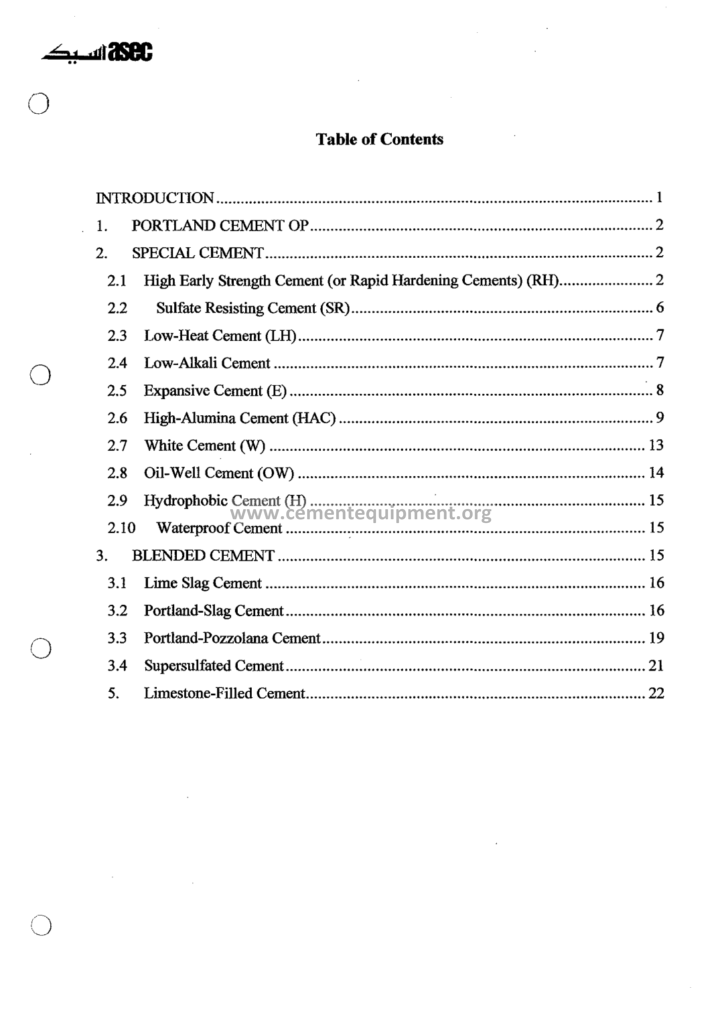
Special And Blended Cement: Complete Technical Guide
The special and blended cements are the diversified products of the modern cement industry: the family of the binders beyond the ordinary grey Portland: the sulfate-resisting, the white, the low-heat, the rapid-hardening, the masonry and the oil-well types: and the modern blends of the clinker with the slag, the fly ash, the limestone, the pozzolana and the silica fume: the cements that answer the durability, the heat, the cost and the environmental pressures of the age: the portfolio that transforms the single-product plant into the market-responsive supplier.
The Complete Cement Technical Package (931 files including the books, the courses, the Excel tools and the presentations: $249.99 one-time: instant download via the PayPal payment) includes this special and blended cement guide with the type tables, the standard references and the production practice: the article walks the file: the SCM chemistry, the blended cement types, the special Portland types, the masonry and the oil-well cements, the standards, the performance, the production and the market: the reader finishes with the complete map of the binder family of the industry.
The blended and the special cements are also the sustainability front of the industry: the clinker is the emission-heavy component (about 800 to 870 kg CO2 per ton with the fuel and the electricity chain), and every percent of the clinker substituted by the slag, the ash or the limestone cuts the emissions at the same product performance: the modern plants sell the CEM II, CEM III, CEM IV and CEM V products that the EN 197-1 system defines: this guide documents the family completely.
1. The Supplementary Cementitious Materials: The Chemistry of the Blends
The blended cements are the combinations of the Portland clinker with the SCMs, and the file opens with the chemistry of the four principal additions:
- The granulated blast-furnace slag (GGBS): the glassy byproduct of the iron blast furnaces: 35 to 45% CaO, 30 to 40% SiO2, 10 to 18% Al2O3 and the minor magnesia: the latent hydraulicity: activates with the alkali and the sulfate of the Portland clinker: the slag share in the CEM III up to 80%: the densest pore system and the best chloride resistance of the blends;
- The fly ash (the pulverized coal ash): the spherical glassy particles with the 40 to 60% SiO2 and the 20 to 35% Al2O3: the pozzolanic reaction with the CH from the clinker hydration: the class F (the low lime, the pozzolanic) and the class C (the high lime, the semi-hydraulic): the ash share of the CEM II/B-V up to 35%;
- The natural pozzolana: the volcanic ashes and the tuffs with the amorphous reactive silica: the classical pozzolana of the Roman concrete heritage: the pozzolanic reaction provides the late strength and the low heat: the CEM IV cements with the pozzolana shares of 20 to 55%;
- The limestone filler: the finely ground limestone (the calcite content above 75% and the clay content limited): the filler and the carboaluminate chemistry: the modern CEM II/A-LL and the CEM II/B-LL with the 6 to 35% limestone: the synergetic densification and the lower cost;
- The silica fume (the microsilica): the ultra-fine amorphous silica (the particle sizes below 1 micron): the 85 to 98% SiO2: the densifying pozzolana of the high-performance concretes: the 5 to 10% replacements: the premium additive of the premium concretes.
The SCM chemistry chapter of the file gives the oxide tables, the glass contents and the reactivity indices of each material: the cement plant that buys the SCMs reads their quality with the same rigor as its clinker: the acceptance tests of the SCMs (the glass content, the fineness, the activity index) fill the file’s tables: the blend chemistry, known at the source.
2. The EN 197-1 Cement Types: The Modern Classification
The European standard EN 197-1 organizes the cement family into the five principal types, and the file presents the complete classification:
| Type | Name | Clinker content % | Main additions |
|---|---|---|---|
| CEM I | Portland cement | 95 – 100 | None (only the minor constituents) |
| CEM II | Portland-composite cement | 65 – 94 | Slag, fly ash, limestone, pozzolana, silica fume |
| CEM III | Blast-furnace cement | 20 – 64 | Granulated slag 36 – 80% |
| CEM IV | Pozzolanic cement | 45 – 89 | Pozzolana and/or fly ash 11 – 55% |
| CEM V | Composite cement | 20 – 64 | Slag + pozzolana + fly ash 36 – 80% |
The standard’s structure of the file: the sub-types (the A at the lower addition, the B at the higher) and the notation examples: the CEM II/A-S 42.5N naming carries the strength class (42.5), the early-strength category (N normal, R rapid) and the addition letters: the reader of the file decodes every product name of the European market: the EN 197-1 system, the language of the modern cement conversation: the ASTM C150 system (the Types I to V) explained as its American cousin in the same chapter.
3. The Strength Classes and the Specification Requirements
The cement types are certified against the strength classes and the property limits, and the file quantifies the specifications:
- The strength classes: the 32.5, 42.5 and 52.5 classes with the N and R early categories: the 42.5N requires the 2-day strength of at least 10 MPa and the 28-day of 42.5 to 62.5 MPa: the 52.5R the 2-day of 30 MPa: the compressive testing of the standard mortars (EN 196-1): the strength classes, the contract language of the cement trade;
- The setting time limits: the initial setting time at least 45 minutes (EN 196-3) and the final at most 12 hours: the soundness (the Le Chatelier expansion below 10 mm): the mandatory minima of the standard’s Chapter 7, enforced by the certification;
- The compositional requirements: the loss on ignition, the insoluble residue and the SO3 maxima of the standard types: the chloride limits: the normative requirements that the production must hold: the certified test reports of the plants;
- The compressive-strength statistics: the conformity assessment of the certification (the average and the individual-value criteria): the conformity factor calculations of the standard: the plant’s quality system, audited by the certification bodies: the CE marking and the conformity certificates, described;
- The local standards: the ASTM C150 (the American types), the codes of the local markets: the file’s comparison tables between the EN and the ASTM product families: the engineer who exports or imports the cement reads both systems fluently.
The specification chapter of the file is the contract-level knowledge: the cement is sold by the standard’s numbers, and the file makes the numbers complete: the certification procedures, the test frequencies and the documentation requirements of the modern cement trade: the product conformity, engineered into the quality system: the cement types, certified by the book.
4. The Special Portland Cements: The White, the Sulfate-Resisting, the Low-Heat and the Rapid-Hardening
Beyond the blends, the special Portland products serve the niche markets with the tailored chemistries:
- The white cement: the Fe2O3 below 0.4% in the clinker (the low-iron raw materials and fuels) and the reducing-to-oxidizing burning: the white clinker with the low C4AF: the uses: the architectural concretes, the terrazzo, the tiles and the grouts: the white cement price premium of 1.5 to 2.5 times the grey: the market of the aesthetics, served by the chemistry;
- The sulfate-resisting cement (the CEM I-SR): the C3A capped at 5% (EN 197-1, the SR classes) with the low AR of the clinker (below 0.9): the ferrite-rich clinkers: the resistance to the external sulfate attack: the applications: the foundations, the sewage works, the marine structures in the sulfate soils: the SR product family, specified by the XA exposure classes;
- The low-heat cements (the LH classes): the heat-of-hydration limits of the standards: the CEM I-LH at the 7-day heat below 270 kJ/kg: the belite-rich clinkers with the low C3A: the mass-concrete applications: the dams and the thick foundations: the hydration-heat engineering of the package’s hydration file, applied in the product;
- The rapid-hardening cements (the R classes and the Type III): the C3S-rich clinkers (60 to 70%) with the fine grinding: the 1-day strengths of the 20 MPa class: the precast and the repair markets: the early-strength economics of the fast construction: the R products, the express lanes of the strength development;
- The low-alkali cements: the equivalent alkali below 0.6%: the reactive-aggregate concretes (the ASR prevention): the alkali balances of the clinker and the blend selections: the low-alkali production, constrained by the raw materials and the fuel choices.
The special-type chapter of the file documents each product with its chemistry, its production route, its standard limits and its market: the special cements of the plant portfolio are the high-margin products of the industry: the file’s product-development tables support the commercial launches: the special Portland family, completely mapped.
5. The Masonry Cements and the Lime-Mortar Binders
The masonry and the mortar applications use the dedicated binder family, and the file covers the products of the bricklaying trade:
- The masonry cement: the clinker ground with the high proportions of the limestone or the other fillers with the air-entraining agents: the workability and the water retention of the mortars: the applications in the block-laying and the rendering: the masonry standards (EN 413-1, the ASTM C91): the product, tuned for the trowel, not the strength chart;
- The mortar mixes: the cement-to-sand proportions of the site mortars (1:3 to 1:6 by volume) and the premixed dry mortars: the workability, the adhesion and the vapor permeability: the render performance of the facades: the mortar technology of the building envelope;
- The cement-lime mortars: the hydrated lime shares of the historical masonry: the plasticity and the self-healing of the lime-rich mortars: the restoration works of the heritage buildings: the lime chemistry of the traditional masonry, documented;
- The adhesive and the jointing products: the tile adhesives, the grouts and the repair mortars: the polymer-modified binder systems: the specialty mortars of the modern construction: the product range of the finishing trade, specified by the file’s tables.
The masonry chapter of the file gives the complete product range of the mortar side of the market: the cement plants and the dry-mortar producers find the formulations and the specifications: the binder family of the masonry, in the hands of the trowel: the mortar knowledge, as professional as the concrete knowledge.
6. The Oil-Well Cements: The Specialties of the Deep
The oil-well cements are the most demanding specialty of the industry, and the file treats the deep-well binders:
- The API classes: the classes A to J of the API Specification 10A: the class A for the shallow wells (to 1,830 m), the class G for the 2,440 m wells and the class H for the higher temperatures and the sulfate environments: the Class G and H the workhorse classes of the world’s wells;
- The requirements: the controlled C3A and the free lime, the fineness and the thickening time curves: the well cements must pump for the hours at the downhole temperatures (40 to 150 °C) and then set predictably: the cement’s thickening time, the critical contract property;
- The additive packages: the retarders (the lignosulfonates, the proprietary synthetics), the fluid-loss additives, the dispersants, the lightweight and the heavyweight extenders: the slurry designs of the drilling engineers: the well-cementing chemistry, its own discipline;
- The testing: the pressurized consistometer tests, the fluid-loss cells and the compressive-strength autoclaves: the well-cement laboratory, a specialty laboratory of its own: the file’s test menu and the API procedures;
- The market: the premium product of the industry at the multiples of the ordinary cement price: the specialty grinding lines and the dedicated plants: the oil-well cement, the professional niche of the cement business.
The oil-well chapter of the file gives the complete specialist knowledge: the classes, the chemistry and the testing: the cement engineers of the oil fields and the cement plants serving them find the reference they need: the deep-well binders, documented to the API rigor: the specialty that pays the premium of the knowledge.
7. The Production of the Blended Cements: The Finish Mill Practice
The blended cements are made in the finish grinding, and the file documents the production routes:
- The intergrinding: the clinker, the gypsum and the SCMs ground together in the finish mill: the simple and the classic route: the softer components (the limestone, the ash) grind finer than the clinker: the uniformity of the interground blend, well controlled: the intergrinding of the CEM II, the standard practice;
- The separate grinding: the clinker and the slag or the ash ground in the separate mills and blended in the mixers or the silos: the separate grinding of the hard slag (the Wi 15 to 20) at its own optimum: the blending silos with the intensive mixers: the flexibility of the separate route: the CEM III production of the large plants;
- The finishing blends: the post-grinding blending in the pneumatic mixers and the silo blenders: the homogenization of the finished cement: the blend homogeneity targets (the CV of the blend below 2 to 3%): the automatic blending of the modern plants: the product flexibility of the single grinding line;
- The moisture and the temperature control: the slag and the ash moisture (10 to 20% for the slag) handled by the mill drying: the mill outlet temperatures and the gypsum protection: the blended cement grinding at the 30 to 45 kWh/t depending on the mix: the power economics of the blends;
- The quality at the packer: the continuous sampling of the finished cement: the fineness, the SO3 and the blend-proportion checks: the conformity of the ships and the trucks: the blend production, certified at the dispatch.
The production chapter of the file gives the complete finish-side engineering: the routes, the economics and the quality systems: the plants producing the blended portfolio apply the file’s balance calculations (the clinker factor, the blend proportions, the silo management): the blended cements, produced with the discipline of the certified products.
8. The Performance of the Blends: The Strength, the Durability and the Heat
The performance profile of the blended cements is the reason for their market growth, and the file quantifies the behavior:
- The strength development: the CEM II cements with the moderate SCM shares hold the strength parity with the CEM I: the CEM III at the high slag shows the lower early (the 2-day at 50 to 70% of the CEM I) and the equal-to-better late strength (the 56 and the 91-day values): the strength-time profiles of the standard types, charted;
- The sulfate resistance: the slag-rich and the ash-rich blends resist the sulfate attack through the low CH and the densified paste: the blended cements in the XA exposures: the SR requirements met by the chemistry and the blend: the durability data of the file’s long-term studies;
- The chloride resistance: the chloride penetration resistance of the slag and the ash blends exceeds the CEM I at the same w/c: the diffusion coefficients of the blends, a factor of 2 to 5 lower in the rich blends: the marine and the de-icing environments, the blends’ home territory: the transport data of the file;
- The ASR mitigation: the SCMs dilute the alkalis and consume the CH: the reactive-aggregate concretes safe with the 25 to 40% SCM blends: the ASR prevention strategy of the file’s chapters;
- The heat of hydration: the 7-day heat of the CEM III/B at 180 to 220 kJ/kg vs the 270+ of the CEM I: the mass-concrete applications without the extra measures: the hydration-heat tables of the blends: the performance compass of the blended family, complete.
| Property | CEM I | CEM II/A-S | CEM III/A | CEM IV/A |
|---|---|---|---|---|
| 2-day strength (relative) | 100 | 90 – 95 | 60 – 75 | 75 – 90 |
| 28-day strength (relative) | 100 | 100 | 95 – 105 | 95 – 105 |
| Chloride resistance | Reference | Good | Excellent | Good |
| 7-day heat (kJ/kg) | 250 – 300 | 220 – 260 | 180 – 230 | 200 – 250 |
| Relative CO2 per ton | 100 | 80 – 90 | 45 – 60 | 70 – 80 |
The performance table of the file is the portfolio compass: each cement type earns its application through the numbers: the engineers select the product by the exposure, the strength schedule and the heat budget: the blends, selected like the professionals select: the performance data of the file, the decision support of the concrete designs.
9. The Quality Control of the Blended Cements: The Specific Tests
The blended production adds the quality dimensions of the blend itself, and the file covers the dedicated control methods:
- The blend proportion verification: the XRF-based proportion checks and the selective dissolution for the slag and the ash content: the blend proportion tolerances of the standard (± a few percent around the nominal): the proportion audits of the certification bodies;
- The SCM quality at the intake: the slag glass content (the microscopy and the XRD), the fineness, the ash LOI and the fineness: the acceptance testing of every SCM delivery: the intake control, the first quality gate of the blend;
- The cement testing per the standard: the full EN 196 test menu (fineness, setting, soundness, strength, heat for the LH classes): the blended cement conformity, certified completely;
- The heat-of-hydration testing: the EN 196-11 semi-adiabatic and the conduction calorimetry for the LH products: the heat conformity of the certified low-heat classes: the calorimetry in the plant laboratory;
- The mark and the documentation: the CE marking, the certificates of conformity and the mill test reports of each shipment: the documentation trail of the sold product: the blend quality, documented to the last bag.
The quality chapter of the file gives the complete control plan of the blended portfolio: the intake, the process and the dispatch gates with their test frequencies: the laboratory organization of the multi-product plant: the quality system of the modern cement producer, run by the file’s procedures: the blended cements, certified by the complete chain.
10. The Market and the Sustainability: The Future of the Binder Family
The blended cements are the growth products of the industry’s environmental transition, and the file closes with the strategic picture:
- The clinker factor reduction: the industry-wide drive from the clinker factor of 0.78 toward the 0.70 and below: each 1% of the clinker substitution cuts the CO2 by about 1% of the cement production: the scenarios of the file: the CEM II/A at the 85% clinker and the CEM II/B at the 70%, the portfolio of the future;
- The constraints of the blending: the SCM availability (the slag and the fly ash are the byproducts of the other industries, the steel and the power), the market acceptance of the lower early strength, the standards’ composition limits: the honest constraint analysis of the file’s strategy chapter;
- The novel additions: the calcined clays (the metakaolin of the clay calcination), the natural and the waste-derived pozzolanas, the carbonated aggregates and the recycled concrete fines: the emerging SCM families with their reaction chemistries: the research-to-production routes of the modern industry;
- The carbon-capture and the electrification: the oxyfuel and the electric calcination demonstrations, the CCS hubs of the cement clusters: the future of the clinker itself: the integrated decarbonization roadmaps of the industry, summarized by the file;
- The commercial strategy: the product differentiation, the certification investments and the customer education: the market pull of the sustainable concretes and the green building schemes: the blended portfolio, the commercial engine of the transition: the cement industry’s product strategy, documented.
The strategy chapter of the file gives the reader the full picture of the industry’s direction: the blends are not only the technical products but the strategic products: the engineer and the manager of the package read the same chapter and plan the portfolio: the special and the blended cements, the products of the past, the present and the future of the industry.
11. The Logistics and the Dispatching of the Blended Portfolio
The multi-product portfolio reaches the market through the logistics chain, and the file covers the dispatch engineering of the blended cements:
- The storage segregation: the separate silos for the different cement types: the empty-between-changes discipline and the changeover purging: the cross-contamination of the cement silos, the invisible quality failure: the silo management plans of the file: the product purity of the dispatch, engineered by the storage discipline;
- The load-out systems: the bulk loading of the tankers (the clamshell fills and the dust extraction), the bag packing lines (the 25 and 50 kg bags at the 1,000 to 4,000 bags per hour) and the big-bag and the container loading: the packing plant with its palletizing and the shrink-wrapping: the dispatch equipment of the modern plant, matched to the product mix;
- The quality at the dispatch: the final samples of every load, the mill certificates of the shipment and the retention samples: the conformity documentation of the loads, the certifying laboratory’s reports: the traceability of the cement from the silo to the truck and the shop: the dispatch QC, the last gate of the product;
- The inventory and the planning: the storage planning of the cement types (the 3 to 7 days of the dispatches), the production scheduling against the demand mix and the seasonal peaks: the silo inventory turns and the stale-cement risks (the setting-time drifts of the old cement): the commercial planning of the portfolio, served by the silo data;
- The export operations: the clinker and the cement exports in the bulk carriers, the shipping moisture and the temperature controls, the export documentation: the international trade of the binder products, operated with the file’s checklists: the logistics of the blended portfolio, from the silo to the world.
The logistics chapter of the file completes the product chain of the binder family: the quality made in the mill survives only through the disciplined storage and the dispatch: the plants with the multi-product portfolios run the segregation and the load-out procedures of the file as the daily operations: the special and the blended cements, delivered as the certified products: the complete chain of the binder family, documented end to end.
12. The Frequently Asked Questions
What is the difference between the pozzolana and the slag in the cements?
The slag is the latent-hydraulic material: it hardens on its own once activated by the alkalis and the sulfates of the Portland clinker: the pozzolana is the reactive-silica material that hardens only by reacting with the CH released by the clinker: both reduce the clinker share and both improve the durability, through the different chemistries: the slag in the CEM III, the pozzolana in the CEM IV.
Why are the blended cements slower in the early strength?
The SCMs dilute the fast-reacting clinker phases: the alite share per unit mass falls and the early hydration slows: the late chemistry (the pozzolanic and the slag reactions) compensates with the equal or better long-term strength: the 28-day parity and the 90-day advantage of the good blends: the speed-versus-durability choice of the applications.
Which cement should I use for the marine structures?
The chloride-rich marine exposures favor the slag-rich cements (the CEM III/A with 50%+ slag) or the ash blends at the low w/c: their denser pore systems and the reduced CH give the 2-to-5-fold better chloride penetration resistance: the concrete cover and the low w/c (below 0.45) still apply: the combination of the blend and the mix discipline wins the marine specification.
Are the special cements much more expensive?
The white cement sells at the 1.5 to 2.5 times the grey price, the oil-well cements at several multiples: the sulfate-resisting and the low-heat products at a modest premium of 10 to 30%: the blended cements cost generally below the CEM I (the lower clinker share): the premium of the specialty matches its production cost and its market value: the portfolio pricing, rational.
Does the package cover the standards of the special cements?
Yes: the file covers the EN 197-1 types, the EN 413 masonry standard, the EN 196 test methods, the ASTM C150 and C595, and the API Specification 10A for the oil-well classes: the complete standard landscape of the binder family, with the type tables and the requirement summaries: the certification knowledge of the package, complete.
13. Conclusion
The special and the blended cements: the SCM chemistry, the standard types, the strength classes, the special Portland products, the masonry and the oil-well binders, the production routes, the performance profiles, the quality control and the market strategy: the complete map of the modern binder family: the products beyond the single grey bag: the durability, the heat, the cost and the CO2 of the industry, engineered through the portfolio: the special and the blended cements, the products of the transition: the guide of the package, the complete reference of the family.
The Complete Cement Technical Package includes the special and blended cement guide with the type tables, the standard summaries and the production practice: the one-time $249.99 purchase, the instant download and the lifetime access: the 931 files of the library: the cement product knowledge of the industry, at the hand of the professional.
Get this blended cement file + the full 931-file package
$249.99 — one-time purchase, instant download, lifetime access
This file is part of the Complete Cement Technical Package (931 files) available from cementequipment.org. Respective rights holders; library copy for the licensed single user.