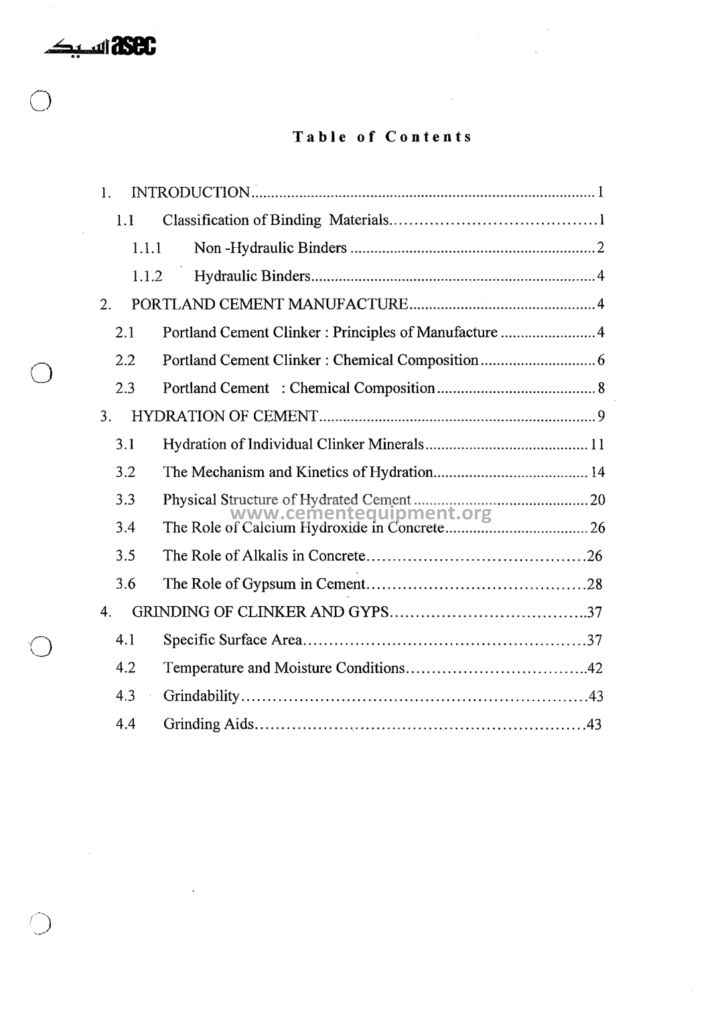
Cement Hydration: Chemistry & Kinetics
The cement hydration is the chemistry at the end of the cement chain: the reactions between the cement and the water that transform the powder into the hardened paste: the alite and the belite to the calcium silicate hydrate, the aluminate to the ettringite and the monosulfate: the reactions that give the concrete its strength, the mortar its bond and the plaster its form: the hydration is the entire purpose of the cement industry: everything the plant produces exists to hydrate well.
The Complete Cement Technical Package (931 files including the books, the courses, the Excel tools and the presentations: $249.99 one-time: instant download via the PayPal payment) includes this hydration guide with the reaction tables, the kinetics charts and the microstructural tools: the article walks the file: the hydration products, the phase reactions, the kinetics of the setting, the heat evolution, the microstructure, the factors of the hydration and the practical consequences: the reader finishes with the complete quantitative picture of the cement-water system.
The hydration science is also the engineering language between the cement plant and the user: the setting time, the early strength and the durability of the concrete are all the visible faces of the hydration chemistry: the cement engineer who knows the hydration answers the questions of the customers, the laboratory and the process: the chemical heart of the cement, documented completely in this guide.
1. The Hydration Products: What the Reactions Create
The hydration of the Portland cement creates the small family of products that fill the paste, and the file opens with their identity:
- The calcium silicate hydrate (C-S-H): the principal product (50 to 60% by volume of the hydrated paste): the poorly-crystalline gel that binds the paste together: the carrier of the strength: its C/S ratio of 1.5 to 2.0 and its variable structure define its properties: the C-S-H is the glue of the cementitious system;
- The calcium hydroxide (CH, portlandite): the crystalline product (20 to 25% by volume): the byproduct of the silicate reactions: it buffers the pore solution pH above 12.5 and protects the steel: it also represents the vulnerability of the paste to the leaching and the carbonation: the CH, the strength’s companion and the durability’s weak point;
- The ettringite (AFt): the high-sulfate aluminate hydrate: the needle-shaped crystals that form in the first hours: the setting regulator product: its formation consumes the sulfate and the C3A: the initial structure of the paste, laid by the ettringite;
- The monosulfate (AFm): the low-sulfate aluminate hydrate: the converted product when the sulfate is exhausted: the plate-like crystals: the phase balance of the aluminate hydrates, governed by the sulfate availability;
- The other minor products: the hydrogarnet, the hydrotalcite and the ferrite hydrates: the microcrystalline fillers of the paste: their quantities small and their influences real: the complete phase census of the hydrated paste.
| Product | Approx. volume % of paste | Role | Form |
|---|---|---|---|
| C-S-H | 50 – 60 | Strength and the binding | Gel, interlocking needles |
| Calcium hydroxide | 20 – 25 | pH buffer, the portlandite crystals | Hexagonal plates |
| Ettringite (AFt) | 10 – 15 (early) | Setting control | Needles |
| Monosulfate (AFm) | 5 – 10 (late) | Aluminate hydration | Thin plates |
| Pores and the capillary water | 20 – 30 | Transport and the durability | Voids, channels |
The phase table of the file is the census of the hardened paste: the volume fractions tell the engineer where the strength comes from (the C-S-H) and where the risks live (the CH and the pores): the remedies of the modern concretes (the SCMs, the low w/c) all act on this census: the product family, known by name.
2. The Reactions of the Phases: The Stoichiometry of the Hydration
The individual phases react with the water in the stoichiometric equations, and the file presents the chemistry in the engineer’s form:
- The alite hydration (the abbreviation in the cement notation): 2C3S + 6H → C3S2H3 + 3CH: the principal reaction of the early and the ultimate strength: the alite reacts fast (the 50% in the first 2 to 3 days at 20 °C) and releases the most heat (about 500 to 520 kJ per kg reacted);
- The belite hydration: 2C2S + 4H → C3S2H3 + CH: the slower reaction (the 50% after 2 to 4 weeks): the belite releases about 260 kJ per kg: the belite-rich cements hydrate slowly and develop the strength later: the low-heat behavior of the belite-rich clinkers explained;
- The aluminate hydration with the sulfate: C3A + 3CaSO4 + 32H → C3A · 3CaSO4 · 32H (ettringite): the rapid reaction moderated by the gypsum: the flash-set prevention is the sulfate’s job: after the sulfate exhausts, the ettringite converts to the monosulfate C3A · CaSO4 · 12H: the sulfate balance of the cement, regulated at the finish mill;
- The ferrite hydration: the C4AF reacts similarly with the water and the sulfate to the ferrite ettringite and the monosulfate analogs: the slower and the less heat-releasing reaction: the ferrite’s contribution to the durability of the sulfate environments;
- The water consumption: the full hydration binds about 22 to 25% of the cement mass as the chemically bound water: the practical w/c of 0.40 provides the reaction water plus the space-filling water: the stoichiometry, the anchor of the moisture calculations of the paste.
The reaction chapter of the file teaches the equations in the cement notation (the C, S, A, F, H shorthand) that the literature of the industry uses universally: the reader who learns the notation reads the whole cement chemistry literature: the stoichiometric numbers (the heat release, the water demand) come from the same chapter: the chemistry, quantified.
3. The Kinetics of the Hydration: The Time Law of the Strength
The hydration proceeds through the stages that the kinetic studies of the file document hour by hour:
- The initial hydrolysis: the first minutes: the surface wetting and the dissolution of the aluminate and the sulfate: the ionic concentrations rise in the pore solution: the first heat peak;
- The induction (dormant) period: the 1 to 3 hours: the slow reactivity of the alite while the solution supersaturates: the workability window of the concrete: the retarders extend the induction, the accelerators shorten it: the induction, the handle of the set-time control;
- The acceleration period: the 3 to 12 hours: the alite hydration accelerates, the C-S-H grows, the setting passes to the hardening: the main heat peak at the 8 to 12 hours: the strength starts its climb;
- The deceleration period: the 1 to 7 days: the diffusion-limited growth as the hydrate layers thicken: the 7-day strength at 65 to 75% of the 28-day value: the continued densification of the paste;
- The long-term consolidation: the weeks to the years: the slow completion of the alite and the belite: the 28-day strength the conventional reference, the year strength 120 to 135% of the 28-day: the strength-time curve of the file, with the temperature dependence: the hydration law, the law of the strength development.
The kinetics chapter connects the chemistry to the calendar of the site: the setting window, the striking times and the curing durations all read the same curve: the file’s charts give the hydration degree as the function of time and temperature for the ordinary and the blended cements: the kinetics, the time dimension of the hydration: the strength, predicted by the curves.
4. The Heat of Hydration: The Thermal Companion of the Reactions
The hydration releases the heat that engineers the massive structures, and the file quantifies the thermal behavior:
- The total heat: the complete hydration of the ordinary Portland cement releases 300 to 500 kJ per kg: the C3A the hottest (1,340 kJ/kg), the alite next (about 500 kJ/kg), the belite lower (260 kJ/kg) and the ferrite lowest (420 kJ/kg of the complete reaction of the phases): the phase composition, the thermostat of the paste;
- The heat evolution curve: the classical peaks: the initial wetting peak, the induction valley, the main aluminate-alite peak at the 8 to 12 hours: the isothermal-conduction calorimetry of the laboratory: the calorimeter curves of the file’s test module;
- The mass-concrete problem: the large pours of the dams and the thick foundations heat internally: the core temperatures 30 to 50 °C above the ambient: the differential thermal cracking when the gradients exceed the 15 to 20 °C per meter: the measures: the low-heat cements (the C3A and the C3S caps), the fly ash and the slag substitution, the cooling pipes, the staged pours;
- The hydration degree and the heat: the heat released is the calorimetric measure of the hydration progress: the engineers follow the strength development through the heat in the field tests (the semi-adiabatic tests): the calorimetry as the hydration’s thermometer: the file’s heat-exposure tables for the different cement types;
- The frost risk: the cold weather delays the hydration and the heat release: the concrete below 5 °C barely hydrates: the winter concreting with the heating and the protection: the hydration and the season, engineered together.
The heat chapter of the file includes the calorimetric data tables of the ordinary cement types and the practical formulas of the temperature rise in the mass sections: the hydration heat, the natural companion of the strength: the engineer who plans the massive structures plans the heat: the numbers of the file make the plan quantitative.
| Clinker phase | Approx. heat of hydration (kJ/kg) | Reaction speed |
|---|---|---|
| C3A | 1,300 – 1,380 | Very fast (minutes to hours) |
| C3S (alite) | 500 – 520 | Fast (days) |
| C4AF | about 420 | Medium (days to weeks) |
| C2S (belite) | 250 – 260 | Slow (weeks to months) |
5. The Microstructure: The Architecture of the Hardened Paste
The strength and the durability of the paste are the architecture of its microstructure, and the file explains the structural science:
- The capillary pores: the water-filled spaces that the hydration never fills: the volume fraction falls with the w/c and the hydration degree: the w/c 0.60 paste leaves 30 to 40% capillary porosity, the w/c 0.35 below 15%: the pore size (the 10 nm to 10 μm) decides the permeability: the durability, set by the pores;
- The gel pores: the tiny internal spaces of the C-S-H (the 0.5 to 3 nm): the gel porosity of 25 to 30% is intrinsic to the C-S-H itself: the gel pores hold the adsorbed water and contribute the shrinkage behavior: the two pore families, the two properties;
- The C-S-H morphology: the inner and the outer products: the dense inner C-S-H near the original grain and the fibrous outer product in the water space: the microstructure images of the file’s SEM plates: the growing solid skeleton, documented;
- The interfacial transition zone (ITZ): the thin zone of the higher porosity around the aggregates (the 10 to 40 μm): the wall effect and the bleeding: the ITZ, the weak link of the concrete: the SCMs and the low w/c densify the zone: the microstructure at the aggregate, explained;
- The porosity-to-strength law: the strength falls with the total porosity by the classical power relations: the 0.30 w/c pastes reach the 80 MPa, the 0.60 pastes the 25 MPa: the microstructure, the physical translation of the w/c discipline.
The microstructure chapter of the file gives the microscopy plates and the porosimetry data: the mercury-intrusion porosimetry curves of the ordinary and the blended pastes: the reader sees why the concrete fails, leaks and freezes through its pores: the microstructure, the materialization of the chemistry: the durability, read from the microstructure.
6. The Factors of the Hydration: The Levers of the Engineer
The hydration responds to the controlled factors, and the file systematizes the levers of the engineer:
- The w/c ratio: the master lever: the lower w/c, the denser paste and the higher strength: the 0.30 vs 0.60 pastes more than double the strength: the w/c also decides the amount of the water available for the complete hydration: the practical minimum for the full conversion about 0.38 to 0.42;
- The temperature: the hydration accelerates with the temperature (double the rate per 10 °C near the ambient range): the curing at the 20 °C standard, the accelerated curing (the steam at 60 to 90 °C) for the precast: the high temperatures also change the product morphology (the denser shells around the grains): the temperature, the kinetics lever;
- The fineness of the cement: the finer cement hydrates faster (the more surface): the Blaine 4,500 cm²/g cement reaches the higher early strength than the 3,000: the fineness also raises the water demand and the heat peak: the particle size, the reactivity lever;
- The cement composition: the C3S and the C3A accelerate the early hydration, the belite and the ferrite slow it: the sulfate content moderates the aluminate: the cement type selection, the prescription of the hydration rate;
- The admixtures: the retarders (the lignosulfonates, the sugars in tiny doses) and the accelerators (the calcium chloride, the triethanolamine): the set-time and the early-strength levers of the site: the admixture chemistry of the file’s chapter;
- The SCMs: the fly ash and the slag dilute the Portland clinker and slow the early hydration but the pozzolanic reactions consume the CH and densify the later paste: the long-term strength and the durability gains: the blended cement hydration, its own regime.
The factor chapter of the file is the summary table of the levers with their quantitative effects: the engineer who wants the faster set, the higher early strength or the better durability finds the correct lever in the table: the hydration, controllable by the informed hand: the complete lever board, documented.
7. The Setting and the Early Hardening: The First Hours
The setting is the process window between the mixing and the hardening, and the file covers the practical mechanics:
- The Vicat setting times: the initial set at the 1.5 to 4 hours and the final set at the 3 to 8 hours for the ordinary Portland: EN 196-3 testing: the classification of the standards (the rapid and the normal and the slow types): the setting window, the operational clock of the concrete;
- The mechanisms: the C-S-H bridges between the grains raise the viscosity (the initial set) and the network stiffens (the final set): the aluminate-ettringite interplay in the first minutes: the gypsum’s moderation role: the setting, the first mechanical signature of the hydration;
- The false set: the apparent stiffening from the gypsum dehydration (the hemihydrate rehydration) that breaks down with the further mixing: the diagnosis and the avoidance: the false-set cases of the too-hot mill conditions, documented;
- The flash set: the rapid irreversible stiffening from the C3A reaction without the adequate sulfate: the sulfate balance failure: the remedies in the finish mill’s gypsum dosing and the inter-grinding temperature control: the two sets, the two chemistries, the two remedies;
- The early strength: the 1-day strength at 15 to 25% of the 28-day: the striking times and the load build programs follow the early curve: the early-hardening accelerators of the precast industry: the first hours of the paste, engineered.
The setting chapter of the file gives the complete practical guide of the first hours: the test methods, the mechanisms, the defects and the corrective actions: the site teams and the cement laboratories share the same vocabulary of the file: the setting, the hydration’s first public appearance: managed and measured.
8. The Hydration of the Blended Cements: The SCM Regime
The blended cements dominate the modern markets, and the file dedicates the full section to their hydration chemistry:
- The dilution and the nucleation: the slag and the fly ash dilute the Portland clinker: the early hydration slows, the hydration degree of the clinker phase rises (the additional space for the growth): the net early strength depends on the blend percentage: the 20 to 30% substitutions hold the early strength well;
- The pozzolanic reaction: the amorphous silica of the fly ash and the natural pozzolanas reacts with the CH to the additional C-S-H: 2CH + SiO2 + H → C-S-H: the reaction needs the CH of the clinker: the long-term densification and the strength beyond the 28 days: the pozzolanic contribution, the late gift of the blend;
- The slag activation: the granulated blast-furnace slag hydrates on its own only slowly: the alkali and the sulfate of the Portland clinker activate it: the C-S-H-rich product with the low CH content: the CEM III cements with the 66 to 80% slag: the sulfate environments, well served;
- The limestone interaction: the limestone filler (the CEM II/A-LL up to 20%) reacts partially with the aluminate to the carboaluminate hydrates: the synergy with the C3A: the limestone cements with the dense paste and the good early strength, at the lower cost: the carbonate chemistry of the modern blends;
- The heat and the durability profile: the blended pastes release the less early heat (the low-heat applications), consume the CH (the improved chloride resistance, the lower ASR risk) and densify late: the hydration regime of the blends, engineered for the specific exposures: the blended cement hydration, completely characterized.
The blended-hydration chapter of the file gives the reaction models and the performance data of the modern blends: the cement plants of the package produce the very blends this chapter explains: the reader closes the loop from the plant’s product portfolio to the hydration behavior: the blends, understood as the chemistry of the future cements.
9. The Hydration and the Environment: The Chemical Attacks
The durability of the hydrated paste against the environmental attacks completes the applied science of the file:
- The carbonation: the atmospheric CO2 dissolves into the pore water and neutralizes the CH: the pH drops from the 12.5 to below 9: the steel loses its passivation: the carbonation depth grows with the square root of the time: the low-w/c dense pastes resist best: the carbonation, the slow thief of the cover;
- The chloride ingress: the diffusion of the chlorides through the pore network to the steel: the threshold of the chlorides at the steel of 0.4 to 1.0% of the cement mass: the densification (the low w/c, the SCMs) and the corrosion inhibitors: the marine concretes, engineered against the transport;
- The sulfate attack: the external sulfates react with the CH and the monosulfate to the expansive ettringite and the gypsum: the cracking and the spalling of the paste: the sulfate-resisting cements (the low C3A below 5%) and the dense mixes: the XA exposures of the EN 206 classes, specified in the file;
- The acid and the leaching: the acids dissolve the CH and the C-S-H: the soft water leaches the calcium: the degradation of the sewer and the industrial structures: the surface protections and the resistant mixes: the chemistry of the attack and the defence;
- The freeze-thaw: the freezing water expands in the saturated pores and destroys the paste: the air-entrained microstructure (the 4 to 7% air) gives the relief spaces: the protection of the pore system, engineered: the environmental chemistry of the hardened paste, the file’s closing science.
The environment chapter of the file is the bridge from the hydration chemistry to the durability engineering: the same paste that gains the strength faces the attacks: the hydrated microstructure is the defence: the file’s attack mechanisms, the prediction tables and the resistant prescriptions serve the durability design of the structures: the hydration, understood in its lifetime context.
10. The Test Methods of the Hydration: The Laboratory Tools
The hydration is studied in the laboratory with the fixed methods, and the file documents the instrumental menu:
- The calorimetry: the isothermal-conduction calorimetry (EN 196-11 for the heat of hydration): the heat-evolution curves of the cements: the 7-day heat of the OPC at 200 to 300 kJ/kg: the heat release, the kinetics thermometer;
- The X-ray diffraction: the phase quantification of the unhydrated and the hydrated samples: the Rietveld refinement of the clinker and the paste: the hydration degrees of the individual phases: the phase census, directly measured;
- The thermal analysis (TGA/DSC): the CH content by the dehydration peak (400 to 500 °C) and the C-S-H and the carboaluminates by their decomposition ranges: the mass-loss curves of the paste: the degree of the hydration, measured gravimetrically;
- The scanning electron microscopy: the microstructure imaging, the backscattered images with the phase contrast: the ITZ studies and the morphology documentation: the visual truth of the hydration: the SEM plates of the file’s atlas;
- The porosimetry: the mercury intrusion for the pore-size distributions: the porosity of the paste vs the w/c and the age: the transport coefficients from the pore data: the microstructure, quantified: the complete instrumental suite of the modern cement laboratory, described with the sample preparations of the file.
The test chapter of the file gives the laboratory the complete procedure references and the interpretation guides: the hydration science in the industrial laboratory, not only in the research institute: the plants and the university teams both use the file’s methods: the hydration, measured with the modern instruments: the science of the cement, verified daily.
11. The Practical Significance: Hydration in the Plant and the Site Decisions
The hydration science serves the daily decisions of the cement plant and the construction site, and the file closes its applied chapters with the practical significance table:
- The cement sales and the technical support: the hydration knowledge answers the customer’s questions: the early strength of the rapid-hardening products, the setting behavior of the hot weather, the heat of the mass foundations: the technical sales engineers of the cement companies apply the hydration curves of the file in the customer consultations: the science, the commercial service;
- The mix verification: the concrete producers verify the cement batches with the setting-time and the strength tests: the hydration-linked specifications of the EN 196 and the ASTM C150: the acceptance of the delivered cement, tied to the hydration behavior: the quality contracts of the trade, executed on the hydration tests;
- The troubleshooting of the site problems: the slow setting, the quick set, the strength failures and the cracking investigated with the hydration mechanisms: the diagnosis paths of the file’s earlier chapters: the remedies documented: the site problems, solved at the chemical root:
- The research and the development: the new cement formulations and the new blends evaluated with the calorimetry and the hydration analyses: the development of the low-carbon cements guided by the kinetic data: the R&D laboratories of the industry, served by the methods of the file;
- The educational value: the hydration course is the bridge between the cement chemistry and the concrete practice: the trainers of the industry use the file’s charts in the operator and the engineer programs: the hydration, taught as the connecting science of the cement industry: the educational summary, the file’s final service.
The practical chapter of the file makes the science operational: the hydration curves and the mechanisms return in the daily decisions of the sales, the quality and the site teams: the reader who studies the complete file carries the chemistry into every cement conversation of the working life: the science, applied: the hydration knowledge of the industry, complete in the guide.
12. The Frequently Asked Questions
How long does the cement hydration actually take?
The rapid part completes in the first 28 days (the conventional reference), the alite in the first weeks and the belite over the months: the full hydration can continue for the years in the moist conditions: the 28-day strength at 100%, the year strength at 120 to 135%: the practical view: the useful hydration span is the years, engineered to the decades of the structure’s life.
Why does the cement get hot when it hydrates?
The hydration reactions are exothermic: the alite releases about 500 kJ per kg and the aluminate more than the kilojoules per kg of the order of 1,300: the heat of the mass concrete raises the core temperature by 30 to 50 °C: the low-heat cements and the SCMs limit the peak for the massive structures: the heat is the natural companion of the strength formation.
What happens if the concrete dries before the hydration is finished?
The hydration stops when the water leaves: the unreacted cement remains in the dry paste and the strength stays below the potential: the properly cured concrete gains the strength for the months, the dried one stops at its early level: the later rewetting does not fully restore the hydration: the curing discipline protects the hydration’s time budget.
Is the hydration the same for the blended cements?
No: the blended cements add the second chemistry: the pozzolanic reactions of the fly ash and the natural pozzolanas with the CH, the alkali-activated slag hydration and the limestone carboaluminate formation: the early reactions slow and the late ones continue longer: the low-heat and the improved durability profiles of the blends, the direct consequences of their distinct hydration.
Does the package include the hydration calculation tools?
Yes: the Complete Cement Technical Package includes the hydration-degree and the heat-evolution calculation sheets with the phase stoichiometry and the strength prediction curves: the 931 files of the library include the calculators, the courses and the books: the hydration science of this article, executable by the tools of the package.
13. Conclusion
The cement hydration: the products, the reactions, the kinetics, the heat, the microstructure, the levers, the setting, the blends, the environment and the tests: the complete chemistry of the cement-water system: the science that turns the powder into the structure: the engineer who masters the hydration understands the final purpose of everything the plant makes: the strength, the durability and the behavior of the concrete, all born in the reactions of this guide: the hydration, the last chemistry of the cement chain, understood completely.
The Complete Cement Technical Package includes the hydration guide with the reaction tables, the kinetics charts and the laboratory methods: the one-time $249.99 purchase, the instant download and the lifetime access: the 931 files of the library: the cement chemistry knowledge, at the hand of the professional.
Get this hydration file + the full 931-file package
$249.99 — one-time purchase, instant download, lifetime access
This file is part of the Complete Cement Technical Package (931 files) available from cementequipment.org. Respective rights holders; library copy for the licensed single user.