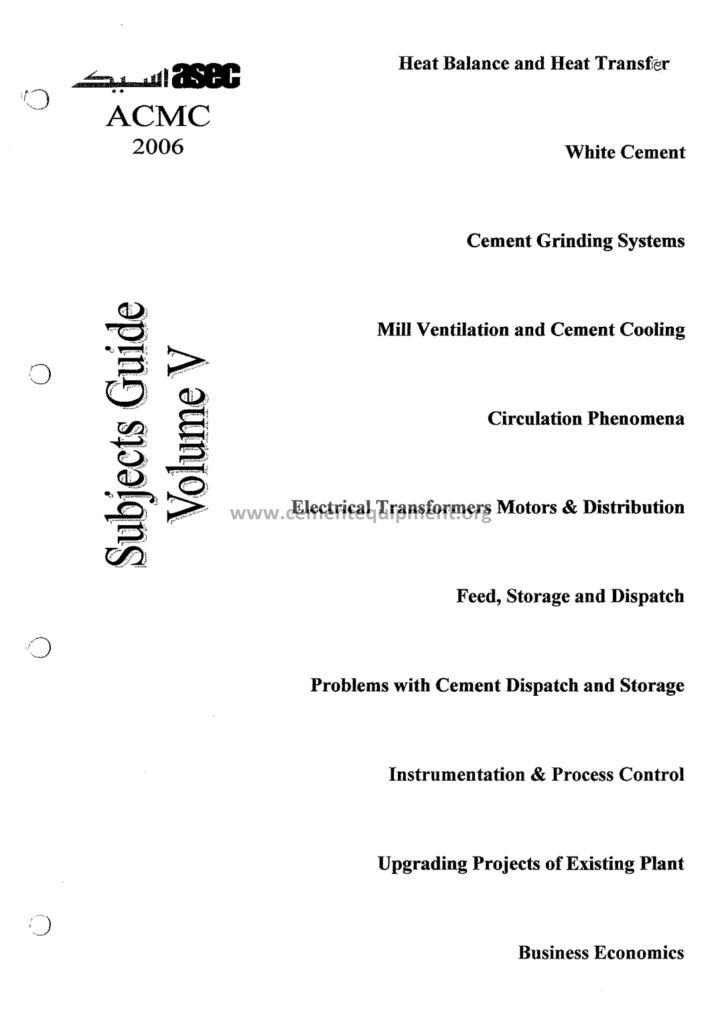
Acmc Vol: Complete Technical Guide
Volume 5 of the Advanced Cement Manufacturing Course (ACMC) is the products volume of the series: the volume that leaves the kiln line and the mill hall to follow the cement from the moment it leaves the finish mill to the moments of its life in the concrete. The course builds the engineer from the raw materials to the shipped product, and the fifth volume is the last link of that chain: the chemistry that makes the product valuable, the tests that verify it and the standards that govern it.
This volume is written for the production engineer who wants to understand what the plant actually makes, for the quality engineer who certifies it and for the technical salesman who must defend it. The chapters carry the numbers of the industry, the worked examples of the real plants and the exercises that turn the reading into the skill. The volume is the completion of the course: without it, the graduate knows how to burn the clinker but not what the clinker becomes.
1. The Place of Volume 5 in the ACMC Course
The course follows the cement process from the quarry to the certificate, and Volume 5 is the destination of the whole program:
- The course chain: the raw materials and the chemistry (Volume 1), the raw grinding and the homogenization (Volume 2), the pyroprocess and the kiln systems (Volume 3), the cement grinding and the process control (Volume 4), and the products: the chemistry, the quality and the application (Volume 5): the last volume receives the engineer who has already walked the plant;
- The knowledge assumed: the clinker burning, the cooling and the finish grinding of the earlier volumes: Volume 5 assumes the engineer knows how the clinker was made and what the process control can and cannot do;
- The knowledge delivered: the phase chemistry of the clinker, the hydration of the cement, the types of the products, the testing of the laboratory and the selection of the cement for the application: the knowledge the engineers of the cement company share with their customers;
The volume completes the course in the way the product completes the plant: the course is not finished until the graduate can answer the question the customer asks, the question of what the cement will do in the concrete.
2. The Phase Chemistry of the Clinker: The Four Actors
The chapters of the volume open the product knowledge with the phases, because every property of the cement is written in the phase composition of the clinker before the grinding:
- The alite C3S: the mineral that carries the early strength and the heat: 55-70% of the ordinary clinker, crystallized in the burning zone as the hexagonal prismatic crystals of the microscope, hydrating fast and determining the 1-day to the 28-day strength: the mineral of the modern high-early cement;
- The belite C2S: the mineral of the slow and the late contribution: 15-30% of the clinker, formed already in the preheater and the calciner, hydrated at the later ages, giving the long-term strength with the low heat: the mineral of the mass concrete and the low-heat mixes;
- The aluminate C3A: the reactive mineral of the early moments: 5-12% of the clinker, the largest consumer of the sulfate and the cause of the flash set when the gypsum is absent: the mineral the set-regulating gypsum exists for;
- The ferrite C4AF: the iron mineral of the low reactivity: 5-12% of the clinker, colored black-brown and responsible for the gray shade of the cement: its burning-easy fusible behavior helps the kiln at the moderate temperatures;
The phase chapters of the volume give the crystal habits, the formation temperatures, the typical contents of the different cement types and the implications of every variation: the phase composition is the DNA of the cement, and the volume teaches its reading.
3. The Arithmetic of the Composition: The Bogue Calculation in the Course
Volume 5 applies the Bogue calculation the way the plant applies it: as the daily instrument of the quality control and the product planning:
- The standard formulas: the C3S from the CaO, the SiO2, the Al2O3 and the Fe2O3 with the coefficients of the classical scheme, the C2S from the remaining silica, the C3A from the alumina beyond the ferrite ratio and the C4AF from the iron: the four lines of arithmetic the quality chemist types daily;
- The honest limits: the Bogue phases assume the full equilibrium and the pure minerals: the actual clinker holds the minor components in the solid solution, and the Bogue numbers differ from the microscopic reality by the few percent: the volume states the limits so the user reads the number with the eye open;
- The use in the planning: the target Bogue values of the plant, the corrections of the raw mix, the expected strength band and the cement type allocation: the formulas become the planning instrument that connects the quarry chemistry to the silo content;
The Bogue chapters close with the worked example on the real oxide analysis of a Portland clinker: the reader performs the calculation by hand, compares the result with the microscope count and learns the tolerance of the instrument he will use all his career.
4. The Hydration of the Four Phases: The Chemistry of the Setting and the Hardening
The hydration chapters of the volume carry the central teaching of the product knowledge, and the numbers of the table below accompany every further chapter:
| Phase | Typical content in CEM I | Heat of hydration kJ/kg | Strength contribution | Reaction speed |
|---|---|---|---|---|
| Alite C3S | 55-65% | ~500 | Early and continued (1-28 days) | Fast |
| Belite C2S | 15-25% | ~260 | Late (beyond 7 days) | Slow |
| Aluminate C3A | 6-10% | ~1340 | Little direct, strong early reaction control | Very fast |
| Ferrite C4AF | 6-10% | ~420 | Small | Fast, moderate |
The hydration proceed follows the sequence every concrete engineer knows in practice: the aluminate and the sulfate fight in the first minutes while the ettringite forms; the alite joins within the hour and the C-S-H begins its growth; the setting arrives when the C-S-H bridges the grains; and the hardening continues with the belite for the years. The chapters explain each event with the chemistry, the quantities and the measurable consequences: the setting time, the heat, the strength and the porosity.
The practical numbers of the volume accompany every hydration chapter: the water demand of the normal consistency at 25-30% for the standard cements, the initial setting at 90-300 minutes, the final setting at 180-600 minutes, the 2-day strength of the R classes above the 20 MPa and the 28-day strength of the 42.5 classes in the 42.5-62.5 MPa band. The same chapters give the consequences of the temperature: the hydration accelerates by roughly the factor of two for every 10 degrees Celsius of the rise, the winter concrete waits, and the summer concrete must be protected from the heat of its own chemistry: the volume quantifies the calendar of the strength with the maturity concept of the curing control.
5. The Sulfate Regulation: The Gypsum Balance of the Cement
The sulfate chapters of Volume 5 treat the addition that decides the workability and the setting of the product:
- The mechanism: the calcium sulfate reacts with the dissolved aluminate and forms the ettringite at the grain surface: the barrier slows the water access and tames the flash set: the gypsum is the traffic light of the early hydration;
- The optimum SO3: the balance point where the strength is the maximum and the expansion the minimum: typically 2.5-3.5% SO3 for the ordinary Portland clinker, shifting with the C3A and the alkalis: the volume gives the plant optimization trials;
- The forms and the false set: the dihydrate, the hemihydrate and the anhydrite, the dehydration of the gypsum in the hot mill, and the false set of the overheated cement in the silos: the diagnostic of the setting complaints of the ready-mix customer;
- The interference: the alkalis of the clinker compete for the sulfate in the pore solution: the alkali-rich clinkers need the higher sulfate, and the volume quantifies the interaction with the examples of the high-alkali plants;
The sulfate chapters give the quality engineer the diagnostic table of the setting problems: the flash set, the false set, the rapid set and the admixture incompatibility, each with the cause chain and the correction in the plant.
6. The Products of the Standards: The EN 197-1 and the ASTM C150 Families
The product chapters of the volume present the cement types the market buys, with the standard clauses the engineer must navigate:
- The EN 197-1 families: the CEM I to the CEM V with the composition brackets of the main constituents: the table of the 27 common cements with the notation the readers of the certificates meet daily;
- The ASTM C150 types: the Types I to V with the chemistry and the performance limits: the alternative alphabet of the world specification practice;
- The strength classes and the early classes: the 32.5, 42.5 and 52.5 with the N, the R and the L suffixes: the class decides the application, the price and the production planning of the mill;
- The conformity requirements: the limits of the standard deviation, the characteristic strength and the release rules: the statistical language of the certificate;
The chapters compare the two main standard systems side by side, because the same company often certifies for the home standard and the export standard, and the volume gives the translation table between the EN and the ASTM designations.
7. The Blended Cements: The Chemistry of the Additions
The volume devotes its longest chapter group to the blended cements, because they are the majority of the world production and the future of the industry:
- The slag cements (CEM III): the latent hydraulic glass of the blastfurnace, activated by the portlandite and the sulfate of the hydrating clinker: the lower heat, the better sulfate and marine resistance, the slower early strength: the volume explains the activation chemistry and the grinding strategy of the hard slag;
- The pozzolanic cements (CEM IV): the natural pozzolana and the calcined materials: the pozzolanic reaction consumes the portlandite and densifies the paste: the longer-term strength and the chloride protection of the marine concrete;
- The limestone cements (CEM II/A-LL): the calcite particles that nucleate the C-S-H, stabilize the ettringite and fill the pores: the modern cement of the European construction with the 6-20% limestone: the chemistry that turned the filler into the component;
- The composite cements (CEM V): the combinations of the slag, the pozzolana and the clinker in the balanced recipes: the flexibility of the product design for the performance and the CO2;
Every addition chapter gives the dosage range, the chemistry of its reaction, the grinding consequences, the strength curve and the durability profile: the reader finishes the group able to design a blended cement budget for his own market.
8. The Quality Control of the Product: The Laboratory of the Course
The volume carries the laboratory of the cement plant as the scene where the product knowledge is verified hourly:
- The sampling: the automatic and the manual sampling of the mill, the silo and the loading points, the composite and the spot samples, the sample reduction and the storage: the representativeness is the first test;
- The physical tests: the Blaine fineness, the residue on the 45-micron sieve, the Vicat setting, the Le Chatelier soundness, the mortar strength of the EN 196-1 prisms and the flow table of the workability: the standard battery of the plant laboratory;
- The chemical tests: the X-ray fluorescence of the oxides, the loss on ignition, the SO3, the chloride, the alkalis and the free CaO of the clinker: the chemistry the certificate reports;
- The release and the statistics: the characteristic strength, the standard deviation, the conformity assessment and the complaint handling: the office side of the quality discipline;
The chapters teach the test procedures step by step with the precision the methods demand, because the EN 196-1 prism broken by the wrong operator tells the lie the customer will discover at the 28 days.
9. The Fineness and the Particle Size Distribution in the Product Quality
The grinding of the finish mill is the last production decision before the product, and the volume connects the mill settings to the concrete behavior:
- The specific surface: the Blaine number of the certificates, the 3,000-4,500 cm2/g of the types, the tolerance of the mill control and the strength response: the lever the production pulls when the strength drifts;
- The distribution curve: the laser diffraction, the RRSB parameters, the 45-micron residue: the fractions under 3 microns, the 3-30 microns and the above 30 microns with their hydration schedules: the distribution is the strength calendar of the cement;
- The grinding economics: the electricity per ton, the mill output, the separator efficiency and the strength-per-cost optimum: the volume quantifies the trade the production manager faces every day;
- The water demand side: the finer cement demands more water: the workability, the shrinkage and the permeability consequences in the concrete: the feedback the ready-mix customer never forgets;
The fineness chapters include the separator curves, the mill audit examples and the troubleshooting of the distribution problems: the production engineer who masters the distribution masters the strength of the plant.
10. The Heat of Hydration and the Mass Concrete of the Volume
The volume treats the heat of hydration with the application chapters that follow the cement into the large pours:
- The heat of the types: the typical 7-day heats: the CEM I at the 330-400 kJ/kg, the CEM III at the 220-280 kJ/kg and the low-heat types below the 250 kJ/kg: the table of the standard annexes the volume reproduces with the commentary;
- The temperature rise: the adiabatic rise of the concrete, the thermal gradient of the pour, the tensile cracking of the young concrete: the numerical example of the volume walks the 3-meter raft from the pouring to the first cracks;
- The levers: the cement selection, the addition blending, the cold aggregates, the pipe cooling, the delayed pours and the surface insulation: the toolbox of the mass concrete engineer;
The heat chapters connect the product chemistry to the structural risk: the same C3A that accelerates the setting is the mineral that heats the core of the dam, and the volume teaches the balance between the early strength and the thermal safety.
11. The Durability Mechanisms: The Product against the Decades
The durability chapters place the cement in the exposure classes of the structures, because the value of the product is measured in the decades of the service:
- The sulfate attack: the external sulfate enters the paste, the delayed ettringite and the thaumasite form, the paste expands and the concrete disintegrates: the sulfate-resistant cements of the limited C3A and the dense mixes are the defense;
- The alkali-silica reaction: the alkalis of the cement meet the reactive silica of the aggregate: the swelling gel cracks the aggregates and the concrete: the low-alkali cements and the pozzolanic dilution protect the structure;
- The chloride and the corrosion: the diffusion of the chlorides to the steel, the depassivation and the rust expansion: the dense paste, the low water-cement ratio and the supplementary materials of the marine practice;
- The carbonation: the CO2 of the air neutralizes the alkaline pore solution inward: the carbonation front reaches the steel and the corrosion begins: the cover and the density decide the years;
Each mechanism is taught with its test method, its limiting chemistry and its design consequences, so the graduate can argue the cement selection with the specifier in the language of the exposure class.
12. The Microscopy of the Clinker and the Product Quality
The volume includes the microscopy chapters that link the burning of the earlier volumes to the product quality of this volume:
- The polished sections: the alite and the belite crystals under the reflected light, the interstitial aluminate and the ferrite, the free lime and the periclase: the visual witness of the burning and the cooling;
- The crystal size and the cooling: the large alite crystals of the slow burning and the slow cooling versus the fine crystals of the fast cooling: the reactivity of the clinker follows the morphology: the basis of the clinker reactivity and the morphology subject of the package;
- The plant use: the daily microscope check of the clinker, the correlation with the kiln parameters and the prediction of the cement quality: the microscope is the earliest warning instrument of the quality line;
The microscopy chapters make the reader able to look at a clinker photograph and read the burning history from it: the same skill the quality departments use to diagnose the strength complaints within the hour.
13. The Special Cements of the Market
The volume closes the products catalog with the special cements that complete the offer of the modern company:
- The white cement: the low iron and the low manganese raw materials, the reducing burning and the rapid cooling: the whiteness index and the architectural applications: the chemistry of the aesthetic product;
- The rapid-hardening cements: the high alite, the high fineness and the low sulfate-retarded early reaction: the precast and the repair markets of the 1-day strengths;
- The oil-well cements: the slurries of the deep wells, the temperature and the pressure of the borehole, the retarders and the strength at the high temperatures: the specialized chemistry of the upstream oil industry;
- The masonry and the expanding cements: the workability-tuned masonry mortars and the expansive phase chemistry of the shrinkage-compensating concretes: the niche products of the catalog;
The special chapters give the production route, the chemistry and the application of each product: the graduate who sells the whole catalog understands the whole industry.
14. The Exercises and the Laboratory Sessions of the Volume
The volume is a course, and it closes with the practical program that converts the reading into the competence:
- The calculation exercises: the Bogue from the oxide data of the own plant, the equivalence between the EN and the ASTM types, the optimum sulfate from the trial series and the strength statistics of the conformity: the hand work of the chapters;
- The laboratory sessions: the Blaine and the PSD, the Vicat and the Le Chatelier, the calorimetry and the mortar prisms: the full battery performed on the cement of the reader’s own plant;
- The case studies: the setting complaint of the ready-mix, the strength failure of the precast, the sulfate damage of the foundation: the diagnosis reports written in the format the industry expects;
The exercises carry the answers in the back of the volume, but the honest reader does the work first: the volume trains the same way the industry trained its generations, by the hand with the numbers.
15. The Admixture Compatibility: The Cement in the Ready-Mix World
Modern concrete never meets the plain water: it meets the water loaded with the admixtures, and the volume teaches the dialogue between the cement chemistry and the admixture molecules:
- The superplasticizers: the polycarboxylate and the naphthalene molecules adsorb on the cement grains and disperse them: the same chemistry that allows the low water-cement ratios of the modern concrete: the volume explains why the same admixture performs differently on the different cements;
- The set retarders and the accelerators: the molecules that delay the alite hydration or push the early reaction: the carbohydrate and the hydroxyl compounds of the retarders versus the calcium salts of the accelerators: the chemistry of the hot-weather and the cold-weather concrete;
- The incompatibility cases: the rapid set of the polycarboxylate on the high-alkali cements, the excessive retardation with the high sulfate cements, the air-entrainment variation with the carbon content of the fly ash: the field complaints the volume diagnoses with the pore solution chemistry;
- The testing practice: the mini-slump and the paste flow tests, the cement-admixture trial series and the temperature sensitivity: the laboratory rituals that prevent the site disasters;
The compatibility chapters mark the modern cement engineer: the engineer who knows the cement alone is half an engineer, and the volume completes the picture with the admixture side of the concrete world.
16. The Certificate and the Conformity: The Document of the Product
Every lot of the cement that leaves the plant carries its certificate, and the volume teaches the document from the production of the number to the reading of the customer:
- The certificate content: the composition declaration, the strength classes, the setting, the soundness, the fineness, the SO3, the chloride and the loss on ignition: the lines of the certificate and the standard clauses behind each one;
- The statistics of the conformity: the characteristic strength of the EN 197-1, the standard deviation of the series, the 95% confidence logic and the release testing: the arithmetic the quality manager applies to every shift sample;
- The customer reading: the concrete designer who reads the certificate for the design strength, the specifier who checks the type and the exposure class, and the site engineer who verifies the delivery lot: the volume trains the writer to serve all the readers;
- The nonconformity handling: the out-of-specification results, the investigation, the re-testing, the customer communication and the corrective action: the white-hot discipline of the quality profession;
The certificate chapters close the quality part of the volume: the product is not finished at the silo, it is finished at the certificate that accompanies it, and the volume trains the signature that goes under the document.
17. The Product and the Process: The Feedback from the Silo to the Kiln
The volume never lets the reader forget that the product quality is made in the process, and the feedback chapters complete the loop:
- The quality signals backward: the 28-day strength and the setting of the cement are the delayed witnesses of the kiln temperature, the raw mix modules and the cooling rate of the weeks before: the volume teaches the correlation charts that connect the dates;
- The early warning instruments: the free lime of the clinker, the microscopy of the phases, the temperature profile of the burning zone and the kiln exit gases: the parameters that predict the cement quality before the grinding;
- The corrective chain: the strength drift triggers the raw mix correction, the burning adjustment and the mill fineness change: the volume gives the decision tree of the quality response;
- The plant examples: the case studies of the real plants: the high-alkali problem, the coarse clinker problem, the underburned clinker problem: each traced from the certificate back to the process parameter;
The feedback chapters give the manager the instrument panel of the product: the quality of the cement is the echo of the process, and the engineer who reads the echo controls the process with the product in mind.
18. The Sustainability of the Product: The CO2 and the Clinker Factor
The volume ends the technical body with the environmental account of the product, the question the industry faces in every meeting today:
- The CO2 of the cement: approximately 0.8-0.9 tons of CO2 per ton of the clinker, about half from the calcination of the limestone and half from the fuel: the arithmetic every cement engineer must carry in the head;
- The clinker factor lever: every percent of the clinker replaced by the slag, the pozzolana or the limestone cuts the product CO2 nearly proportionally: the blended cement chemistry of the volume becomes the sustainability instrument;
- The process levers: the thermal efficiency of the kiln, the alternative fuels, the waste heat recovery and the grinding efficiency: the production side of the CO2 account;
- The future technologies: the oxyfuel combustion, the amine scrubbing, the new clinker phases of the lower calcination temperature and the carbonation of the concrete: the roadmap the chapter outlines for the coming decades;
The sustainability chapters give the graduate the numbers and the arguments of the modern cement conversation: the product that must be defended is also the product that must be transformed, and the volume prepares both conversations.
19. The Production Planning of the Product Mix: From the Modules to the Silos
The volume closes the practical body with the planning instrument that connects everything: the table of the product mix the plant must produce, store and certify in the same day. The modern plant runs several types from the same clinker base, and the planning chapters teach the arithmetic of that juggling:
| Cement type | Clinker need | Addition used | Fineness target cm2/g | SO3 target |
|---|---|---|---|---|
| CEM I 42.5N | 95-100% | Gypsum only | 3,300-3,600 | 2.8-3.2% |
| CEM II/A-LL 42.5R | 80-90% | Limestone 6-20% | 3,800-4,300 | 3.0-3.5% |
| CEM II/B-S 32.5N | 50-65% | Slag 21-35% | 3,600-4,000 | 3.0-3.6% |
| CEM III/A 42.5N | 35-50% | Slag 36-65% | 3,900-4,500 | 3.2-3.8% |
| SR (sulfate resistant) | 90-100% (SR clinker) | Gypsum only | 3,200-3,500 | 2.5-3.0% |
The planning chapters give the silo allocation, the mill scheduling, the blending practice of the finished cement and the logistics of the certification: the reader closes the volume able to plan the day of his own plant, from the clinker stock to the loaded truck.
20. The Frequently Asked Questions of the Volume
Q: Can the volume be used without the previous volumes of the ACMC course?
A: The product chapters restate the essential phase chemistry, so the reader with the process background can start here; the full course reading removes the gaps the references assume, and the package offers both paths.
Q: Does the volume teach the Bogue calculation in full?
A: Yes, the formulas, the worked example and the tolerance discussion are all in the composition chapters, alongside the prerequisites module of the package that drills the arithmetic separately.
Q: Which cement standard is the volume built around?
A: The EN 197-1 is the working backbone, with the ASTM C150 compared clause by clause: the graduate reads both certificates fluently.
Q: Is the heat of hydration data sufficient for the dam design work?
A: The volume gives the type heats, the adiabatic rise calculations and the mitigation methods, with the references to the full standard tables of the package for the design work.
Q: What makes this volume different from the ordinary chemistry textbooks?
A: The volume is written from the plant: every chapter carries the production consequence, the laboratory procedure and the case of the real industry, the perspective the university books lack.
21. The Closing of the Volume
Volume 5 of the ACMC course closes the program where the industry earns its money: at the product. The engineer who finishes the volume understands that the cement is a chemistry written in the quarry, burned in the kiln, ground in the mill and tested in the laboratory, and that every customer question about the setting, the strength, the heat or the durability has its answer in the phases, the hydration and the standards of this volume. The course is complete when the graduate can walk from the raw material pile to the customer site and defend the product at every step with the numbers: that walk is the career of the cement engineer, and this volume is its last textbook.
Get this ACMC vol.5 + the full 931-file package
$249.99 — one-time purchase, instant download, lifetime access
This file is part of the Complete Cement Technical Package (931 files) available from cementequipment.org. Respective rights holders; library copy for the licensed single user.