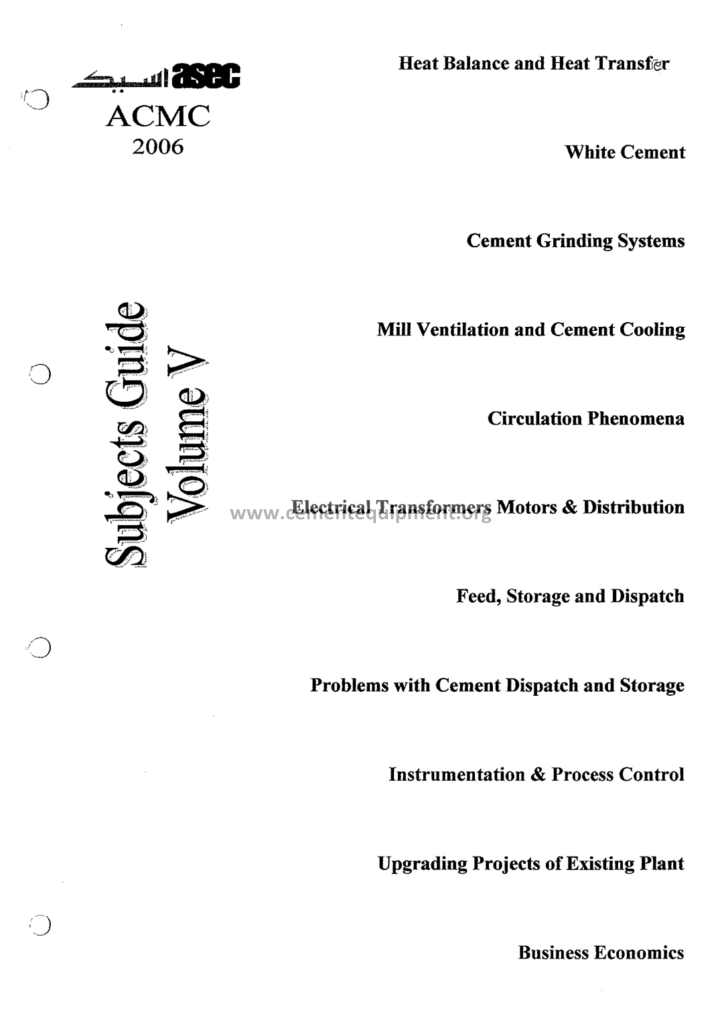
Vol Subjects Guide: Complete Technical Guide
The fifth volume of the cement course series turns from the production equipment toward the product itself: the chemistry of the clinker phases, the reaction of the cement with water, the standards that define the cement types and the quality control that guarantees the shipped material. Where the earlier volumes described how the plant makes the clinker, the fifth volume describes what the clinker becomes in the silo, in the bag, in the mixer and in the concrete: the chemistry of the product, the testing of the laboratory and the performance of the structure.
This subjects guide gives the reader the index, the dependency map and the reading order of the volume’s chapters, so the engineer who opens the fifth volume for reference can find the subject without reading the whole course. The guide is the map; the chapters are the territory. Together they form the study program of the cement chemistry and the cement product knowledge, the same program the quality engineers, the laboratory chiefs and the technical salesmen of the industry were trained on and still train today.
1. The Structure of Volume 5: The Chain from the Clinker to the Concrete
The volume is organized along the natural chain of the cement life: the composition of the clinker, the grinding of the cement, the reaction with the water, the properties of the hardened paste and the performance of the concrete. Every chapter of the volume sits on the one before it, and the reader who follows the chain sees the product the way the industry sees it: as a chemistry that must be made, tested and sold:
- The composition chapters: the clinker phases, the Bogue calculation, the minor elements and the interaction of the components: the chemistry the product inherits from the kiln and carries in every grain;
- The hydration chapters: the reaction of the four main phases with the water, the hydration products, the heat of hydration and the development of the strength: the chemistry the product performs in the mixer and the structure;
- The products chapters: the cement types of the standards, the blended cements, the special cements and the cement selection for the application: the chemistry the company offers on the market;
- The quality control chapters: the sampling, the testing, the strength development, the fineness, the soundness and the setting: the chemistry the laboratory verifies on every lot before the release;
- The durability chapters: the sulfate attack, the alkali-silica reaction, the chloride penetration and the carbonation: the chemistry the decades test and the structures prove;
The chapters speak the same engineering language as the previous volumes: the same tables, the same units, the same logical numbering that allows the reader to move between the subjects of the product without friction, and the same worked examples that make the abstract chemistry visible in the plant numbers.
2. The Composition Chapters: The Four Main Phases of the Clinker
The volume opens the product with the phases the kiln produces, because the cement quality is decided before the cement exists, in the chemistry of the clinker. The four main phases are the four actors of every cement story, and the engineer who knows their properties knows the plot of every hydration, every strength curve and every durability case:
- The alite (C3S): the calcium silicate phase that gives the early strength: typically 55-70% of the Portland clinker, reacting fast with the water, releasing the most heat and carrying the 1-day and the 7-day strength: the phase the burning zone and the flame exist for;
- The belite (C2S): the other calcium silicate, formed at the lower temperature in the kiln: 15-30% of the clinker, hydrating slowly and contributing the strength mainly after the first week: the phase of the later ages and the low-heat behavior;
- The aluminate (C3A): the calcium aluminate phase: the regulator of the early reaction, the main consumer of the gypsum during the hydration and the source of the rapid setting when it reacts uncontrolled: 5-12% of the clinker, small in the quantity and enormous in the influence;
- The ferrite (C4AF): the calcium alumino-ferrite phase, taking the iron of the raw mix: 5-12% of the clinker, hydrating fast but contributing little strength, controlling the clinker color and easing the burning of the kiln at the lower temperature;
The composition chapters give the phase analysis methods side by side: the Bogue calculation from the oxide analysis, the microscopic point counting of the polished sections and the X-ray diffraction quantification of the modern laboratories. The three methods must agree within the known tolerances, because each has its blindness: Bogue assumes the equilibrium and the pure phases, the microscopy counts the crystals one by one with the eye of the experienced petrographer, and the XRD reads the crystal structure itself with the calibration curves of the instrument.
3. The Hydration Chapters: What the Cement Does with the Water
The hydration is the core subject of the volume, and the chapters build the picture from the first minutes to the years, because the concrete of the site behaves as the sum of the chemical events that start when the water meets the cement grain:
- The first minutes: the aluminate reacts with the water and the sulfate of the gypsum, the ettringite needles form on the grain surfaces and the paste stiffens: the gypsum of the cement regulates this flash reaction and gives the concrete its working time and its placement window;
- The first hours: the alite begins its reaction in earnest, the C-S-H gel and the portlandite crystals appear between the grains, the paste loses its workability and sets: the setting time of the cement is the time of this alite-triggered framework, measured by the Vicat needle;
- The first days: the C-S-H gel grows into the capillary pores, the strength climbs steeply, the heat of hydration releases into the structure: the concrete of the first week is the concrete of the C-S-H, and the design of the formwork stripping follows this growth;
- The first years: the belite reacts slowly, the long-term strength grows, the pore structure refines and the permeability falls: the durability of the concrete is mostly the product of this slow continuation that the accelerated tests can only estimate;
The chapters quantify the hydration products with the numbers the laboratory needs: the C-S-H of the variable calcium to silica ratio and the enormous surface area, the portlandite Ca(OH)2 of the ordered crystal form, the ettringite and the monosulfate of the aluminate family, the hydrogarnet of the ferrite: each hydration product with its role, its stability limits and its consequences for the concrete property and the exposure class.
4. The Heat of Hydration and the Temperature of the Structure
The hydration releases heat, and the heat decides the destiny of the mass concrete: the volume treats the subject with the numbers the designer needs, because the temperature history of the young concrete is written in the cement chemistry long before the pour:
- The heat quantities: the alite releases about 500 kJ/kg, the belite 260 kJ/kg, the aluminate 1340 kJ/kg and the ferrite 420 kJ/kg over the full hydration: the aluminate is the small phase but the big heat source, and the low-heat cements limit it for this reason;
- The measuring methods: the isothermal calorimetry of the laboratory, the semi-adiabatic Langavant method of the field and the heat of solution method of the classical standards: the laboratory practice of the low-heat cement verification;
- The structural consequence: the temperature of the young concrete rises in the core, the cold surface contracts against the hot interior, and the large pours crack when the thermal gradient exceeds the tensile capacity: the dams, the raft foundations and the bridge abutments are the victims;
- The control levers: the cement type selection, the pozzolanic and the slag additions, the cold aggregate, the pipe cooling, the pour sequencing and the insulation of the surfaces: the heat chapters give the engineer the full toolbox of the mass concrete practice;
The heat chapters connect the cement laboratory to the concrete site: the 3-day and the 7-day heat figures of the cement certificate are the design data of the dam and the foundation engineer, and the volume teaches how to read them, how to verify them and how to select the cement that will not crack the pour.
5. The Products Chapters: The Cement Types of the Standards
The product chapters translate the chemistry into the catalog: the cement types the standards define, the market sells and the specifier selects. The standards are the contract of the industry, and the volume reads them clause by clause:
- The EN 197-1 system: the CEM I of the pure Portland, the CEM II of the Portland with the addition, the CEM III of the blastfurnace, the CEM IV of the pozzolanic and the CEM V of the composite: the European system of the 27 common cements with the composition tables the reader must navigate;
- The ASTM C150 system: the Type I general purpose, the Type II moderate sulfate resistance, the Type III high early strength, the Type IV low heat and the Type V high sulfate resistance: the American system organized by the performance limits rather than the composition brackets;
- The strength classes: the 32.5, 42.5 and 52.5 classes of the EN system with the N and the R variants of the early strength: the strength class is the contract between the producer and the concrete designer, and the certificate carries it on the first line;
- The special products: the white cement, the sulfate-resistant cement, the oil-well cement, the masonry cement, the rapid-hardening and the expanding cements: the niche products of the industry, each with the chemistry tailored to its application;
The volume walks the reader through the standard tables with the numbers and the tolerances: the composition limits, the strength requirements, the setting requirements, the soundness limits and the heat limits: the cement engineer must read the standard the way the lawyer reads the contract, because the conformity claim and the customer dispute both hang on the comma of the clause.
6. The Blended Cements: The Additions and Their Chemistry
The additions are not the inert fillers of the popular belief: they are the chemical participants of the hydration, and the volume gives them their chemistry, because the blended cements are the majority of the cement sold in the world today:
- The blastfurnace slag: the latent hydraulic material: in the alkaline environment of the hydrating cement it reacts on its own and forms its own C-S-H: the CEM III cements reach the strengths of the CEM I at the later ages with the lower heat and the better sulfate resistance;
- The natural and the calcined pozzolana: the siliceous and the aluminous materials that consume the portlandite in the pozzolanic reaction: the volcanic ash, the tuffs, the calcined clays: the strength at the later ages, the denser pore structure and the durability gain against the chlorides;
- The limestone: the filler that acts: the fine limestone accelerates the early reaction of the alite, stabilizes the ettringite and fills the pores of the paste: the modern CEM II/A-LL cements of the 6-20% limestone carry the real chemistry in the small carbonate particles;
- The silica fume: the ultra-fine byproduct of the ferrosilicon industry, reacting fast and almost completely, the densifier of the high-performance concrete: the 5-10% silica fume mixes of the bridge decks and the high-rise columns of the modern cities;
The volume explains why the clinker factor is the sustainability story of the industry: every percent of the clinker replaced by the addition reduces the CO2 of the product by nearly the same percent, and the chemistry of the blended cements makes the replacement technically sound when the addition is well chosen, well proportioned and well ground with the clinker.
7. The Quality Control Chapters: The Laboratory of the Cement Plant
The quality control chapters follow the cement from the mill to the certificate: the sampling, the testing and the release, because the certificate the customer receives is only as good as the discipline that produced the numbers:
- The sampling discipline: the automatic samplers of the mill outlet, the composite samples of the silo, the dust sampling of the loading: the sample that does not represent the lot invalidates every test that follows, and the volume teaches the sampling schemes of the standards;
- The physical testing: the fineness by the Blaine of the 3,000-4,500 cm2/g ordinary cements, the particle size distribution by the laser instruments, the setting time by the Vicat, the soundness by the Le Chatelier, the strength by the mortar prisms of EN 196-1: the physical body of the certificate;
- The chemical testing: the X-ray fluorescence of the main oxides, the loss on ignition, the SO3, the chloride and the alkalis: the chemical body of the certificate that feeds the Bogue calculation and the conformity check;
- The release decision: the statistical acceptance, the certificate of analysis, the retention samples and the complaint archive: the quality chapter closes the loop between the laboratory, the production and the shipping;
The quality chapters give the tolerances of the industry as the running numbers: the C3S and the C3A variation limits of the plant control, the Blaine tolerances of the mill, the 28-day strength target bands of the production planning and the standard deviation arithmetic of the quality manager who must hold the conformity against the drift of the process.
8. The Fineness and the Particle Size Distribution: The Hidden Quality Dimension
The fineness is the cheapest lever of the cement quality, and the volume devotes a full chapter group to its measurement and its consequences, because the same chemistry ground to the different distributions behaves like different products:
- The Blaine surface: the specific surface by the air permeability method: the classical number of the cement certificates: the 3,000-4,500 cm2/g typical range and the 5,000 and above of the rapid cements: the number the mill controls every hour;
- The particle size distribution: the residue on the 45-micron sieve, the laser diffraction full curve, the RRSB distribution parameters: the fraction under 3 microns hydrates in the day, the 3-30 micron fraction in the month, the coarse fraction slowly or never: the distribution is the schedule of the strength development;
- The strength consequences: each lift of the Blaine surface accelerates the early strength by the hours or the days, but the over-grinding costs the electricity, the mill output and the water demand of the concrete: the optimum is a balance, not a maximum;
- The water demand: the finer cement needs more water for the same workability: the permeability of the paste, the drying shrinkage and the cracking risk follow the water-cement ratio: the volume quantifies the trade with the examples of the ready-mix practice;
The volume gives the RRSB charts, the separator curves and the mill ball adjustments that shape the distribution, because the particle size distribution is the meeting point of the grinding engineer and the concrete technologist, and the dialogue between them is written in the cement commerce every day.
9. The Durability Chapters: The Cement against the Decades
The durability is the performance the young concrete cannot show, and the volume teaches the mechanisms so the engineer can look ahead, because every structure is designed for the decades and the cement chemistry must serve the whole lifespan:
- The sulfate attack: the external sulfates of the soil and the groundwater react with the aluminate hydrates to form the delayed ettringite and the thaumasite: the expansion and the cracking of the concrete in the foundations and the sewers: the C3A-limited sulfate-resistant cements are the answer;
- The alkali-silica reaction: the reactive silica of the aggregate reacts with the alkalis of the pore solution of the concrete: the alkali-silica gel swells with the water and cracks the concrete from the inside: the low-alkali cements and the pozzolanic additions protect the structure;
- The chloride penetration: the chlorides of the marine and the deicing environments diffuse through the concrete to the reinforcement and depassivate the steel: the corrosion starts and the cracks open: the dense concrete, the silica fume and the adequate cover are the defense;
- The carbonation: the atmospheric CO2 neutralizes the alkalinity of the concrete from the surface inward, and the reinforcement loses its passive layer at the carbonation front: the dense paste, the low water cement ratio and the cover resist the decades;
Each durability mechanism has its test in the volume: the sulfate resistance testing, the mortar bar test of the alkali-silica reaction, the rapid chloride permeability test and the accelerated carbonation chamber: the tests are the crystal ball of the cement chemist, and the volume explains what each test really proves and where it lies.
10. The Position of Volume 5 in the Package: The Dependencies and the Reading Order
Volume 5 assumes the raw materials, the process and the clinker quality chapters of the earlier volumes, and it feeds the concrete and the application books that follow in the package:
- The dependencies: the raw mix ratios of the process volumes (the lime saturation factor, the silica and the alumina modules) decide the phase composition that the Volume 5 chapters explain: the clinker microscopy chapters of the process volume provide the phase evidence the product chapters interpret;
- The reading order: the composition, then the hydration, then the products, then the quality control, then the durability: the natural order the chapters of the volume follow, with the exercises placed at the end of each chapter group;
- The reference use: the subjects guide gives the engineer the fast path to any specific chapter: the index by subject, by phase, by test and by cement type: the triage of the reference reader who needs the answer today;
The volume sits in the package exactly where the product sits in the plant: after the production and before the customer, holding the chemistry of everything the company sells and the laboratory verifies, and linking the process books of the package to the concrete books of the package.
11. The Comparison of the Cement Types: The Selection Table
The volume closes the product comparison with the selection table the engineer can carry into the design meetings, because the specification work is where the chemistry meets the application:
| Application need | Recommended cement family | Key chemistry of the selection |
|---|---|---|
| General reinforced concrete | CEM I 42.5N / ASTM Type I | 45-60% C3S, 8-12% C3A, Blaine 3,300-3,800 |
| Mass concrete, dams | CEM III / ASTM Type IV | Low heat: C3A below 7%, C3S limited |
| Sulfate soils, sewers | SR cement / ASTM Type V | C3A below 3-5%, low C4AF |
| Fast construction, precast | CEM I 52.5R / ASTM Type III | High C3S, high fineness, fine distribution |
| Marine structures | CEM III / CEM IV with silica fume | Low alkalis, low C3A, dense paste |
| White architectural work | White Portland cement | Low Fe2O3, low Mn2O3, special burning |
The table is the summary of the volume’s teaching: the cement is selected by the chemistry of its phases, and the chemistry of the phases is the chemistry the volume explains page by page, from the raw mix of the quarry to the certificate of the laboratory.
12. The Test Methods of the Standards: The How of Every Number
The volume does not stop at the principles: it walks the reader through the standard test methods themselves, because the numbers of the certificate are only meaningful when the hand that made them followed the method:
- The EN 196 methods: the EN 196-1 of the mortar strength, the EN 196-2 of the chemical analysis, the EN 196-3 of the setting and the soundness, the EN 196-6 of the fineness, the EN 196-7 of the sampling: the European method family the volume explains test by test;
- The mortar preparation: the sand of the standard gradation, the water-cement ratio of the standard mix, the mixing machine, the prism molds, the curing at the 20 degrees and the crushing at the 1, 2, 7 and 28 days: the small details that make the big differences between the laboratories;
- The internal control versus the certificate: the fast methods of the plant (the quick free lime, the rapid strength estimation) versus the reference methods of the certificate: the volume explains how the plant calibrates its fast methods against the reference;
The method chapters complete the laboratory picture of the volume: the engineer who has done the EN 196-1 prism himself reads the certificate of the supplier with the respect of the practitioner, and the volume gives the practical sessions that produce that respect.
13. The Volume 5 in Practice: The Study Plan of the Reader
The volume demands the practical work from the reader, because the chemistry is learned by the hand as much as by the eye, and the study plan of the chapter ends closes the teaching with the exercises:
- The laboratory weeks: the Bogue calculation from the plant oxide data, the microscope session on the clinker sections, the calorimetry run of the own cement and the mortar testing of the own plant: the exercises the volume assigns chapter by chapter;
- The standard reading: the EN 197-1 and the ASTM C150 tables read with the volume’s commentary: the production engineer sees the limits his plant must hold and the quality engineer sees the certificate his laboratory issues;
- The report writing: the certificate interpretation, the complaint investigation and the concrete case studies: the volume gives the report skeletons the industry expects, from the internal memo to the customer letter;
The engineers who work the volume through gain the ability the industry pays for: the ability to read a cement certificate like a map, to spot the cause of the setting or the strength complaint in the chemistry of the phases, and to select the cement that will serve the structure for the decades.
14. The Sulfate Regulation: The Gypsum and the Setting Behavior
The gypsum of the cement is the smallest addition and the most misunderstood one: the volume explains its chemistry with the precision the plant needs, because the setting and the strength of every lot of the cement hang on the sulfate balance:
- The role of the gypsum: the calcium sulfate added at the grinding (typically 3-5% as SO3, which is 5-7% as the dihydrate) slows the flash reaction of the aluminate: without it the paste stiffens within the minutes, with too much it suffers the false set and the strength loss;
- The optimum sulfate: the SO3 content that gives the maximum strength and the minimum expansion for the given clinker: the optimum depends on the C3A content, the alkali content, the fineness and the temperature of the grinding: the volume gives the optimization procedure with the plant experiments;
- The sulfate forms: the dihydrate, the hemihydrate and the anhydrite of the natural gypsum and the industrial byproducts: the grinding heat dehydrates the gypsum to the hemihydrate, and the stale cement in the hot silos can suffer the false set from the dehydrated forms;
- The water demand side: the soluble alkalis of the clinker react with the sulfate in the pore solution and change the setting and the workability: the volume connects the clinker alkalis, the sulfate form and the admixture behavior of the concrete;
The sulfate chapters close the composition part of the volume: the plant that understands its own clinker-alkali-sulfate triangle controls the setting complaints and the strength results instead of fighting them, and the volume gives the diagnostic table of the setting problems with their causes and their corrections.
15. The Frequently Asked Questions
Q: Do I need the earlier volumes to use the Volume 5 chapters?
A: The product chapters assume the clinker quality knowledge of the process volumes, but the composition chapters of the Volume 5 restate the essential chemistry of the phases: the package reading order removes the friction for the reader who starts with the product.
Q: Which chapter should the quality control engineer read first?
A: The hydration chapters and the quality control chapters: the laboratory practice of the plant is concentrated there, and the composition chapters add the chemistry behind every test result of the certificate.
Q: Is the Bogue formula covered in the volume or only in the prerequisites?
A: The full Bogue arithmetic sits in the products prerequisites chapters of the package, and the Volume 5 applies it to the quality and the product selection questions: the two documents of the package are designed as one study path.
Q: Does the volume cover the modern blended cements in depth?
A: Yes: the slag, the pozzolana, the limestone and the silica fume additions each have their chemistry chapters, with the CO2 and the sustainability context of the modern product mix the industry sells today.
Q: What is the heat of hydration range the volume works with?
A: The ordinary Portland cements release about 250-400 kJ/kg at the 7 days, the low-heat types stay under the 250 kJ/kg, and the volume uses these ranges through the mass concrete examples and the cement selection case studies.
16. The Closing Words of the Guide
The subjects guide of the volume shows the map of the product knowledge: the phases of the clinker, the reactions of the hydration, the types of the standards, the tests of the laboratory and the mechanisms of the durability. The engineer who follows the map will read the cement certificate with the chemistry in his head, will understand what the concrete does during the first minutes and the first decades, and will speak the language of the laboratory, the sales office and the design office in one. The remaining volumes of the package continue the journey into the concrete technology and the application engineering, and the guide of the fifth volume will be the landmark of that journey.
Get this Vol.5 subjects guide + the full 931-file package
$249.99 — one-time purchase, instant download, lifetime access
This file is part of the Complete Cement Technical Package (931 files) available from cementequipment.org. Respective rights holders; library copy for the licensed single user.