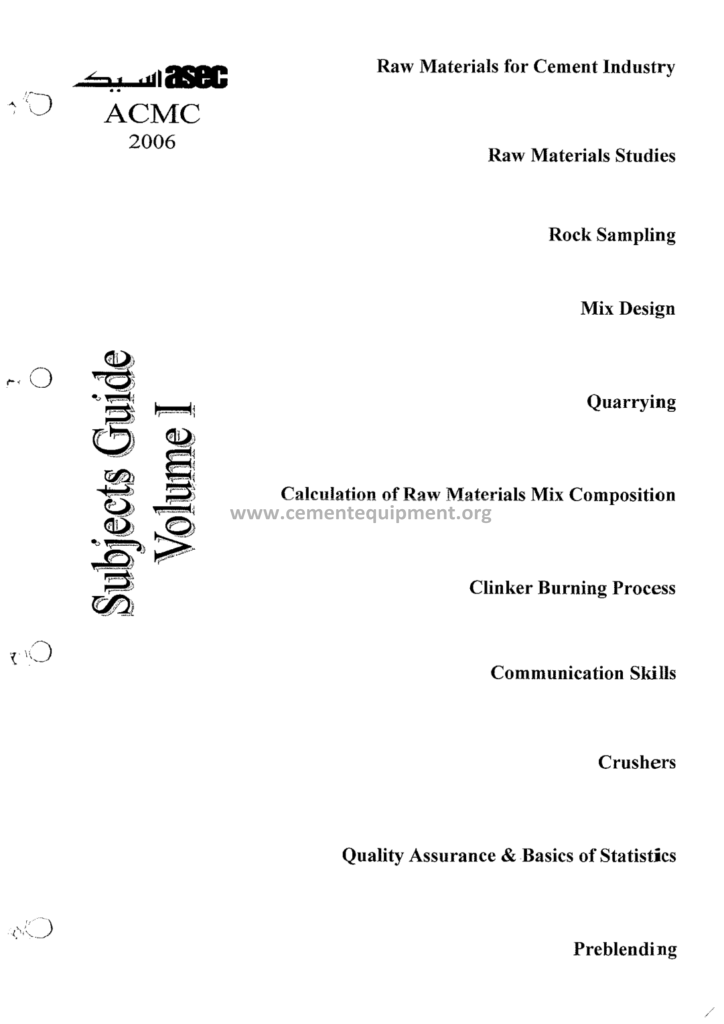
Acmc Vol To Vol: Complete Technical Guide
The Advanced Cement Manufacturing Course (ACMC) in its complete form of the five volumes is the study program that carries the engineer across the whole cement plant: the raw materials and the chemistry of the first volume, the raw grinding and the homogenization of the second, the pyroprocess of the third, the finish grinding and the process control of the fourth, and the products of the fifth. The five volumes are built as one curriculum, with the dependencies marked, the numbering shared and the exercises chained from the quarry to the certificate.
This article presents the full course the way the training department of the industry presents it to the new engineer and the experienced professional alike: the content of every volume, the order of the study, the prerequisites that support the later volumes and the practical plan that turns the reading into the competence. The course is the university of the cement process, and these pages are its syllabus.
1. The Course in One Page: Five Volumes, One Chain
The ACMC is organized as the material flow of the plant itself, and its five volumes follow the flow from the quarry face to the customer truck:
- Volume 1, the foundations: the cement chemistry, the raw materials, the clinker phases and the process overview: the language of everything that follows;
- Volume 2, the preparation: the raw material crushing, the raw grinding, the drying, the raw mix proportioning and the homogenization: the preparation of the feed the kiln deserves;
- Volume 3, the burning: the preheater, the calciner, the rotary kiln, the cooler, the fuels, the refractories and the thermal economy: the heart of the process;
- Volume 4, the finish: the finish grinding systems, the separators, the mill drives and the process control of the plant: the production of the cement itself;
- Volume 5, the product: the clinker phases, the hydration, the cement types, the quality control and the durability: the chemistry of what the company sells;
Each volume assumes the one before it, each chapter of every volume carries the same numbering logic and the same engineering units, and the five together cover the plant the way the plant exists: as a line, not as a collection of machines.
2. Volume 1: The Raw Materials and the Cement Chemistry
The first volume establishes the two foundations of the whole course: the chemistry of the cement and the materials the plant starts from:
- The cement chemistry: the oxides of the system (the CaO, the SiO2, the Al2O3, the Fe2O3, the MgO and the SO3), the four main clinker phases and the minor components: the chemical vocabulary the five volumes share;
- The calcareous raw materials: the limestone and the marl, the chalk and the shells: the purity criteria, the composition testing and the quarry assessment: the CaO source of the mix;
- The argillaceous raw materials: the clay, the shale and the marl again: the silica, the alumina and the iron they bring: the balancing partner of the limestone;
- The corrective and the additive materials: the sand for the silica, the iron ore and the bauxite for the alumina and the iron, the laterite and the slag: the fine-tuning materials of the mix;
The volume closes the foundations with the calculation instruments the whole course uses: the modules of the raw mix, the Bogue arithmetic of the phases and the mass and the heat balance methodology: the instruments the reader will not leave for five volumes.
3. Volume 2: The Raw Grinding and the Homogenization
The second volume prepares the feed: the raw meal the kiln burns is the product of the crushing, the drying, the grinding and the homogenization, and the volume covers each step with the equipment and the operation:
- The crushing and the drying: the crushers of the plant (the hammer, the impact, the jaw and the roll), the drying in the dryers and the combined grinding-drying mills: the size reduction of the raw materials to the grindable feed;
- The raw grinding systems: the ball mills of the classical plants and the vertical roller mills of the modern lines: the grinding circuits, the classifiers and the power demand: the equipment chapters of the volume;
- The proportioning: the weighfeeders, the X-ray fluorescence and the on-line analyzer: the control of the raw mix chemistry toward the target modules, hour by hour;
- The homogenization: the blending silos of the continuous and the batch types, the homogenizing systems and the storage of the raw meal: the stabilization of the chemistry the kiln depends on;
The second volume makes the reader able to run a raw grinding department: the fineness targets of the raw meal, the residues, the moisture control and the chemistry statistics, the whole daily discipline of the raw mill superintendent.
4. Volume 3: The Pyroprocessing of the Course
The third volume is the thermochemical heart of the course, the volume of the kiln systems and the burning:
- The preheater and the calciner: the suspension stages and their heat exchange, the calcination degree, the cyclone efficiencies and the build-ups: the tower that prepares the feed for the kiln;
- The rotary kiln: the vessel, the drive, the support, the flame and the burning zone: the mechanics and the process of the machine that makes the clinker: the central subject of the whole course;
- The cooler: the grate systems, the secondary and the tertiary air, the clinker quality effect of the cooling: the recovery machine at the outlet of the vessel;
- The fuels and the refractories: the coal, the petcoke and the alternative fuels with their combustion chemistry, and the refractory bricks, their wear and their campaigns: the energy and the armor of the line;
The third volume closes with the heat balance of the line, the efficiency numbers of the modern kilns at the 700-800 kcal/kg and the audit practice that finds the losses: the volume that made the pyroprocess engineer.
5. Volume 4: The Finish Grinding and the Process Control
The fourth volume carries the course from the clinker silo to the cement silo, and it adds the control dimension that ties the whole plant together:
- The finish grinding systems: the closed circuit ball mills, the high-pressure grinding rolls, the vertical roller mills and the separators: the systems of the modern cement grinding with their classification curves;
- The mill operation: the ball charge, the liners, the ventilation, the cooling and the grinding aids: the practical operation of the finish mills with the fineness and the temperature targets;
- The process control: the instrumentation of the plant, the kiln control strategies, the automation levels and the operator practice: the control room of the modern plant as the course teaches it;
- The quality integration: the sampling, the rapid testing and the feedback from the laboratory to the process: the loop that holds the product quality;
The fourth volume gives the engineer the mill side of the plant in the same depth the third volume gave the kiln side: the grinding engineer of the course graduates with the ball charge arithmetic, the separator curves and the control philosophies in his hand.
6. Volume 5: The Products of the Course
The fifth volume completes the chain at the product, and its chapters have been presented in the previous article of this series in detail:
- The phases and the hydration: the clinker minerals, their reactions with the water and the development of the strength: the chemistry the customer experiences;
- The cement types: the EN 197-1 and the ASTM C150 families, the blended cements and the special products: the catalog the market buys;
- The quality control: the sampling, the testing, the certificate and the conformity statistics: the laboratory discipline of the industry;
- The durability: the sulfate attack, the alkali-silica reaction, the chlorides and the carbonation: the performance of the product over the decades;
The fifth volume turns the process engineer into the product engineer, the professional who can answer the customer, defend the certificate and select the cement for the structure: the complete graduate of the course.
7. The Prerequisites Modules: The Arithmetic Foundations of the Course
Between and around the volumes, the course carries the prerequisites modules that drill the instruments the later volumes assume: the calculation backbone of the whole curriculum:
- The modules of the raw mix: the lime saturation factor, the silica and the alumina modules, their targets and their corrections: the arithmetic of the raw mix ratios that fixes the phase composition of the clinker;
- The Bogue formula: the calculation of the alite, the belite, the aluminate and the ferrite from the oxide analysis: the four lines of arithmetic that appear in every quality meeting;
- The minor elements: the alkalis, the sulfur, the chloride, the magnesia, the phosphorus and the titanium in the clinker: their limits, their cycles and their consequences for the process and the product;
- The interactions: the interaction between the components of the system, the kiln feed, the fuels and the additions: the system view that the isolated chapters cannot give;
The prerequisites are the same instruments the volumes apply, drilled to the automatic level: the course places them where the reader needs them, before the chapters that assume them.
8. The Course Language: The Units, the Tables and the Numbering
A course of five volumes is only coherent when its language is one, and the ACMC enforces the discipline across all its chapters:
- The units: the metric system throughout, the kilocalories and the megajoules, the grams per liter, the cm2/g of the Blaine and the micrometers of the particle sizes: no translation of the units between the volumes, no conversion errors in the exercises;
- The tables: the same table formats of the oxide analyses, the balances and the equipment data across the volumes: the reader reads a new chapter with the eye already trained by the old one;
- The numbering: the chapter and the section numbering that maps the subjects across the volumes: the reference system that lets the reader jump from the kiln chapter of the third volume to the clinker phase chapter of the fifth with the cross-references printed;
- The naming: the same names for the same things from the quarry to the certificate: the raw meal, the kiln feed, the clinker, the cement and the concrete never confused in the course text;
The language discipline is the hidden value of the complete course: the five volumes behave as one book of the five parts, and the engineer who studied the first volume opens the fifth with the same grammar.
The volume also carries the numerical benchmarks that the reader meets consistently: the lime saturation factor of the 92-98 range, the silica module of the 2.2-2.8, the alumina module of the 1.3-1.7, the specific heat consumption of the modern precalciner lines at the 700-800 kcal per kilogram of the clinker, the cooler loss at the 80-130 kcal, and the specific power of the finish grinding at the 25-35 kWh per ton: the same numbers appear in the exercises of every volume, so the reader internalizes the benchmarks of the industry and hears the alarm when a plant number leaves the band.
9. The Dependency Map of the Course: What Assumes What
The volumes are not five independent books: they are the stages of one study, and the course prints the dependency map so the reader never walks into a chapter without the ground below it:
| Subject group | Requires | Feeds |
|---|---|---|
| Raw mix modules (prerequisites) | Volume 1 oxides and materials | Raw grinding, kiln feed, clinker phases |
| Bogue arithmetic (prerequisites) | Oxide analysis of Volume 1 | Volume 5 phase quality and products |
| Kiln systems (Volume 3) | Raw meal preparation (Volume 2) | Clinker quality, Volume 5 phases |
| Finish grinding (Volume 4) | Clinker and gypsum chemistry | Cement quality and the certificates |
| Products (Volume 5) | All four volumes plus the prerequisites | The market, the customer, the concrete |
The map shows the reader where he stands and where he can go: the reference reader entering at the products volume is directed to the prerequisites modules first, and the graduate returning for the refresh knows which volume to reopen for which subject.
10. The Exercises and the Self-Study Plan of the Complete Course
The course is a training program, not a reference shelf, and its self-study plan is built for the working engineer with the hours after the shift:
- The weekly rhythm: the two chapters per week with the exercises, the one quit session per weekend, the monthly review: the plan of the motivated engineer who finishes the course in the eight to the ten months;
- The hands-on sessions: the calculations performed by the hand, the laboratory sessions of the own plant, the plant walks with the checklists: the course converts the reading into the muscle memory;
- The answer discipline: the exercises carry the answers in the back of the volumes, but the course is explicit: the honest attempt first, the answer as the check: the same discipline the plant demands when the numbers matter;
- The certification of the self: the end-of-course review questionnaire that the readers use to test their own readiness: the mirror the graduate looks into before he declares himself a cement engineer;
The study plan makes the course a personal project: the engineer who follows it measures his progress in the chapters and the exercises completed, and the industry measures the result in the competence of his decisions.
11. The Readers the Course Serves
The complete course serves the different roles of the cement company with the same curriculum arranged at the different depths:
- The new engineers: the full sequence of the five volumes with the prerequisites: the two years of the industry training compressed into the months of the self-study: the fast start of the career;
- The production and the quality staff: the targeted volumes and the modules of their departments with the deep exercises: the kiln, the mill and the laboratory staff of the plant;
- The maintenance engineers: the mechanical chapters of the volumes and the equipment sessions: the maintenance of the plant understood with the process behind it;
- The sales and the technical service: the product volume and the quality chapters: the language of the customer and the certificate: the commercial side of the technical career;
The course serves all the readers with the same material because the cement plant is one system and the engineers of every department serve the same product: the complete course builds the complete professional.
12. The Course in the Complete Package: The Position Among the 931 Files
The ACMC is the course spine of the Complete Cement Technical Package, and its position among the 931 files is the position of the curriculum within the library:
- The course as the organized path: the five volumes and the prerequisites give the reader the sequence, while the hundreds of the handbooks and the references of the package give the depth for the specific subjects: the course tells what to read, the library provides the details;
- The complementary files: the subjects guides of the volumes, the clinker microscopy references, the standards documents, the equipment handbooks, the plant case studies and the control manuals: the package is built so that the course chapters reference the library files by the name;
- The practice files: the excel-style calculation workbooks, the balance templates and the quality control sheets of the package complete the exercises of the course with the ready instruments: the graduate walks into the plant with the tools of the office;
The complete course and the complete package are one building: the curriculum is its structure and the 931 files are its rooms, and the engineer who takes the package takes the whole building.
13. The Comparison: The Course Approach versus the Handbook Approach
The five volumes are a course, and the distinction from the reference handbook is the value the reader should understand before buying:
| Dimension | The ACMC course | The classical handbooks |
|---|---|---|
| The reading path | One ordered sequence with the dependencies | Alphabetical or topical browsing |
| The exercises | Worked problems with the answers per chapter | Reference data without the practice |
| The depth | The operational and the practical depth | The theoretical and the data depth |
| The completion | A defined graduate profile | A shelf to consult |
| The time | Months of the planned study | Years of the casual reading |
The course is the program; the handbook is the library. The package provides both: the course volumes for the formation and the handbook files for the reference, and the five volumes of the ACMC are the formation.
14. The Accessories of the Course: The Subjects Guides and the Quizzes
The five volumes are accompanied by the accessories that complete the training apparatus: the subjects guides, the quizzes and the answer files that the reader of the complete course receives in the package:
- The subjects guides: one guide per volume, giving the index, the dependency map and the reading order of the chapters: the navigator of the reference reader and the syllabus of the student: the guides prevent the lost time of the browsing reader;
- The quizzes and the question banks: the chapter quizzes with the marked answers, the module tests and the end-of-course questionnaire: the self-testing instruments that show the reader where the understanding is thin before the plant shows it in the hard way;
- The answer files: the worked solutions of the exercises and the quizzes, printed in the separate files so the honest attempt is not spoiled by the glance at the printed answer: the self-discipline equipment of the self-study course;
- The calculation workbooks: the excel-style files of the balances, the modules and the Bogue arithmetic that the exercises of the volumes use: the reader types his real plant data into the instruments of the course;
The accessories make the course a complete training system rather than the shelf of the books: the reader studies with the same apparatus the industry training centers use, and the package delivers the apparatus with the volumes.
15. The Operating Practice: The Plant Walk Checklists of the Course
The complete course carries the practical instruments the volumes cannot hold: the checklists that take the reading onto the plant floor, where the knowledge of the course meets the reality of the equipment:
- The kiln line checklist: the preheater pressures, the gas temperatures, the cooler compartment pressures, the flame shape, the burning zone temperature, the free lime and the coating condition: the walk that audits the burning line in the hour;
- The mill checklists: the ball charge level, the liner wear, the separator settings, the ventilation and the product fineness: the audit of the grinding department performed with the parameters of the course in hand;
- The laboratory checklist: the sampling points, the test execution, the calibration status and the certificate content: the audit of the quality department against the standard procedures the course teaches;
- The safety and the housekeeping observations: the discipline part of the plant walk: the course reminds that the engineering knowledge lives in the clean and the safe plant: the habits of the professional;
The checklists convert the course into the working instrument: the graduate who walks his plant with the checklists in the pocket practices the course every day, and the practice is the purpose of the training.
16. The Standards and the References the Course Works With
The course is anchored to the standards and the reference documents of the industry, and the complete package places them beside the volumes:
- The product standards: the EN 197-1 of the cement types, the EN 196 of the test methods, the ASTM C150 and the ASTM C109 of the American practice: the volumes cite them chapter by chapter, and the package provides the readers with the reference copies in the library;
- The process references: the classical handbooks of the industry process (the cement data handbooks and the process guides of the package) that carry the detailed tables the course chapters summarize: the course points, the library details;
- The quality frameworks: the ISO 9000 family of the quality management and the statistical practice of the conformity: the quality chapters of the fifth volume apply the frameworks the certificates report;
- The environmental references: the emission limits and the BAT references of the sector: the environmental chapters of the course cite the limits the modern plants must hold;
The course is the map and the standards are the territory: the complete package of the 931 files includes both, so the reader who needs the annex of a standard or the table of a handbook finds it in the same library as the course chapter that cited it.
17. The Case Studies and the Plant Examples of the Course
The course teaches through the cases of the industry as well as the theory, and the five volumes carry the plant examples that give the numbers their faces:
- The raw material cases: the limestone change of the quarry, the moisture swing of the wet season and the corrective material introduction: the real situations of the raw materials department with the mix recalculations worked in the chapters;
- The burning cases: the coating collapse of the burning zone, the preheater blockage, the cooler snowmen and the kiln instability: the diagnosis chapters of the third volume reconstruct the events parameter by parameter, exactly as the shift foreman experienced them;
- The quality cases: the strength complaint of the ready-mix customer, the setting problem of the precast plant and the certificate dispute: the fifth volume walks the investigation from the complaint letter to the root cause with the test results of the retracing;
- The modern cases: the alternative fuel introduction, the clinker factor reduction and the cooler modernization: the change management cases that show how the plant evolves with the course knowledge;
The case studies are the bridge between the classroom and the plant floor: the engineer who has studied the cases of the volumes recognizes the situations of his own plant, and the recognition is the first step of the cure.
18. The Frequently Asked Questions
Q: How long does the complete course take?
A: The self-study plan assumes the eight to the ten months at the two chapters per week, though the engineers who study full-time compress the course into the three months: the volumes are also consultable chapter by chapter for the reference use.
Q: Is the mathematics of the course difficult?
A: The mathematics is the arithmetic of the plant: the modules, the Bogue, the balances and the statistics: the prerequisites modules drill each instrument, and no advanced calculus is required anywhere in the five volumes.
Q: Can I buy only the volumes I need?
A: The course is offered in the complete package of the 931 files, and the complete course is the recommended path: the dependencies of the volumes make the complete set the coherent purchase.
Q: Does the course cover the modern blended cements and the alternative fuels?
A: Yes: the third volume covers the alternative fuels in the pyroprocess chapters and the fifth volume covers the blended cements and the sustainability of the product: the course is the modern industry, not the museum of the process.
Q: What preparation does the new engineer need before the course?
A: The general technical background and the familiarity with the plant work: the first volume of the course restates the fundamentals, and the prerequisites modules assume no prior cement knowledge: the course starts at the beginning.
19. The Closing of the Article
The complete ACMC course of the five volumes is the formation program of the cement engineer: the foundations of the first volume, the preparation of the second, the burning of the third, the finish of the fourth and the products of the fifth, bound by the prerequisites modules and the shared language into one curriculum. The engineer who walks the course from the quarry to the certificate becomes the professional the industry recognizes: the one who can read the plant as a line, argue with the numbers, and meet the customer with the product in the head. That is the graduate profile of the five volumes, and it is the profile every cement company of the world hires.
Get this ACMC vol.1 to vol.5 set + the full 931-file package
$249.99 — one-time purchase, instant download, lifetime access
This file is part of the Complete Cement Technical Package (931 files) available from cementequipment.org. Respective rights holders; library copy for the licensed single user.