Why hammer crusher hammers wear quickly
Hammer wear is mainly controlled by hammer metallurgy and heat treatment, rotor speed and impact energy, feed size/hardness/moisture, crusher clearances, and the quality of material distribution across the rotor. Fast wear is therefore usually a process or component-selection problem rather than a reason to replace the complete crusher.
For the machine itself—working principle, rotor, grate, capacity, motor power and design calculations—use the main Hammer Crusher technical guide. This page stays focused on wear life and maintenance.
written by
Amanda Lee
The hammer head wear of the hammer crusher is unavoidable, but if the wear is too fast and the frequency is too high, it is necessary to check whether there is a problem in the equipment itself or in the operation. The main factors affecting the wear of the hammer head are: the material of the hammer head, the manufacturing quality and structural design, the technical design of the crusher, the feeding situation and the gap between the various parts in the structure.
Rapid hammer wear: practical inspection matrix
Compare wear patterns and operating records before selecting a new hammer alloy or changing crusher settings. The observations below are diagnostic clues, not proof of a particular failure mechanism.
| Evidence to record | Possible contributor | Safe next verification |
|---|---|---|
| Wear concentrated on one rotor side or a few hammers | Uneven feed distribution, incorrect hammer installation or rotor condition | Review feed-chute distribution and maintenance records; inspect hammer positions and rotor condition only after approved isolation |
| Rapid wear coinciding with a new quarry bench or feed source | Changed abrasiveness, oversize, hardness or tramp-material exposure | Compare representative feed samples, size distributions and metal-detector or magnet records with the original design basis |
| Material buildup, plugging or uneven discharge | Moisture, poor discharge flow, worn grates or out-of-spec clearances | Review throughput, moisture and blockage history; inspect grates and clearances against OEM limits during locked-out maintenance |
| Cracked or fractured hammer rather than gradual abrasion | Impact overload, unsuitable toughness, casting defect or incorrect mounting | Preserve the failed part, document fracture surfaces, verify material certificates and obtain an OEM or metallurgical assessment before restarting |
| Accelerated wear after rotor, hammer or feeder changes | Changed tip speed, feed presentation, balance or installation geometry | Check approved configuration, vibration trends, fastener records and commissioning data; do not change rotor or feeder speed without engineering approval |
Safety and acceptance: follow site lockout/tagout and stored-energy procedures before internal inspection. Record measured hammer dimensions, weight or wear profile, operating hours, feed characteristics and the manufacturer’s discard criteria. Replace or reconfigure parts only within the installed crusher’s approved design and maintenance requirements.
01. Effect of hammer material
In general, the hammer with a higher hardness has a higher wear resistance. To improve the wear resistance of the hammer, it is necessary to increase its hardness, but as the hardness increases, the impact toughness of the hammer will decrease. Therefore, how to balance the hardness of the hammer and the good impact toughness is the key to improve the wear resistance of the hammer.
Common materials for hammerheads are: high manganese steel, high chromium cast iron, low carbon alloy steel.
High manganese steel has good toughness, good manufacturability and low price. Its main feature is that under the action of large impact or contact stress, the surface layer will rapidly produce work hardening, and its surface can work-harden under sufficiently severe impact or contact stress. The resulting wear performance depends on the actual grade, heat treatment, impact regime and abrasive feed; a universal work-hardening multiplier is not established here. However, if the impact force is insufficient or the contact stress is small during use, the surface cannot be quickly subjected to work hardening, and the wear resistance of the high manganese steel cannot be fully exerted.
High-chromium cast iron is a wear-resistant material with excellent anti-wear properties, but has low toughness and is prone to brittle fracture. In order to make the high-chromium cast iron hammer safely run, a composite hammerhead has been developed, that is, high-chromium cast iron is cast in the head of a high-manganese steel or a low-alloy steel hammerhead, or the working part of the hammerhead is made of high-chromium cast iron, and the hammer handle is partially used. Carbon steel, the two are combined to make the hammer head have high hardness, and the hammer handle has high toughness, fully exploiting the respective advantages of the two materials to overcome the shortcomings of the single material and satisfying the performance requirements of the hammer. However, its manufacturing process is complicated and the process requirements are strict.
Low-carbon alloy steel is mainly alloy structural steel containing various elements such as chromium and molybdenum. It has high hardness and good toughness, and its matrix structure has martensite, bainite or bainite + martensite composite structure. Service-life comparisons between low-carbon alloy steel, manganese steel and high-chromium alloys are application-dependent and should not be stated as a universal multiplier. Material grade, heat-treatment specification, impact toughness, hardness profile, feed abrasiveness and operating duty must be evaluated together against the crusher manufacturer’s approved hammer specification. Mechanical-property acceptance limits must come from the selected material grade, qualified supplier test records and OEM requirements, not a universal tensile-strength threshold.
02. Hammer manufacturing quality
The manufacturing process of the hammer is also a key factor in determining its service life. If there are defects in the surface or internal manufacturing of the hammerhead, such as shrinkage cavities, cracks, and through crystals, it will not only reduce the performance of the hammer but also cause the hammer to break. Therefore, reasonable casting and heat treatment processes must be established in the production of hammers.
For example, for high-chromium cast iron hammers, vertical pouring and reasonable use of external cold iron should be adopted, and the casting temperature should be strictly controlled, so that the hammer head can have good solidification sequence and feeding conditions during casting, and thus obtain dense Internal organization and weakening the coarse grain.
03. Structural design of the hammer
The hammerheads of different structures and geometric shapes have great differences in the mechanical properties of the heat treatment and the internal metallographic structure, which in turn have a great influence on the wear resistance, especially the impact of the hammer with large thickness and large size is more prominent. . The thicker the hammer, the harder it is to harden, and the worse its wear resistance.
Since the internal wear resistance of the hammer head is significantly lower than that of the surface, this condition can only be improved by a reasonable casting and heat treatment process for the hammer head having a large thickness, but this means improving the wear resistance of the hammer head. The performance is limited. The best way is to optimize the structure of the hammer without changing the kinetic energy and strength of the hammer. On the one hand, the utilization of the hammer can be improved, and on the other hand, the structural pair can be reduced. The effect of heat treatment performance, to avoid the wear resistance of the hammer head is reduced.
04. Crusher technical parameters
The life of the hammer is also related to the technical parameters of the crusher, the most important of which is the power and speed of the rotor. These two parameters directly reflect the linear velocity and impact force of the hammerhead. They are not only related to the production capacity of the crusher, but also to the degree of impact hardening of the hammerhead.
The hammer with good impact hardening will have a prolonged service life. The rotor speed is too low, not only the low production capacity, but also low kinetic energy, resulting in poor hammer impact hardening and poor wear resistance; the rotor speed is too high, although the hammer can obtain better impact hardening and equipment productivity, but also The hammer head, the stringer and the lining plate are strongly worn, which is also detrimental to the service life of the hammer head, and at the same time, the power consumption is significantly increased.
05. Clearance of each part of the crusher structure
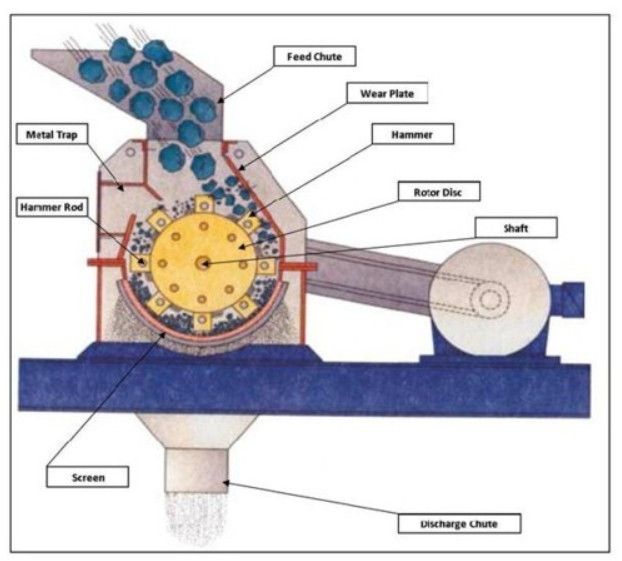
Here mainly refers to the gap between the rotor body and the crushing plate, the purlin and the feed roller, and the gap between the hammers. The size of these gaps is related to whether there is accumulation on the stringer and near the safety gate.
If there is accumulation, when the hammer is unable to press the material from the stringer, it will be severely rubbed and worn. If the gap is too small, although the crushing quality and efficiency of the material can be improved, it is easy to form accumulated material and blockage, which causes the hammer head to wear; the gap is too large, although material accumulation can be avoided, but the crushing effect and efficiency are low. Therefore, inspect and record clearances against the machine-specific OEM wear and setup limits during an approved maintenance window. Never adjust internal crusher clearances or reach into the crushing chamber while the rotor or feed equipment can move: isolate and lock out all energy sources, verify zero energy, and secure the rotor and any suspended or stored loads first. Correct blocked discharge and worn parts only under the manufacturer’s maintenance procedure.
06. Crusher feeding situation
Feeding conditions include: 1 feed size and hardness; 2 feeding mode of the crusher. The former is related to whether the crusher will encounter the impact impulse when the material and the hammer hit the material. The latter will cause the difference of the material to the rotor due to the different feeding modes, and also affect the impact impulse when the hammer hits the material.
When the weight of the hammer and the rotor speed are constant, the collision impulse of the hammer is proportional to the material quality and the drop, and the magnitude of the collision impulse is directly related to the degree of work hardening and wear resistance of the hammer. Feed size, drop height, distribution and feeder rate should remain within the installed crusher’s approved design envelope. Do not increase feeder speed or deliberately coarsen feed as a generic remedy for hammer wear; first compare the actual material and operating data with OEM limits for impact energy, rotor balance, throughput, blockage risk and wear.
In addition, excessive moisture content of the material will have a certain impact on the life of the hammer. If the water content is too high, the materials are easily bonded into a mass, which causes accumulation of materials and aggravates the wear of the hammer.
The hammer crusher has the advantages of simple structure, large crushing ratio, simple operation and maintenance, etc., but the hammer head wears fast and the service life is short, which is also a prominent problem of the machine. In actual production, improving the service life of the hammer crusher requires not only the manufacturer to guarantee and improve the material, mechanical properties and quality of the hammer, but also the correct use and scientific maintenance of the user, so that the equipment is always in the Good condition.
Need technical or sourcing support?
Use the inquiry page for crusher support and spare-parts sourcing.