intro (answer paragraph)
Types of concrete are distinguished by four things: the binder (Portland mixes, blends, geopolymer), the density (normal, lightweight, heavy), the grade (strength class of the mix), and the condition of casting (plain, reinforced, prestressed, self-compacting). In practical terms the answer to “how many types of concrete are there?” is a classification, not a count: there are seven main families and around four dozen named commercial classes, but every one of them is a combination of the same four parameters below. A structural engineer will usually see 4–6 types per site; a producing plant inventories dozens in its catalog. This article gives you the classification, the mixes, the strength, and the application table — with the numbers taken from cement and concrete courses rather than generic brochure claims.
The four distinguishing parameters — every type of concrete is defined by these so it matters which one you buy:
- Binder — Portland cement (OPC, PPC, PSC), blended, white, or geopolymer. The binder sets the strength class and the sulfate resistance.
- Density / aggregate — normal weight (2,200–2,400 kg/m³), lightweight (300–1,900 kg/m³) with pumice/foam, heavyweight (above 2,600) with barite/steel shot for radiation shields.
- Compressive strength grade — from C8/10 (blinding) to C80/95 (precast plants); mixtures are labelled in MPa or psi; the standard compression test ages 7, 14, 28 days.
- Field form — plain vs reinforced vs prestressed vs sprayed vs self-compacting; transportation and placement technique is what actually differentiates jobsite types.
2. The early classification: 7 main types the textbooks teach
The classic cement-industry courses (like the ones shipped with this site’s technical package — see [Concrete Categories] chapter of the ASEC/ACMC course) split the family by a single leading property of the mixed mass: is it weight-bearing, mass-weight, or transportable? For knowledge purposes the classic mains are:
| # | Type | Primary property | Typical use |
|---|---|---|---|
| 1 | Plain/ordinary concrete | No steel inside the mass | Blinding, footings under steel, pavement base |
| 2 | Reinforced concrete (RCC) | Steel bars/mesh add tensile capacity | Beams, columns, slabs, foundations |
| 3 | Pre-stressed concrete | Steel tendons compressed before load | Bridges, floor slabs, water tanks |
| 4 | Pre-cast concrete | Cast in a separate mold, then set | Wall panels, manholes, pipes, sleepers |
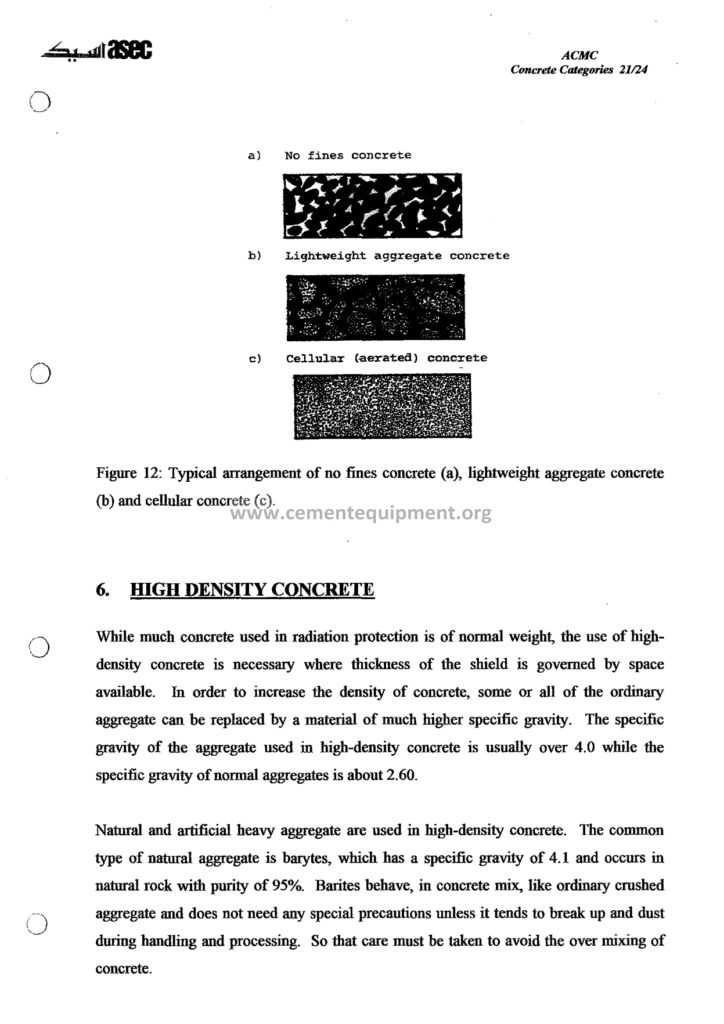
| 5 | Lightweight concrete | Air (foam / pumice) inside the mass | Roof fills, insulation, partition blocks |
| 6 | Heavy concrete | High-density aggregate | Radiation shielding, counterweights |
| 7 | Special concrete | Any mass for a special condition |
Take the concrete types of the general construction world and it looks the same: a reinforced slab, a prestressed girder, a lightweight partition block — they are really not the same batching process, they are different concrete directions in the same CN.
3. How the industry actually classifies concrete (authoritative)
There are three standard classification axes in the cement/concrete engineering textbooks; they form the real answer for engineers:
- By the binder mix (a): Ordinary Portland (OPC), Portland Pozzolana (PPC), Portland Ground Granulated Blast-furnace (GGBS-P), Sulphate-Resisting (SRC), White, Masonry; the compressive and early. ASTM C150 types I–V with the ASTM blend types (S, P, AV, with slags) and European EN 197-1 CEM I–V. Full tables in the types-of-cement article already published on this site (internal link above).
- By the form in the frame (b): plain vs reinforced vs post-stressed vs self-compacting (SCC) vs extruded.
- By the density (c): normal-heavy-lightweight. This is the main commercial separation for specials.
- By the performance demand — high-strength (≥ 50 MPa, up to 120 for high-high), high-mach (HPC with depressors), high-performance-concrete (HSC/HPC), self-compacting (SCC), rapid hardening, and the fiber type (steel-fiber (SFRS), polymer (FPS) also the “ultra” (HPC, UHPC).
The two reference standards every engineering office uses:
– ASTM C150 — the classification of cement (types I–V by sulfate and heat).
– EN 197-1 — the European cement classification (CEM I, II, III, IV, V with proportions in the names).
– IS 456 (India) — designates mix design grades M10–M80 and their 28-day cube strength.
These are a duplicate of the cement types article, so we integrate them differently here: concrete type = cement type + form + density + grade.
4. Concrete mix types (the pouring side) — strength mixes vs placement
For production, the mix types are what the batching plant calls grades: M10, M15, M20, M25, M30, M35, M40 (IS 456) or A1-, A2-in-the-NC (the old American practice). The grade number is the characteristic compressive strength at 28 days for a 150 mm cube (or a 28-day cylinder for the US practice).
| Grade (IS 456) | 28-day strength MPa | Typical member |
|---|---|---|
| M10 | 10 | Blinding, footboard |
| M15 | 15 | PCC bed, columns light |
| M20 | 20 | Floors, footings (common) |
| M25 | 25 | Columns, beams standard |
| M30 | 30 | Multi-story standard |
| M35 / M40 | 35/40 | Higher loads; forms |
| M45+ | 45–80 | High strength, HPC |
Self-compacting concrete (SCC) — flow < 800 mm slump-flow, no vibration, used in dense rat-forced members and factory casting; viscosity already holds the mixture without work. High-strength (≥ 55 MPa) needs superplasticizer, silica fume or metakao, low w/b (0.25–0.35); it is not the same as “strong” in the generic.
5. Structural concrete types — the five of real life
- Plain concrete (PC) — no steel: blinding layers, footings small, pavement, base; cheap but no tension resistance → it is never structural for T.
- Reinforced concrete (RC/RCC) — bars in tension zones; the workhorse of all buildings: 1 forged, every frame; steel at cover 20–40 mm; fire and corrosion checks.
- Pre-stressed concrete — tendons pulled before the load (both ends) then released → the section under permanent work forced into compression, the of tension eliminated; 2×–4× span capacity of the same section as RC. Its transport is high precision. Post-tensioned (tendons pulled on site) vs pre-tensioned (inind).
- Pre-cast concrete — panels/pipes/blocks cast in the factory with permitted quality, then assembled; speed + quality, joints are the engineering detail.
- Self-compacting concrete (SCC) — flows by self-weight through dense reinforcement; no vibration; used in columns in a dense reshuffle columns, height casts.
6. The strength tables: what each type of concrete gives (28-day)
| Concrete type | Density (kg/m³) | 28-day compressive (MPa) | Mix water/cement (approx) |
|---|---|---|---|
| Plain low (M10–15) | 2,200 | 10–15 | 0.55–0.65 |
| Standard (M20–30) | 2,300–2,400 | 20–30 | 0.40–0.50 |
| High-strength (M40–60) | 2,350–2,450 | 40–60 | 0.30–0.40 |
| HPC (≥ 60 MPa) | 2,400–2,500 | 60–80+ | 0.25–0.35 |
| Lightweight (foam/structural) | 300–1,900 | 2–40 | n/a (density class) |
| Heavy (shielding concrete) | 2,600–4,000 | 20–40 | 0.45–0.55 |
| SCC | 2,200–2,400 | 25–60+ | 0.32–0.42 |
| UHPC (ultra HPC) | 2,300–2,500 | 120–200+ | < 0.25 |
Everything in this table is from the category — if you produce your own “types of concrete” answer, quote the strength you honestly build, because the number is the actual spec.
8. The builders’ actual types (daily site language)
On a cement plant’s concrete works (platforms, foundations, cooling towers, silos):
- Foundation concrete / blinding — M10–M15, low strength, leveling.
- Structural concrete — M25–M35 foundations, columns, plinths.
- Mass concrete (silo bases, piers) — high cement → thermal shrink cracks → low-heat cement or blast-furnace blend, pour in lifts with controlled temperature.
- Concrete for masomy / non-load — blocks, panels.
- Repair (pavement/industrial floor) — high strength, abrasion resistance + fibers.
9. Exact nut of the topic chapter (what we teach in “Concrete Categories” — from the ACMC pack)
The Euclid-Strong (ACMC vol.2, Concrete Categories) course (packed into the same product collection as this website) box just this: all concrete has the same raw = cement + aggregate + water; categories = the proportions and the mode of loading. The module [Fundamentals of Concrete and Concrete Technology] in the same pack supplies the mix graphs.
The categories it distinguishes (in the course order):
1. Lime-based / ancient (historical) — not used for structural anymore.
2. Ordinary, medium and high — by the 28-day C strength.
3. Plain vs reinforced vs prestressed (the classification we summarize).
4. Special by additive — frost-protective, acid-resistant, waterproof.
The concrete “category” divider table (rendition) — for every type, the factors that define it.
Now, why a buyer must ask for “type, class AND form” together — when you send an RFQ for “concrete”, the asset purchaser writes: ready mix, grade M30, limestone 20 mm, class F2, strength 30 N, 28-day. That file gets built — those are the spec pages the course covers.
10. The special types worth knowing (named concrete products)
| Named product | What it is | Typical strength |
|---|---|---|
| Pervious concrete (water-per) | No fine agg; drains stormwater | 5–15 MPa |
| Foam / cellular concrete | Air to make stable foam | 2–15 MPa |
| Fibre-reinforced (FRC) | Steel/poly propene fibres | 20–60+ |
| Shotcrete / gunite | Pneumatic projection | 25–55 |
| Concrete for radiation (heavy) | Barite / magnetite | 5–40 |
| 22-grade Topping/fairing | thin kitchen/adding concrete | 20–40 |
| Exposed / decorative (colored, light) | design mixes | equal |
| Roller-compacted (RCC-paving) | warm mix heavy, perp | 20–35 |
Selection rule: strength controls the transfer of load, mass controls the cost, relation the slab/casts the default — everyone who can simplify the three got the correct category.
11. Concrete grade vs cement type (misunderstanding that costs money building)
Many people confuse “cement type” with “concrete grade”. They are NOT the same:
- Cement type → about the cement only (ASTM/EN classes, blend, resistance) — see the types-of-cement article for the full set.
- Concrete grade / type → the result of the mix: strength + application (form, density, addition). Same cement produces M15 or M60 concrete, depending on w/c, course, and quality.
For the same CEM I 42.5, a 0.60 w/c yields a 15 MPa-ish concrete; a 0.30 w/c with super-plastifier a high 60 MPa; the cement is the same. This is the single most expensive misunderstanding — you need both of them but they do not describe the same axis.
12. FAQ — concrete types (short answers for students)
How many types of concrete are there? There are 7 families (plain, reinforced, prestressed, precast, lightweight, heavy, special/ad-d) — plus dozens of commercial sub-types by binder, density, and additive. Six axes (by weight, by strength, by form, by mode, by binder, by standard) are the answer.
What are the 7 types of concrete? Plain, reinforced, prestressed, precast, lightweight, high-strength (dense), and special types (SCC, fibers, pervious, etc.).
Which concrete type is strongest? Ultra-high-performance concrete (UHPC) reaches 120–200 MPa at 28 days; between common site types, high-strength M60 (≥ 60 MPa) has the highest realistic.
What are the main 4 types of concrete? Ordinary/plain, reinforced, prestressed, lightweight (as in the classic teaching).
** is what concrete made of?** Cement + water + aggregates (fine sand + coarse stone) + additives. See mix in Section 3.
What is the difference between type1 and type2 concrete? In the US/ASTM naming, Cement type I (OPC) vs type II (moderate sulfate) — but that is a cement class, not a concrete family. See the types-of-cement article.
What is the strength of M30 vs M25? M30 reaches >= 30 N/mm² at 28 days (cube), M25 25; the concrete grade name = the strength on the day for the same quality mix. The test tube summary of the strength article: 7 days ~ 65–70%, 14 ~ 85–90%, 28 = 100% of the 28-day undere build. See the 28-days-strength chart post.
Deep-dive extras from the technical package
The 133 MB Lea’s Chemistry of Cement and Concrete (5th edition, 2019) canonical reference on cement-concrete chemistry is part of the cement technical package — its concrete-properties chapters (colunas VI–X) cover every parameter the table above uses (early strength, shrinkage, sulfate behavior). The ACME “Fundamentals of Concrete Technology” module is 9 volumes of the same resource.