intro (answer paragraph)
Clinkering is the high-temperature stage of cement manufacturing in which raw meal (limestone-derived lime + clay-derived SiO2, Al2O3, Fe2O3) turns into clinker — the hard, dark, roughly 5–25 mm lumps that are later ground with gypsum into cement. The word comes from the product itself: the lumped, partially fused mass leaves the rotary kiln at roughly 1,350–1,450°C, the clinkering temperature at which a liquid phase forms and the four main cement minerals crystallize out of it. In the plant, one tonne of clinker comes from about 1.26–1.57 tonnes of dry kiln feed after the feed loses CO2 (calcination) and moisture (Section 8 gives the exact factor from the site’s plant tool).
Clinkering is not a single reaction — it is a chain of five process stages (preheating/calcination, exothermic reaction, sintering/burning, cooling), each running at an engineered temperature. The cement type a plant produces follows almost entirely from the clinker phases it holds in the burning zone, then it grinds the clinker. Everything in this guide comes from the “Clinker Burning Process” and “Advances in Cement Clinkering” course modules shipped in the technical package, plus the live Clinker-vs-Kiln-Feed-Factor Excel tool.
2. What exactly is a clinker?
A clinker lump is a hard pellet, roughly 5–25 mm, dark gray to black at the surface, made of four crystalline phases locked together in a partially glassy matrix:
| Phase | Short name | Typical % of clinker | Role in cement |
|---|---|---|---|
| Tricalcium silicate | C₃S (alite) | 55–70 | Early + main 28-day strength |
| Dicalcium silicate | C₂S (belite) | 15–30 | Later strength (7 days → 1 year) |
| Tricalcium aluminate | C₃A | 5–13 | Early hydration, drives sulfate demand & heat |
| Tetracalcium alumino-ferrite | C₄AF (ferrite) | 5–12 | Low heat, sulfate tolerance, dark colour |
| Free lime | f-CaO | 0.5–2.0 (target) | Must stay low — unsoundness if high |
| Minor oxides | MgO, SO₃, alkalies, Cl | < 3–5 (sum) | Process control + quality limits |
The operator’s primary clinker-control number is free lime (f-CaO). If the laboratory shows f-CaO above about 1.5–2.0%, the feed was insufficiently burned — the kiln is either too cold, too fast, or the raw quality drifted. If f-CaO is below about 0.5%, overburning usually caused it (and grinding energy goes up). The two-side limbo is the daily game of the kiln operator.
3. The clinker burning process — the full chain in five zones (ACMC course)
A modern rotary kiln is a 40–80 m steel tube, 3.5–6 m in diameter, lined with refractory, inclined 3–4%, rotating at 1–4 rpm, feeding up to 100–1,000 t/h (precalciner lines). The meal enters cold at the high end and leaves as clinker at the low end. The “Clinker Burning Process” chapter (ACMC vol.1) divides the journey into five zones:
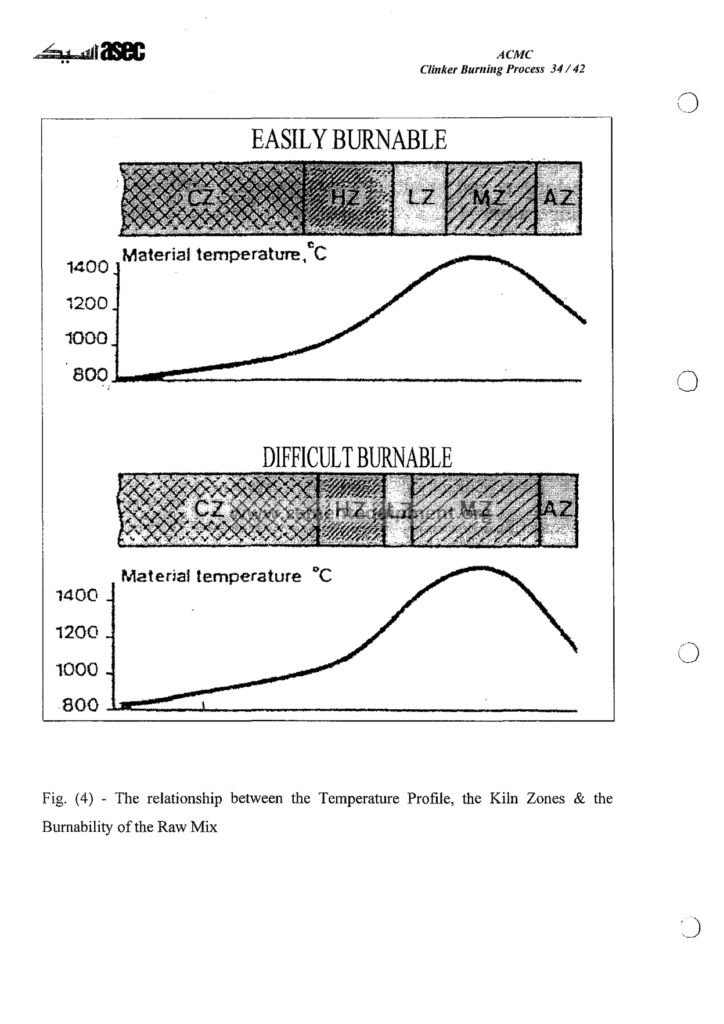
Zone 0 — preheater / precalciner (600–900°C). Raw meal is air-lifted through 4–5 cyclone stages against the hot kiln gas; 90–95% of the calcium carbonate decomposes in the calciner before material ever enters the kiln shell. Only the last 60–80% of the burn takes place inside the kiln itself.
Zone 1 — drying / preheating (100–600°C). Free water and bound water leave; the carbonate starts to crack. This zone is a heat exchanger: the meal is heated by the exhaust gas 2counter-flow.
Zone 2 — calcination (600–900°C). CaCO3 → CaO + CO2. Strongly endothermic, ~1.7 GJ per tonne of clinker — this is why the calciner consumes a big part of the energy bill. Each 1% shift in the meal’s LOI shifts the required kiln heat input and the clinker factor proportionally (Section 8).
Zone 3 — exothermic transition (900–1,200°C). 2CaO + SiO2 → belite (C2S) starts to form and the early aluminate species form. This zone is where the reaction “fires itself”: energy starts being released instead of absorbed.
Zone 4 — burning / sintering zone (1,350–1,450°C). The liquid phase (melt) appears — 20–30% of the mass in the hottest zone. The last free lime dissolves into the melt, and from the melt alite (C3S) crystallizes around the belite grains. This is the clinkering zone, the heart of the process; the flame temperature reaches 1,800–2,000°C.
Zone 5 — cooling zone (1,450 down to ~1,100°C in the kiln, then fast-quench in a clinker cooler to 50–100°C). Rapid cooling stabilizes the phases, preserves the alite, and gives the clinker “grindability”. Over-slow cooling lets belite transform and reactive phases crystallize badly — quality loss.
4. Clinkering stage-by-stage — the temperature table
| Stage | Material temperature | Main reaction | Heat / notes |
|---|---|---|---|
| Preheater | 100–600 °C | Water + early carbonate loss | heat exchanger system |
| Calcination | 600–900 °C | CaCO₃ → CaO + CO₂ | endothermic ~1.7–1.8 GJ/t |
| Exothermic | 900–1,200 °C | 2CaO + SiO₂ → C₂S | heat released |
| Sintering / clinkering | 1,350–1,450 °C | C₂S + CaO → C₃S (in melt) | the clinkering window |
| Cooling | 1,450 → 100 °C | phase fixation | fast = grindable; slow = bad |
Why 1,450°C? The melt must be there; at 1,250°C the mixture only partly melts; the clinkering zone must hold glassy-liquid enough to let C3S grow into large, well-formed alite crystals. Higher temperatures force more melt and (within limits) more conversion — but runaway causes rings and damage. Lower temperatures give a “dusty” clinker with high free lime.
5. From clinker to cement (what happens next)
Clinker as it leaves the cooler is not (useable) cement: its C3A welds water instantly (flash set). The plant then:
- mixes 3–5% gypsum (CaSO4·2H2O) → the set-regulating sulfate source,
- optionally adds blast-furnace slag, fly ash or limestone → blended cements (limits in the types-of-cement article),
- grinds to about 380–420 m²/kg (Blaine) → finished cement bag/silo.
So the correct chain is: raw meal → clinkering → clinker → + sulfate + grinding → cement.
White cement, for comparison, is the same chain with a low-Fe2O3 raw mix (iron removed from the clinker for whiteness), normally clinkered slightly cooler, then quenched under controlled conditions to keep the whiteness and neutralize colouring ions.
6. Bogue phases — how the plant predicts the clinker
Clinker quality is predicted from the raw-meal chemistry with the classic Bogue equations:
C₃S = 4.071×CaO − 7.600×SiO₂ − 6.718×Al₂O₃ − 1.430×Fe₂O₃ − 2.852×SO₃
C₂S = 2.867×SiO₂ − 0.7544×C₃S
C₃A = 2.650×Al₂O₃ − 1.692×Fe₂O₃
C₄AF = 3.043×Fe₂O₃
Where all oxides are weight fractions of the clinker. The control prerequisites:
- LSF (lime saturation factor): 0.90–0.98 (target). Too high ⇒ burnability hell (free lime persists); too low ⇒ weak cement.
- SR (silica ratio): 2.0–3.0 — higher = harder to burn, more strength potential.
- AR (alumina ratio): 1.3–2.5 — governs melt fluidity + sulfate performance.
All three are computed plant-daily and covered in detail in the cement chemistry and types-of-cement articles (linked above).
8. Clinker / kiln-feed factor — real plant data from the site’s tool
The technical package ships Clinker-vs-Kiln-Feed-Factor.xls, a simple mass-balance calculator that plants use to plan production. It takes: kiln feed tonnes, LOI of the feed, dust-loss and coal ash; it outputs the conversion factor with the coal NCV included. A real run with values from that tool:
| Parameter | Value | ||
|---|---|---|---|
| Kiln feed basis | 11,905 MT | ||
| Clinker produced | 7,581.5 MT | ||
| Kiln feed → clinker factor | 1.570 | ||
| Raw meal → clinker factor | 1.507 | ||
| Kiln feed LOI | 36.08 % | ||
| Preheater dust loss | 4 % | ||
| Specific heat | 735 kcal/kg clinker | ||
| Coal NCV (kiln / PC coal) | 6,304 / 6,353 kcal/kg | ||
| Weighted NCV | 6,334.8 |
Basic design rule: expect 1.40–1.60 t of kiln feed per 1 t of clinker (average around 1.55 in dry process with precalciner). The exact factor depends on your LOI and dust loss; enter your own numbers in the site’s calculator /clinker-feed-factor/.
8. Control, troubleshooting and daily checks
The kiln control room watches, in order: free lime (fastest delegate of burning), CO/NOx/O₂ pattern (flame vs charge), cooler underneath pressure (both heat transfer and ring condition), and material sample / clinker vehicle.
Practical troubleshooting table:
| Symptom | Likely cause | Corrective action |
|---|---|---|
| f-CaO climbing | under-burning | raise flame temperature or residence time (lower kiln speed softly) |
| Dusty pale slinker | cold flame, too much O2 at the nose | add fuel in step, stabilize flame, check binder |
| Snowmanning / rings | excessive liquid + instable feed | control feed chemistry (lower LSF in small steps), stabilize flams |
| Dark glassy clinker | over-burning | reduce heat / shorten retention |
| Greenish clinker | reducing atmosphere / slow cooling | adjust O2 control, cooler fan earlier |
| Clinker sticking to chains | sulfur/pH circulation | manage sulfur balance, inspect preheater cycles |
FAQ — clinkering (short, direct answers)
What is clinkering? The high-temperature stage (1,350–1,450 °C) in cement manufacturing where raw meal burns in the rotary kiln and turns into clinker lumps. It is the core chemical conversion of the entire cement process.
What is clinker? The hard 5–25 mm lumps produced in the kiln, composed mainly of alite (C₃S), belite (C₂S), aluminate (C₃A) and ferrite (C₄AF), ground with gypsum into cement.
Why is clinkering done? Only in the melt can C3S (alite — the main strength component) crystallize. By clinkering, the oxides achieve the phases that give the cement its setting and strength behavior.
What temperature? Material 1,350–1,450 °C; the flame 1,800–2,000 °C. The danger zone is when the melt fraction becomes excessive or rings begin to form.
What is the clinker conversion factor? The tonnes of dry kiln feed needed to produce 1 tonne of clinker — typically 1.4–1.6; the tool on this site gives 1.570 on kiln-feed basis for the sample plant table (Section 8).
How long does clinkering take? Material residence in the burning zone is measured in minutes (~10–30 min total kiln retention in a modern line, of which the burn zone holds the chemical window); the phase chemistry concentrates in those minutes.
Why does clinker color matter? Grey = normal burn. Green/brown = reducing zone; dark glassy = over-burn. Color is a preliminary “eye check” used between lab results.
What is a precalciner and why does it change clinkering? A calciner (Suspension Preheater with a dedicated burner) shifts 55–60% of the fuel from the kiln to the preheater tower, so the kiln’s burning zone only finishes calcination and does the clinkering. That split is what pushed line capacities from ~3,000 t/d to 10,000+ t/d and sharpened the separate control of calcination vs clinkering — the two now have their own temperatures and O₂ control loops.
What is a burner flame position’s effect on the clinker? Flame shape, length and momentum set where the 1,450°C melt zone sits: a long lazy flame keeps the melt zone shallow and slow-cools; a short intense flame gives a sharp zone and hard sintering. Operators adjust primary/secondary air and positioning to hold the burning zone in the middle third of the shell — the same tuning in every operator course in the package.
Deep-dive extras from the technical package
- “Clinker Burning Process” (ACMC vol.1, 43 pp) — the zone-by-zone narrative above plus the kiln chain diagrams; p.35 contains the clinkering-stage spread used as this article’s feature image.
- “Advances in Cement Clinkering” (Innovations in Cement Manufacturing 1, 2016; chapter authored with J.I. Bhatty) — modern treatment of the target zone processes, the fate of sulfur and alkalies (volatile cycles), oxygen/atmosphere control at the exit pair, and mineral-chemistry notes; used for the sulfur-circulation and troubleshooting bullets.
- Clinker-vs-Kiln-Feed-Factor.xls — production data table in Section 8.
- Lea’s Chemistry of Cement and Concrete 5th ed. (2019) — the scientific basis of the phase chemistry in Section 2 and the Bogue in Section 7.