Roughly 4.1 billion tonnes of cement were produced worldwide in 2024 — and nearly all of it came out of the same sequence: quarry limestone and clay, grind them to a fine powder, heat them to almost 1,500°C in a rotary kiln until they fuse into clinker, then grind the clinker with gypsum back into the grey powder you buy in a bag. This article walks the entire manufacturing of cement step by step, with the diagram, the chemistry, and the dry and wet process compared.
The short version: the manufacturing of cement runs in seven stages — (1) quarrying and crushing the raw materials, (2) grinding and blending them into raw meal, (3) preheating and calcination in a preheater/calciner tower, (4) clinkering in a rotary kiln at about 1,450°C, (5) rapid clinker cooling, (6) finish grinding with gypsum and additives, and (7) storage, packing, and dispatch. The chemistry is concentrated in stages 3–5, where limestone is decarbonated and the oxides react into the four clinker minerals that become cement.
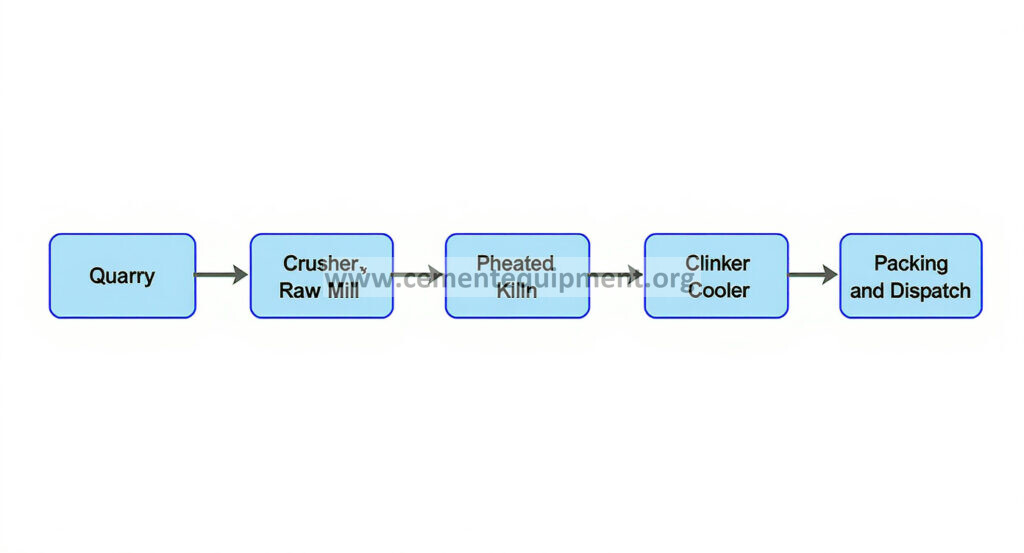
The manufacturing of cement process flow chart (the diagram, in words)
If you draw the manufacturing of cement flow chart, you get a horizontal chain of seven boxes connected by arrows:
Quarry → Crusher → Raw mill → Blending silo → Preheater/Calciner tower → Rotary kiln → Clinker cooler → Finish mill → Cement silos → Packing & dispatch
For the cement process flow diagram, the three chemistry-critical stages — preheating/calcination, the kiln, and cooling — sit in the middle, and the two grinding stages (raw mill, finish mill) bracket them on either side. The manufacturing of cement diagram for a modern dry process line feeds the kiln a dry powder, so the dry process flow chart runs through the preheater tower and calciner; a wet process diagram feeds a slurry. That single difference explains the entire energy gap between the two.
Stage 1 — Raw material extraction and crushing
Cement needs four oxides, and they come from a short list of rocks. The basic raw materials used in the manufacture of cement:
| Element needed | Oxide | Typical source | Share of raw mix |
|---|---|---|---|
| Calcium | CaO | Limestone, chalk, marl | ~75–80% |
| Silicon | SiO₂ | Clay, shale, silica sand | 15–20% |
| Aluminum | Al₂O₃ | Clay, shale, bauxite | (in the clay) |
| Iron | Fe₂O₃ | Clay, iron ore, mill scale | 1–3% |
The question “how is cement made from limestone?” is answered right here: limestone supplies the calcium oxide that becomes the silicate phases in clinker. A typical plant grinds roughly 1.5 tonnes of raw materials to make 1 tonne of clinker — about a third of the limestone mass is lost as CO₂ in the kiln, which is also why plants sit next to their quarry (EPA).
Extraction is drilling and blasting (or ripping in soft deposits). The rock is then crushed — typically to under 25 mm — and stockpiled in pre-blending beds to smooth out the natural variation of the quarry face. The kiln downstream tolerates almost no chemistry swings, so this is where uniformity starts.
Stage 2 — Grinding and blending: making raw meal
The crushed rock is ground to a fine powder called raw meal (kiln feed), typically so fine that 85–90% passes a 90-micron sieve. Grinding is done in a vertical roller mill (VRM) or a ball mill; new raw-grinding lines are almost universally VRMs because they use 20–30% less grinding power than a ball mill of equal capacity.
Chemistry is controlled by three ratios that every process engineer knows:
| Ratio | What it controls | Typical OPC range |
|---|---|---|
| LSF — Lime Saturation Factor | Free-lime risk, alite content, burnability | 0.92–0.98 |
| SM — Silica Modulus | Silicate vs liquid-phase balance | 2.2–2.6 |
| AM — Alumina Modulus | C₃A : C₄AF ratio, setting time | 1.3–1.6 |
The ground meal is homogenised in a continuous blending silo. A well-run blending silo cuts the standard deviation of LSF in the kiln feed by a factor of 7–10 versus the input stream — this is what makes consistent clinker chemistry possible on a continuously running kiln. An LSF swing of more than ±2 points at the kiln feed is typically enough to push free lime, fuel consumption, and refractory wear out of range.
Stage 3 — Preheating and calcination
Raw meal enters the top of a multi-stage cyclone preheater tower and cascades down against the rising kiln exhaust gas. By the time it leaves the tower, the meal is hot and roughly 90–95% of its limestone has already decarbonated in the calciner:
CaCO₃ → CaO + CO₂ (850–900°C)
This is where the bulk of the process CO₂ is released — about 500 kg of CO₂ per tonne of cement comes from calcination alone (EPA). It’s also where most of the kiln line’s thermal efficiency is won or lost: the precalciner section typically burns 55–60% of the plant’s total fuel.
Stage 4 — Clinkering in the rotary kiln (the cement clinker manufacturing process)
The calcined meal enters the upper end of the rotary kiln — an inclined, slowly rotating steel tube lined with refractory. As it tumbles toward the hot discharge end, the material climbs to a burning-zone temperature around 1,450°C against a flame of roughly 1,800–2,100°C. A liquid phase appears at about 1,250–1,300°C, and the remaining free lime reacts with the silicates to form clinker.
The finished clinker is a mixture of four minerals that decide how the cement performs:
| Clinker mineral | Shorthand | Typical share | Role |
|---|---|---|---|
| Alite | C₃S | ~55–60% | Early + late strength |
| Belite | C₂S | ~20–25% | Late strength (28 days+) |
| Aluminate | C₃A | ~8–10% | Early strength, high heat of hydration |
| Ferrite | C₄AF | ~7–10% | Minor effect |
Clinker leaves the kiln as hard, dark-grey nodules of 3–25 mm — the intermediate product that becomes cement once ground.
Stage 5 — Clinker cooling
Hot clinker exits the kiln at around 1,400°C and is quenched to roughly 100–150°C in a grate cooler (or planetary/rotary cooler). Cooling does two jobs:
- It locks in the clinker phase mineralogy — fast cooling preserves the high-strength alite glass form; slow cooling degrades it toward lower-strength belite.
- It is a heat exchanger. The recovered hot air is returned to the kiln and calciner as combustion air — the cooler recovers up to 30% of the heat input to the kiln system (EPA).
Stage 6 — Finish grinding: clinker to cement
Cooled clinker is ground with roughly 3–5% gypsum (or natural anhydrite) to control setting time, plus — increasingly — supplementary cementitious materials such as blast-furnace slag, fly ash, limestone, or pozzolan. This finish grinding is almost always done in a closed-circuit ball mill with a separator. The clinker-to-cement ratio set here is the single lever that controls both cost and carbon footprint: substituting SCMs can cut a plant’s footprint by up to 10% (PCA).
Stage 7 — Storage, packing, and dispatch
Cement is stored dry in silos (it reacts with moisture and CO₂ over time, which is why bagged cement has a shelf life), sampled for quality against the relevant standard, then dispatched in bulk by tanker/rail, or bagged in 25–50 kg sacks by rotary packers. In most markets the large majority ships in bulk; bags serve the retail and small-contractor channel.
Manufacturing of cement by dry process vs wet process
Nearly all modern capacity is dry process — the kiln feed enters as a dry powder. The older wet process fed a water-based slurry and carried a large energy penalty from evaporating that water, which is why it’s been phased out almost everywhere.
| Dry process (modern) | Wet process (legacy) | |
|---|---|---|
| Kiln feed form | Dry powder (raw meal) | Water-based slurry |
| Typical thermal consumption | ~3.4–3.5 GJ/t clinker | 5–6 GJ/t or more |
| Status | Standard for all new capacity | Survives only where raw materials are very wet |
| Flow chart | Dry powder path through preheater/calciner | Slurry path directly to kiln (no calciner benefit) |
The intermediate configurations — semidry, dry with preheater, dry with preheater/precalciner — are variations on the dry route. Five pyroprocessing variants exist in total (EPA): wet, long dry, semidry, dry with preheater, and dry with preheater/precalciner.
The chemistry of cement manufacturing (chemical equations)
The chemistry that answers “how is cement made chemical equation” style questions:
Calcination (850–900°C, mostly in the calciner):
CaCO₃ → CaO + CO₂
Clinkering (1,250–1,450°C, rotary kiln) — the oxides combine into the four minerals:
– Alite: 3CaO·SiO₂ (C₃S) — calcium oxide + silica → tricalcium silicate
– Belite: 2CaO·SiO₂ (C₂S) — dicalcium silicate
– Aluminate: 3CaO·Al₂O₃ (C₃A) — tricalcium aluminate
– Ferrite: 4CaO·Al₂O₃·Fe₂O₃ (C₄AF) — tetracalcium aluminoferrite
Finish grinding: clinker + 3–5% gypsum (CaSO₄·2H₂O) → Portland cement. The gypsum controls setting time — without it, cement can flash-set when mixed with water.
Energy and emissions: the environmental impact of the cement manufacturing process
Cement is one of the most energy- and carbon-intensive products made at scale — this is the environmental impact that shows up in the literature and exam syllabuses:
- Energy: a modern dry-process line consumes about 3.4–3.5 GJ per tonne of clinker; legacy wet kilns burned 5–6 GJ/t or more.
- CO₂ from calcination: about 500 kg CO₂ per tonne of cement (EPA) — the limestone decomposition itself, before any fuel is burned.
- Total CO₂ from the pyroprocess: typically 0.85–1.35 tonnes of CO₂ per tonne of clinker, depending on fuel mix and efficiency.
- Alternative fuels: US plants coprocess tire-derived fuel and other alternatives supplying more than 15% of the sector’s energy (PCA), reducing landfill burden.
These numbers matter because roughly half the CO₂ from cement comes from the chemistry (calcination), not the flame — which is why clinker substitution and lower-clinker cements, not just kiln efficiency, are the industry’s main decarbonisation levers.
IELTS Task 1 and study notes
The cement making process diagram is a classic IELTS Task 1 process-description exercise. If you’re describing it, the key stages to name in order are: quarrying → crushing → grinding → blending → preheating → calcination → kiln → cooling → final grinding with gypsum → packing. Use sequencing language (“first”, “then”, “after that”, “finally”) and note the two energy-intensive steps (calcination and the rotary kiln at 1,450°C).
For the manufacturing of cement pdf/ppt variants of this content: the full process is available in print-ready form with the downloadable cement technical package on this site, and a video companion to this article walks the plant tour stage by stage.
FAQ
What are the raw materials for manufacturing cement? Limestone (calcium), clay or shale (silicon and aluminum), and iron ore (iron). The mix is typically ~75–80% limestone, 15–20% clay, and 1–3% iron-bearing correctives, plus small additions of silica sand as needed.
How is cement made from limestone? Limestone provides the calcium oxide. It is crushed, ground with clay into raw meal, heated in a preheater and rotary kiln (1,450°C) where it reacts into clinker, then ground with gypsum into cement.
What is the cement manufacturing process step by step? (1) quarry, (2) crush, (3) grind and blend into raw meal, (4) preheat and calcine, (5) clinker in the rotary kiln, (6) cool, (7) finish-grind with gypsum, (8) pack and dispatch.
How is cement made for kids? Cement is made by crushing limestone and clay, baking the powder in a giant rotating oven (a kiln) at almost 1,500°C until it forms little grey balls called clinker, then grinding those balls with gypsum into the fine grey powder that builders mix with water.
What temperature is the cement kiln? The material in the burning zone reaches about 1,450°C; the flame is roughly 1,800–2,100°C. The liquid phase that accelerates clinkering forms at about 1,250–1,300°C.
What is clinker? Clinker is the hard, nodular intermediate (3–25 mm) produced by fusing the raw mix in the kiln. It is ground with gypsum to make Portland cement. Its four main minerals are alite (C₃S), belite (C₂S), aluminate (C₃A), and ferrite (C₄AF).
What is the difference between wet and dry process cement manufacture? The wet process grinds the raw materials with water into a slurry; the dry process uses a dry powder. Dry is far more energy-efficient (~3.4–3.5 vs 5–6 GJ/t clinker) and is the standard for all modern plants.
Why is gypsum added to cement during grinding? Gypsum (calcium sulfate) controls the setting time of the cement. Without it, clinker can set too fast when mixed with water.
What is the chemical equation for cement manufacturing? The key step is calcination: CaCO₃ → CaO + CO₂. The clinker minerals then form from CaO reacting with silica, alumina, and iron oxide; grinding clinker with gypsum (CaSO₄·2H₂O) gives Portland cement.
For the chemistry behind the kiln — the calcination and clinkering reactions and how each mineral affects the finished cement — the companion guides on this site cover the 10 key chemical reactions in clinker production and the reaction zones of the rotary kiln. If you’re starting from raw materials, the raw materials used in cement production guide lists every mineral and its oxide role.
From a quarry bench to a bagged tonne in a week’s production: that’s the manufacturing of cement — chemistry at 1,450°C, controlled by three ratios and a lot of moving iron.