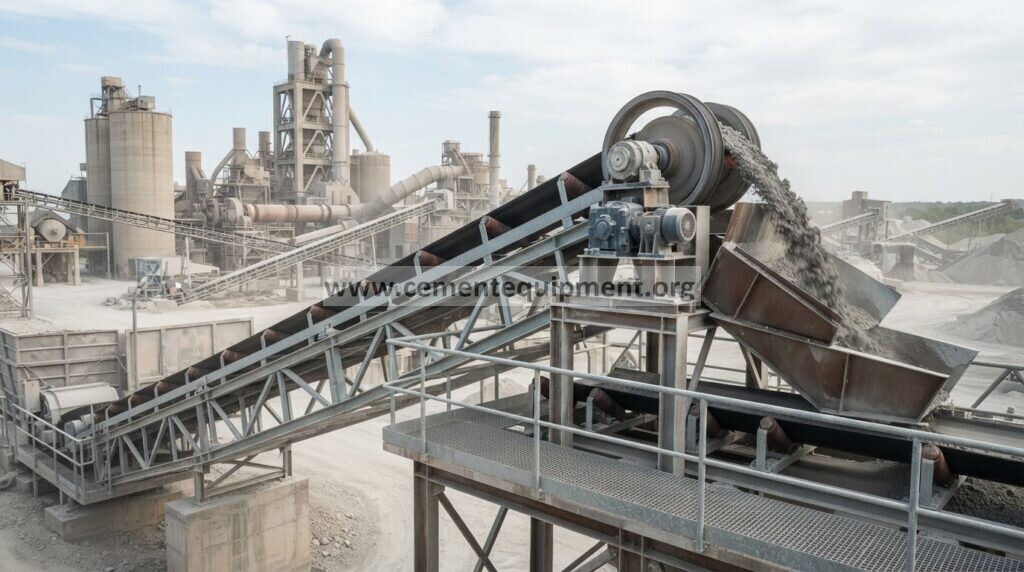

Quick engineering answer
Belt misalignment should be diagnosed from the tracking pattern, not corrected by repeatedly steering idlers. Check loading symmetry, pulley and idler alignment, structure, belt condition, take-up and buildup; then identify whether the belt drifts continuously, only under load, or at a repeatable conveyor location before making adjustments.
What Conveyor Belt Misalignment Means
Conveyor belt misalignment, or mistracking, means the belt does not run consistently near the intended centerline of the conveyor. In a cement plant, the root cause can be mechanical, loading-related or structural. Common causes include skewed pulleys or idlers, off-center loading, damaged or poorly aligned splices, material buildup, incorrect tension distribution and distorted conveyor structure.
The key diagnostic rule is to identify where the belt first begins to move away from center. The first deviation point usually gives more useful evidence than the location where the belt finally rubs a frame or trips a switch.
Why Mistracking Matters in Cement Plants
Persistent mistracking can damage belt edges, contaminate walkways with spillage, overload return-side cleanup, damage skirts and idlers, and eventually stop the conveyor. It can also hide a loading or structural problem that becomes progressively worse. Correcting the tracking problem early is normally easier than repairing a damaged belt.
How to Diagnose Belt Mistracking
Observe the belt empty and loaded because the tracking behavior can change with material distribution. Start upstream of the visible problem and inspect the first pulley, idler set, loading point or splice where the belt begins to shift. Confirm that pulleys and idlers are square to the conveyor centerline, rotating freely and not carrying material buildup. Then check loading symmetry, skirt pressure, splice condition, take-up action and structural alignment.
Visual Diagnostic Flow
Where does the belt first begin to move off center?
Does it happen empty, loaded, or only after a splice passes?
Check loading, buildup, pulley/idler geometry, splice and take-up.
Apply one change, observe multiple revolutions, then document the result.
Key Technical Checks
- Check whether mistracking starts only under load; this strongly points toward loading distribution, skirt interaction or structural deflection.
- Inspect head, tail, bend and take-up pulleys for buildup and alignment.
- Confirm idler frames are square and that rolls turn freely without seized bearings.
- Inspect the splice for squareness and local belt distortion.
- Check take-up travel and tension balance rather than simply adding more tension.
- Look for buildup on return idlers and pulleys, especially with sticky raw material or wet conditions.
Common Corrective Mistakes
- Tilting random idlers near the rubbing point without finding where mistracking starts.
- Increasing belt tension to solve a geometry or loading problem.
- Ignoring a crooked splice or pulley buildup.
- Adjusting multiple idler sets at once, which removes the ability to identify which change helped.
- Tracking an empty belt correctly while ignoring off-center material loading during production.
Symptom-to-Check Matrix
| Observed behavior | First checks | Likely direction |
|---|---|---|
| Belt tracks well empty but moves sideways when loaded | Loading point, chute centering, skirts, structural deflection | Loading-related or structure-related mistracking |
| Belt shifts near the same pulley in all conditions | Pulley alignment, buildup, bearing condition, nearby idlers | Mechanical geometry or contamination |
| Mistracking begins after a splice passes | Splice squareness and local belt distortion | Splice or belt condition |
| Return belt wanders after wet or sticky operation | Return idlers, pulley buildup and cleaning system | Material buildup or seized rollers |
Practical Troubleshooting Sequence
- Identify the first location where the belt departs from center.
- Compare empty-belt and loaded-belt tracking.
- Remove buildup and confirm all nearby rollers rotate freely.
- Check pulley and idler alignment against the conveyor centerline.
- Inspect the splice and belt condition.
- Verify material is loaded near the belt center and that skirts are not forcing the belt sideways.
- Make one controlled adjustment at a time and observe several belt revolutions before the next change.
- Document the final condition so future maintenance has a reference.
Frequently Asked Questions
Why not just reset the belt-misalignment switch?
The switch reports the symptom. Resetting it does not correct off-center loading, skewed idlers, pulley buildup, a crooked splice or structural distortion.
What should be checked first?
Find the first point where the belt leaves the centerline, then compare tracking empty and loaded. That usually narrows the problem faster than adjusting the idlers where the belt finally rubs.
Should belt tension be increased to correct mistracking?
Not automatically. Excess tension can add unnecessary load while leaving the real cause unchanged. Verify take-up condition, alignment, loading and buildup before changing tension.
Why can a belt track correctly empty but poorly when loaded?
Material may be entering off center, skirts may apply asymmetric force, or the structure may deflect under load. Inspect the loading zone before changing downstream tracking idlers.
When should the conveyor be stopped for inspection?
Stop and inspect when mistracking is damaging the belt edge, contacting fixed structure, causing significant spillage, or indicating a damaged pulley, idler, splice or belt condition that cannot be checked safely while running.
Engineering References
The troubleshooting sequence was cross-checked against specialist bulk-material handling guidance.
Final Recommendation
Do not treat conveyor mistracking as an idler-adjustment exercise. Find the first deviation point, separate loading effects from mechanical alignment, correct buildup or damaged components, and make controlled tracking adjustments only after the geometry is credible. For broader design context, see the Belt Conveyor Design guide and the Infinity for Cement Organization technical library.