Innovations In Cement Manufacturing: Complete Guide & Downlo
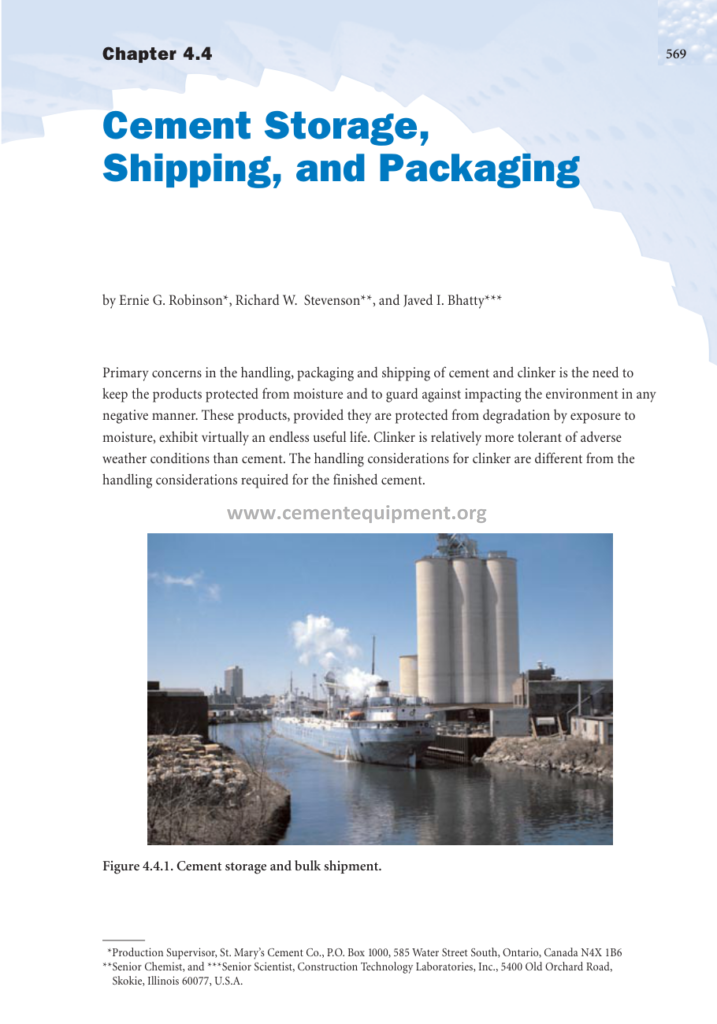
Primary concern in the handling, packaging and shipping of cement and clinker is the need to keep the products protected from moisture and to guard against impacting the environment in any negative manner, and Chapter 4.4 of the Innovations in Cement Manufacturing series opens with this double requirement because it shapes everything that follows. Cement and clinker, provided they are protected from degradation by exposure to moisture, exhibit virtually an endless useful life, and the handling considerations for clinker are different from the handling considerations required for the finished cement. The cement, a fine powder whose hydration begins the moment water is present, must be kept dry from the mill outlet to the point where the concrete mixer adds water, while the clinker, a granulated, relatively weather-tolerant material, must be stored, cooled, and reclaimed without losing the grindability and the reactivity that the kiln produced. This article expands the original chapter into a complete technical package covering cement silo storage and extraction, clinker storage and reclaim, the packing machines and bag handling that convert silo cement into marketable bags, the bulk loading systems that ship cement to trucks, railcars, and ships, and the moisture protection, environmental control, and logistics innovations that modern dispatch demands.
The purpose of this article is to give the engineer and the logistics manager a complete working picture of the dispatch chain: how cement and clinker are stored so that their quality survives, how the cement is extracted from storage and delivered to the packers and the loading stations, how the packing machines produce bags of accurate weight and intact seal, how the bulk terminals load trucks, railcars, and vessels without dust or weight loss, and how the innovations of automation, weighing, and fleet management have transformed the last stage of the cement-making process into a precision logistics operation.
1. Why Moisture Protection Governs the Whole Design
The chemistry of cement makes the storage problem precise. Portland cement is a reactive powder: in the presence of water it hydrates, and even a small amount of moisture degrades it irreversibly. A cement that has absorbed a few percent of water shows lumps, reduced strength, extended setting, and a resistance to flow that defeats the packers and the aerators; the hydration products that form on the surface of the grains seal the grains together and consume the very compounds that should later react with the mixing water of the concrete. The storage and handling systems are therefore designed around one commandment: keep the cement dry.
The moisture arrives by three paths. The first is the direct entry of rain or spilt water through leaky roofs, open hatches, and badly designed vents; the second is the condensation of moisture from the air on the cold cement surfaces, which explains why cement silos are dried, vented through desiccant-protected filters, and not vented to the open air without care; and the third is the hygroscopic absorption of moisture from damp conveying air, the reason the compressed air of aeration systems and the conveying air of pneumatic systems are dried and filtered. The design of every hatch, vent, filter, and air system in the dispatch chain is a defence against these three paths.
Clinker is comparatively tolerant of weather, because its hydration is slow and its grains are large, but moisture is still its enemy in two indirect ways. A wet clinker surface feeds moisture to the finish mill, where it raises the grinding difficulty, coats the media, and consumes the gypsum’s effectiveness; and the surface moisture of the clinker introduces water into the cement product itself. The clinker storage therefore keeps the pile free-draining, the clinker conveyors are protected from rain, and the reclaim roots the material from the dry core of the pile rather than from the wet outer crust.
This moisture discipline explains most of the engineering of this chapter: the covered clinker storage, the aeration and drying of the silos, the totally enclosed conveying of the cement, the dust collection at every transfer, and the weatherproofing of the ship and truck loading heads. The environmental requirement, guarding against any negative impact, runs in parallel, and the two requirements together, dry product and clean plant, define the dispatch department of the modern plant.
2. Cement Storage in Silos and Domes
The finished cement is stored in silos, vertical cylindrical structures whose height, typically 30 to 60 metres, gives the gravity flow that the extraction needs. The silos are built in concrete, which is the standard for the large installations because of its economy and its tolerance of the abrasion and the pressures, or in steel panels, which are erected quickly and serve the medium and smaller plants. The rows of silos at the big plants, each holding 10,000 to 40,000 tonnes, are among the most visible monuments of the industry.
The silo is not a simple hopper; it is a precision storage device whose flow behaviour must be engineered. The cement flows under gravity to the extraction points at the bottom, and the discipline of the flow is set by the hopper angles, the fluidizing pads, and the extraction devices. The modern silo bottom is a radial arrangement of fluidizing pads, porous tiles through which low-pressure air is blown, so that the cement above the pads is aerated and flows towards the centre or towards a ring of discharge points, where the material is extracted by air slides or screws into the central discharge.
Two flow failure modes dominate silo operation, and every silo discipline is designed to avoid them. Bridging occurs when the cement arches above a discharge point and supports itself, stopping the flow despite the material above it; rat-holing occurs when the cement flows through a narrow vertical channel above the outlet, leaving the surrounding material to stay in place as a dead wall. Both failures are caused by caking, compaction, and insufficient fluidization, and both are cured by the same tools: continuous or frequent aeration, hopper geometry steep enough for the material, and extraction that draws from the whole silo footprint rather than from single points.
The silo’s air management completes the design. The cement enters by gravity or by pneumatic conveying, and the displaced air must leave through a venting filter sized for the filling rate; the air for the aeration must be clean and dry; and the interior must be inspectable and cleanable, because every cement silo eventually builds a cake layer that must be removed. The modern silos are fitted with level measurement, continuous weighing or weighing systems in the discharge, and the aeration interlocks that prevent a silo from being over-pressurized or sucked flat by a blocked filter.
3. Clinker Storage: Covered Piles and Stockpiling Systems
The clinker, cooled in the cooler and transported from the kiln building, is stored either in the covered hall or in the open stockpile, and the choice between the two is an economic and climatic decision. The covered storage, a steel or concrete hall with a portal scraper or a circular store, protects the clinker from rain and dust, keeps the pile drained, and costs more; the open stockpile, with its stacker and reclaimer, is cheaper but subjects the material to the weather. In wet climates the covered store is practically standard; in dry climates the open pile remains common.
The functional heart of clinker storage is the reclaim system, which must deliver a uniform, cold, and dry stream of clinker to the finish mills. The portal scraper reclaims the pile from the full width and height of the cross-section, blending the material so that the mill feed varies as little as possible; the circular stockpile runs the stacker and the scraper in a continuous rotation; and the open-pile systems use the bucket wheel and the bridge reclaimer. The reclaim rate is the feed guarantee of the finish grinding department, and its control, through the reclaimer speed and the mill feed belt scale, is a routine and vital control loop.
The conditions at the reclaim point reveal the whole system’s design quality. The reclaimer should meet the mill belt with clinker at or below 80 to 100°C, free of dust, and free of the oversize flakes and the tramp material that damage the mill feed belts. The hot clinker from the cooler is therefore spread and cooled in the pile, and a rotary breaker or hammer crusher at the storage intake reduces the oversize flakes before they enter the storage or the reclaim circuit. The metal detector at the reclaim discharge protects the mill from the mill liners, hammers, and scrap metal that occasionally travel with the clinker belt.
The storage management extends to the inventory itself. The clinker pile is turned over deliberately, because the oldest material, having absorbed the most weather and the most CO2, is reclaimed first; the pile’s surface is kept drained and, in the open store, the fines that pack the surface are managed so that rain does not make a crust. The innovations in clinker storage have concentrated on the automation of the stacker and reclaimer positioning, the blending mathematics of the portals, and the dust control of the intake and reclaim points, and the modern stores run with a fraction of the manpower of their predecessors.
4. Extraction and Conveying of Cement to the Packing Plant
Between the storage silos and the packing machines the cement travels through a short chain of enclosed machines, and this chain is the same family described in the conveying chapter of this series, tuned here for the requirements of the final product. The silo discharge feeds the central extraction point, from which the cement is lifted to the packer feed bins by bucket elevators, and distributed to the bins by air slides and screw conveyors; the dust collectors at every transfer return their catch to the same stream.
The chain must protect three things: the cement’s dryness, its temperature, and its flowability. The cement leaves the finish mills at 90 to 120°C, and the storage and the conveying gradually cool it, but the packing machines prefer the cement at or below roughly 80°C, because warm cement in the bags sweats and degrades, and because the packer’s weigh cells and valves must handle a stable material. The intermediate storage in the packer feed bins, typically with a capacity of one to two hours of packing output, buffers the flow between the mill circuit and the packers, and the bins are aerated and vented so that the cement flows without bridging.
The conveying of this final stage must also keep the cement aerable and free-flowing, and this is where the cement quality, the mill operation, and the dispatch system meet. A cement that is too hot, too moist, or too fine will not flow through a chute, will coat the silo walls, and will choke the packer nozzles; the dispatch department’s complaints are traditionally a sensitive indicator of the finish mill’s performance. The modern plants manage the interface with instrumentation that the older plants lacked: temperature measurement at the mill discharge, flow measurements on the silo discharges, and the weighing of the dispatched tonnage against the mill production, so that the dispatch balance is part of the plant’s daily mass balance.
The energy and housekeeping of this chain are minor compared with the kiln and the mills, but they are not negligible: the elevators and the air slides draw a steady electrical load, the compressed air for the aeration and the seal-air of the elevators is a permanent consumer, and the dust collection at every transfer adds its share. The designer’s discipline is the same as in the rest of the plant: measure, enclose, and recover, so that the last tonne of the day is as dry and as clean as the first.
5. Packing Machines: The Rotary Packer
The packing machine is the instrument by which the cement plant finally produces its parcels of tradeable product, and the standard of the industry is the rotary packer, a rotating turret that carries a ring of filling spouts, typically six, eight, ten, or twelve, around a central feed bin, so that the bags are filled while the turret carries them past the spouts. The cement flows into the bags by gravity, assisted by an auger in the spout or by an impeller that pressurizes the cement, and the weighing is performed inside the machine at each station.
The two filling principles divide the market. The auger packer forces the cement into the bag through a rotating screw in the spout, which gives it the ability to handle fine and aerated cement but adds a compression of the product and a slightly faster bag; the impeller packer uses a spinning impeller in a pressure chamber to blow the cement into the bag, which is gentler on the product and the standard for the larger machines. Both types are fitted with the same automatic valve, the bag spout inserted into the valve of the valve-type bag, and both are offered in semi-automatic and fully automatic configurations with the bag placers, the net-weighing, and the takeaway conveyors.
The weighing system is the packer’s precision element. The modern packers weigh the bag continuously during filling, using a weigh cell under each spout that controls the fill by a coarse-fine two-speed action: the coarse flow fills most of the bag quickly, and the fine flow completes the net weight to the target within a tolerance of a few hundred grams on a 50 kg bag. The legal metrology of the packer matters commercially, because the bag weights are checked by the authorities and by the customers, and the plant that gives away 200 grams on every bag is donating one percent of its product while the plant that underfills loses its customers.
The throughputs of the modern machines are industrial in scale: a twelve-spout rotary packer fills upwards of 2,000 to 3,500 bags per hour, which on 50 kg bags means 100 to 175 tonnes per hour, and the packing line’s design capacity must match the dispatch programme, the trucks, and the silo stocks. The innovations around the packer have automated the manual work: the bag magazine and the automatic bag placer, the automatic bag clamps, the checkweight scale after the packer, the automatic bag reject, and the robots that replace the manual palletizers, all treated in the following sections.
6. Bags and Bag Quality
The bag is a piece of sophisticated packaging engineering, and the cement plant’s quality control extends to it because the bag is the guarantor of the product’s journey. The valve bag, so named for the self-sealing valve at one corner through which the cement is filled, is made in three material families: the multi-ply paper bag, typically three to five plies of extensible kraft or of the composite papers, the single-ply or laminates of polyethylene for the moisture-critical markets, and the woven polypropylene laminated bags for the demanding overseas and bulk-bag trades. The paper bag breathes, the plastic bag seals moisture out completely, and the woven bag carries the heaviest duty.
The valve and the valve patch are the points of failure. The valve is a short inset tube whose closure must seal the bag after the spout withdraws, and the seal quality, the valve patch placement, and the paper’s internal sizing, the agent that gives the kraft its wet strength, determine whether the bag leaks at the valve in the rain. The paper quality controls the strength against impact and the dimensional stability, and the cement plants with the best dispatch reputations are known for their bag specifications, their incoming bag inspection, and their storage of the empty bags in dry, covered warehouses, because wet, embrittled paper fails at the customer’s site.
Bag size and fill quality complete the picture. The standard bags fill to 25 kg or 50 kg, with the 50 kg bag the universal building trade standard and the 25 kg the hardware and DIY format, and the plant may pack multiple bag types from the same silo by programmed changes of the packer settings. The fill quality includes the net weight accuracy, the absence of spillage, the cleanliness of the bag exterior, and the integrity of the valve seal, checked by the automatic inspection systems: the checkweigher, the metal detector, and increasingly the camera systems that inspect every bag for torn corners and open valves.
The environmental and safety face of the bag is the dust at the packing station. The bag filling operation, the bag cleaning, and the takeaway conveyors are all connected to the dedusting system, and the modern packing plant has a lower dust exposure than many laboratories, with the worker’s breathing zone protected by the local extraction at every automatic station and by the overall ventilation of the hall. The bag itself has become an instrument of the plant’s environmental accounting, since the paper and the film wastes of the packing halls are segregated and recycled, and the dust collected from the hall is returned to the silo for dispatch.
7. Palletizing, Wrapping, and Bag Handling
The bag, once filled, entered the palletizing systems of the modern plant, a fully automated train in all but the smallest: the bag is conveyed from the packer, turned and stacked by the palletizer into a stable pattern, typically eight bags per layer with interlocking layers, on a pallet of standard dimensions, until the stack reaches its target, commonly 40 to 50 bags on the half-pallet and up to 60 on the full pallet, and the pile is then strapped or wrapped to hold it for the forklift.
The palletizers of the industry divide into the mechanical floor-level and high-level machines with their layer-forming aprons and the robotic palletizers, in which one or more articulated robots grasp the bags with vacuum or clamp grippers and place them layer by layer. The robotic machines have swept the modern plants because they are flexible, programs can be changed from the control room in seconds, they occupy a fraction of the floor space, and their handling is gentle enough for the weaker bag stocks. The role of the layer sheet, the slip sheet between layers, has also grown, because it stabilizes the load and protects the bags from the strapping.
The wrapping and strapping complete the unit load. The plastic strapping, applied through the strap slots of the stack, holds the load together against the vibration of the truck; the stretch wrap, applied by the rotating ring over the loaded pallet, adds the moisture protection that the bags alone cannot provide, a protection that matters enormously for the sea transport where the containers are ventilated barely at all. The pallet itself is subject to the plant’s load documentation: the pallet weight, the bag count, and the destination are printed on the load ticket or the barcode that the forklift reads at every step.
The automation of the packing hall has produced one of the clearest labour savings in the industry. The modern line from the silo to the truck is staffed by a control room operator and a handful of attending technicians; the robots place the bags, the wrapping machine wraps the pallets, and the pallet conveyors deliver the loads to the truck bay, so that the manual labour of the packing hall, historically one of the heaviest jobs in the plant, has been engineered almost completely out of the process. The safety gains are equally documented: the musculoskeletal injuries of manual bag handling, long the industry’s most frequent harm, have nearly disappeared from the automated lines.
8. Bulk Loading: Trucks, Railcars, and Ships
The bulk dispatch carries the majority of the world’s cement, and its loading technology is among the most specialised in the plant. The truck loading stations of the modern plant load a tanker of 30 to 40 tonnes in ten to fifteen minutes through a loading spout connected to the silo outlet, with the truck weighed on the scale before and after loading to confirm the dispatched tonnage, and the loading sealed against dust by a telescopic spout that descends into the truck’s hatch and by the dust collection connected to the spout head.
The loading spout is the critical component: a telescopic fabric or metal tube, with a dust hood at its lower end, that reaches into the tanker hatch so that the cement flows into the vessel with a minimum of free fall and dust. The performance of the spout is set by its aeration, its dust extraction, and its level sensing: the modern spouts are fitted with sensors that stop the flow when the tank is approaching full, and the loading rate is controlled against the tank’s venting capacity, because the tank vents through the same spout head and a spout loaded faster than the vents can handle spills dust and pressure from the hatch.
The rail loading follows the same logic at a larger scale. The covered hopper cars are positioned under the loading towers, and the loading chutes, arranged to load the car’s several compartments sequentially or simultaneously, are fed by the silo discharge at rates of several hundred tonnes per hour. The car loading carries its own weighing discipline, the flood loading to a nominal weight with a trim load, and the modern terminals load the cars under the control of the scale system with a documentation that links each car to its shipping order.
The ship and barge loading, practised at the cement plants with water access, is the largest scale of all. The continuous ship loader, a gantry or quay-mounted machine whose boom carries the loading spout to the vessel’s hatches, loads at rates from several hundred to more than a thousand tonnes per hour, and the empty ship is trimmed to the cargo plan by movement of the loader along the quay and by the adjustable spout. The dust at the ship loading is controlled at the spout head, and the hold’s moisture protection is the ship’s own hatch sealing, which the shore discipline checks with the vessel before the loading starts, because the sea voyage, with its condensation and its motion, is the harshest moisture test the cement will ever take.
9. The Weighing and Documentation Infrastructure
The dispatch department is the plant’s final point of legal and commercial contact with its customers, and its weighing and documentation infrastructure is therefore an instrument of commercial precision. The truck scales, the rail scales, and the belt scales of the loading systems are verified against the national standards and periodically calibrated, the net weights of the single bags are certified by the packer’s weigh systems and checked by the authorities, and the whole dispatch is documented against the sales orders with a precision that the rest of the plant, engaged in a continuous process, does not need.
The modern dispatch management system is a full logistics platform. The sales orders arrive electronically and are planned into the loading programme; the trucks arrive at the gate, are identified by registration and order number, and are directed to the correct bay by the gate system; the loading bays measure the filling against the order; and the weighbridge and the delivery notes close the loop, with the truck weighed full and empty and the delivered tonnage reconciled against the order’s despatched tonnage. The system’s data feed the plant’s daily reports, the sales statistics, and the production reconciliation, so that the tonnes dispatched are reconciled with the tonnes produced, stored, and lost every day.
The palletized bag dispatch has its own documentation logic. The pallet labels carry the product, the net weight, the bag count, the production date, and the lot, and the modern quality systems trace each pallet back through the packing shift and the silo to the mill and the clinker batch, a traceability that the large customers, the infrastructure projects, and the export authorities demand. The camera systems at the palletizers and the checkweighers provide the automatic quality documentation, so that the rejected pallets and the rework are recorded with their causes.
The innovations in the weighing and documentation field have been the quiet stars of the dispatch modernization: the weigh-in-motion systems that weigh the trucks without stopping them, the radio frequency identification of trucks and railcars that removes the manual identification, the electronic seals, and the integration of the whole dispatch data stream into the plant’s enterprise systems, so that the cement plant, historically the physical end of the production line, has become its commercial and informatic frontier as well.
10. Environmental Control of the Dispatch Department
The environmental requirement of the chapter’s opening, guarding against any negative impact, is implemented in the dispatch department by a complete dust control architecture. Every transfer of the dusty materials is enclosed and connected to the dedusting network; the silo fills are vented through filters sized for the filling air; the loading spouts carry their own compact filters; and the packing hall and the loading bays are ventilated so that the worker’s breathing zone stays within the occupational limits for respirable dust.
The collected dust of the dispatch circuits is the visible measure of its efficiency. The dust from the silo vents and the packing hall contains the finest fraction of the cement, rich in alkalies, and it returns to the silo by the dust conveyors so that nothing is wasted; the environmental accounting of the dispatch department is therefore part of the plant’s yield accounting. The measurable environmental performance of the modern terminals, the low stack opacities, the silent operation, and the absence of carry-back dust on the roads, is the public face of the plant’s whole environmental programme.
The spills and the packaging wastes are managed with equal rigour. The bag seeds at the packing machine, the damaged bags caught by the inspections, and the dust from the floor cleaning systems are collected and returned by the pneumatic and mechanical circuits to the silo or the waste handling, so that the packing hall’s clean floor is not cosmetic but part of the balance. The empty pallets, the plastic film, and the paper wastes leave the plant in the recycling streams, and the plant’s environmental and safety reports document both the emissions and the wastes of the dispatch area.
Noise is the second environmental face of the dispatch department. The blowers, the compressors, the packers, and the conveyors generate continuous noise, and the modern halls are designed with acoustically treated enclosures around the loudest machines and with the compressors housed in their own insulated rooms, so that the workers’ exposure is controlled and the neighbours of the plant, increasingly residential in the growing cities, are protected from the night-time operations that the dispatch department, alone among the plant’s departments, routinely performs in the customer’s hours rather than in the process’s hours.
11. Comparison of Handling and Dispatch Systems
The following table consolidates the dispatch options into the comparison the planner uses, matching the product and the market to the appropriate system and showing the characteristic capacities and duties:
| System | Product | Typical rate | Moisture protection | Dust control | Typical use |
| Bag packer, 6–12 spouts | Bags 25/50 kg | 1,000–3,500 bags/h | bag + pallet wrap | local extraction | retail, hardware, specialty |
| Robot palletizer + wrapper | Palletized bags | 30–120 pallets/h | stretch wrap | basically clean hall | domestic and export bag trade |
| Truck bulk loading bay | Loose cement | 150–300 t/h | sealed spout | spout filter | ready-mix and block plants |
| Rail hopper loading tower | Loose cement | 300–600 t/h | sealed chutes | chute filters | long-distance inland trade |
| Ship loader, gantry boom | Loose cement | 400–1,200 t/h | vessel seal + spout | spout filter | export and coastal trade |
| Clinker ship loading | Loose clinker | 500–2,000 t/h | vessel holds | hooded chutes | clinker export trade |
The numbers of the table drive the commercial engineering of dispatch. The bag trade commands a price premium and serves the markets the bulk cannot reach, at the cost of the bags, the labour, and the packing capacity; the bulk trade moves the mass of the product at the lowest cost per tonne; and the clinker trade exports the intermediate product to the markets, increasingly common, where the cement is ground from imported clinker at the destination. The plant’s dispatch mix, bag versus bulk, domestic versus export, is a strategic decision whose parameters the table makes visible.
12. Innovations in Cement Shipment: From Robots to Digital Logistics
The dispatch department has absorbed the full force of recent automation and digital innovation, and the chapter’s message is that the frontier of cement manufacturing has moved to the last stage of the plant. The robotic palletizing lines, the automatic bag placing, and the checkweight- and vision-inspected packing lines have converted the most labour-intensive department of the plant into one of its most automated, and the machines are increasingly integrated: the packing plan, the pallet pattern, and the truck loading bay are all programmed from the same system that receives the sales orders.
The digital logistics layer sits on top of the automation. The trucks are booked into time slots at the gate, the loading bays are scheduled against the silo stocks and the production forecasts, and the whole dispatch runs to a short-horizon schedule that the plant’s operations planning optimizes together with the mills and the silos. The weighbridge systems stream the data to the invoicing and the sales systems, and the customer portal gives the buyers their own view of the order progress, the tonnage, and the documentation, a transparency that the industry’s best practice now treats as a competitive requirement.
The newest innovations touch the physical layer itself. The silo level and the moisture instrumentation of the dispatch stocks feed the quality system; the conveyor condition monitoring and the predictive maintenance of the packing machines have cut the breakdowns that once interrupted the truck queues; and the energy management of the dispatch department, the variable speed blowers, the scheduled compressors, and the load-proportional conveyors, has joined the plant’s energy programme. The indicators of the future, the autonomous forklift, the driverless yard trailer, and the machine learning that forecasts the daily dispatch demand, are already being demonstrated in the industry’s advanced plants.
Through all these layers, the two old requirements of the chapter remain the measurement of everything: the product must arrive dry, and the handling must leave no footprint on the environment. The engineering of moisture protection, from the silo vent filters to the container wrapping, and the engineering of environmental control, from the spout filters to the drainage of the yards, are the constants around which every dispatch innovation is built, and they will remain so for as long as cement is shipped.
Frequently Asked Questions
Why does moisture damage cement even in small amounts?
Because Portland cement hydrates on contact with water. A few percent of absorbed water forms hydration products on the grain surfaces, which lump the powder, raise the water demand, reduce the strength development, and consume the reactive compounds that should serve the concrete. That is why the silos, the conveying air, the loading spouts, and the venting of the entire dispatch chain are engineered to keep the cement dry from the mill to the mixer.
What is the difference between handling clinker and handling cement?
Clinker is a granulated, fairly weather-tolerant product: it can be stored in covered or open piles, it is reclaimed by scrapers and bucket wheels, and its main enemies are surface moisture, which hurts the finish mill, and the free lime and dust losses. Cement is a fine, hygroscopic powder that must be kept perfectly dry, stored in aerated silos, and moved only in totally enclosed machines, which is why the two products have entirely different storage and transport systems.
How does a rotary packer fill the bags accurately?
The bag is clamped to a spout on the rotating turret, and the filling proceeds in two stages: a coarse flow fills most of the bag quickly, then a fine flow tops it to the target weight while a weigh cell under the spout measures continuously. The two-speed weighing gives an accuracy of a few hundred grams on a 50 kg bag, at rates of several thousand bags per hour on the larger machines.
Why is a bulk loading spout such a specialized device?
Because the cement must leave the silo, enter the tanker hatch, and displace the tank air without any free fall to the atmosphere. The telescopic spout reaches into the hatch, its head collects the displaced dust air, and its sensors stop the flow at the full level, while the loading rate is matched to the tank’s venting capacity so the tank cannot pressurize or spill dust.
What protects the cement during sea transport?
Three layers: the cement is loaded dry and cold into holds or big bags; the hatch sealing of the vessel is checked by the shore disciplines before loading; and for bag cargoes the pallets are stretch-wrapped, and the bags themselves are usually of the moisture-resistant or plastic laminated types. The voyage’s condensation and motion are the harshest test in the distribution chain, which is why the export packaging specifications are the strictest in the business.
Why are robots replacing manual palletizing in packing halls?
Because bag handling is heavy, repetitive work that the automated lines perform faster, more flexibly, and without injury risk. The robotic palletizers switch patterns by program in seconds, occupy less floor space, handle the bags gently enough for the weaker stocks, and cut the musculoskeletal injuries that were historically the cement industry’s most common harm, while also running with far fewer people.
Final Summary
Chapter 4.4 of Innovations in Cement Manufacturing closes the production chain with the handling, packaging, and shipping of cement and clinker, and this article has expanded the chapter into a complete technical package. The article established the double requirement of the chapter, moisture protection and environmental protection, and followed it through the storage of the cement in aerated silos, the storage and reclaim of the clinker in the covered and open stores, and the extraction and conveying chain that delivers the cement to the dispatch equipment.
The technical core covered the packing machines and their weighing systems, the bags and their seal and paper engineering, the palletizing and wrapping train, and the bulk loading of trucks, railcars, and ships, together with the weighing and documentation infrastructure that makes the dispatch the plant’s commercial and legal front line. The operational dimension treated the environmental control of the dispatch department, the comparison of the dispatch systems through their capacity and duty tables, and the innovations, from robots to digital logistics, that are turning the last stage of the plant into one of its most automated.
The conclusion of the chapter is that the quality of the cement in the customer’s silo is decided in two places: in the kiln and the mill, and in the dispatch department that protects it. The engineering of dryness, from the silo vent filters to the ship’s hatches, and the engineering of environmental performance, from the loading spout filters to the recycling of the packaging wastes, carry the product and the plant’s reputation across the last kilometre, and the plants that treat their dispatch as seriously as their kilns are the plants whose cement arrives intact, accurately weighed, and with a record that the marketplace can trust.
Get this cement file + the full 931-file package
$249.99 — one-time purchase, instant download, lifetime access
This file is part of the Complete Cement Technical Package (931 files) available from cementequipment.org. Respective rights holders; library copy for the licensed single user.