Innovations In Cement Manufacturing: Complete Guide & Downlo
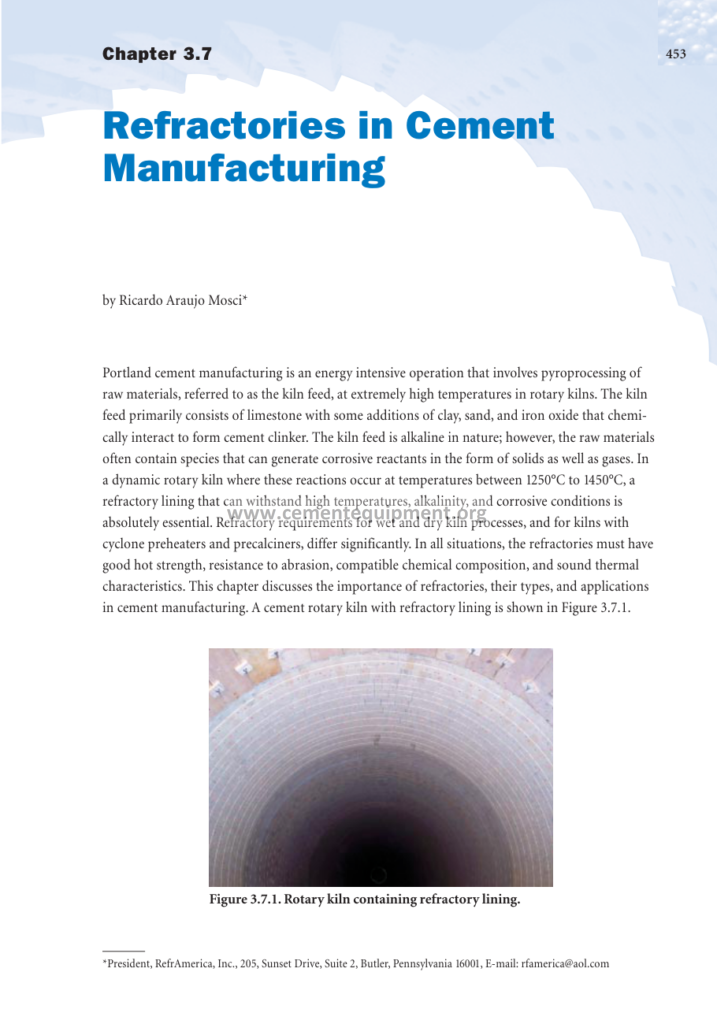
Portland cement manufacturing is an energy-intensive operation that involves pyroprocessing of raw materials at extremely high temperatures in rotary kilns, and Chapter 3.7 of the Innovations in Cement Manufacturing series, written by Ricardo Araujo Mosci, addresses the material system that makes that operation possible: the refractory lining. The kiln feed primarily consists of limestone with additions of clay, sand, and iron oxide that chemically interact to form cement clinker, and the feed is alkaline in nature, while the raw materials often contain species that can generate corrosive reactants in the form of solids as well as gases. In a dynamic rotary kiln where these reactions occur at temperatures between 1,250 and 1,450°C, a refractory lining that can withstand high temperatures, alkalinity, and corrosive conditions is absolutely essential. This article expands the original chapter into a complete technical package covering the role of the refractories, the families of refractory products, the selection per kiln zone, the mechanism of wear and attack, coating formation, installation and maintenance practice, and the innovations that continue to extend the life and the economy of the kiln lining.
Refractory requirements for wet and dry kiln processes, and for kilns with cyclone preheaters and precalciners, differ significantly, and in all situations the refractories must have good hot strength, resistance to abrasion, compatible chemical composition, and sound thermal characteristics. This article follows the original chapter’s treatment of the importance of refractories, their types, and their applications in cement manufacturing, developing each theme with the detail the operating and maintenance engineer needs: what the bricks must do, what the product families offer, where each product belongs, how the lining fails, how the coating protects it, and how the modern innovations in materials and installation have changed the economics of the burning line.
1. The Multiple Roles of the Refractory Lining
The original chapter is explicit that the role of refractories in cement kilns is multiple, and enumerating the roles is the correct way to open the subject, because each role sets a separate requirement that the brick must satisfy simultaneously. The first role is to protect the steel shell against heat. The material and gas temperatures inside the rotary kiln surpass the maximum working temperature recommended for carbon steel, and without refractories the kiln shell would be destroyed by heat: as soon as the refractory lining fails, the kiln must be shut down for lining repair, and the overheated areas on the kiln shell, the hot spots or red spots, are the visible signature of that failure.
The second role is to protect the kiln shell against abrasion. Cement clinker is very abrasive, and without the refractory, the rotating shell would be worn through by the rolling and sliding bed of hot, hard clinker material in a matter of months rather than the years that the lining system is designed to deliver. The abrasion resistance of the lining is therefore a distinct requirement from its heat resistance, and the products must balance the two.
The third role is thermal: the refractory conserves the heat of the process, reducing the shell temperature, the radiation losses, and the fuel consumption. A lining with proper insulation behind the working lining keeps the shell temperature in a manageable range and contributes directly to the thermal efficiency that the energy chapters of the series quantify. The thermal role is expressed in the hot face temperature that the process needs, the cold face temperature that the shell can tolerate, and the insulating layers between them.
The fourth role is chemical: the lining must resist the attack of the process fluids, the alkaline feed, the clinker melt, the gases, and the volatile salts, and the chemical compatibility of the brick with the process is what the zone-by-zone selection practice manages. Each of these roles could justify the lining alone; their combination is why the refractory system of a kiln is one of the most carefully engineered material systems in industrial practice, and why it is, at the same time, one of the largest operating costs of the burning line.
2. The Thermal and Mechanical Environment of the Kiln Zones
The design of the lining begins with the map of the kiln’s zones, because the demands on the refractory differ from zone to zone more than any other factor. The kiln presents a graded environment from the inlet, where the feed enters cool and dusty, through the calcining and the transition zones, where the material is chemically most aggressive as it approaches the melt, to the burning zone, where the liquid phase and the peak temperatures create the harshest conditions, and finally to the nose and the cooler where the mechanical stresses dominate.
The burning zone is the thermal summit: the gas temperature can exceed 1,800°C, the material is molten at the surface, and the chemical attack by the liquid phase and the volatile alkalies and sulfates is strongest. The transition zones flank the burning zone, where the material alternates between the solid and the partially melted states and where the brick experiences the thermal shock of the moving coating and the chemical attack of the cyclic salt loads. The calcining zone and the kiln inlet carry a cooler, more abrasive service, with the dust and the returning material abrading the lining.
The mechanical environment compounds the thermal one. The kiln rotates continuously, flexing the shell and the lining, and the differential expansion and the ovality of the shell stress the brickwork at every revolution. The rotation also demands that the lining stay mechanically locked in place, which is why the brick installation systems, the casing, the shims, and the mortar are as much a design discipline as the brick chemistry itself.
The design consequence is a zoned lining: each zone is lined with the product whose thermal, mechanical, and chemical properties match the zone’s service, and the joints between the zones are engineered so that the transitions are gradual rather than abrupt. The original chapter’s insistence that the refractory requirements differ significantly between the wet and dry processes and between the kilns with and without precalciners follows from this same logic: the thermal and the chemical profiles of the process set the demands on each zone, and the process type changes the profiles.
3. The Families of Refractory Products
The refractory products available to the cement kiln can be organized into a small number of families, each built around a dominant oxide chemistry, and the original chapter develops the two great families of the modern kiln: the basic bricks, based on magnesia or dolomite, and the high-alumina family, with its alumina-silicate products, alongside the insulating products that back them.
The basic bricks have magnesia or dolomite as their major component and a secondary mineral, such as alumina, zircon, or spinel, as a minor component, with the major component concentration typically between 60% and 95% by mass. Natural sources of refractory-quality magnesia or dolomite are found in very few countries, and most of the magnesia used in cement kiln brick comes from seawater or brine deposits, the so-called synthetic magnesia or periclase sinters, a fact of supply that shapes the economics of the whole family.
The high-alumina products, based on the alumina-silica system, are the other principal family, and they dominate the cooler sections and the preheater, where the service is abrasive and the chemical attack is less severe. The alumina content of the products ranges from the medium-alumina bricks of the lower temperatures up to the very high alumina products near the burning zone’s cooler flanks, and the family also includes the products modified with chromia, zirconia, or silicon carbide for special duties.
The insulating products complete the system: low-density, low-conductivity bricks and castables placed behind the working lining to limit the shell temperature and the heat loss, and their thermal performance is expressed in the thermal conductivity that sets the cold-face temperature for the given heat flow. The three families, the basic, the high-alumina, and the insulating, together with the mortars, the castables, and the shotcretes of the repair practice, are the complete toolkit of the kiln lining.
4. Magnesia-Based Bricks and Their Chemistry
The magnesia-based bricks are the workhorses of the burning zone and its flanks, and their chemistry explains both their strength and their limitations. Magnesia alone is not used in kiln brick manufacture because of its poor thermal cycling properties, and for this reason the magnesia is blended with a secondary mineral before it is pressed and fired into bricks, the secondary mineral conferring the thermal shock properties or the modified chemical properties to the brick.
The choice of the secondary mineral defines the product. The magnesia-chrome bricks, historically the standard of the burning zone, combine the magnesia with the chromite, which confers the thermal shock resistance, but the chromium brings its own chemistry, including the risk of the chrome phase transformations that the industry has since moved away from in many regions, and the chromium-free alternatives have increasingly replaced them. The magnesia-spinel bricks replace the chromite with a synthetic spinel, typically magnesium-aluminate spinel, which provides the thermal shock performance without the chromium, and they have become the dominant burning-zone product in modern practice.
Iron oxides and spinels have been extensively used as the secondary constituents for this purpose, and trials were also run with the oxides of manganese, and the development of the bonding chemistry, from the direct-bonded to the fused-grain and the spinel-bonded microstructures, has steadily improved the hot strength and the resistance to the penetration of the clinker melt. The basic brick that survives the burning zone does so by a combination of the grain chemistry, the bonding, and the protection of the coating that the next section develops.
The economics of the magnesia family follow its supply: because the refractory-grade magnesia is made from seawater or brine in a handful of countries, the cost of the basic bricks is substantial, and their consumption per tonne of clinker is one of the direct costs that the maintenance department tracks and the innovation literature seeks to reduce. The direction of the development, toward the higher hot strength, the better coating compatibility, and the longer life, is the direction of the whole refractory economy.
5. Dolomite Bricks and the Coating Affinity
The dolomite family is the other member of the basic group, and its special value is its chemistry’s compatibility with the clinker. Because of their compatibility with the clinker minerals, dolomite bricks have good affinity for coating, making them an excellent choice for burning zone applications, and the coating affinity is the most valuable single property a burning-zone brick can have, because the protective coating is what actually shields the brick from the liquid and the heat.
Most dolomite bricks receive additions of zirconia or other secondary minerals to improve their thermal shock properties and also to delay the brick infiltration with the clinker melt and the alkali salts, and some modern dolomite bricks include additions of magnesia, while others include additions of pitch or tar to decrease the brick permeability and reduce its susceptibility to chemical attack. The result is a family of products tuned to the specific chemistry of the feed and the fuel that the plant burns.
The original chapter reports the economic position of the family: dolomite products offer the lowest direct cost among all basic bricks, but their application has its limitations, and those limitations are the moisture sensitivity and the hydration of the dolomite, which require careful storage, careful handling, and careful installation practice, and which have historically limited the family’s acceptance in plants with humid climates or difficult logistics.
The choice between the magnesia-spinel and the dolomite families in the burning zone is therefore an economic and a logistic decision as much as a technical one: the dolomite offers the cost advantage and the superior coating chemistry, while the magnesia-spinel offers the robustness against the moisture and the flexibility of the supply. The refractory selection of a plant is, in this respect, a microcosm of the whole engineering discipline: the best product for one plant is not necessarily the best for another, and the selection is made on the full balance of the service, the climate, and the economics.
6. The High-Alumina Family and the Non-Basic Zones
The high-alumina family carries the kiln outside the burning zone, and its chemistry is the alumina-silica system, whose properties vary systematically with the alumina content. The higher the alumina content, the higher the refractoriness and the better the resistance to the clinker’s attack, and the products are specified by their alumina percentage, from the 40-to-50% class of the cooler duties up to the 70-to-90% class of the severe positions.
The high-alumina products are the natural choice for the kiln inlet, the calcining zone, and the transition zones where the magnesia-based bricks are not needed, and they extend into the preheater and the cooler, where the service is dominated by the abrasion of the material and the moderate temperatures. Their chemical resistance to the alkaline feed is good up to the temperature where the alkali reaction with the alumina-silica phases becomes severe, which is why the selection is zone-specific.
The family also includes the special-duty products: the bricks and the castables modified with silicon carbide for the abrasion service, the zirconia-bearing products for the highest positions, and the phosphate-bonded and the self-flowing castables for the repair and the monolithic work. The preheater, in particular, is now largely a castable and a pre-cast environment, because the complex geometry of the cyclones and the riser ducts favors the monolithic installation over the brick.
The high-alumina family is also the home of the products with the widest tolerance for the thermal cycling, which makes them the first choice for the positions that see the frequent start-ups and shutdowns, such as the kiln nose and the cooler. The diversity of the family, expressed in alumina content, bonding, and special additions, is what allows the zone-by-zone design to be satisfied across the whole non-basic part of the line.
7. Coating Formation and Its Role in Burning-Zone Life
The single most important phenomenon for the life of the burning-zone lining is the formation of the coating: the layer of the partly fused clinker material that bonds to the brick surface and shields it from the full violence of the process. The coating forms because the clinker liquid wets the hot face of the basic brick and partially reacts with it, building a layer whose composition is a mixture of the clinker melt and the brick’s surface chemistry, and whose thickness and stability are governed by the operating conditions.
The quality of the coating is set by the balance of the process variables: a stable, well-formed coating is maintained when the feed chemistry, the burning-zone temperature, and the rotation are steady, and it is destroyed when the operation becomes unstable. The original chapter’s operational companions note the consequences: the coating loss shows up immediately in the shell temperatures as the hot spots, and the rebuilding of a good coating takes time and steady operation, which is why the refractory life and the operational stability are the same story.
The chemistry of the coating explains its protective power: the coating is itself a ceramic layer of high refractoriness that presents a much lower thermal conductivity and a much higher resistance to the liquid penetration than the bare brick, so the brick behind it operates cooler and cleaner. The coating also couples the lining to the process chemistry, which is why the burning-zone brick must be chemically compatible with the coating rather than simply resistant to it.
The management of the coating is therefore a permanent activity of the burning team. The shell scanner maps the coating thickness around the shell; the hot spots signal the thin places; the operator adjusts the burning and the feed to restore the even coverage; and the planned stops are used to inspect and to repair the damaged areas before they become outages. The coating is, in effect, the plant’s own refractory protection system, applied and maintained for free by the process itself, and the refractory is the substrate that hosts it.
8. The Mechanisms of Refractory Wear and Attack
The refractory fails through a limited number of well-characterized mechanisms, and the original chapter’s treatment, together with the long literature of the kiln refractories, allows them to be enumerated. The first mechanism is the chemical attack: the alkaline feed, the clinker melt, and the volatile salts penetrate the brick’s pores, react with the bonding and the grains, and progressively destroy the brick’s structure. The attack is most severe where the liquid is present and where the volatiles condense, which is why the burning zone and the upper preheater see the harshest chemical service.
The second mechanism is thermal shock: the rapid heating and cooling of the brick at the start-ups, the shutdowns, and the feed changes generate stresses that crack the brick, and the cracks open the surface to the penetration and the spalling. The thermal cycling resistance of a product is therefore one of its most important rated properties, and the products of the zones that see the cycling are chosen for it.
The third mechanism is abrasion: the moving bed of the clinker and the dust erode the brick surface, and the abrasion dominates in the cooler sections, the kiln inlet, and the lower parts of the preheater where the material velocities are high. The fourth mechanism is mechanical: the shell ovality and the rotation flex the lining, the differential expansion and the shell deformation loosen the brickwork, and the brick falls when its locking fails.
The fifth mechanism is the moisture damage: the magnesia and the dolomite bricks hydrate when exposed to water, which is why the storage, the kiln shutdowns, and the washdowns are managed so that the water never meets the basic brick. Each of these mechanisms has its diagnostics, and the shell scanning, the brick inspection, the record of the stops, and the failure photographs of the red spots are the instruments by which the plant assigns each failure to its mechanism and selects the corrective product or practice.
9. Refractory Selection per Kiln Zone
The zone-by-zone selection is the practical heart of the refractory subject, and the following table consolidates the selection logic that the original chapter and the practice establish, mapping each zone to its service and to the product families that serve it:
| Kiln zone | Dominant service | Typical lining |
| Kiln inlet | Abrasion, dust, moderate temperature | High-alumina brick, castable |
| Calcining zone | Abrasion, alkali-laden gas, rising temperature | High-alumina brick |
| Lower transition zone | Thermal cycling, chemical attack onset | High-alumina, semi-basic products |
| Burning zone | Liquid attack, peak temperature, coating duty | Magnesia-spinel, dolomite, magnesia-chrome |
| Upper transition zone | Cycling, coating instability | Magnesia-spinel, semi-basic |
| Kiln nose | Thermal cycling, abrasion, seal interaction | High-alumina castable, precast segments |
| Cooler | Abrasion, moderate temperature, thermal shock | High-alumina brick, silicon carbide castable |
| Preheater tower | Moderate temperatures, deposits, geometry | Castables, precast shapes, insulating layers |
The table is the map of the discipline: the selection follows the service, the service follows the zone, and the zone follows the process. The burning zone carries the basic products, the non-basic zones carry the high-alumina family, and the insulation is placed wherever the shell temperature must be limited, with the whole arrangement engineered so that the transitions between the zones are gradual and the joints are managed.
10. Insulation and the Thermal Design of the Shell
The thermal design of the kiln shell and the preheater is the counterpart of the working lining, and the insulation strategy is a distinct engineering activity within the refractory discipline. The purpose of the insulation is to hold the shell temperature within the range the steel can tolerate, to limit the heat loss to the surroundings, and to protect the working lining by keeping the brick’s cold face cooler.
The heat flow through the composite wall, from the hot face of the working lining to the outside of the steel shell, is governed by the thermal conductivities of the layers and their thicknesses, and the design computes the shell temperature for the given process temperature and the layer arrangement. The design target for the shell temperature is typically set so that the steel remains below the range where its creep and its oxidation accelerate, and the scanner verifies the design in service, because a rising shell temperature is the first sign of the lining wear or the coating loss.
The insulating products, the low-conductivity bricks and castables, are placed between the working lining and the shell, and their thickness is limited by the mechanical integrity of the system: a thick insulating layer weakens the anchoring of the working lining, so the design is a compromise between the thermal economy and the mechanical security. The higher the process temperature, the greater the value of the insulation, which is why the burning zone and its flanks carry the carefully engineered multi-layer arrangements.
The innovations in the insulation are continuous: the low-cement and the ultra-low-cement castables reduce the thermal conductivity at high temperature, the ceramic-fiber products provide high-performance insulation in the lower-duty positions, and the microporous insulations are entering the cooler positions. The thermal design of the shell is, like the chemical design of the brick, a living part of the refractory economy of the plant.
11. Installation, Bricking, and the Anchoring Systems
The installation of the lining is as decisive for its life as its chemistry, and the discipline of the bricking campaign has its own body of practice. The installation begins with the inspection and the preparation of the shell: the ovality is measured, the shell is cleaned, and the geometry is corrected where necessary, because a distorted shell cannot host a sound lining. The bricks are then laid on the refractory mortar, with the joints engineered for the expansion allowance and the locking at the key.
The modern installation has moved from the hand-setting toward the mechanization: the bricking rigs rotate into the kiln, the brick-robots lay the heavy basic brick in the burning zone, and the mortar application is mechanized, reducing the labor, the time, and the variability of the campaign. The monolithic installation, the castables and the shotcrete, has grown in importance for the complex geometries, and the pre-cast and the modular systems have shortened the outages.
The anchoring systems are the mechanical skeleton of the monolithic linings: the metal anchors, welded to the shell, hold the castable in place through the thermal cycling, and the design of the anchor spacing, the anchor geometry, and the allowance for the expansion is a dedicated engineering activity. The refractory economy of the plant depends as much on the quality of the anchoring as on the quality of the material, and the failures of the monolithic linings are most often anchoring failures.
The bricking campaign is also an economic event: the outage time, the labor, the material, and the opportunity cost of the lost production are all charged to the refractory budget, and the optimization of the campaign, the use of the partial repairs, the targeted replacement of the zones that have worn rather than the whole kiln, and the scheduling of the stops to coincide with the other maintenance, is a continuous improvement activity that the refractory innovations literature documents as one of the largest savings opportunities of the burning line.
12. Monitoring, Hot Spots, and the Shell Scanner
The monitoring of the lining is the instrument of its management, and the shell scanner is the tool that has transformed it. The infrared scanner, mounted at the kiln supports, sweeps the shell continuously and produces the thermal map of the entire kiln, and the map is read against the design expectations: a normal shell temperature with a stable coating pattern indicates a healthy lining, while a rising temperature indicates a thinning of the brick or the coating, and a sudden hot spot indicates a loss of the lining material.
The reading of the thermal map is a diagnostic art. The burning zone runs at a higher shell temperature than the rest of the kiln, the coating pattern shows as the cool islands on the map, and the transition between the zones shows as the thermal steps. The trending of the map over the weeks identifies the slow wear of the bricks and the progressive loss of the coating, and the alarms at the set thresholds trigger the response: the reduction of the heat input, the monitoring at a higher frequency, and the planning of the repair before the spot becomes a failure.
The hot spots and the red spots, the visible glowing areas of the shell, are the advanced stage of the same warning, and the original chapter’s illustration of a refractory failure creating a red spot on the shell is the classic image of the discipline. When a red spot appears, the kiln’s rotation and the burner management are adjusted immediately to reduce the heat to the damaged area, the shell is observed continuously, and the stop is planned for the repair, because an unmanaged red spot leads to the shell buckling and the catastrophic damage.
The innovations in monitoring continue: the multi-camera systems with the automated detection, the integration of the scanner data with the process data for the correlation of the events, and the trending software that predicts the remaining lining life, so that the bricking is scheduled on the evidence rather than on the fixed calendar. The monitoring turns the refractory from a passive material into a managed asset, which is precisely the direction of the modern innovation.
13. Innovations in Refractory Materials and Their Economy
The innovations of the refractory field have been driven by the economics of the lining: the refractory is one of the largest direct costs of the burning line, and every extension of its life, every reduction of its price, and every improvement of its performance is a direct saving. The first family of innovations is the material development: the chromium-free burning-zone bricks, the spinel-bonded microstructures, the low-cement castables, and the corrosion-resistant formulations have progressively extended the life of the critical zones while removing the environmental and health concerns of the chrome products.
The second family is the design development: the engineered thermal systems, the zoned linings matched to the process, the precast and the modular solutions, and the insulation arrangements that balance the economy and the security. The third family is the installation development: the mechanized bricking, the shorter campaigns, and the partial-repair strategies that concentrate the cost where the wear actually is.
The economic measure of all of these innovations is the refractory cost per tonne of clinker, and the industry records show the long improvement: the better products, the better installation, and the better operation have together reduced the specific refractory consumption of the modern kilns well below the levels of the earlier era. The remaining opportunity is concentrated in the burning zone, where the economics of the coating and the wear dominate, and in the thermal losses, where the insulation improvements continue to pay.
The direction of the future is set by the pressures on the process: the alternative fuels bring new chemical attack profiles, the higher-capacity kilns bring higher mechanical stresses, and the carbon agenda brings the demand for the longer campaigns and the lower heat losses, all of which the refractory innovation must serve. The subject of the refractories, far from being a static material catalog, is one of the most active fronts of the innovations series.
14. Refractory Management as a Plant Discipline
The management of the refractories is best understood as a plant discipline with its own data, its own economics, and its own continuous improvement, and the original chapter’s framing supports that view. The data of the discipline are the bricking records, the shell scans, the hot-spot history, the process conditions at the failures, and the material analyses, and the discipline is the correlation of the data into the causes and the corrective actions.
The economics of the discipline are the refractory budget: the material cost, the installation cost, the outage cost, and the value of the production lost during the stops, all expressed per tonne of clinker, and the improvement activity is the reduction of that number. The tools of the improvement are the product trials, the zone redesigns, the installation practice changes, and the operating changes, each validated against the refractory economics.
The organization of the discipline assigns clear responsibilities: the process engineers own the burning conditions that the lining sees, the mechanical engineers own the shell and the installation, and the purchasing and the quality functions own the materials and the suppliers, and the cross-functional review of the refractory events is where the improvement decisions are made. The plants that manage the refractory as a discipline achieve lining lives and costs that the plants that treat it as a maintenance event never reach.
The operational lessons of the discipline are stable across the decades: protect the coating, hold the burning stable, manage the volatile chemistry, keep the water away from the basic brick, and repair on the evidence rather than on the calendar. These are the lessons the chapter teaches, and they are the same lessons that the modern monitoring and the material innovations have made easier to practice.
15. The Refractory Life Cycle: A Consolidated Workflow
To close the technical treatment, the refractory discipline is consolidated into the life-cycle workflow that the plant follows, from the design through the operation to the repair:
- Design the zoned lining: map the kiln zones, assign the service to each, select the working, the insulating, and the joint products, and engineer the transitions and the anchoring.
- Engineer the thermal design: compute the shell temperatures for the process conditions, and verify that the steel and the mechanical system can carry them.
- Install with discipline: inspect and prepare the shell, lay the bricks or cast the monolithics with the correct joints, the expansion allowance, and the curing.
- Dry and heat up carefully: follow the controlled warm-up curve, removing the moisture and accommodating the expansion without the thermal shock.
- Operate for the coating: hold the burning and the feed stable, monitor the shell scan, and manage the hot spots and the volatile chemistry continuously.
- Inspect and record: at every stop, inspect the lining, measure the residual thickness, photograph the damage, and record the conditions of the failure.
- Repair on the evidence: replace the worn zones, patch the damaged areas, and schedule the next campaign on the measured residual life rather than the calendar.
The workflow is the operational form of the chapter: the refractories are engineered, installed, operated, monitored, and replaced as a continuous system, and the innovations of the field, the materials, the installation, and the monitoring, are the instruments of each step. The plant that runs the loop well converts the refractory from a cost to be suffered into an asset to be managed.
Frequently Asked Questions
Why does the kiln need a refractory lining at all?
Because the process temperatures far exceed the working limit of the steel shell, the clinker is extremely abrasive, and the chemical attack of the alkaline feed and the melt would destroy the bare shell. The lining protects the shell against the heat, the abrasion, and the chemistry, and it conserves the heat of the process, all at once.
What is the difference between the basic and the high-alumina brick families?
The basic bricks, based on magnesia or dolomite, carry the burning zone and its flanks, where the liquid attack and the peak temperatures demand their chemistry and their coating affinity. The high-alumina family, based on the alumina-silica system, carries the cooler, the kiln inlet, the calcining zone, and the preheater, where the abrasion and the moderate temperatures prevail.
Why is the coating so important to the burning-zone brick?
The coating, a layer of the partly fused clinker bonded to the brick, shields the brick from the liquid attack, the heat, and the abrasion, and it is the difference between a brick that lasts a full campaign and one that fails in months. The coating is maintained by the stability of the operation, and its loss appears immediately as the hot spots on the shell.
What causes the red spots on the kiln shell?
A red spot is an overheated area of the shell where the lining has thinned or the coating has been lost, so the heat penetrates to the steel. It signals a refractory failure in progress, and the immediate response is to reduce the heat input and manage the rotation while a repair is planned, because an unmanaged red spot can buckle the shell.
Why can water destroy the basic bricks?
Because the magnesia and the dolomite bricks hydrate in the presence of water, cracking and disintegrating. The storage, the shutdown handling, and the washdowns are therefore managed so that moisture never reaches the basic brickwork, and the humidity of the climate is a factor in the choice between the dolomite and the magnesia products.
How do the refractory innovations reduce the plant’s costs?
By extending the lining life through the better materials and the coating management, by shortening the installation outages through the mechanization and the monolithics, by concentrating the repairs where the wear actually is, and by reducing the heat losses through the insulation. All of these reduce the refractory cost per tonne of clinker, which is the measure of the discipline.
Final Summary
Chapter 3.7 of Innovations in Cement Manufacturing treats the refractory system as one of the essential technologies of the kiln, and this article has expanded it into a complete technical package. The article opened with the multiple roles of the lining, the protection against the heat, the abrasion, and the chemistry, together with the thermal economy, and mapped the graded environment of the kiln zones that sets the demands of the products.
The material science covered the families of the refractories, the magnesia-based and the dolomite bricks of the burning zone with their coating chemistry, and the high-alumina family of the non-basic zones, together with the insulation systems, the mechanisms of wear and attack, and the zone-by-zone selection table. The operational and management dimensions covered the coating formation, the installation and the anchoring, the shell scanning and the hot-spot management, and the innovations and the economics that have reduced the refractory cost per tonne, and the article closed with the life-cycle workflow that carries the discipline into the plant.
The result is a complete picture of the refractory as the armored skin of the burning line: a zoned, engineered, monitored, and continuously improved material system whose management is one of the largest opportunities for cost, reliability, and efficiency in the cement plant. The innovations of the field, in materials, installation, and monitoring, are the direct expression of the chapter’s lesson, that the lining is not a consumable to be suffered but an asset to be managed.
Get this cement file + the full 931-file package
$249.99 — one-time purchase, instant download, lifetime access
This file is part of the Complete Cement Technical Package (931 files) available from cementequipment.org. Respective rights holders; library copy for the licensed single user.