Innovations In Cement Manufacturing: Complete Guide & Downlo
Innovations in Cement Manufacturing Chapter 10.3, Virtual Cement, is the visionary section of the Portland Cement Association’s master reference, contributed by the NIST scientists Jeffrey W. Bullard, Chiara F. Ferraris and Edward J. Garboczi, which introduced the cement industry to the idea that the material itself can be tested in the computer long before it is made in the plant. The “virtual cement” is the computational counterpart of the physical powder: a three-dimensional digital representation of the real cement particles, whose hydration is simulated step by step, whose microstructure grows before the scientist’s eyes, and whose properties, the heat of hydration, the strength, the permeability, the rheology and the durability indicators, are computed from that microstructure instead of being measured in a laboratory. The chapter presented the first generation of this technology, built on the measurement of the real particle size distribution by scanning electron microscopy and image analysis, on hydration algorithms that reproduce the reaction of each phase, and on the microstructure-property relations that link the digital microstructure to the engineering numbers of the concrete. This guide develops Chapter 10.3 for the engineer of today: the principles of the virtual representation, the simulation of the hydration and the microstructure, the prediction of the properties, the modern laboratory of the technique (the VCCTL), its validation and its limits, and its evolution into the digital twins and the machine-learning models at the frontier of the industry, showing how the virtual cement became one of the cornerstones of the digital construction world.
1. The Motivation: Why Test the Cement in a Computer at All
The physical testing of cement is slow and expensive: a full cement characterisation, with the fineness, the setting, the strength at 28 days and the durability indicators, consumes weeks of laboratory time and large quantities of a material that, at the instant of the test, has already been produced and delivered. The industry runs its quality control on sampling and extrapolation, and the innovation of the virtual cement was to open another route: if the behaviour of a cement could be predicted from its composition, its particles and its environment, then the designer could explore the effect of a new clinker, a new fineness, a new gypsum or a new addition before burning a single tonne, and the quality department could understand the measured results in terms of the underlying mechanisms. The motivation is the same as in every simulation: the virtual experiment is free, fast, infinitely repeatable, and it can look inside the material, where no instrument measures.
The second motivation is the depth of understanding. The microstructure of the cement paste, the arrangement of the gel, the unreacted particles, the pores, the crystals and the interfaces, is the physical reality behind every engineering property, and it can only be observed by destructive microscopy at selected instants. In the virtual world, the microstructure is the native output of the calculation: the scientist can follow the growth of the hydration products hour by hour, count the pores, map the phases and quantify the transport paths, and correlate each structural feature with the properties, building the mechanism-based knowledge that the empirical tests cannot give. The chapter therefore belongs to the long tradition of the computational materials science, and its authors gave the cement industry the same gift that the steel and the polymer industries had received earlier: the ability to reason about the product from its internal structure.
2. Building the Virtual Particle: Representing the Real Cement Digitally
The first step of the virtual cement is the faithful digital representation of the starting powder. The real cement is a collection of particles of different phases (alite, belite, aluminate, ferrite, gypsum, and the additions) with a particle size distribution spanning from below one micrometre to nearly one hundred, and the virtual model must reproduce this mixture. The pioneering method of the chapter’s generation builds the digital particles from the real measurement: a scanning electron microscope image of a polished section is analysed, the phases are identified by their grey levels or by the X-ray mapping, and the two-dimensional information is reconstructed into representative three-dimensional particles by stereological reconstruction or by random packing, so that the virtual powder reproduces the measured size distribution, the phase proportions and the spatial arrangement of the real cement. The modern version of the same principle uses the particle size analyser and the diffraction data, or generates synthetic particles from the composition, and it validates the reconstruction by comparing the virtual packing with the measured one.
The precision of this reconstruction matters because everything that follows depends on it: the reaction rates scale with the surface area of each phase, the packing density with the size distribution, and the percolation of the pore network with the arrangement of the grains. The chapter’s modellers therefore spent as much care on the characterisation as on the simulation: the X-ray microanalysis of the phases, the image analysis of thousands of particles, and the statistical verification that the reconstructed powder really represents the population of the real one. This discipline, measure the input faithfully before computing, is the permanent lesson of the virtual approach, and the modern user of the technique inherits it: a virtual simulation is no better than its input characterisation, so the input data and its uncertainty are always documented beside the results.
3. The Simulation of Hydration: Making the Virtual Paste React
With the digital powder assembled and mixed with the virtual water at the chosen water-to-cement ratio, the simulation must reproduce the hydration: the sequence of dissolution, nucleation and growth by which the water transforms the powder into the paste. The chapter’s generation used the cellular-automaton approach, the celebrated CEMHYD3D model of NIST: the digital space is divided into voxels (volume elements), each voxel carries a phase label, and the simulation cycles through the dissolution rules (a voxel of alite in contact with the water dissolves with a probability proportional to its reactivity), the diffusion of the dissolved species in the pore voxels, and the nucleation and growth of the reaction products (C-S-H, portlandite, ettringite, monosulfate) in the water-filled voxels, following the kinetics of each phase. The outcome is a time-lapse of the microstructure: the hydration degree, the phase fractions and the pore system evolve exactly as the real paste does, and the simulated extent of the hydration can be compared hour by hour with the measured degree obtained by the calorimetry and the quantitative X-ray diffraction.
The modern generations of the simulation replaced or hybridised the cellular automaton with the continuum and the kinetic models: the dissolution-precipitation models that track the ions in the pore solution with the thermodynamic equilibrium codes, the boundary-nucleation and growth models, and the molecular and the mesoscale simulations of the C-S-H itself. Each level adds realism at the price of computation: the voxel models are fast and cover the millimetre scale; the solution-based models capture the chemistry of the pore water; the atomistic models resolve the structure of the gel. The professional use of these tools matches the level to the question, and the chapter’s legacy is precisely the idea that the whole hierarchy exists: the virtual cement is not one code but a ladder of codes, from the statistical particle models to the first-principles chemistry, all built to answer the same question, how does this powder hydrate, with increasing detail.
4. The Microstructure as the Output: What Grows in the Virtual Paste
The central output of the hydration simulation is the evolving microstructure, and the virtual world gives the scientist what the laboratory can only sample: the complete three-dimensional picture of the paste at any instant. The phase map distinguishes the unhydrated clinker, the C-S-H gel of its different densities, the portlandite, the ettringite, the monosulfate, the air voids and the capillary pores, and the surfaces and the interfaces can be measured to the voxel. From this map the quantitative descriptors are computed: the total porosity and its evolution, the pore size distribution, the connectivity (percolation) of the pore network, the surface area of the gel, and the degree of the hydration of each phase. These descriptors are the bridge between the microstructure and the properties, because each engineering property of the paste is a function of the same structure: the strength grows with the solid fraction and the perfection of the gel, the permeability is set by the connected porosity, and the rheology of the fresh paste is set by the packing and the flocculation of the early particles.
The insight that the chapter’s authors extracted from the virtual experiments, and that the industry then verified in the laboratory, is the competition between the space-filling of the products and the percolation of the pores: for the same water-to-cement ratio, a cement that hydrates fast and uniformly produces a finer, more disconnected pore network, and the durability of the paste depends primarily on this connectivity. The virtual experiments also revealed the effects of the particle size distribution on the packing, the role of the fine fraction in the early densification, and the mechanism of the additions (the limestone and the pozzolana) in the blended microstructure, predictions that the physical experiments subsequently confirmed, and the same structural reasoning today underpins the design of the high-performance and the low-carbon binders of the modern decade.
5. From Microstructure to Properties: The Prediction Engine
The last stage of the virtual testing is the conversion of the microstructure into the engineering properties, and each property has its own computational route. The heat of hydration is computed directly from the reacted masses and the enthalpies of the reactions, giving the full calorimetric curve that the mass-concrete designer needs. The electrical and chemical transport are simulated on the pore network by solving the diffusion and the conduction problems on the voxel grid, producing the effective diffusivity, the resistivity and the permeability indicators with the tortuosity of the pores. The rheology of the fresh paste is estimated from the particle interactions and the early flocculation simulated by the particle methods. The mechanical behaviour is computed with the micromechanical models that distribute the load among the phases and the pores of the mature microstructure, predicting the elastic modulus and, through the damage models, the compressive strength. The elastic and the transport predictions reached a remarkable agreement with the measured values of the standard cements, which validated the method and gave the industry confidence in its use.
| Property | Virtual method | Laboratory method | Typical agreement |
|---|---|---|---|
| Heat of hydration | Enthalpy of the reacted masses | Isothermal calorimeter | Excellent (<5%) |
| Pore solution / pH | Thermodynamic equilibrium codes | Pore pressing and titration | Very good |
| Ionic diffusivity | Diffusion solved on the microstructure | Chloride migration cell | Good to very good |
| Resistivity / permeability | Conduction on the pore network | Bulk resistivity, permeameter | Good |
| Elastic modulus | Micromechanics of the phases | Ultrasonic or mechanical testing | Good |
| Compressive strength | Damage models on the microstructure | Standard prisms | Qualitative to good |
| Rheology of the paste | Particle interaction models | Rheometer | Qualitative to good |
The honest reading of this table is the lesson of the chapter: the transport and the thermal properties, which depend mostly on the porosity and the connectivity, are predicted reliably; the mechanical and the rheological properties, which depend on the details of the gel and the particle contacts, are captured qualitatively and quantitatively at the engineering level, but the physical testing remains the arbiter. The virtual cement was never proposed as the replacement of the laboratory; it was proposed as its complement, the fast, cheap, insightful first filter that points the experiments where they matter.
6. The Virtual Cement and Concrete Testing Laboratory (VCCTL)
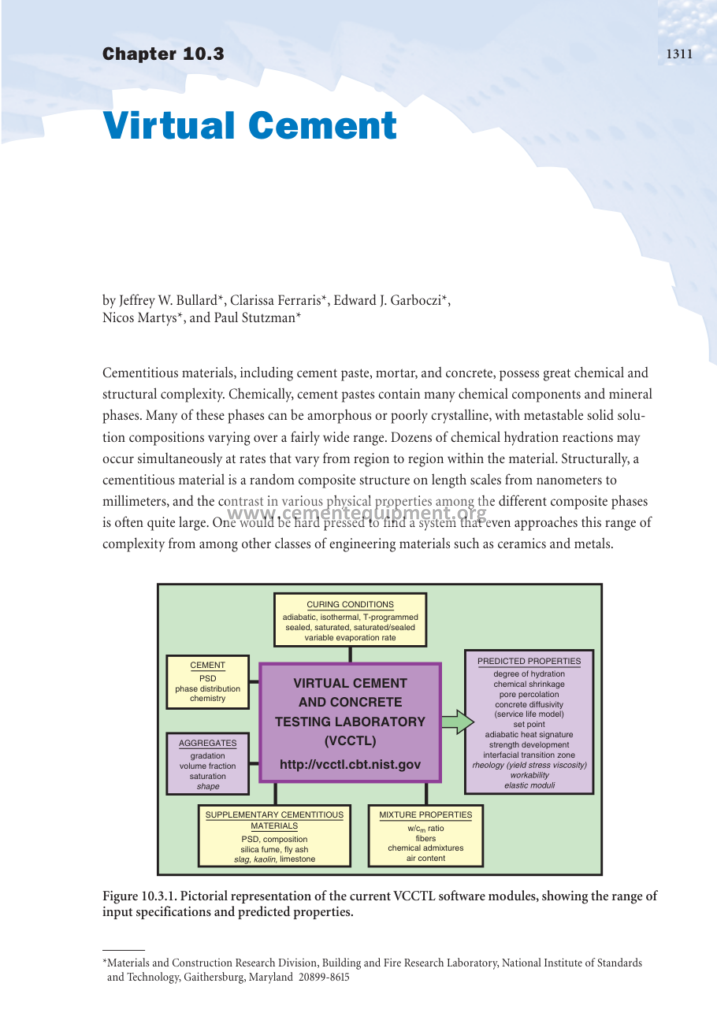
The scientific programme of the chapter’s authors converged into a single organised tool: the Virtual Cement and Concrete Testing Laboratory (VCCTL) of NIST, the freely available software that implements the complete virtual chain, from the measured particle characterisation to the computed properties, in a standardised workflow. The user loads the cement compositions (the oxide and the phase analyses), the particle size distributions of the cement and the additions and the mix parameters (water-to-cement ratio, temperature, time), and the tool builds the virtual particles, simulates the hydration and the microstructure evolution, and outputs the phase fractions, the porosity, the heat, the transport properties and the selected mechanical indicators over the user-chosen ages. The VCCTL became the standard demonstration of the feasibility of the virtual testing, used in the research, the education and the industrial evaluation, and its successive versions added the blended cements, the temperature and the curing effects, and the links to the concrete-level models.
The engineering use of the VCCTL is typical of the modern cement company: the evaluation of a new clinker or a new addition before the full plant trials (the virtual screening reduces the number of the physical mixes), the understanding of a product deviation (why did the strength drop, which phase and which porosity changed), the prediction of the heat for a mass pour with the actual cement of the batch, and the training of the engineers in the hydration science without the days of the laboratory. The tool’s limitation, the computing cost of the fine voxel grids on the large volumes, was steadily reduced by the computational progress, and the modern successors of the VCCTL run on the graphics processors and the cluster machines, bringing the hours of the first simulations down to minutes, which is the quiet technical evolution that made the virtual cement a practical instrument rather than a research curiosity.
7. From the Virtual Cement to the Virtual Concrete and the Virtual Plant
The virtual approach did not stop at the paste; it extends up the hierarchy and along the process. At the concrete level, the virtual concrete models assemble the virtual mortar around the aggregate particles, add the interfaces (the interfacial transition zone around each aggregate, whose richer pore structure dominates the transport of the concrete) and the air voids, and compute the transport and the damage of the composite, so the designer can test the durability of a mix before a single mould is filled. At the process level, the same philosophy builds the virtual plant: the flowsheet and the kiln models described in Chapter 10.2, the mill and the separator models, and the logistics models, running together as the digital twin of the factory, in which the operator and the planner test the scenarios without touching the real line. The virtual cement is therefore the paste-level member of a complete virtual estate, from the particle to the plant, and each level feeds the next: the virtual paste gives the properties to the virtual concrete, the virtual concrete to the structures, and the digital twin of the plant relates the whole to the costs and the emissions.
This hierarchy is the architectural idea that the chapter’s foreword anticipated and that the industry has since built. The modern engineering office holds the tools of every level, integrated into the workflows of the product development, the quality, the design and the operations, and the data flow between the laboratory of the plant and the virtual models is continuous: the measured characterisation feeds the models, and the models’ predictions guide the next measurements. The virtual cement, once a research demonstration, became a normal instrument of the cement and concrete industry, and the engineer of today moves up and down the hierarchy as routinely as the engineer of a generation ago moved between the formula and the test report.
8. Validation and the Limits: What the Virtual World Cannot Do
The professional use of the virtual cement demands the honest knowledge of its limits, and the chapter’s authors were exemplary in stating them. The first limit is the input: the virtual results inherit every error of the characterisation, and a powder that is not faithfully represented cannot be faithfully simulated. The second is the model physics: the cellular-automaton and the current kinetic models reproduce the main reactions with the calibrated constants, but the details of the gel structure, the effect of the admixtures at the molecular scale, the alkali and the sulfate speciation of the pore solution, and the temperature and the humidity coupling are approximations, and every strong claim made on these details must be verified. The third is the scale: the simulated volumes of a cubic millimetre are large enough for the paste transport but small compared with the heterogeneity of a real element, so the concrete-level predictions inherit the uncertainty of the simulated paste. The fourth is the time: the long-term behaviour (decades), the leaching and the degradation are extrapolations, and the durable design still leans on the long-term physical and field data.
The validation discipline is consequently non-negotiable: every virtual model is benchmarked against the measured calorimetry, the XRD hydration degree, the microscopy and the standard properties of the same cement, the calibration constants are adjusted only within their physical ranges, and the predictions are presented with their uncertainty. The plants and the laboratories that follow this discipline use the virtual tools with confidence, because they know exactly what has been validated and what has not; those that treat the simulation as a magic oracle are the ones that the chapter’s honest scepticism protects. The role of the physical testing is therefore not diminished but redefined: the measurements become the arbiter, the calibrator and the supplier of the inputs of the virtual world, and the two worlds, the real and the virtual, form a single experimental loop that is faster and deeper than either alone.
9. The Applications in Product Development, Standards and the Decarbonisation Agenda
The virtual cement found its most productive home in the three great arenas of the modern industry. In the product development, it is the first filter of every new idea: the effect of a higher limestone content, a finer slag, a different gypsum, a calcined clay, a new clinker composition is simulated before the pilot trials, the promising variants are then produced and tested in the laboratory, and the number of the physical mixes is cut by an order of magnitude. The development of the modern low-clinker binders, the LC3 family, the high-limestone products and the ternary blends, has been guided exactly by this virtual-first approach, because the parameter space (the clinker composition, the additions, the fineness, the sulfate) is too large to explore physically. The product developer uses the virtual heat curves for the mass-concrete products, the virtual transport for the durability claims, and the virtual strength evolution for the strength-class design, and he documents the virtual predictions side by side with the measured certificates of the final products.
In the standards and the specifications, the virtual methods entered as the research engine behind the decisions: the standardisation bodies and the research committees (the ASTM committees on the cement and the concrete, the RILEM technical committees and the national institutes) used the microstructural and the transport simulations to understand the performance of the new products in the aggressive environments, to interpret the field observations, and to design the test programs that the empirical tradition alone could not have planned, and the performance-based specifications (the ASTM C1157 philosophy) found in the virtual predictions a natural ally, because a specification written on performance needs the fastest possible assessment of new formulations. In the decarbonisation agenda, the virtual cement serves the carbon logic directly: every virtual experiment that replaces a physical one saves the energy and the materials of the trial, every predicted property accelerates the acceptance of the low-clinker products, and the virtual screening of the alternative raw materials and the supplementary cementitious materials of the circular economy (the slags, the ashes, the calcined clays of the future) maps their potential before the supply contracts are signed, turning the computational material science into an instrument of the climate transition of the industry.
10. The Modern Evolution: Machine Learning and the Digital Twins of the Material
The evolution of the virtual cement over the two decades since the chapter has followed two complementary paths. The first is the pure computational power: the voxel simulations on the high-performance clusters and the GPU, the resolution refined to the nanometre, and the coupling with the molecular dynamics that resolve the C-S-H itself, so that the virtual paste of today contains more physics per voxel than the first versions did per cubic millimetre. The second is the infusion of the machine learning: the neural networks and the generative models are trained on the enormous sets of the virtual (and the measured) microstructures, and they learn the microstructure-property relations and even the hydration kinetics, so that the prediction of a new composition runs in seconds instead of hours. The combination produced the modern digital twin of the material: a continuously updated virtual representation of a real cement batch that follows its hydration and predicts its performance in the structure, supported by the recorded data of the cloud.
The machine-learning shortcut brings the new risks that the professional must manage: the trained models inherit the biases and the ranges of their training data, they can extrapolate silently, and their predictions must be validated exactly like the physics-based ones. The best practice of the field is the hybrid approach: the physics-based models provide the structure and the mechanism, the machine learning accelerates the computation and captures the complex couplings, and the physical measurements arbitrate both. This hybrid is the living form of the chapter’s vision: the virtual cement, reinforced by the computing revolution, has become the standard first step of the product development and the quality understanding of the modern industry, and the engineer who is fluent in it communicates with the material science of the sector in the language of the twenty-first century.
11. Frequently Asked Questions
What exactly is the “virtual cement”?
It is the computational counterpart of the physical powder: a three-dimensional digital representation of the real cement particles, whose hydration is simulated to grow a virtual microstructure, from which the material’s properties (heat, strength, transport, durability indicators) are computed instead of being measured.
Can the virtual cement replace the laboratory testing?
No: it complements it. The virtual methods are fast, cheap, repeatable and see inside the material, but the physical tests arbitrate, calibrate and validate them, because the mechanical and the long-term properties still depend on details that the models approximate; both worlds form one experimental loop.
How is the real cement represented in the model?
By characterising the real powder, typically with the scanning electron microscopy and image analysis, the X-ray phase analysis and the particle size measurement, and reconstructing the three-dimensional virtual particles that reproduce the measured size distribution, phase proportions and arrangement.
Which properties are predicted most reliably?
The heat of hydration, the pore solution chemistry and the transport properties (diffusivity, resistivity, permeability) are predicted reliably because they depend on the porosity and the connectivity; the strength, the rheology and the long-term durability are predicted qualitatively and at the engineering level and demand the physical verification.
What is the VCCTL?
It is the Virtual Cement and Concrete Testing Laboratory of NIST, the standardised software in which the user loads the cement composition, the particle size distributions and the mix parameters and receives the computed phase evolution, porosity and properties, the reference implementation of the chapter’s idea.
How is the virtual approach used in practice by a cement company?
To screen a new clinker or a new addition before the plant trials, to understand a quality deviation from the simulated microstructure, to predict the heat of hydration of the actual batch for a mass pour, and to train the engineers in the hydration science, all with fewer physical mixes and shorter cycles.
Does the modern machine learning change the virtual cement?
Yes: the neural models trained on the virtual microstructures accelerate the predictions and capture the complex couplings, but they inherit the ranges and the biases of their training data, so the professional practice keeps the physics-based models as the structure and the measurements as the arbiter of the hybrid.
12. Summary and Conclusion
Virtual cement, the chapter of the PCA volume written by the NIST pioneers, gave the industry the digital twin of its own material: the faithful digital reconstruction of the powder, the simulated hydration and the growing microstructure, and the computed properties that turned the internal structure into engineering numbers. The method’s journey, from the measured particle images to the cellular-automaton hydration, to the VCCTL, to the machine-learning and the high-performance computing of today, is the journey of the computational materials science in cement, and its philosophy remains the one the chapter taught: measure the input faithfully, model the physics honestly, validate against the measurements, and use the virtual world as the fast, deep, cheap complement of the real one. The virtual cement is now part of the standard toolbox of the research laboratories, the product-development groups and the quality organisations of the industry, and it stands beside the virtual plant and the virtual concrete in the digital estate of the sector. The engineer who understands this chapter understands how the cement and concrete of the future are being designed, tested and optimised before they are ever produced, and that capability, the ability to compute the material before making it, is one of the defining competitive assets of the modern cement professional.
Get this cement file + the full 931-file package
$249.99 — one-time purchase, instant download, lifetime access
This file is part of the Complete Cement Technical Package (931 files) available from cementequipment.org. Respective rights holders; library copy for the licensed single user.