Cement Plant Automation & Optimization Guide
Automation and optimization are the two inseparable engines of the modern cement plant’s profitability. Automation means the instrumentation, the distributed control system (DCS) and the control loops that keep thousands of parameters inside their operating windows, so that the kiln, the mills and the entire material flow run stably without constant manual intervention. Optimization means the systematic improvement of the set points, the recipes and the operating strategies so that the plant uses the least energy per tonne of clinker, produces the highest quality with the least variability, and operates as close as possible to its physical limits of capacity. The two disciplines meet at every level of the plant: the field instruments feed the DCS, the DCS runs the proportional-integral-derivative (PID) loops that hold temperature, pressure and flow, the advanced controls use mathematical models and expert rules to stabilise the processes that the PID loops cannot manage alone, and the plant-wide optimisation layer reconciles the production plan, the energy budget and the product quality. This guide gives the complete picture of cement plant automation and optimization, from the individual PID loop on a fan damper to the fuzzy-logic and neural-network controllers of the burning zone, with the practical rules of tuning, the economics of implementation and the modern trends of data-driven operation.
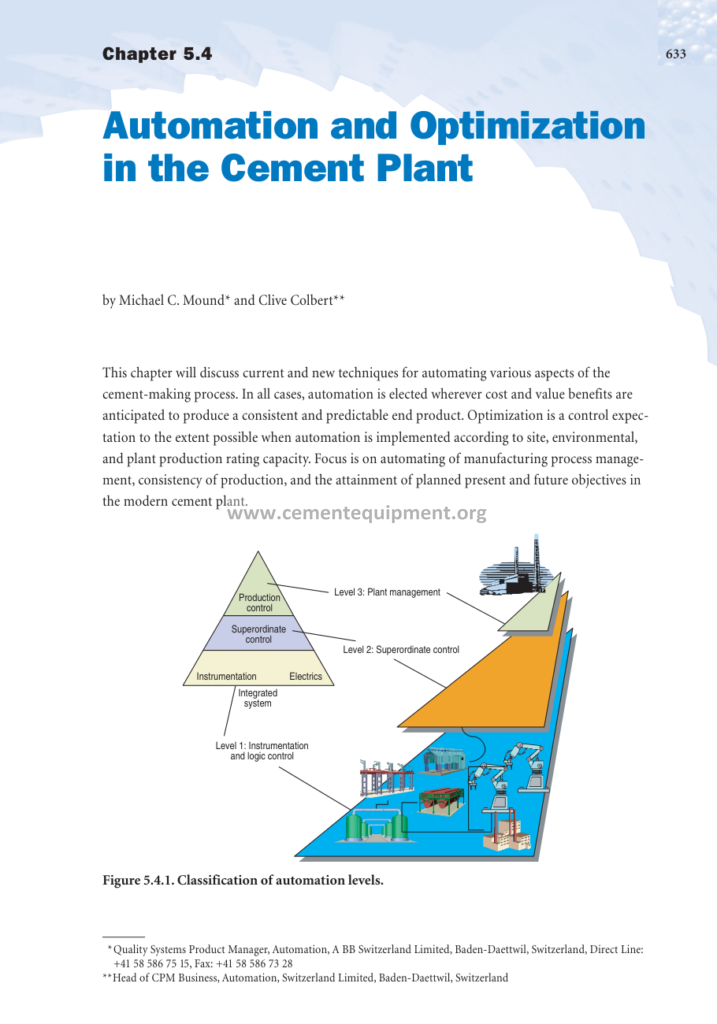
1. The Automation Pyramid of a Cement Plant
The automation of a plant is best understood as a pyramid with four levels. At the bottom, level 0, are the field devices: the thermocouples and pyrometers, the pressure and differential-pressure transmitters, the level sensors, the flow and moisture instruments, the belt weighers, the analysers and the final control elements such as control valves, damper actuators and variable-speed drives. Level 1 is the control system itself: the PLCs and the DCS controllers that scan the inputs at high frequency, execute the interlock and PID logic, and send the outputs to the actuators; this level contains the direct digital control of every motorised and regulated element of the plant. Level 2 is the supervisory level: the operator stations and servers of the DCS, the historical data storage, the alarm management, the advanced process control packages and the quality data systems, which take a plant-wide view. Level 3 is the production management level: the laboratory information system (LIMS), the manufacturing execution system (MES), the energy management and the production planning, which decide what to produce, when and at which cost. Above everything sit the enterprise level (ERP) and, increasingly, the cloud platforms for analytics and artificial intelligence.
Each level has its own time constant. The field and loop level reacts in milliseconds; the supervisory level in seconds and minutes; the planning level over shifts, days and weeks. The art of the automation engineer is to keep each layer simple enough to be reliable, to make the interfaces clean so that the data flows without distortion, and to ensure that a failure at any level degrades gracefully: if the advanced control fails, the PID loops and the operator continue to run the plant; if a controller fails, the field interlocks protect the equipment. This redundancy of responsibility is the first principle of industrial automation, and the cement plant, with its continuous high-temperature process, lives by it.
| Level | Name | Typical equipment | Time constant | Example in the plant |
|---|---|---|---|---|
| 0 | Field devices | Sensors, transmitters, actuators, drives | Milliseconds | Thermocouple of the kiln exit gas |
| 1 | Direct control | PLCs, DCS controllers, interlocks, PID loops | Milliseconds to seconds | Draught loop of the induced-draught fan |
| 2 | Supervisory | Operator stations, servers, historian, APC | Seconds to minutes | Kiln expert system, alarm supervision |
| 3 | Production management | LIMS, MES, energy management, planning | Shifts to weeks | Raw mix recipe from the on-line XRF |
| 4 | Enterprise | ERP, cloud analytics, dashboards | Days to months | Cost per tonne reports to the group |
The correct functioning of the pyramid is verified by the data that flow upward and the set points and the decisions that flow downward: the field measurements become the loops, the loops become the trends, the trends become the KPIs and the KPIs become the management decisions, while the decisions return as targets, set points and recipes. The architecture is complete only when both directions work reliably, and the failure of a single link, a drift in an analyser or a lost historian feed, degrades the whole decision chain above it, which is why the instrument and the network maintenance are part of the same optimisation discipline as the loops themselves.
2. Instrumentation: The Senses Without Which No Control Exists
Automation begins with measurement, and the cement plant is one of the most heavily instrumented processes in industry because its product is made in a hostile environment. The typical instrument list of a modern line includes:
- Temperature: thermocouples in the preheater stages and the calciner, infrared pyrometers on the kiln shell, multi-point thermocouples in the kiln burning zone, gas temperature sensors in the riser duct, and the shell scanner that measures the entire kiln surface temperature to detect hot spots;
- Pressure and differential pressure: the draught of the whole gas path from the kiln exit to the bag filter, the differential pressure of each cyclone and each filter compartment, and the draught of the mill circuits;
- Flow: gas flow measurements with pitot tubes, flow nozzles and thermal mass flowmeters, material flow with belt weighers, loss-in-weight feeders and solids flow meters, and liquid flowmeters for fuel and water;
- Levels: continuous level measurement in all silos, bins and hoppers, using guided radar, capacitance and weight-based load-cell measurement on the silo support;
- Composition: the X-ray fluorescence analyser of the raw meal, the oxygen (O2), carbon monoxide (CO) and nitrogen oxide (NOx) analysers of the kiln exit gas, the moisture meters for fuels and materials, and the on-line particle size analysers of the cement;
- Position and speed: the strokes of the damper actuators, the speed of the kiln and mill drives, the vibration of the fans and the mills.
Each instrument is placed with a purpose and maintained on a calibration schedule, because a cement plant that misbelieves its instruments cannot be controlled: the operators and the advanced controllers act on what the sensors say, and a drift of the oxygen analyser or a fouled pyrometer window will propagate into the fuel rate, the clinker quality and the emissions. The instrument maintenance program, with its spare parts, its cleaning regime on the probe purging systems and its periodic recalibration, is therefore a direct contributor to optimisation performance.
3. The Elementary Control Loop: PID in Theory and Practice
The workhorse of level-one control is the PID controller, whose output combines the proportional term (responding to the current error), the integral term (eliminating the accumulated error) and the derivative term (anticipating the direction of change). For a fan damper, a PID loop holds a set pressure: the controller reads the measured draught, compares it with the set point, and moves the damper to correct any deviation, with the tuning constants determining how fast and how stably it responds. In the cement plant PID is found in hundreds of loops: draught control of the kiln induced-draught fan, pressure control of the air slides and the filters, temperature cascades on the mill and the kiln, level control of the silos fed by the mill discharge, and flow control of the fuel and raw mixes.
Tuning these loops is both science and experience. The classical methods are the open-loop reaction-curve method (of Ziegler–Nichols), in which the process step response is measured and the Kp, Ti and Td are computed from the dead time and the time constant, and the closed-loop ultimate-gain method. In practice, the plant processes have large dead times and long time constants, so the derivative term is often used sparingly or eliminated, the integral term dominates for steady-state accuracy, and anti-windup and clamping must be implemented so that the controller does not over-integrate when the actuator is at its stop. A well-tuned draught loop keeps the oxygen of the kiln exit gas within business; a badly tuned one causes oscillations that are visible in the clinker quality, in the fuel consumption and in the life of the refractory. Most plants maintain a loop-tuning program in which every critical loop is retuned after any major modification of the equipment.
4. Cascade, Feedforward and Ratio Control: The Advanced Loop Structures
Beyond the single PID, the process structure of the plant uses combinations of elementary loops:
- Cascade control: an outer loop (for example the calciner temperature) drives the set point of an inner, faster loop (the fuel flow); this gives the plant a fast response to fuel disturbances while the slow outer loop keeps the main variable on target;
- Feedforward control: a measurable disturbance is measured directly and the controller output is pre-corrected before the error appears; in the kiln, the feed rate of the raw meal is feedforwarded to the fuel rate so that a change in feed is anticipated, avoiding a temperature dip;
- Ratio control: two flows are kept in a fixed ratio, for example the fuel and combustion air, or the raw mix components in the proportioning feeders;
- Override and limiting control: protective loops that trim the primary controller when a safety or equipment limit is reached, for example reducing the fuel when the oxygen falls below the flammability margin;
- Sequence control: the interlocks and start/stop sequences that bring the fans, mills and clinker handling into operation in a safe order, with permissive and protection logic.
These structures are the grammar of the DCS configuration. A professional control narrative documents every loop: its purpose, its process variable, its manipulated variable, its cascade relationships, its alarms and its interlocks, so that the operators and the engineers share a single mental model of the control strategy. This documentation is also the basis of the later optimisation work, because you cannot optimise a loop that nobody can describe.
5. The Kiln: The Rock Star of Difficult Control
The rotary kiln is the most difficult controlled object in the plant and one of the hardest in industry. Its combination of very large dead time, strong nonlinearities, reverse-acting variables, long-term drift of the refractory and frequent disturbances from the feed and the fuel make it nearly uncontrollable by a single PID loop. The control problem is to hold the burning zone temperature and the clinker quality while the feed, the fuel characteristics, the kiln speed, the draught and the secondary air all change. The operator’s dashboard combines the kiln camera image of the flame, the NOx as an indicator of the burning-zone temperature, the oxygen in the kiln exit gas, the free lime of the clinker, the kiln motor torque (kiln amps) and the shell scanner output.
The classical automatic control of the burning zone uses a cascade: the NOx (or a temperature measured at the burning zone) is the primary measured variable of the first layer; the fuel rate is the manipulated variable; the draught is adjusted to keep the oxygen in range; the kiln speed and the feed rate agree with the production plan established by the upper layer. Because the response is slow and delayed, the controller must be tuned with extreme care: too aggressive, and the kiln oscillates between over-burning and a drop in temperature that allows snowmen and rings; too conservative, and the controller does nothing useful and the quality drifts. This is precisely why the industry moved beyond classical control to the expert systems that are described in the next section.
6. Advanced Process Control: Expert Systems, Fuzzy Logic and Neural Networks
Advanced process control (APC), commonly called the expert system or the kiln fuzzy controller, solved the problem that classic control could not: it replicates the reasoning of the best human operator, but faster, more consistently and across more variables. The modern multi-variable system monitors up to fifty measured variables (feed, fuel, O2, CO, NOx, kiln speed, kiln amps, temperatures of the stages, secondary air, cooler data, bypass data and the clinker free-lime feedback) and manipulates several set points simultaneously (fuel, draught, kiln speed, cooler settings) toward a strategy that it computes in real time.
The knowledge base encodes the operator’s rules in the form of fuzzy logic: the rules read in plain language, for example “if the burning-zone temperature is high and the kiln amps are low, then reduce the fuel slightly”, with membership functions translating the qualitative terms (high, low, slightly) into continuous numerical actions. The system adds safety layers that act before the operator sees the problem: a check of the CO to avoid explosive atmospheres, a check of the oxygen to avoid reducing conditions, and a limit on the fuel rate to protect the refractory and the bypass. The second generation of these systems added model predictive control (MPC), which uses a dynamic model of the kiln to predict the future trajectory of the process and to optimise the set points over a horizon, and neural networks that learn the nonlinear process model from the historical data accumulated by the DCS. In the best installations the result is a 24 hour per day stability of the burning zone, a measurable reduction of the free-lime variability, an increase of the alternative-fuel share (because the control handles the disturbances that the heterogeneous fuel creates) and a reduction of the specific heat consumption of 2 to 5%, plus a substantial reduction of the refractory and mechanical stress.
7. Grinding and Mill Optimization
The finish mill presents a different but equally valuable control problem. The objective of the mill control is to hold the cement fineness and strength within specification while maximising the throughput and minimising the specific electrical energy. The manipulated variables are the feed rate to the mill, the separator speed and the separator feed, the mill ventilation (the air flow and the water injection for the temperature), and, in a vertical roller mill, the grinding pressure, the dam ring height and the internal recirculation. The measured variables are the mill power (from which the filling degree of a ball mill is inferred), the differential pressure of a VRM (the bed height indicator), the separator current, the return flow (the rejects), the outlet temperature and the product fineness, both by the on-line analyser and by the laboratory samples.
The classical control strategy for a ball mill in closed circuit uses the mill power or the material level as the main loop: when the mill is overfilled, the power drops and the differential pressure rises, so the controller reduces the fresh feed; the separator is then run in a master–slave relation so that the fineness stays on target; the mill ventilation and the water injection keep the outlet temperature below the limit that would degrade the gypsum and blind the separator. In a VRM the equivalent problem is the stabilisation of the grinding bed: too thin a bed and the mill vibrates, too thick and it chokes, and the controller balances the feed, the grinding pressure and the dam ring in a loop that modern plants close automatically. The feed-forward link from the analyser of the product fineness to the separator speed closes the quality loop in near-real time, and the selected campaign strategy (produce the coarsest acceptable cement when the demand is high) is the everyday optimisation that increases the overall output of the plant without any capital investment.
8. The Raw Mix and the Integration of Quality with Process Control
The raw material preparation line integrates the quality laboratory directly into the control loop. The on-line X-ray analyser measures the oxides of the raw meal as it leaves the mill, the proportioning feeders of limestone, clay and correctives are adjusted continuously by a quality control computer that computes the required doses to target the clinker moduli (LSF, silica ratio, alumina ratio), and the result is a raw meal that feeds the kiln with a minimal variability. The homogenisation silo then serves as the last smoothing stage, and its discharge is blended to a certified composition. This closed loop between chemistry, dosing and process is the foundation of all the quality that follows: a kiln fed with a narrow raw meal variability produces a more uniform clinker, which in turn gives a more uniform cement strength, which allows the plant to certify its products with smaller safety margins and therefore lower additions cost.
The same integration extends downstream: the laboratory results of the cement (strength, fineness, SO3, setting time) are entered into the LIMS and fed back to the finish mill control, so that the mill adapts to the reactivity of the clinker and the season (in hot weather the intermediate storage and the mill outlet temperature change). The plant-wide quality system therefore behaves as one large feedback loop that starts at the quarry and ends at the certificate of the customer, and the modern automation platform is the nervous system that connects the two ends.
9. Optimization of Energy and Mass Balances
Beneath the automatic control lies the systematic optimisation of the plant: the audit, modelling and tuning work that reduces the specific heat and electrical consumption. The thermal audit uses the mass and energy balance of the kiln system, measured over a stable period, to allocate the heat to its destinations: the heat of calcination and clinker formation, the heat of evaporation of the moisture, the losses in the kiln exit gas, the cooler losses and the shell losses. The balance identifies the targets: a reduction of the excess air, an improvement of the cooler efficiency to raise the secondary and tertiary air temperature, a reduction of the shell losses by a better refractory condition, and an optimised feed moisture. The electrical audit does the same for the drives: the specific energy of the grinding (kWh per tonne), the separator efficiency, the grinding media distribution and the liner profile of the mill, and the fan efficiencies reduced by inlet dampers replaced by variable-speed drives.
Each of these measures follows the same optimisation life cycle: measure (with calibrated instruments and a dedicated trial), model (with the mass and energy balance or the process simulation), recommend (with an investment and payback analysis), implement (with the plant and the suppliers), and verify (with the new balance and a comparison against the baseline). The optimised plant then lives on, and the continuous monitoring of the key performance indicators (see the next section) keeps it there, because an optimised state is not permanent: it degrades with the wear of the equipment and the drift of the operating practices, which is why optimisation is a discipline of the staff, not a one-time project.
10. The Operator’s Workplace: DCS Displays, Alarms and Decision Support
All this automation still needs the human, and the human needs a workplace designed for the job: the central control room with the large video wall or the workstation-based DCS. The operator panels are organised by process area (quarry, raw mill, kiln, cooler, finish mill, dispatch), with trend displays that show the recent history of the key variables, alarm summaries that rank the deviations by priority, and overview displays that let the operator see the whole line at a glance. The alarm philosophy is crucial: a modern plant manages the total alarm rate so that the operator is not flooded by chatter, and each alarm has a recognised meaning, a priority and an action, audited and rationalised regularly. The human-machine interface quality is a direct factor of the operating safety and performance, and the industry standard (for example the ISA-101 philosophy) guides the design of the screens.
The decision support layer completes the operator’s toolkit: the data historian stores the measurements for months or years; the shift reports summarise the production, the fuel, the quality and the emissions of the shift; the on-line KPIs give the operator the feedback of his own performance (the kiln stability index, the free-lime variability, the specific heat, the mill output); and the advanced control displays show what the controller is doing and why, so the operator can diagnose and override when needed. In the modern plants this role is evolving toward the “operator of the exception”, who manages by walking around and by exception alerts while the advanced controls run the routine, a transformation that only a well-documented and reliable automation platform permits.
11. KPIs, Data Historians and the Road to Artificial Intelligence
The optimisation of the plant is measured by key performance indicators that the manager reads from the historian. The thermal and electrical specific consumptions (MJ per tonne of clinker, kWh per tonne of cement), the kiln availability and the number of trips, the free-lime standard deviation, the burning-zone temperature stability, the cement strength margin, the alternative-fuel substitution rate, the mill output, the production plan achievement and the OEE (overall equipment effectiveness) form the balanced scoreboard of the plant. Each KPI is calculated on a common time basis (for example the 24-hour rolling average on the clinker tonnes), compared with the reference and the target, and reviewed daily in the morning meeting and monthly in the performance report.
The modern step is the use of the accumulated historical data for machine learning: the models trained on the historian predict the future values of the variables, detect the abnormal patterns earlier than the alarms, identify the root causes of the stop events, and recommend the optimal set points under the changing conditions of the market (electricity price, fuel price, product demand). The digital-twin approach builds a live simulation of the kiln and the mills that the operator and the planner use to test the scenarios before applying them to the real plant. The data and the models never replace the process understanding, but they multiply the speed at which the plant learns, and the plants that combine the disciplined data archive with the process consultants inside the same team are the plants that sustain the best performance year after year.
12. Implementation, Safety and Return on Investment
Every automation project follows a professional execution path: the feasibility and the benefit study, the detailed design with the P&IDs and the control narratives, the FAT (factory acceptance test) of the software, the installation, the SAT (site acceptance test), the commissioning and the performance test with a guaranteed saving, and the training and handover to the operations. The safety functions are designed separately from the control functions, with the SIL-rated shutdown logics for the process safety (for example the fuel trip on loss of draught or on high CO), so that the non-safety control can be modernised without weakening the protective layers. The change management covers both the software versions and the operating procedures, because the benefit of the automation is collected only if the procedures and the control match each other.
The economics are compelling when measured honestly. A typical kiln advanced control project of a modern 5000 tonnes per day line returns a reduction of 1.5 to 3% of the heat consumption, an increase of 2 to 4% of the production, a higher alternative-fuel share and a prolonged refractory life, which together often pay back the investment in well under a year. The speed with which the benefit appears, however, depends on the staff: the control engineer who tunes the loops, the process engineer who maintains the balances, and the operators who trust and use the system, all of them trained and motivated. The automation is therefore not a purchase but a capability, and the plant that treats it as such is the plant that keeps its optimization gains for the decades of the equipment life.
13. Frequently Asked Questions
What is the difference between a PLC and a DCS?
A PLC (programmable logic controller) is a rugged, fast controller used for the discrete interlocks and the simple loops of the individual machines; a DCS (distributed control system) is the plant-wide network of controllers, servers and operator stations specialised for the continuous process control of the whole line. Modern systems combine both: the DCS consists of DCS-grade controllers, and the PLCs of the package equipment communicate with it through a fieldbus.
Can the kiln be controlled fully automatically, without an operator?
For routine steady operation, yes: the advanced control can hold the burning zone, and the operator supervises. For abnormal situations, start-ups, trips and maintenance, the human remains essential, and the plant always keeps the operator in the loop for the decisions that the models cannot make.
What is fuzzy logic doing in a cement kiln controller?
Fuzzy logic converts the qualitative rules of the expert operator, expressed in words like “high”, “low” and “slightly”, into continuous numerical actions through membership functions; it is the mechanism that lets the controller reason the way a skilled human reasons, with soft transitions instead of hard on/off decisions.
How much can automation reduce the energy cost of a plant?
Typical certified savings are 1.5 to 5% of the specific heat of the kiln and 3 to 10% of the specific electrical energy of the grinding, plus the indirect savings of the higher alternative-fuel share and the longer equipment life; the honest total depends on the baseline of the plant and on the staff discipline.
Why is the kiln so difficult to control?
Because of its very large dead time (many minutes between changing the fuel and seeing the response), its nonlinear behaviour, its reverse-acting variables (for example a too-hot burning zone can drop the back-end temperature), and the disturbances of the feed, the fuel and the refractory condition; these features defeat the classical single-loop control and demand the multi-variable approach.
What role do the operators play once the expert system runs?
They supervise, they diagnose, they handle the transitions and the abnormal events, they override when the situation demands physical understanding, and they feed the knowledge that keeps the fuzzy rules and the models current; the best plants treat the operators as the first line of the optimisation team.
Does automation require new instrumentation?
Usually a modest upgrade: the advanced control feeds on the existing measurements, but the quality of the inputs limits the benefit, so the plants often add the on-line analysers, the shell scanner and the gas analysers that the optimisation needs, replacing the drifting or missing sensors of the old line.
14. Summary and Conclusion
Automation and optimization are the performance system of the cement plant: the measurements and the PID loops hold the process, the cascade and feedforward structures make it stable, the expert systems and the model predictive control run the kiln day and night, the raw-mix and mill loops close the quality circuit, the balances and the KPIs keep the plant on its targets, and the data historian and the machine learning open the road to the digital and artificial-intelligence era. The tools are not ends in themselves: they are the instruments with which the plant converts its physics into profit, and the benefit of every percentage point of heat saved, every megawatt-hour of grinding energy avoided and every hour of additional availability is visible directly on the cost per tonne of the product. The professional who masters this system, from the tuning of a damper loop to the architecture of an advanced controller, holds the key to the operating excellence of the industry, and the plants that combine the automation platform with a disciplined, trained and motivated team are the plants that define the benchmark of the modern cement business.
Get this cement file + the full 931-file package
$249.99 — one-time purchase, instant download, lifetime access
This file is part of the Complete Cement Technical Package (931 files) available from cementequipment.org. Respective rights holders; library copy for the licensed single user.