Alternative Materials in Cement Manufacturing
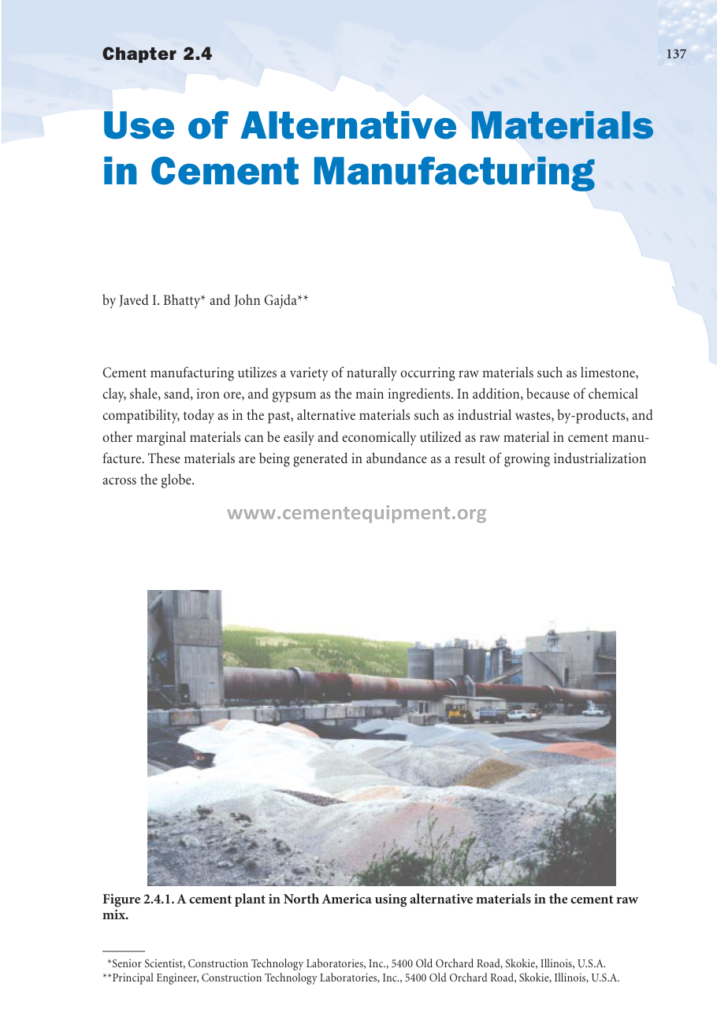
Alternative materials are the by-products, wastes and renewable resources that modern cement plants substitute for the classical limestone, clay, coal and natural gas of the traditional process. The cement industry is one of the few sectors capable of consuming large volumes of heterogeneous industrial and municipal residues safely, because the rotary kiln operates at 1450 °C, with long residence times in the gas, a high-temperature alkaline environment that neutralises acids, and a product stream in which the mineral components of the waste are incorporated into the clinker. Alternative materials are used in two distinct roles: alternative raw materials, which substitute for the calcium, silicon, aluminium and iron oxides that build the clinker, and alternative fuels, which substitute for the thermal energy that drives the process. In the best modern plants, up to 90% to 100% of the thermal energy can come from alternative fuels, and significant fractions of the raw mix can be replaced by industrial by-products such as slag, fly ash, phosphogypsum and boiler slags. This guide explains the full technology of alternative materials: the sources, the quality requirements, the process effects, the emission behaviour, the regulatory framework and the economic logic of a substitution strategy, giving the process engineer and the environmental manager the complete competency for one of the defining topics of the modern cement industry.
1. Why the Industry Turned to Alternative Materials
The shift toward alternative materials was driven by four converging forces. The first is economic: coal, petroleum coke and natural gas are expensive, and waste-derived fuels are normally much cheaper per unit of energy, sometimes even bringing a gate fee for their disposal. The second is environmental: the cement process can destroy hazardous organic wastes at higher temperatures and residence times than a dedicated incinerator at a fraction of the capital cost, and it recycles the mineral residue into a useful product instead of landfilling it. The third is regulatory: ever-tightening limits on thermal and process emissions force the industry to reduce fossil fuel consumption, and the European Industrial Emissions Directive, the EU Emissions Trading System and national carbon taxes reward the substitution of carbon-neutral biomass and of waste. The fourth is strategic: the security of fossil fuel supply for a large energy-intensive plant is a permanent risk, and a diversified fuel portfolio made of locally available wastes is more resilient than a single imported fossil source.
The result is a structural change of the industry. A modern kiln rated at 5000 tonnes per day of clinker, consuming roughly 3.2 to 3.6 GJ per tonne of clinker, needs about 16 to 18 GJ per hour of thermal energy: the equivalent of several hundred tonnes of solid fuel per day. Feeding such a fire from alternative sources requires a dedicated receiving, storing, dosing and injection infrastructure that is now a standard component of every new plant, designed from the start for the fuel and raw material policy of the plant.
2. Alternative Raw Materials Replacing the Calcareous Component
The calcareous component supplies the calcium oxide of the clinker and is normally limestone. Several alternative materials can substitute for part of it:
- Chalk and marl: naturally soft, high-moisture calcareous rocks that reduce the need for blasting and crushing energy, used widely in northern Europe and North Africa;
- By-product lime sources: carbide sludge from acetylene production, lime sludges from sugar refining, paper de-inking and water treatment, ground to the fineness required for raw meal; each source must be dried and tested because the water of the process is expensive to evaporate;
- Demolition and construction waste: crushed concrete fines and masonry rubble containing calcium carbonate, which in some plants replaces a significant percentage of fresh limestone;
- Marine shells and oyster shells: rich in calcium carbonate, available in coastal regions, and an example of a circular construction economy;
- Blastfurnace and steel slags: despite being used mainly as additions or as a silica source, some high-calcium slags contribute both calcium and silica and reduce the clinker temperature requirement.
Every substitute calcium source must fulfil the same discipline as limestone: a sufficiently low MgO content (to stay below the 5% magnesia limit of the clinker), a low alkali and chloride content, a predictable moisture, and a supply volume large enough to justify the investment in receiving and storage. The burnability of the raw mix is closely tied to the particle size distribution of the calcareous material, so coarse limestone-like substitutes must be ground with the same care as the primary limestone.
3. Alternative Raw Materials Replacing the Argillaceous Component
The argillaceous component supplies the silica, alumina and iron oxide, and it is here that the substitution potential is largest, because industrial by-products are naturally rich in exactly these oxides:
- Fly ash from coal combustion: a fine, homogeneous source of silica, alumina and iron, already in powder form, which reduces the need for clay quarrying and grinding; used both as an alternative raw material in the raw mix and as a cement addition in the finish mill;
- Blastfurnace slag: rich in lime, silica, alumina and magnesia; when correctly proportioned it lowers the required burning temperature and is an excellent component of the raw mix in addition to its role as a cement addition;
- Laterite and bauxite residues: iron- and alumina-rich materials that correct the iron and alumina modules; red mud from the aluminium industry is increasingly studied as a substitute for the iron corrective;
- Foundry sand: spent silica sand from metal casting, an excellent source of SiO2 that otherwise would be landfilled;
- Sewage sludge ash and incinerator ash: after thermal stabilisation, used for their silica, phosphate and iron content, with strict control of heavy metals and phosphorus;
- Shale, slate and overburden: naturally occurring argillaceous rocks available at the quarry that can extend the life of the deposit;
- Coal ash and boiler slag from the plant itself: the ash produced by the fuel in the kiln, which is automatically incorporated in the clinker and which the raw mix design must anticipate.
The dosing of these materials must be continuously corrected against their variability: while limestone is often stable for years, by-products such as fly ash or foundry sand can shift in composition week by week, so the plant relies on on-line X-ray fluorescence, automated proportioning and the homogenisation bed to absorb the fluctuations before the raw meal enters the kiln.
4. Alternative Raw Materials: Iron and Silica Correctives
Beyond the two main components, the raw mix needs small correctives that adjust the alumina ratio and the iron content. The traditional correctives are iron ore, bauxite and silica sand, and each has alternative sources:
- Iron correctives: iron ore pellet fines, mill scale from steel rolling, pyrite cinders from sulfuric acid plants, and red mud; these raise the Fe2O3 in the mix, increasing the liquid phase and improving the burnability;
- Alumina correctives: bauxite, aluminium dross and high-alumina clays, used to raise the alumina module for rapid-hardening or white cement production;
- Silica correctives: quartz sand, but also quarry overburden and specific industrial sands; when the silica modulus is low, the mix needs this correction to avoid an excessive liquid phase in the kiln;
- Gypsum sources: while normal in the finish mill, alternative calcium sulfate sources such as phosphogypsum, desulphurisation gypsum (FGD) from power plants, and chemical gypsum from citric acid production can substitute natural gypsum, provided chloride and radioactivity controls are respected.
The selection of correctives follows the same rules: purity, moisture, grindability, and consistency. The consequence of a wrong corrective is a drift of the clinker modules, a change in the free lime of the clinker and a shift in the strength of the product, so the quality department treats the corrective feeds with the same statistical control as the main components.
5. Alternative Fuels: The Complete Portfolio of Substitutes
The alternative fuel portfolio of a plant is usually organised by physical state and caloric value. The main categories are:
- Solid alternative fuels: refuse-derived fuel (RDF) from municipal solid waste, solid recovered fuel (SRF) with a defined calorific value and composition, shredded tyres (whole or chipped, very high calorific value and high iron), plastic waste, biomass such as wood chips, sawdust, olive and rice husks, palm kernel shells, sewage sludge (both as dried fuel and as raw material), meat-and-bone meal, and textile residues;
- Liquid alternative fuels: waste solvents, used oils, distillation residues, paint and adhesive wastes, which are dosed from dedicated tanks through a burner or injected through lances;
- Gaseous alternative fuels: landfill gas, process and pyrolytic gas, and increasingly hydrogen blends, injected in the kiln or the calciner;
- Co-processing of hazardous wastes: certain chlorinated solvents, expired chemicals and contaminated fuels, consumed in compliance with the Basel Convention and the European rules because of their destruction potential in the alkaline kiln environment.
The table below summarises the typical quality parameters of the most common alternative fuels and their substitution targets.
| Fuel | Lower heating value (MJ/kg) | Moisture (%) | Substitution point | Required treatment |
|---|---|---|---|---|
| Whole tyres | 28–32 | <5 | Kiln inlet / calciner | Cutting or preheating |
| RDF / SRF | 12–18 | 10–25 | Kiln, calciner, separate line | Shredding, classifying, dedusting |
| Wood chips / biomass | 10–16 | 20–50 | Calciner and kiln | Chipping, drying |
| Plastic waste | 30–40 | <5 | Kiln burner and calciner | Shredding, blending |
| Waste solvents | 22–30 | <10 | Main burner lances | Filtration, storage, pumping |
| Used oil | 38–42 | <2 | Main burner | Filtration and analysis |
| Sewage sludge (dried) | 10–14 | 5–15 | Calciner / kiln inlet | Drying, dosing |
| Meat and bone meal | 15–18 | 5–10 | Kiln / calciner | Grinding, dosing |
Each fuel, however, brings its own chemistry: the ash enters the clinker and must be balanced by the raw mix; the moisture costs energy to evaporate; the volatile elements must be controlled; and the chlorine, sulfur and alkali content must be kept within the limits that the kiln gas circuits and the bypass can tolerate. The fuel quality management is therefore a permanent part of the process.
6. The Quality Requirements of Alternative Fuels: How to Say Yes or No
Before a waste stream can be accepted as a fuel, it must pass a technical due diligence with defined acceptance criteria. The essential parameters are:
- Lower heating value (LHV): the energy content must be high enough to justify the handling cost; solid fuels below about 8–10 MJ/kg are usually treated as raw material or rejected;
- Moisture: above 25–30% the water evaporation consumes a large part of the thermal benefit and aggravates the mill drying duty, so high-moisture fuels must be thermally dried or blended;
- Chlorine content: the critical killer. Chlorine forms low-melting potassium and sodium chlorides that condense in the kiln feed and cause blockages, rings and bypass overload; the chloride input to the kiln must be kept under roughly 25 to 60 g of Cl per kg of clinker, depending on the design of the system;
- Sulfur: enters as SO3, forming sulfates and increasing the sulfate circulation; excessive sulfur raises cement sulfate content and requires extra bypass or raw mix adjustment;
- Alkalis (Na2O, K2O): influence the alkali cycle, the quality of the clinker and the low-alkali rating of the product, so high-alkali fuels must be diluted;
- Heavy metals: mercury, cadmium, thallium and lead are the most strictly limited, set by the emission regulations and monitored in the fuel, the kiln dust and the emissions;
- Ash content and composition: the ash becomes part of the clinker, so a highly variable ash demands raw mix correction;
- Phosphorus, halogens, PCB and dioxin precursors: limited by the destruction and by-product criteria of the waste classification.
The plant operates a raw-material-and-fuel acceptance policy in which every incoming stream is sampled, analysed in the laboratory, assigned a graded quality profile and stored separately. The dosing system blends the variable streams so that the moment-to-moment input to the kiln stays within the design envelope of the process.
7. Co-Processing: Why the Kiln Destroys and Recycles
Co-processing is the simultaneous use of waste as fuel and as raw material in the cement kiln. The rotary kiln is an ideal thermal treatment reactor for four reasons. First, the temperature: the flame reaches 1800 to 2000 °C and the solids in the burning zone reach 1450 °C, far above the 800 to 1100 °C needed to destroy most organic pollutants. Second, the residence time: the gases spend several seconds in the high-temperature zone and the solids spend minutes, longer than in a dedicated incinerator. Third, the alkaline environment: the lime-rich atmosphere neutralises the acid gases (HCl, SO2) forming harmless salts, and it absorbs heavy metals partially into the clinker. Fourth, the by-product: the mineral ash of the waste is incorporated into the clinker, so there is no secondary ash residue to landfill, which constitutes genuine recycling.
The combustion of a waste particle, unlike the homogeneous droplets of a liquid fossil fuel, is a staged process: the particle first dries, then devolatilises, then burns the volatile gases and finally the fixed carbon. This is why solid alternative fuels are normally injected at the calciner or at the kiln inlet, where they can burn with a longer residence time, while the main burner keeps a stable high-temperature flame built on the primary fossil fuel or on a liquid alternative fuel. The combustion quality is measured by the oxygen content of the kiln exit gas and by the completeness of burn-out, and the process control must be adapted because a heterogeneous fuel introduces more fluctuation than natural gas.
8. From Fuel Receiving to Burner: The Preparation Line
The substitution strategy lives or dies in the preparation line, the physical chain between the gate of the plant and the injection point in the kiln. For a solid alternative fuel there are up to seven consecutive unit operations. The first is receiving: the truck or rail wagon is weighed, sampled and analysed at the gate, and the material is discharged into an enclosed reception hall that contains the dust and the odour. The second is primary size reduction: coarse streams such as municipal and industrial waste are pre-shredded to a particle size of a few hundred millimetres, and metallic and heavy inert parts are removed by magnets, eddy-current separators and air classification, both to protect the shredder and to prevent ballistic rejects in the kiln. The third is secondary shredding, which brings the fuel to the 30 to 80 mm particle size that the plant has chosen for complete burnout inside the calciner or at the kiln inlet. The fourth is homogenisation and storage: the shredded fuel is stored in covered bays and blended in layers, so that the calorific value delivered to the kiln does not swing; fine fuels are kept in silos with discharge aids because they bridge and rat-hole. The fifth is drying, when the moisture exceeds the design limit: rotary driers may use the hot exhaust gas from the kiln system or a dedicated burner, and the dried fuel is separated from the moist air by cyclones and filters before it is redosed. The sixth is dosing: the fuel is extracted from the silo by a variable-speed screw or belt, weighed by loss-in-weight or belt weigher, and pneumatically or mechanically transported to the injection point, where a rotary valve and a distribution box feed the lances or the burner. The seventh is injection and ignition control on the burner tier, at the calciner and at the kiln inlet, each with its own combustion aerodynamics.
The design rules of the preparation line are the safety rules of the whole plant: alternative fuels can self-heat, produce flammable dust, release CO and combustible gases during storage and handling, and ignite in the shredder and the conveying lines. The storage bunkers are therefore monitored for temperature and CO, equipped with inerting systems (carbon dioxide or nitrogen), protected by explosion-relief panels and spark-detection with extinguishing at the transfer points, and the entire chain is operated from the central control room, where the weight, the level, the temperature and the vibration of every machine are alarmed. A modern preparation line handling 5000 tonnes of alternative fuel per week is consequently as much a safety engineering project as a process project, and it is audited by the insurance and the regulatory authorities with the same intensity as the kiln itself. This infrastructure is the physical condition of every high substitution rate reported in the industry, and it explains why the substitution rates of the best plants are not only a question of market availability but of deliberate investment in a controlled, safe and precise feeding chain.
9. The Effect of Alternative Fuels on the Process and the Clinker
Substituting alternative fuels changes the thermochemistry and the gas flows of the kiln. The ash of solid fuels is larger and less predictable than coal, and its composition (silica, alumina, iron, and sometimes phosphorus or zinc) enters the clinker and modifies its phases: high phosphorus reduces the alite content and slows the early strength; high magnesium increases the periclase; high zinc and lead change the burning behaviour. The plant compensates by dispatching the raw mix: a typical plant computes the target clinker composition assuming a fuel ash factor and adjusts the limestone, clay and corrective doses daily or even hourly.
The volatile cycles also change. Chlorine, sulfur and alkalis circulate between the kiln, the preheater and the raw meal, forming alkali sulfates and chlorides that condense on the feed and recirculate. With high alternative-fuel input the chlorine input rises, and the plant must rely on a kiln gas bypass (which draws a fraction of the kiln gas out after the riser and quenches it) to discharge the excess volatile load before it blocks the preheater stages. The bypass dust, rich in alkalis and chlorides, is either discarded or partially returned after washing, and its management is one of the operational topics that determines how much alternative fuel a given system can accept. The emissions side is handled with the same care: downstream, the bag filter and the desulphurisation systems keep the SO2 and dust within the permit, while the lower flame peak of alternative fuels contributes to lower NOx formation, an advantage that the process engineer uses in the emission budget.
10. The Environmental and Regulatory Framework
The use of alternative materials is not a free pass: it is regulated by the tightest environmental rules. The industrial emissions regulation of the European Union requires that co-processing of waste in cement kilns meet the Best Available Techniques (BAT) conclusions of the Large Combustion Plants and Waste industries, with emission limit values for dust, SO2, NOx, HCl, HF, heavy metals (plus Hg, Cd, Tl), dioxins and furans, and PAHs. The waste streams are classified under the European Waste Catalogue, hazardous wastes follow the rules of the Basel Convention for transboundary movement, and each plant operates under the waste treatment permit that defines which wastes it may accept and under which analysis regime.
Mercury deserves special attention because it is volatile and accumulates in the system: a plant burning alternative fuels must monitor the mercury in the raw materials, the fuels, the clinker, the mill and the stack, and must keep the input below the thresholds, usually managed by an activated-carbon dosing system on the bag filter. Dioxins and furans are controlled by respecting the temperature regime: they are destroyed above 850 °C for more than two seconds in the presence of oxygen, and reform only if incomplete combustion products and catalytic dust cool slowly in a critical window, which modern designs avoid. The regulatory compliance is verified by continuous emission monitoring, by periodic stack measurements and by the audited waste acceptance record, and a plant that masters this framework turns regulation from a cost into a competitive advantage.
11. Alternative Materials as Cement Additions: The Finish-Mill Link
The same by-products that serve as alternative raw materials return to the process in the finish mill as additions that replace clinker in the final product: granulated blastfurnace slag (latent hydraulic), siliceous and calcareous fly ash (pozzolanic), natural and calcined pozzolana, limestone filler and silica fume. This close loop is what makes the industry so effective at valorising residues: a tonne of slag can reduce both the raw mix need of the pyro line and the clinker ratio of the finished cement, cutting energy, CO2 and waste simultaneously. The quality discipline of the finish mill demands that each addition be ground or dried to the required fineness and moisture, dosed precisely by calibrated feeders, and blended to homogeneity in the cement mill silo before dispatch, because the performance of the concrete depends directly on the consistency of the blended product.
The choice between using a by-product as a raw material or as an addition is an optimisation of the plant: a limited resource such as fly ash can either displace clay in the raw mix (saving fuel in the kiln) or displace clinker in the cement (saving the largest fraction of CO2), and the economics decided by the carbon price and the local market usually favour the second route. The process engineer must therefore think of the plant as a single system in which the raw mix, the fuel, the additions and the products draw from the same pool of by-product resources.
12. Quality Control and Receiving Infrastructure
Handling thousands of tonnes of heterogeneous waste requires a complete receiving chain that does not compromise the process. Typical elements are: a weighbridge and a sampling station for each incoming truck; a fast on-line analyser for the moisture and the calorific value of solid fuels; separate storage bays with fire protection for fuels that can self-heat; enclosed hoppers and dosing silos with vibrating extraction; belt conveyors and pneumatic conveying for the fines; and a central control-room interface that tracks the consumption, the stock and the grade of every stream. The laboratory runs the acceptance analyses, keeps the certified record of each batch, and communicates the acceptance or rejection decision to the gate before the vehicle descends to the storage area, so that a rejected stream never enters production.
For raw materials, the same logic applies at the raw-mix stage: the on-line XRF, the belt weighing of the feeders, the homogenisation bed and the raw meal blending silo absorb the variability, and the kiln feed quality is continuously monitored so the process does not drift. The quality system of the whole alternative-materials operation is built on the same statistical foundations as the main process: capability, drift charts and alarm limits, applied to a much more variable input.
13. Economic Considerations and the Business Logic of Substitution
The economics of alternative materials are decided by three balances: the fuel price differential, the gate fee, and the handling and preparation cost. If a waste fuel has a lower effective price per GJ than coal after all storage, shredding and dosing costs, and after the process penalties (extra bypass, extra raw mix correction, extra maintenance), then it is economical. The gate fee, the amount charged for the disposal service, improves the balance further for hazardous wastes, which is why cement plants can accept certain wastes essentially for free or with income while still saving fuel. The investment side includes the receiving line, the shredder, the dosing and the process safeguards, and the payback is typically calculated over a few years, with the fuel savings and the gate fees as the income.
The calculation must also include the risk side: an alternative fuel strategy increases the complexity and the variability of the process, and a bad batch can cost more in clinker quality and plant trips than it saves in fuel. This is why the most successful plants run their alternative fuel input as a controlled percentage of the thermal input, tuned gradually upward as the experience grows, and why the report of the operator tracks not only the substitution rate but also the kiln stability, the fuel burn-out, the clinker quality and the emission compliance of every campaign. The substitution rate is a management target, but the sustainable substitution rate is the engineer’s target, and the difference between them is the discipline of the process.
14. Frequently Asked Questions
Is burning waste in the kiln the same as an incinerator?
No. The cement kiln combines higher temperatures (1450 °C solids), longer gas residence times and an alkaline medium that neutralises acid gases, and the ash is fully incorporated into the clinker. There is no secondary waste to landfill, which is why co-processing is considered high-grade recycling rather than simple incineration.
What limits how much alternative fuel a plant can use?
The main limits are the chlorine, alkali and sulfur load of the fuel, the volatiles cycling capacity of the system, the bypass capacity, the oxygen and combustion stability of the kiln, and the availability of a stable enough fuel quality; many modern plants reach 60% to 100% thermal substitution with the right preparation and control.
Do alternative fuels reduce the quality of the clinker?
Not if managed correctly. The ash enters the clinker, so the raw mix is corrected to compensate; the chlorine and volatile elements are discharged by the bypass. The result is a clinker of full specification quality; the risk is purely operational and controllable.
What are the most strictly controlled pollutants?
Mercury, cadmium, thallium, dioxins and furans, and the acid gases HCl and SO2. Each is managed by fuel analysis, temperature regime, sorbent dosing and continuous emission monitoring.
Can a by-product be both a raw material and a cement addition?
Yes. Fly ash, slag and pozzolana can enter the raw mix as argillaceous or siliceous sources and simultaneously replace clinker in the finish mill. The plant optimises the use of each limited by-product between the two routes based on economics and carbon price.
What is the acceptance criterion for a waste to become a fuel?
The stream must have an adequate calorific value, a controlled moisture and a chemistry (chlorine, sulfur, alkalis, heavy metals) within the plant’s acceptance thresholds, and it must be traceable and documented under the waste regulations; a failed acceptance analysis sends the truck back.
Does co-processing require special permits?
Yes. The plant must hold a waste treatment permit listing the accepted waste types, must operate under the BAT emission limits, and hazardous wastes fall under the Basel Convention for any cross-border movement.
15. Summary and Conclusion
Alternative materials have moved from a niche experiment to the defining technology of the modern cement industry: they replace the limestone, clay, iron and silica of the raw mix with industrial by-products, and they replace coal, coke and gas with the prepared waste fuels of the circular economy, destroying hazardous residues at 1800 °C in the flame and recycling the mineral part into the clinker. The engineering of this transformation is a complete discipline: fuel quality acceptance, receiving and preparation infrastructure, raw-mix correction for the ash, volatile-cycle management with the bypass, emission compliance for mercury and dioxins, and the economic optimisation between the raw-material and the cement-addition routes. The plants that master it gain lower fuel cost, stable supply, decisive environmental credibility and a direct contribution to the decarbonisation of the industry, because every tonne of clinker made from alternative raw materials and low-carbon fuels reduces the fossil footprint of the built environment. As the carbon price rises and the waste streams of the world grow, the substitution rate of the industry will keep climbing, and the engineer who understands the chemistry, the process and the regulation of alternative materials is the engineer who will design and run the cement plants of the next decades.
Get this cement file + the full 931-file package
$249.99 — one-time purchase, instant download, lifetime access
This file is part of the Complete Cement Technical Package (931 files) available from cementequipment.org. Respective rights holders; library copy for the licensed single user.