Roller Press Technology: Learning Guide
The roller press, also known as the high-pressure grinding roll (HPGR), is one of the most significant innovations of the modern cement grinding technology, and this article is a complete technical study of the machine and its circuits, written to give the reader everything needed to understand, operate and optimize a roller press installation. The roller press grinds the material between two counter-rotating rolls under extreme pressure, and in doing so it does something that the ball mill cannot: it grinds the material bed itself, particle against particle, so that the energy is consumed in the fracture of the particles rather than in the motion of the media. The result is a specific energy consumption that is 30 to 50% lower than the ball mill for the same fineness, and a feed that the downstream ball mill or the finishing process can handle at a much higher rate. The innovation was introduced commercially in the 1980s, and it has since spread through the cement industry in three circuit configurations: the pre-grinding circuit, in which the roller press prepares the feed of the ball mill; the hybrid circuit, in which the material is ground in the roller press and finished in the ball mill with the classifier in the loop; and the finish-grinding circuit, in which the roller press grinds the cement to the final fineness with the de-agglomerator and the separator. This article covers the working principle, the machine design, the circuits, the operating parameters, the wear and the maintenance, the troubleshooting and the economics of the roller press, and it is written for process engineers, production managers, maintenance engineers and graduate engineers in the cement industry.
The Innovation: High-Pressure Bed Grinding
The roller press is the application of a simple but powerful principle: when a bed of particles is compressed between two rolls at a pressure far above the compressive strength of the particles, the particles fracture in the bed, and the energy of the compression is converted into new surface. The key insight of the innovation is that the grinding is not the impact or the attrition of the individual particles, as in the ball mill, but the fracture of the entire bed: the particles touch each other, the load is transmitted through the contact points, and the cracks propagate through the grains until the bed collapses. The efficiency of this mechanism is far higher than the tumbling mechanism, because the energy is applied directly to the fracture instead of being dissipated in the media motion, the sound and the heat. The measured result is that the roller press consumes 10 to 20 kWh per tonne for the pre-grinding and 20 to 35 kWh per tonne for the finish grinding, compared with 30 to 45 kWh per tonne for the ball mill, a saving of 30 to 50% that has made the machine the standard of the new installations and the major upgrades.
The product of the roller press is a compacted cake, not a powder: the material exits the rolls as a dense agglomerate, the so-called cake, in which the particles are welded together by the pressure, and the cake must be de-agglomerated before the material can be classified or finished. The de-agglomeration is performed by the de-agglomerator, a machine with the rotating studs that breaks the cake back into the particles, and the de-agglomerated material is then processed by the separator or the ball mill. The cake also contains a proportion of the finished fines, the material that was fine enough to pass the nip without further fracture, and their recovery is one of the functions of the circuit: the fines are extracted early, by the separator or the classifier, so that they are not reground. The combination of the energy saving and the early fines extraction gives the roller press circuits their characteristic economy.
The innovation also changed the design of the downstream equipment. The ball mill that follows the roller press in the pre-grinding and the hybrid circuits receives a feed that is 30 to 60% finer than the fresh clinker, and it is therefore smaller, lower-powered and less costly than the mill that would grind the clinker from the beginning. The separator of the finish-grinding circuit operates on a feed with a high proportion of the finished material, and the circuit is designed for the classification of the high-fines feed. The roller press is therefore not a replacement of the ball mill but a partner of it, and the design of the whole circuit, the press, the de-agglomerator, the mill, the separator and the fans, is the object of the circuit engineering.
| Circuit | Ball mill role | Fines recovery | Specific energy | Capacity increase over ball mill | Complexity |
|---|---|---|---|---|---|
| Pre-grinding | Finishes the grinding, closed circuit | By the mill separator only | 10–20 kWh/t (press) + mill | 30–60% | Low; best for retrofit |
| Hybrid | Finishes the coarse fraction, in the loop | Early extraction before the mill | Intermediate | 40–70% | Moderate |
| Finish-grinding | Eliminated or minimal | Full classification of the cake | 20–35 kWh/t for the system | Reference for new plants | High; most demanding control |
The innovation has been so successful that the roller press is now offered by all the major suppliers, with the machines ranging from the small presses of the mini-cement plants to the giants with the rolls of 2.8 m diameter and the throughputs above 1,000 tph.
The Working Principle and the Machine Design
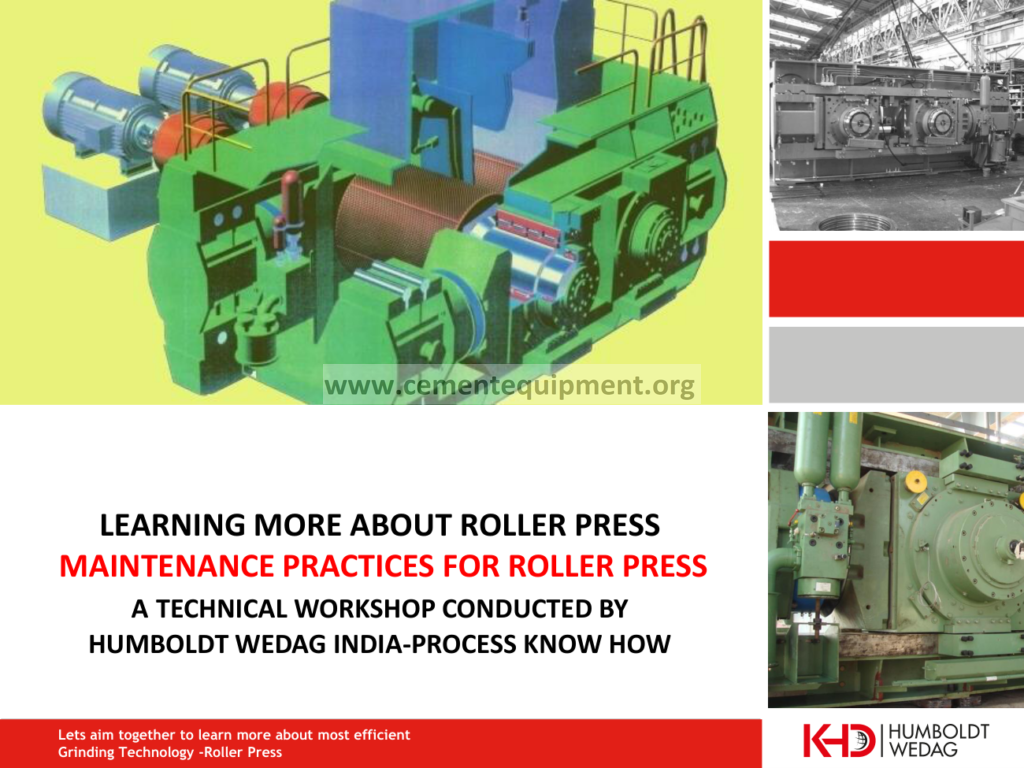
The roller press consists of two rolls, the fixed roll and the floating roll, mounted in a massive frame, with the material fed into the nip between them from above. The rolls are driven in opposite directions, and the material is drawn into the nip by the friction of the roll surfaces, compressed as the gap narrows, and extruded as the cake at the bottom. The pressure of the grinding is applied by the hydraulic system of the floating roll, which presses the roll against the material bed with a force that is set by the operating pressure, typically 50 to 150 MPa on the roll surface, and the actual pressure in the material bed is several times higher, because the contact area of the bed is smaller than the roll area. The rolls are studded or profiled: the surface is covered with the hard studs of tungsten carbide or the segmented liners, which create the texture that grips the material and prevents the slippage, and which are the wear parts of the machine.
The design of the machine is dictated by the forces involved. The grinding force, which can exceed 10,000 tonnes on the large machines, is carried by the frame, a massive steel structure that must be rigid enough to keep the roll geometry accurate under the load: a flexing frame changes the gap and the pressure distribution, and it ruins the grinding. The bearings of the rolls, which carry the grinding force, are the spherical roller bearings of the largest sizes, and their lubrication and cooling are critical. The drive system, the motors and the gearboxes, transmits the torque to the rolls at the low speed of the grinding, typically 0.5 to 2 m/s of roll surface speed, and the large machines use the twin drives with the motors at both ends of each roll, synchronized by the electrical control. The feed system delivers the material to the full width of the nip, with the feed chute and the feed gate that control the level of the material above the nip, and the feeding, the level and the evenness across the width, is one of the most important operating parameters.
The auxiliary systems complete the machine. The hydraulic system supplies the grinding pressure, and it includes the accumulators that absorb the dynamic loads of the grinding, because the pressure in the bed fluctuates with the feed and the material; the lubrication system serves the bearings, with the oil circulation and the cooling; and the instrumentation includes the roll gap, the pressure, the bearing temperatures, the motor currents and the feed level. The modern machines are equipped with the sensors and the control systems that keep the press at its operating point: the gap is controlled by the feed, the pressure is controlled by the hydraulics, and the power is the product of the two. The machine is also equipped with the safety systems, the guards, the interlocks and the metal detectors, because the tramp metal in the feed is the main threat to the rolls, and its detection and removal are the protection of the machine.
The Roller Press Circuits
The three circuit configurations of the roller press correspond to the three roles that the machine can play in the grinding system. In the pre-grinding circuit, the simplest and the oldest configuration, the roller press grinds the fresh feed, the clinker and the additives, and the cake is fed to the ball mill, which finishes the grinding in the closed circuit with the separator. The ball mill receives the pre-ground feed, its throughput rises by 30 to 60%, and its specific energy falls correspondingly; the roller press operates without its own separator, and the circuit is the least complex to operate and to retrofit. The pre-grinding circuit is the standard choice for the retrofit of an existing ball mill plant, because it requires the smallest changes to the existing equipment.
The hybrid circuit is the intermediate configuration. The roller press and the ball mill are both in the closed circuit with the separator, but the material passes through the roller press before the mill: the fresh feed and the separator reject are combined at the roller press, the cake is de-agglomerated and the separator, or the press’s own classifier, extracts the fines, while the coarse material passes to the ball mill for the finish grinding. The hybrid circuit recovers the fines early, which reduces the material load on the ball mill, and it achieves a lower specific energy than the pre-grinding circuit at a moderate complexity. The hybrid circuit is the configuration of many of the modern installations, and its design, the flows and the splits, is the object of the circuit engineering.
The finish-grinding circuit, or the roller press finish mill, is the most advanced configuration. The roller press grinds the material to the final fineness in the closed circuit with the de-agglomerator, the separator and the air classifier, and the ball mill is eliminated or reduced to a small de-agglomeration and drying role. The finish-grinding circuit achieves the lowest specific energy, typically 20 to 30 kWh per tonne for the ordinary cement, but it is the most demanding to operate, because the fineness of the product is controlled entirely by the press and the separator, and the press must be operated very stably. The finish-grinding circuits are used for the new plants and the major upgrades where the full benefit of the technology is sought, and their design, the classification, the de-agglomeration and the temperature control, is the most demanding of the roller press engineering.
Operating Parameters of the Roller Press
The operating parameters of the roller press are the grinding pressure, the feed level and the feed evenness, the roll speed, the gap and the specific throughput, and each has its effect on the performance. The grinding pressure is the primary parameter: increasing the pressure increases the specific energy and the size reduction, up to the point where the bed becomes too dense and the extrusion loses its efficiency, and the operating pressure is set against the material, the fineness target and the machine limits. The feed level above the nip is the parameter that ensures the even, continuous feeding of the material into the nip: a low level starves the nip, the gap closes and the pressure falls, and a high level floods the machine and the material spills. The feed must also be distributed evenly across the full width of the rolls, because an uneven feed creates an uneven pressure, an uneven gap and an uneven wear.
The roll speed sets the throughput and the residence time: a higher speed gives a higher throughput but a shorter time in the nip, and the optimum speed is a compromise between the capacity and the size reduction. The gap between the rolls is the indicator of the operating point: the gap opens as the feed rate rises and closes as the material becomes finer or the pressure rises, and its control is the control of the machine. The specific throughput, the tonnes per hour per unit of the roll area, is the design and the operating reference, typically 100 to 250 tph per square meter of the roll surface. The specific energy of the press, the kWh per tonne, is the product of the pressure and the throughput, and it is the key economic parameter of the operation: the operator trades the pressure against the fineness and the energy, exactly as the operator of the ball mill trades the charge against the fineness and the energy.
The material parameters complete the operating picture. The moisture of the feed must be controlled: the moist material packs in the feed system and the nip, and the feed moisture above about 3 to 4% creates the handling and the grinding problems. The temperature of the feed, which for the cement grinding is the temperature of the clinker and the return material, affects the operation, and the hot feed can exceed the temperature limits of the machine and the product. The particle size distribution of the feed, the proportion of the coarse particles and the fines, affects the bed formation: the feed should contain a balance of the sizes that forms a dense bed, and the extreme feeds, all coarse or all fine, reduce the efficiency. The feed composition, the clinker, the gypsum and the additives, is the basis of the product quality, and its proportioning is the quality function of the circuit, as in any grinding system.
The De-Agglomerator and the Fines Recovery
The cake that exits the roller press must be de-agglomerated before it can be classified or ground further, and the de-agglomerator is the machine that performs this task. The de-agglomerator is a horizontal or vertical machine with a rotor of studs or hammers, which breaks the cake into the individual particles without grinding them further: the energy of the de-agglomeration is small, 1 to 2 kWh per tonne, because the cake is only agglomerated, not ground. The de-agglomerated material has a particle size distribution that is similar to the feed, with the addition of the new fines, and its flow properties are good enough for the transport and the classification. The design of the de-agglomerator includes the wear protection of the rotor and the chamber, the access for the inspection and the cleaning, and the ventilation, because the de-agglomeration generates the dust.
The fines recovery is the function that gives the roller press circuits their early economy. The cake contains 20 to 40% of the material finer than the product target, which was fine enough to pass the nip without further grinding, and the recovery of these fines by the separator or the classifier, before the ball mill, removes them from the grinding loop. The fines recovery is achieved by the classification of the de-agglomerated material: the separator, which may be the press’s own separator or the circuit separator, extracts the finished material, and the coarse material passes to the mill or returns to the press. The efficiency of the fines recovery, and the bypass of the classification, are the same subjects as in any separator system, and the measuring and the optimization of the separator, which this package covers in its separator article, apply directly to the roller press circuits.
The interaction of the press and the separator is the heart of the finish-grinding circuit. The material enters the press, the cake is de-agglomerated, the separator extracts the product and returns the reject, and the reject, which is the coarse fraction, is fed back to the press with the fresh feed. The circulating load of this circuit is typically 100 to 200%, and its control, together with the press pressure and the separator speed, sets the fineness of the product. The stability of the finish-grinding circuit is the demanding part: the press is a continuous machine whose grinding is set by the pressure and the feed, and the fineness is set by the separator, and the two must be balanced against the feed and the quality targets. The plants that run the finish-grinding circuits successfully have mastered this balance, and their experience is the reference for the operation of the newer plants.
Wear and the Roll Surface
The wear of the rolls is the dominant maintenance cost of the roller press, and its management is one of the central technical disciplines of the machine. The roll surfaces are protected by the studs, the hemispherical or conical protrusions of the tungsten carbide, which are embedded in the roll body, and by the hardfacing or the segments between the studs. The wear proceeds in two ways: the erosion of the matrix between the studs, which wears faster than the studs and creates the pockets, and the loss of the studs themselves, which break out or wear down over the service life. The wear is accelerated by the abrasive materials, the high pressures and the feed contamination, and it is uneven: the wear is higher in the center of the roll, where the pressure and the material flow are highest, and at the edges, where the material escapes the nip and abrades the edge surfaces.
The condition of the roll surface decides the performance of the press. A worn surface loses its grip: the material slips in the nip, the grinding force is not transmitted to the bed, the pressure must be increased to compensate, and the energy efficiency falls. The monitoring of the surface is therefore a routine task: the roll profile is measured at the maintenance stops, the studs are checked for the breakage, and the wear rate is recorded. The reconditioning of the rolls, the replacement of the lost studs and the hardfacing of the matrix, is performed at the defined intervals, typically every 6,000 to 12,000 hours of operation, and the reconditioning is a specialist job, performed by the suppliers with the dedicated equipment, or by the plants with the in-house capability. The reconditioning restores the surface to its design condition, and the interval between the reconditionings is the key economic parameter of the roll management.
The lifetime economics of the rolls are the sum of the purchase cost, the reconditioning cost and the performance penalty of the worn surface. The plant manages the rolls against the recorded data: the wear rate is correlated with the throughput, the pressure and the material, and the operating practice is adjusted to extend the intervals, while the maintenance planning coordinates the reconditioning with the mill stops. The roll segments, where the segmented design is used, can be replaced instead of the reconditioning, and the choice between the two is an economic comparison made on the plant’s own data. The management of the roll wear is one of the clearest examples of the integration of the operation and the maintenance that this package emphasizes: the operator’s pressure and feed decisions drive the wear, and the maintenance engineer’s schedule and the quality of the reconditioning drive the performance of the next campaign.
Operating Problems and Troubleshooting
The common operating problems of the roller press are the vibrations, the slipping of the rolls, the uneven wear, the blockages of the feed system, the tramp metal damage and the temperature excursions, and each has its characteristic causes and remedies. The vibrations, which can be violent enough to trip the machine, are caused by the uneven feed, the slipping, the worn surface, the loose components and the bearing problems, and the diagnosis uses the vibration monitoring, the gap and the pressure records and the inspection. The slipping of the rolls, in which the material fails to be drawn into the nip, is caused by the feed starvation, the low friction of a worn surface and the wet or the dusty material, and the remedy is the feed control, the reconditioning and the material conditioning. The uneven wear, with the grooves or the edge wear, is caused by the uneven feed and the pressure distribution, and its prevention is the evenness of the feed across the width, which the feed system and the operation must deliver.
The blockages of the feed system are caused by the moist or the sticky material, the oversized lumps and the bridging, and their prevention is the control of the material, the sizing of the feed and the provision of the cleaning access; their response is the reduction of the feed and the use of the cleaning devices, with the safety procedures for the work in the feed hopper. The tramp metal damage is the most feared problem: a piece of the scrap metal in the feed passes between the rolls, the studs and the surface are damaged, and the roll may need the reconditioning or the replacement. The protection is the metal detection and the removal at the feed, the magnetic separators and the metal detectors with the reject gates, and the discipline of the maintenance and the housekeeping that keep the metal out of the material. The temperature excursions, in which the bearings or the material overheat, are caused by the lubrication problems, the overloading and the hot feed, and their management is the condition monitoring and the operating limits.
The troubleshooting of the roller press follows the same method as the rest of the plant: the measurement, the diagnosis and the action. The machine is equipped with the instrumentation, the gap, the pressure, the power, the temperatures and the vibration, and the trends of these signals are the first evidence of the problems: a rising vibration with a constant feed, a falling gap with a constant pressure, a rising bearing temperature, each points to its cause. The maintenance records, the inspection reports and the wear measurements complete the picture, and the diagnosis combines the process data with the mechanical facts. The troubleshooting discipline, and the documentation of the problems and their solutions, builds the plant’s own knowledge of the machine, and the roller press, like every machine of the plant, becomes more reliable as its behavior is understood and recorded.
The Economics of the Roller Press
The economics of the roller press are the economics of the energy, the capacity and the capital. The specific energy saving of 30 to 50% against the ball mill is the primary benefit: for a plant grinding 100 tph of cement at 35 kWh per tonne in the ball mill, the roller press circuit at 22 kWh per tonne saves 1,300 kW of the electrical power, which at the typical electricity prices is worth a large annual sum. The capacity benefit is the second: the roller press circuit produces more cement from the same or a smaller ball mill, and the retrofit of the pre-grinding to an existing plant typically increases the capacity by 30 to 60%, which is the cheapest capacity that the plant can buy. The capital cost of the roller press circuit, including the press, the de-agglomerator, the separator and the conveyors, is comparable to the ball mill it replaces, and the payback of the retrofit projects is typically 2 to 4 years, driven by the energy and the capacity benefits.
The operating costs of the roller press include the wear of the rolls, the reconditioning and the maintenance, and the electricity. The roll wear and the reconditioning are the largest of the maintenance costs, and their optimization, through the operating practice and the roll management, is part of the economic management of the machine. The electricity of the press and the auxiliaries is the largest variable cost, and its control, through the pressure and the throughput, is the daily economic lever of the operation. The comparison of the roller press with the vertical roller mill, the other modern grinding technology, is the strategic choice of the new plants: the vertical mill has the lower capital cost and the simpler operation for the raw grinding, while the roller press offers the lower specific energy for the finish grinding and the greater robustness for the abrasive materials, and the choice is made on the plant’s specific conditions, the materials, the products and the energy prices.
The economics of the existing plant, the retrofit, deserve a special note. The pre-grinding retrofit of an existing ball mill is the lowest-risk application of the technology, because it preserves the existing mill and its quality control, and its benefits, the capacity and the energy, are measured directly on the plant’s own data. The hybrid retrofit adds the fines recovery and the energy saving, at a moderate additional complexity. The finish-grinding retrofit, which converts the plant to the roller press finish grinding, is the most demanding and the most rewarding, and it is chosen by the plants that seek the full benefit. The retrofit decision is made on the plant’s own baseline: the measured capacity, the energy and the quality, the projected benefits and the payback, and the supplier’s guarantees and the reference installations. The roller press, in all its configurations, is an innovation that pays for itself, and its adoption, whether in the new plant or the retrofit, is one of the soundest investments of the cement industry.
Frequently Asked Questions about the Roller Press
How does the roller press grind the material?
By the high-pressure grinding of the material bed between two counter-rotating rolls. The particles are compressed against each other under a pressure of 50–150 MPa, and the bed fractures particle by particle, which is far more efficient than the impact and the attrition of the ball mill.
What is the specific energy of the roller press circuits?
The pre-grinding and the hybrid circuits achieve 10–20 kWh per tonne for the press itself, and the finish-grinding circuit 20–35 kWh per tonne for the whole system, compared with 30–45 kWh per tonne for the ball mill, a saving of 30–50%.
What is the cake and why must it be de-agglomerated?
The cake is the compacted material that exits the rolls, in which the particles are welded together by the pressure. It is broken back into the particles by the de-agglomerator, which consumes only 1–2 kWh per tonne, before the material is classified or finished.
What are the three circuit configurations?
The pre-grinding circuit, in which the press prepares the ball mill feed; the hybrid circuit, in which the press and the mill are both in the closed circuit with the separator; and the finish-grinding circuit, in which the press grinds to the final fineness with the separator, without the ball mill.
What is the main maintenance cost of the roller press?
The wear of the roll surfaces, which are reconditioned every 6,000–12,000 hours by the replacement of the carbide studs and the hardfacing. The wear is managed by the operating practice, the monitoring and the maintenance planning.
How much capacity does a pre-grinding retrofit add?
Typically 30–60% for an existing ball mill plant, with a specific energy reduction of 20–30%. The payback of the retrofit projects is typically 2–4 years, driven by the energy and the capacity benefits.
Summary and Final Recommendations
The roller press is one of the most important innovations of the modern cement grinding, and its understanding and its operation are now part of the standard professional equipment of the grinding engineer. This article has covered the innovation and its principle, the machine design, the three circuit configurations, the operating parameters, the de-agglomeration and the fines recovery, the wear and the maintenance, the troubleshooting and the economics. The recommendations are these: understand the circuit, because the press is operated as part of the system, not as a machine alone; control the feed, its level, its evenness and its composition, because the press is fed, not filled; manage the pressure against the energy and the fineness, because the pressure is the daily economic lever; monitor the rolls, because the surface condition decides the performance; plan the reconditioning with the stops, because the rolls are the maintenance item that cannot be improvised; and measure the benefits, the energy, the capacity and the quality, because the innovation pays for itself only when its benefits are realized and held. The roller press is a mature innovation, but its full potential is realized only by the plants that apply the technical discipline that this article has set out, and the reader who applies it will find the roller press one of the most productive machines of their plant.
Get this cement file + the full 931-file package
$249 — one-time purchase, instant download immediately after payment
This file is part of the Complete Cement Technical Package (931 files) available from cementequipment.org.