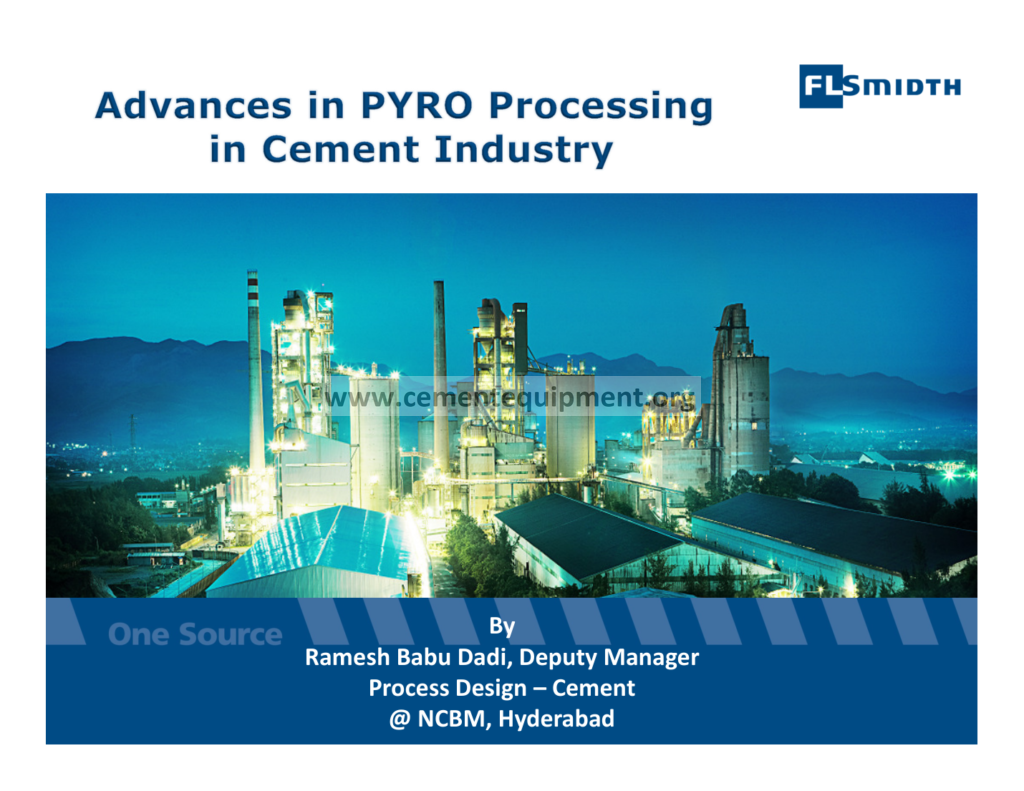
Advances In Pyro Processing: Complete Technical Guide
The pyroprocessing section of a cement plant — the preheater tower, calciner, rotary kiln and clinker cooler — is where the heart of clinker formation beats, and it is also where the largest share of the plant’s thermal energy is consumed and its most expensive equipment lives. Advances in pyro processing over the past three decades have transformed this section from a manually tuned, empirically operated piece of heavy machinery into a precisely controlled chemical reactor system governed by instrumentation, simulation software and advanced process control. This article is a complete technical deep-dive into the modern pyroprocessing line, covering the evolution of cyclone preheaters and calciners, kiln combustion and flame management, alternative fuel co-processing, refractory technology, gas conditioning, heat recovery, oxygen enrichment, predictive maintenance and the digital tools that now define best practice. Whether you are a process engineer, production manager, plant trainer or student preparing for a cement industry career, this package of knowledge explains what has changed, why it changed, and how the latest advances deliver the measurable gains in thermal efficiency, availability, clinker quality and environmental compliance that modern cement plants must achieve to remain competitive.
1. The Evolution of the Pyroprocessing System
Pyroprocessing is the collective name for every operation that takes place between the raw meal entering the preheater and the cooled clinker leaving the cooler. In a modern dry-process plant the line consists of a five- or six-stage cyclone preheater tower, an inline or separate-line calciner, a rotary kiln 4 to 6 meters in diameter and 60 to 90 meters long, and a grate or reciprocating clinker cooler. The historical journey to this configuration was driven by energy price and thermal efficiency: long wet kilns consumed 5,500 to 6,500 kJ per kilogram of clinker, while a modern preheater-calciner kiln operates at 2,900 to 3,200 kJ per kilogram, and the best-in-class plants approach 2,700 kJ per kilogram.
The single most important step change was the addition of the cyclone preheater, which replaced chain sections and drying zones by recovering waste heat from the kiln exit gases. Each preheater stage raises the meal temperature by roughly 100 to 130 degrees Celsius and separates the heated meal from the gas in a matter of seconds. The calciner, introduced commercially in the 1970s, was the second revolution: it moved the endothermic decomposition of calcium carbonate out of the kiln and into a vessel where 55 to 65 percent of total fuel can be burned at temperatures of 850 to 900 degrees Celsius, dramatically reducing the heat load on the kiln burning zone and allowing kiln throughput to increase by 50 to 100 percent relative to pre-calciner designs.
Modern plants are therefore not one reactor but a series of coupled reactors, each with its own residence time, temperature profile and gas flow. Understanding the mass and energy flows between them is the foundation of every advance described below, and most modern control and optimization systems are built around a dynamic model of exactly these coupled flows.
2. Preheater and Cyclone Design Advances
Cyclone design has evolved from simple tangential-entry separators to optimized low-pressure-drop geometries. Early preheaters had pressure drops of 1,000 to 1,200 millibar across the tower; modern designs achieve the same or better separation efficiency at 450 to 600 millibar total drop, saving 2 to 4 kWh per tonne of clinker in fan power alone. Key geometric parameters that designers tune include the inlet velocity, usually 15 to 25 meters per second, the vortex finder diameter, the cone angle and the dip of the inner cylinder.
Separation efficiency per stage is critical because any material carried over to the next stage is reheated a second time, wasting energy. Modern cyclones typically achieve 92 to 95 percent collection per stage, with the stage efficiency deliberately increasing toward the top of the tower where the meal is finest and carryover most expensive. Several suppliers now offer:
- Low-pressure-drop inlet scrolls and optimized dust outlets that reduce drop by 20 to 30 percent per stage.
- Wear-resistant linings in the inlet, cyclone roof and cone, extending campaign life to 8 to 12 years.
- Split feed arrangements and central feed boxes that distribute meal evenly between twin cyclones and prevent short-circuiting.
- Center-pipe and inverting-cone designs that stabilize the vortex core and reduce pressure fluctuation.
- Meal distribution gates and adjustable slide valves for equal flow splitting across parallel cyclones.
- Enhanced gas distribution plates at the kiln riser duct inlet for uniform meal suspension.
Perhaps the most important operational advance is the trend toward ever-larger preheater towers for single lines: where 5,000 tonnes per day used to require parallel strings, a single tower now handles 10,000 to 12,000 tonnes per day with a single string of large cyclones, simplifying gas flow, reducing build-up surface and lowering capital cost per tonne.
3. Calciner Technology and Fuel Flexibility
The calciner is the most flexible part of the modern pyro line and the main enabler of alternative fuel use. Three basic configurations dominate. In the inline calciner, the calciner vessel sits in the kiln riser duct so that all combustion air must pass through the kiln; in the separate-line calciner, tertiary air is ducted directly to the calciner vessel, allowing much higher substitution rates; and in the two-duct or SLC-S configuration, both kiln exhaust gas and tertiary air enter the vessel separately to control atmosphere and temperature independently.
The calcination reaction, CaCO3 decomposing to CaO and CO2, requires about 1,780 kJ per kilogram of CaCO3, and in a correctly operated calciner, 90 to 96 percent of the meal is calcined before it enters the kiln. Calcination degree is the single most important variable for kiln stability: low calcination degree forces the kiln to absorb the endothermic reaction in its own burning zone, producing a cold, unstable flame and poor coating. Modern control systems therefore calculate calcination degree continuously from gas temperatures and fuel rates, and operators tune the calciner fuel share to hold it in the 92 to 95 percent range.
Fuel flexibility in the calciner is now routine. Because the calciner operates at 850 to 900 degrees Celsius with a long gas residence time of 2 to 4 seconds, coarse alternative fuels such as whole tyres, shredded plastics, solid recovered fuel and biomass can achieve high burnout. Separate-line calciner designs that introduce the alternative fuel at the vessel bottom in a strongly reducing zone, followed by tertiary air injection further up, are standard practice and enable thermal substitution rates above 80 percent. The key engineering constraints are the oxygen availability per cubic meter of vessel volume, typically designed at 0.15 to 0.25 kilograms of oxygen per cubic meter per hour, and the need to avoid local reducing zones that volatilize sulfur and form buildup.
4. Kiln Combustion and Burner Advances
The rotary kiln burner has advanced from a simple single-channel pipe to a multi-channel device that shapes the flame precisely. Modern burners are built around five concentric channels: a central oil or gas lance, a main fuel channel carrying pulverized coal or petcoke, an axial air channel, a swirling radial air channel and a third channel for secondary alternative fuel delivery. By adjusting the momentum ratio between axial and swirl air, the operator changes the flame shape from long and lazy to short and bushy without stopping the kiln.
The concept of momentum is central. Axial momentum, defined as the product of axial air mass flow and velocity, typically 12 to 18 kilograms per meter per second squared in modern burners, controls flame length. High momentum produces a short, intense flame that concentrates heat in the burning zone, improves coating stability and reduces the risk of the flame impinging on the feed. Typical flame lengths are 10 to 18 meters in a 60-meter kiln, and burner tip velocities range from 120 to 250 meters per second for the axial stream and 100 to 150 meters per second for the swirl stream.
Advances in burner design include the use of wear-resistant titanium or boron-alloyed nozzle tips, water-cooled fronts for high alternative-fuel substitution, and the integration of flameless or staged-oxidation combustion zones that reduce NOx formation by up to 30 percent. Some suppliers now offer digital burner adjustment where stepper motors reposition the swirl vanes remotely from the control room, allowing the process engineer to sweep through flame shapes during commissioning and lock in the optimum.
5. Alternative Fuel Co-Processing and Its Advances
Co-processing waste in cement kilns remains the most visible advance of the last two decades. The kiln system offers temperatures above 1,450 degrees Celsius in the material bed, gas temperatures above 1,800 degrees Celsius in the flame, residence times of several seconds for gas and 20 to 30 minutes for solids, and a scrubbing environment provided by the alkaline raw meal that neutralizes acid gases. These attributes make the kiln an exceptionally good thermal treatment device, and every tonne of alternative fuel burned displaces roughly 2.5 to 3.2 GJ of fossil fuel energy.
The technical advances concern preparation and feeding. Alternative fuels must be prepared to a particle size that guarantees burnout: solid recovered fuel is typically shredded to under 50 millimeters with metals and chlorides removed, liquid solvents are filtered and blended in-line, and sewage sludge is dried to 55 to 65 percent dry solids before injection into the calciner riser. Feeding technology has evolved into double-flap airlocks, screw feeders with nitrogen inerting, and pneumatic conveyance with pick-up velocities above 25 meters per second to prevent pipe blockages.
Advances in monitoring allow the plant to maximize substitution safely: online calorific value estimation from mass-flow and moisture measurement, continuous CO and O2 analysis at the kiln inlet and tower top, and thermal imaging of the flame zone. Substitution rates of 60 to 85 percent at the calciner and 20 to 40 percent at the kiln main burner are now routinely achieved in Europe, with the key constraints being chloride and sulfur cycles, volatile metal circulation, and the local legislation covering emission limits for heavy metals and organics.
6. Oxygen Enrichment and Combustion Intensification
Oxygen enrichment is a proven advance for debottlenecking the kiln system. Injecting oxygen into the main burner flame raises flame temperature and reduces primary air volume, which frees secondary air capacity for combustion of alternative fuels. Practical experience shows that every 1 percent increase in combustion oxygen content raises kiln production capacity by roughly 3 to 5 percent in a well-run line, or alternatively lowers specific fuel consumption by 2 to 3 percent at constant output.
The economics depend on the local price of oxygen versus the marginal value of clinker production, and the technology is most attractive when the plant is production-limited, when alternative fuel substitution is constrained by primary air, or when a plant operates at reduced capacity with poor flame stability. Key design points are the oxygen injection lance position inside the burner pipe, typically 100 to 300 millimeters behind the tip, and the strict requirement to avoid oxygen contacting fuel upstream of the nozzle, which can create flashback conditions. The main risks are increased NOx formation, which must be managed with staged combustion or SNCR, and higher refractory temperatures in the immediate burning zone, requiring premium magnesia-spinel bricks.
7. Refractory Technology Advances
Refractory life is a major availability cost in pyroprocessing, and advances have been substantial. In the burning zone, magnesia-spinel bricks with fused or sintered spinel and calcium zirconate bond systems have largely replaced periclase-chromite bricks, eliminating chromium health concerns while offering similar or better thermal shock resistance and coating adhesion. Free-flowing and low-cement castables with corrosion inhibitors now line the lower transition zone and the cooler, extending campaign life from 6 to 12 months to 18 to 24 months in many plants.
The measurable advances include better thermal conductivity data that feeds heat-loss models, sophisticated installation techniques using dry-out schedules controlled by thermal imaging, and monitoring systems that detect refractory failure early. The most effective monitoring advance is the combination of shell temperature scanning, which detects hot spots, with optical fiber distributed temperature sensing along the kiln shell, which measures axial temperature profiles continuously and can localize a brick failure within a few meters. This allows planned refractory repair windows instead of emergency shutdowns. Table 1 summarizes typical refractory choices across the pyro line.
| Kiln Zone | Typical Refractory | Service Life | Main Failure Mode |
|---|---|---|---|
| Preheater and riser | Low-cement castable or shaped 40-60% alumina | 8-12 years | Abrasion, thermal cycling |
| Calciner | 60-70% alumina castable with anchors | 6-10 years | Alkali attack, buildup removal damage |
| Kiln inlet and chain zone | 40-60% alumina brick | 3-6 years | Thermal shock, chemical attack |
| Upper transition zone | 60-70% alumina or magnesia-alumina spinel | 1-2 years | Coating instability |
| Burning zone | Magnesia-spinel, MgO-CaZrO3 | 6-18 months | Thermal fatigue, chemical corrosion |
| Lower transition zone | Magnesia-spinel with high thermal conductivity | 1-2 years | Thermal shock at shell hotspots |
| Cooler and grizzlies | Alumina castable and SiC tiles | 3-8 years | Abrasion, thermal cycling |
8. Gas Conditioning and Emission Control Advances
Pyroprocessing advances would be meaningless without the emission control systems that make high-substitution operation legal. The three pillars are the electrostatic precipitator or bag filter, the SNCR or SCR system for NOx, and the SO2 and acid gas scrubbing systems. On the filter side, modern bag filters with low-pressure pulsed-jet cleaning achieve outlet dust below 10 mg per cubic meter, and high-temperature filtration with e-PTFE membranes is now standard on coal mills and kiln lines.
NOx abatement has advanced along two complementary routes. Primary measures reduce NOx at the source: low-NOx burners with staged combustion, optimized calciner temperature and oxygen profiles, and control of flame temperature. Secondary measures catch what remains. Selective non-catalytic reduction injects ammonia or urea into the preheater at 850 to 1,000 degrees Celsius and achieves 40 to 60 percent reduction at a reagent cost that is modest but dependent on stable temperature. Selective catalytic reduction with a catalyst operating at 280 to 350 degrees Celsius in the bypass gas stream achieves 80 to 90 percent reduction, and several plants now operate SCR on the full gas flow using high-dust configurations despite catalyst erosion concerns.
SO2 control uses the inherent alkalinity of the raw meal: if the SO2 is generated in the kiln, the meal absorbs most of it, and exit concentrations of 50 to 200 mg per cubic meter are typical. Problems arise when pyritic sulfur in the raw material oxidizes in the preheater where temperatures are too low for absorption. The standard advance is a bypass or a small hydrated-lime injection system at the tower exit, which has proven to be 90 percent effective at low capital cost compared to wet scrubbers.
9. Heat Recovery and Energy Efficiency Advances
Thermal efficiency advances target the three great losses of the pyro line: cooler vent air, kiln shell radiation and preheater exit gas. The cooler is the largest opportunity: modern reciprocating grate coolers with hydraulic drive recover 70 to 75 percent of the clinker heat as combustion air and secondary steam, versus 55 to 60 percent for older grate designs. Vent air heat can be recovered to dry coal, biomass or raw material, or to preheat boiler feedwater for a waste heat recovery power plant.
Waste heat recovery power generation is the most capital-intensive advance and is now standard on lines above 4,000 tonnes per day in regions with high electricity prices. A typical system recovers heat from the preheater exit gas at 300 to 340 degrees Celsius and from the cooler vent at 350 to 400 degrees Celsius, generating 25 to 40 kWh of electricity per tonne of clinker with an organic Rankine cycle or conventional steam cycle. The key engineering challenge is that heat recovery in the preheater raises the exit gas temperature, which increases thermal energy consumption, so the optimization is done on a system basis with a payback calculation.
Shell heat loss reduction has advanced through the use of better insulation in the transition zones and cooler, plus careful control of coating in the burning zone. A kiln shell at 200 to 300 degrees Celsius radiates 25 to 60 watts per square meter per degree of temperature difference; a 20-degree reduction across the whole shell saves 0.5 to 1.5 percent of the thermal energy, a number worth about half a million dollars a year on a 5,000-tonne-per-day line.
10. Instrumentation and Process Simulation Advances
The most consequential advance of the digital era is the availability of dense, reliable instrumentation and the software to interpret it. A modern pyro line is instrumented with gas analyzers at the kiln inlet, tower top and stack; thermocouples and radiation pyrometers along the kiln; shell scanners; kiln inlet and outlet gas analyzers; cooler bed temperature mapping; and clinker free-lime measurement every 15 to 30 minutes by X-ray diffraction. These streams feed process simulators that solve the coupled mass and energy balances in real time.
Dynamic process simulators now allow operators and engineers to test control strategies without touching the real kiln. The same physics-based models used for design are applied to operation: a simulator can predict the effect of a 10 percent change in calciner fuel on kiln inlet temperature, burning zone temperature and free lime within seconds. This capability has transformed commissioning: new lines are brought to full production in weeks instead of months because control loops are pre-tuned against the model.
Simulation also supports optimization studies of the whole pyro line: the interaction between cooler vent flow, secondary air temperature, flame momentum and NOx formation can be explored in a matrix of hundreds of cases, and the operating envelope documented before any change is tried on the real equipment.
11. Advanced Process Control and Digital Twin
Advanced process control has moved from exotic to standard. Model predictive controllers operate the kiln system as a multivariable unit, manipulating calciner fuel, kiln fuel, kiln speed, ID fan, cooler fans and burner settings to hold burning zone temperature, free lime, O2 and NOx within tight targets. Reported benefits are consistent across published plant case studies: a 3 to 8 percent production increase, a 2 to 5 percent reduction in specific heat consumption, a 5 to 15 percent reduction in NOx, and a marked reduction in operator intervention and thermal upsets.
The digital twin extends the concept. A live thermal and mass model of the line runs in parallel with the plant, continuously reconciled with measurements, and is used to predict coating state, refractory wear, cyclone build-up propensity and even the day ahead energy consumption. When combined with machine learning on historical data, the twin supports condition-based maintenance: fan vibration spectra, motor current harmonics and differential pressure trends are fused into remaining-useful-life estimates for the cyclone string and cooler drive.
The human factor remains central. The most advanced control system cannot compensate for poor calciner operation or a burner flame that is misaligned. The standard practice in top-performing plants is a weekly pyro review where the process engineer, shift operators and control room staff jointly review the previous week’s trends, coating index, free lime variability and alternative fuel quality, and agree on the next week’s operating targets. This discipline, more than any single technology, converts the advances described in this article into sustained results.
12. Future Directions in Pyro Processing
Several technologies are on the horizon. Electrified calcination is the most radical: pilot plants use electric heating or concentrated solar energy to drive the calcination reaction, eliminating fossil fuel from the calciner entirely and producing a pure CO2 stream that can be captured at low cost. Full oxy-fuel combustion of the kiln is under demonstration at pilot scale, aiming for a 95 percent CO2 capture rate; the technology requires careful management of gas tightness, corrosion and the altered flame dynamics.
Hydrogen co-firing is being tested in several countries, with the main challenges being flame stability at high hydrogen fractions, NOx formation due to higher adiabatic flame temperatures, and the material behavior of burner tips and refractories. Process intensification through higher calciner residence time, counter-current preheating and increased oxygen enrichment will continue to push thermal efficiency toward the theoretical limit of about 2,000 kJ per kilogram of clinker, and the digital twin will remain the integrating layer that turns these technologies into reliable operation.
Frequently Asked Questions
What is the difference between a preheater and a calciner?
The preheater is a series of cyclones that heat the raw meal using kiln exhaust gas without changing its chemical composition. The calciner is a separate vessel where fuel is burned to drive the calcination reaction — the decomposition of calcium carbonate into lime and carbon dioxide. A modern system performs 90 to 96 percent of the calcination in the calciner, keeping the kiln itself for the final clinkering reaction.
Why is calcination degree so important for kiln operation?
Calcination is strongly endothermic: it absorbs about 1,780 kJ per kilogram of CaCO3. If this reaction happens inside the kiln, it cools the burning zone and destabilizes the flame and coating. By moving 90 percent or more of the reaction into the calciner, the kiln receives hot, highly reactive meal and can run with a stable, short flame at high throughput.
How much alternative fuel can a modern kiln burn?
With a separate-line calciner and tertiary air, thermal substitution rates of 60 to 85 percent at the calciner and 20 to 40 percent at the main burner are routine in Europe, giving overall substitution rates of 50 to 80 percent. The practical limits are set by chloride and sulfur cycles, fuel burnout, and emission legislation rather than by the combustion system itself.
Does oxygen enrichment always improve kiln performance?
No. Oxygen enrichment increases production and flame temperature, but it also raises NOx and burning zone refractory temperatures. It is economically justified only when the plant is production-limited, when alternative fuel substitution is constrained by primary air volume, or when flame stability is poor at reduced load. Each case requires a mass and energy balance study and an economic evaluation.
What is the most cost-effective emission control advance?
Primary measures are almost always the cheapest: low-NOx burner settings, staged combustion in the calciner, and stable operation that avoids upset conditions. Where secondary measures are needed, SNCR with urea injection is the lowest capital cost option for NOx, and hydrated lime injection is the lowest cost option for SO2 peaks.
Summary
Pyro processing has advanced from an empirical art to a model-based engineering discipline. The modern line combines low-pressure-drop cyclone towers, flexible calciners burning 50 to 80 percent alternative fuels, multi-channel burners with precise momentum control, refractory systems engineered for 12 to 24 month campaigns, dense instrumentation, dynamic simulation and model predictive control. The benefits are measurable: 2,700 to 3,200 kJ per kilogram thermal consumption, availability above 92 percent, NOx below 200 mg per cubic meter, and alternative fuel substitution rates that cut fossil fuel cost by more than half. For the engineer, the unifying skill is the mass and energy balance — the same calculation that sizes a preheater also tunes a calciner, evaluates oxygen enrichment, justifies a heat recovery plant and validates a digital twin. The advances described in this article are therefore not isolated technologies but the current state of a single continuous optimization problem, and the plant that treats them as such is the plant that stays ahead of the cost curve.
13. The Pyro-Process Innovation Roadmap of the Modern Plant
The pyro-processing section of the cement plant receives the innovations in waves, and the roadmap of the modern plant follows the sequence of the process needs: the raw meal preparation first, the preheater and the calciner next, the rotary kiln third and the clinker cooler fourth. Each innovation wave carries its measured benefits: the suspension preheater cut the specific heat consumption from the 5500 kJ/kg of the wet process to the 3100-3400 kJ/kg of the modern dry line; the precalciner doubled the kiln production capacity; the cross-bar and the reciprocating grate coolers recovered the clinker heat at the 68-72% recuperation efficiency; and the tertiary air duct with the separate calciner air circuit balanced the combustion air of the system. The innovation roadmap is the documented history of the process numbers, and every modernization project of the pyro-section is evaluated against the benchmark of the specific thermal energy, the clinker quality and the availability.
14. The Kiln System Data Platform and the Process Analytics
The advances in the pyro-processing rest today on the data platform: the DCS historians of the modern plants record more than ten thousand process tags, from the cyclone pressure drops to the kiln shell thermography points, and the process analytics convert the data into the operator guidance. The kiln shell scanner images, the raw meal analyzer streams and the gas analysis traces are fused in the expert systems that recommend the set-point changes of the fuel rate, the feed rate and the ID fan speed. The analytics detect the onset of the ring formation from the pressure and the temperature signatures, the preheater blockages from the draft excursions and the coating instability from the shell temperature gradients: the advanced analytics of the pyro-section turn the historical plant data into the predictive maintenance and the process optimization decisions that the modern kiln operators take at the control room screen.
15. The Operational Case Numbers of the Pyro-Process Improvements
The case numbers of the pyro-process improvements are the evidence the plant collects: the installation of the rotary kiln inlet seal cut the false air from the 12% to the 4% of the kiln gas flow, raising the gas temperature at the preheater bottom stage by 15-25 degrees and lowering the heat consumption by 30-60 kJ/kg of clinker; the calciner oxygen trim control reduced the specific fuel consumption by 15-30 kJ/kg through the better combustion; the grate cooler air distribution optimization recovered the 10-20 MJ per tonne of clinker into the kiln secondary air; the waste heat recovery units added the 5-8 kWh of the electricity per tonne of clinker from the preheater and the cooler exhausts. Each case number is the measured delta between the before and the after campaigns, and the complete set of the case numbers builds the business case of the pyro-process innovation.
13. The Pyro-Process Innovation Roadmap of the Modern Plant
The pyro-processing section of the cement plant receives the innovations in waves, and the roadmap of the modern plant follows the sequence of the process needs: the raw meal preparation first, the preheater and the calciner next, the rotary kiln third and the clinker cooler fourth. Each innovation wave carries its measured benefits: the suspension preheater cut the specific heat consumption from the 5500 kJ/kg of the wet process to the 3100-3400 kJ/kg of the modern dry line; the precalciner doubled the kiln production capacity; the cross-bar and the reciprocating grate coolers recovered the clinker heat at the 68-72% recuperation efficiency; and the tertiary air duct with the separate calciner air circuit balanced the combustion air of the system. The innovation roadmap is the documented history of the process numbers, and every modernization project of the pyro-section is evaluated against the benchmark of the specific thermal energy, the clinker quality and the availability.
14. The Kiln System Data Platform and the Process Analytics
The advances in the pyro-processing rest today on the data platform: the DCS historians of the modern plants record more than ten thousand process tags, from the cyclone pressure drops to the kiln shell thermography points, and the process analytics convert the data into the operator guidance. The kiln shell scanner images, the raw meal analyzer streams and the gas analysis traces are fused in the expert systems that recommend the set-point changes of the fuel rate, the feed rate and the ID fan speed. The analytics detect the onset of the ring formation from the pressure and the temperature signatures, the preheater blockages from the draft excursions and the coating instability from the shell temperature gradients: the advanced analytics of the pyro-section turn the historical plant data into the predictive maintenance and the process optimization decisions that the modern kiln operators take at the control room screen.
15. The Operational Case Numbers of the Pyro-Process Improvements
The case numbers of the pyro-process improvements are the evidence the plant collects: the installation of the rotary kiln inlet seal cut the false air from the 12% to the 4% of the kiln gas flow, raising the gas temperature at the preheater bottom stage by 15-25 degrees and lowering the heat consumption by 30-60 kJ/kg of clinker; the calciner oxygen trim control reduced the specific fuel consumption by 15-30 kJ/kg through the better combustion; the grate cooler air distribution optimization recovered the 10-20 MJ per tonne of clinker into the kiln secondary air; the waste heat recovery units added the 5-8 kWh of the electricity per tonne of clinker from the preheater and the cooler exhausts. Each case number is the measured delta between the before and the after campaigns, and the complete set of the case numbers builds the business case of the pyro-process innovation.
Get this cement file + the full 931-file package
$249 — one-time purchase, instant download, lifetime access
This file is part of the Complete Cement Technical Package (931 files) available from cementequipment.org. Respective rights holders; library copy for the licensed single user.