Cement Health & Industrial Hygiene: Guide
Industrial hygiene, also known as occupational hygiene, is the science of anticipating, recognizing, evaluating, and controlling workplace environmental factors and stressors that can lead to illness or impaired health of workers or those in the surrounding community. This definition, from the American Industrial Hygiene Association, captures the four-part discipline that protects workers: anticipation of hazards before they occur, recognition of hazards that are present, evaluation of the magnitude of exposure, and control of exposures that exceed acceptable levels. Industrial hygiene practice requires detailed knowledge of a broad array of physical and life sciences, an organized and analytical approach to problem solving, and an intimate understanding of the process being managed. In the cement industry, the industrial hygienist works across a plant that combines a quarry, crushers, mills, a high-temperature pyroprocessing system, fuel handling, heavy vehicles, and dusty product handling, which means that nearly every category of workplace hazard appears somewhere on site. This article provides a complete technical treatment of health and industrial hygiene in cement plants: the hazard inventory, the science of exposure, occupational exposure limits, monitoring and sampling methods, the hierarchy of controls, medical surveillance, and the management systems, including ISO 45001 and OSHA practice, that keep worker health programs effective.
The Scope of Industrial Hygiene in a Cement Plant
The industrial hygienist in a cement plant faces a hazard inventory that spans five categories. Chemical hazards include cement dust, respirable crystalline silica, hexavalent chromium, coal and fuel oils, ammonia and urea used for NOx reduction, caustic materials, welding fumes, and laboratory chemicals. Physical hazards include noise above 85 dB(A), heat stress in kiln and clinker areas, vibration from hand tools and mobile equipment, and ionizing radiation from nuclear gauges. Biological hazards appear mainly in water and waste handling and in laboratory work. Ergonomic hazards are associated with manual handling of bags, heavy tools, and repetitive maintenance work. Finally, safety hazards, the mechanical and kinetic dangers of machinery and vehicles, are the immediate cause of most injuries and are managed by the safety program, while the hygiene program addresses the health consequences that develop over time.
The relationship between the industrial hygiene program and the environmental program is a defining feature of the cement industry. The dust that pollutes the atmosphere is the same dust that workers inhale, and the control equipment, baghouses, enclosures, and extraction systems, serves both purposes. A plant that controls fugitive dust for environmental compliance has automatically improved worker exposure, and a plant that ignores worker exposure will show it in the same boundary dust measurements. Modern plants therefore manage exposure and emissions with a shared dust management program, a shared monitoring program, and a shared control philosophy.
Terminology: Toxicity, Hazard, and Risk
Precise terminology is the foundation of industrial hygiene. Toxicity is the inherent ability of a substance to injure a bodily organ or system, interrupt a biochemical process, or affect an enzyme system. Hazard is the potential for harm that exists in the properties of a substance and the circumstances of its use. Risk is the probability that harm will occur, given the hazard and the exposure. Cement dust is an example of the distinction: its toxicity is relatively low, but the hazard is real because it is ubiquitous, and the risk materializes when exposure is high and prolonged. Chromium in cement is a sharper case: hexavalent chromium is highly toxic, and the risk of allergic dermatitis and respiratory effects is managed by reducing hexavalent chromium in the cement itself, by dust control, and by personal protection.
Exposure is the meeting of the worker and the hazard, and it occurs through four routes. Inhalation is the dominant route for dust, fumes, and gases, because the lungs present a large, permeable surface. Skin contact is significant for caustic materials, chromium, fuels, and solvents, and it includes both direct contact and the transfer of contaminants from clothing. Ingestion occurs mainly through poor hygiene, such as eating or smoking in dusty areas, and its prevention is the reason washing facilities are placed at the exits of dirty areas. Injection, through cuts and punctures, is a route for lubricants and hydraulic fluids. Every exposure assessment must consider all four routes, because controlling only inhalation while allowing skin contact leaves the worker unprotected.
The Chemical Hazard Inventory of Cement Plants
The chemical hazards of the industry start with cement dust itself. Portland cement is a strongly alkaline material that irritates the skin, eyes, and respiratory tract, and wet cement can cause chemical burns because its alkalinity continues to increase as it hydrates. The respiratory effects of prolonged dust exposure are managed under exposure limits for total and respirable dust, with the ACGIH threshold limit values of 10 mg/m3 total inhalable dust and 4 mg/m3 respirable dust, and the OSHA permissible exposure limit for total dust at 15 mg/m3 and respirable at 5 mg/m3, which apply to Portland cement generally in the United States.
The critical constituents are crystalline silica and hexavalent chromium. Respirable crystalline silica is a constituent of limestone, sandstone, and fly ash used as raw materials, and it is released in the quarry, crusher, and raw mill. Prolonged high exposure causes silicosis, and silica is classified as a human carcinogen. The modern occupational exposure limits are stringent: the OSHA permissible exposure limit for respirable crystalline silica is 0.05 mg/m3 as an 8-hour time-weighted average, and the ACGIH threshold limit value is 0.025 mg/m3. Hexavalent chromium, present in clinker and cement at low concentrations, causes allergic contact dermatitis in sensitized workers and is classified as a carcinogen by inhalation; the OSHA limit is 0.005 mg/m3, and the industry has largely controlled the skin problem by reducing hexavalent chromium in cement, with additional protection from dust control, gloves, and barrier creams.
| Substance | Sources | OSHA PEL (8-h TWA) | ACGIH TLV (8-h TWA) | Principal health effect |
|---|---|---|---|---|
| Total cement dust | Handling, packing, loading, mills | 15 mg/m3 | 10 mg/m3 (inhalable) | Respiratory irritation, lung function decline |
| Respirable cement dust | As above | 5 mg/m3 | 4 mg/m3 | Lung function decline |
| Respirable crystalline silica | Quarry, raw mill, drilling | 0.05 mg/m3 | 0.025 mg/m3 | Silicosis, lung cancer |
| Hexavalent chromium | Cement, clinker, welding fume | 0.005 mg/m3 | 0.0002 mg/m3 (respirable) | Allergic dermatitis, lung cancer |
| Carbon monoxide | Kiln gas, diesel equipment, confined spaces | 50 ppm | 25 ppm | Oxygen deprivation, asphyxiation |
| Ammonia | SNCR injection, refrigeration | 50 ppm | 25 ppm | Eye and respiratory irritation |
| Sulfur dioxide | Kiln gas, fuel burning | 5 ppm | 0.25 ppm | Respiratory irritation, bronchospasm |
| Coal dust | Coal storage, coal mill | 2.4 mg/m3 (respirable) | 0.9 mg/m3 (respirable) | Coal workers’ pneumoconiosis |
Physical Hazards: Noise, Heat, Vibration, and Radiation
Noise is the most widespread physical hazard in a cement plant. Crushers, mills, fans, compressors, and pneumatic tools routinely produce levels above 85 dB(A), and ball mills can produce 95-105 dB(A) in their immediate vicinity. The occupational exposure limit is a time-weighted average of 85 dB(A) over 8 hours in most jurisdictions, with a 3 dB exchange rate, meaning that each doubling of exposure time halves the allowable level, or equivalently each 3 dB increase halves the allowable time. Exposure above the action level of 80-82 dB(A) triggers a hearing conservation program: noise measurement, worker training, hearing protection, and audiometric testing. Noise-induced hearing loss is irreversible, cumulative, and preventable, which makes the hearing conservation program one of the highest-value hygiene activities in the plant.
Heat stress is the second major physical hazard, concentrated in the kiln floor, clinker cooler, and maintenance work in hot ducts and kiln interiors. The body’s heat balance is threatened by the combination of radiant heat from the kiln shell, convective heat from hot surfaces, humidity, and the metabolic heat of the work itself. Heat-related illness ranges from heat cramps and heat exhaustion to life-threatening heat stroke. The management program includes engineering measures such as insulation and reflective surfaces, administrative measures such as work-rest cycles and hydration, and medical awareness through heat illness training and first-response procedures. Wet-bulb globe temperature measurements are used to quantify the heat load and to define work limits for the day.
Vibration affects workers who use pneumatic tools and drive mobile equipment. Hand-arm vibration from grinders, chipping hammers, and pneumatic tools can cause hand-arm vibration syndrome, with finger blanching and numbness; the exposure is limited by the tool vibration level and the daily exposure time under standards such as the EU Vibration Directive, which sets an action value of 2.5 m/s2 and a limit of 5.0 m/s2 for hand-arm vibration. Whole-body vibration from haul trucks and loaders contributes to back and spinal problems and is assessed by the same family of standards. Ionizing radiation is limited to nuclear gauges used for level and density measurement; the sources are sealed, the areas are controlled, and the program is governed by the radioactive materials license and by routine leak testing and dosimetry.
The Anticipation-Recognition-Evaluation-Control Model in Practice
The discipline of industrial hygiene follows the four-part model, and the cement plant applies it continuously. Anticipation occurs at the design stage: new equipment, new fuels, and new raw materials are reviewed for the hazards they will introduce, using safety data sheets, process chemistry, and engineering judgment. The management of change procedure is the vehicle for anticipation, because a change to a fuel, a mill liner, or a cleaning chemical can introduce a new exposure before anyone recognizes it. Recognition is the day-to-day identification of hazards in the workplace: walk-through surveys, job observations, and the reporting of symptoms by workers all feed the recognition process, and the hygiene program maintains a hazard inventory that is updated whenever the process changes.
Evaluation is the quantitative core of the discipline: the measurement of exposures and their comparison with occupational exposure limits. Evaluation begins with a task inventory, identifying each job and the agents to which it is exposed, and proceeds to personal sampling, in which a worker carries a sampling pump with a filter or sorbent tube through a full shift, and the laboratory analysis converts the collected mass to a concentration. The results are compared with the limits, and the comparison is made statistically, because exposure varies from day to day and worker to worker. Control, the fourth element, applies the hierarchy of controls to reduce exposures that approach or exceed the limits, and it is discussed in detail below.
Exposure Monitoring and Sampling Methods
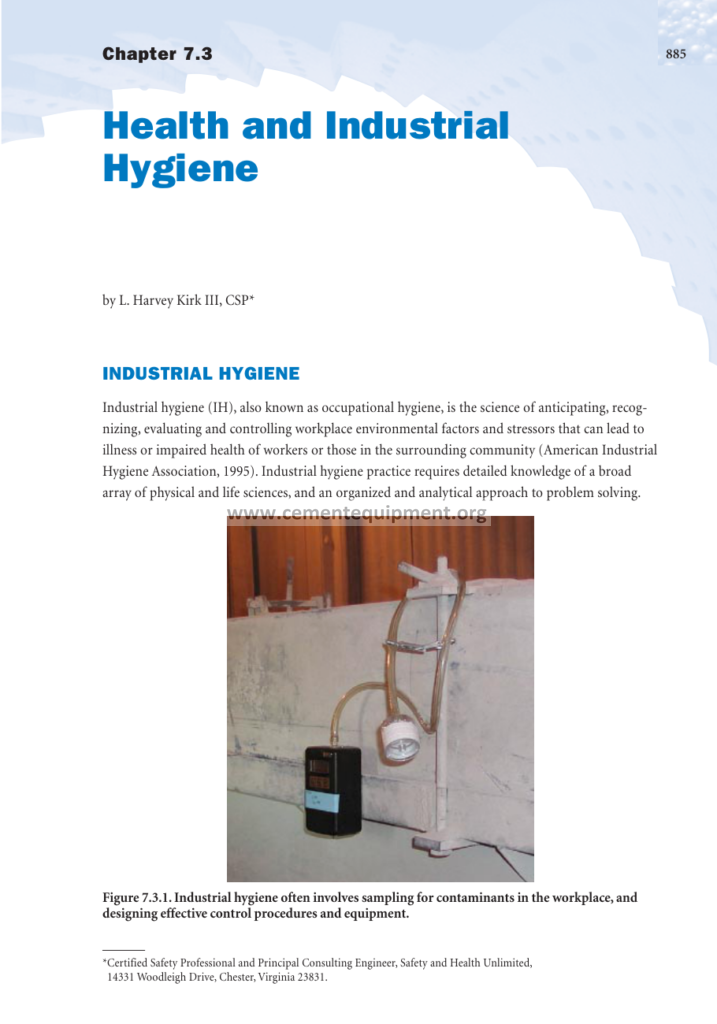
Personal sampling is the foundation of exposure evaluation. For dust, the standard method collects the inhalable or respirable fraction on a pre-weighed filter mounted in a cyclone that separates the respirable fraction by inertial classification, with the pump calibrated to the flow rate that matches the respirable criterion. The filter is weighed before and after sampling in a controlled laboratory, and the mass divided by the sampled volume gives the concentration. For respirable crystalline silica, the same dust sample is analyzed by X-ray diffraction or infrared spectroscopy to determine the silica content. For gases such as carbon monoxide, ammonia, and sulfur dioxide, the samples are collected on sorbent tubes or in bags and analyzed by gas chromatography or direct-reading instruments.
Direct-reading instruments complement laboratory sampling. Real-time dust monitors, based on light scattering or piezoelectric measurement, show the variation of dust concentration across the shift and are used to identify the moments of peak exposure, such as a kiln inspection or a bag-change operation. Personal gas detectors worn by workers in kiln areas give continuous warning for carbon monoxide and other acute hazards. The sampling strategy follows a defined protocol: representative workers for each task group, full-shift sampling on multiple days, and sampling under worst-case conditions, because the objective is to identify the maximum credible exposure and to verify that the controls protect against it. The results are recorded in an exposure database that supports trend analysis and the medical surveillance program.
The Hierarchy of Controls
The hierarchy of controls is the organizing principle of exposure management, and it is applied strictly: elimination, substitution, engineering controls, administrative controls, and personal protective equipment, in that order, with the most effective controls at the top. Elimination removes the hazard entirely, for example by changing a process that does not use a hazardous chemical. Substitution replaces the hazard with something safer, for example replacing a chlorinated solvent with a water-based cleaner or using a cement formulation with reduced hexavalent chromium. Engineering controls are the technical measures that keep the worker separate from the hazard: enclosure of dusty processes, local exhaust ventilation, process automation, and machine guarding. Administrative controls reduce exposure by limiting time, for example through rotation and job scheduling, and through training and procedures. Personal protective equipment is the last line of defense, to be used where the higher controls cannot fully eliminate the hazard.
- Elimination and substitution are decided at design: raw materials, fuels, additives, and cleaning chemicals are selected with their hazards in mind.
- Engineering controls are the workhorses: enclosure and extraction on crushers and conveyors, dust collection on mills and silos, ventilation of workshops and laboratories.
- Administrative controls manage the residual risk: exposure-time limits, work-rest schedules in heat, rotation of noisy tasks, and mandatory hygiene such as washing and changing before breaks.
- PPE protects against the remainder: respirators, hearing protection, gloves, boots, and coveralls, each selected for the specific hazard and maintained and replaced as part of the program.
The hierarchy is not a menu; it is a sequence. A respirator program that is built on an uncontrolled dusty process is a failure of hygiene, because respirators fail through fit, misuse, and fatigue, while an enclosure that contains the dust protects everyone in the area regardless of individual behavior. The most effective programs therefore measure themselves by the extent to which the upper levels of the hierarchy carry the load.
Ventilation and Dust Control as Hygiene Measures
Ventilation is the principal engineering control for airborne hazards, and its design follows defined principles. Local exhaust ventilation captures the contaminant at its source: a hood at the loading point, an enclosure around a transfer chute, and a duct system that carries the dusty air to a dust collector. The system is designed by capture velocity, the air velocity at the point of contaminant release needed to overcome the process’s own air currents, typically 0.5 to 1.5 m/s for dusty operations, and the hood shape and position are as important as the fan size. The captured air is filtered before discharge, and the collector returns clean air and recovered product.
General ventilation dilutes contaminants that cannot be captured at the source, and it is specified by air changes per hour for workshops, laboratories, and control rooms. The kiln area requires ventilation for both heat and carbon monoxide, and the confined spaces of the plant, silos, hoppers, kiln interiors, and ducts, are never entered without measurement of oxygen, flammability, and toxicity, because the residual dust and gas inside them can be lethal. The ventilation systems are part of the plant’s asset register and maintenance program, because a hood that is dislodged or a duct that leaks silently converts a controlled process back into an uncontrolled one.
Respiratory Protection
Where the airborne hazard cannot be eliminated, the respirator program takes over, and it must be managed as a formal program: selection, fit testing, training, maintenance, and medical evaluation. The selection depends on the hazard and its concentration. Disposable filtering facepieces protect against dust where the concentration is a moderate multiple of the limit; elastomeric half-masks with replaceable filters protect at higher concentrations; and powered air-purifying respirators, with a blower and helmet, are used for sustained dusty work because they are comfortable and their positive pressure prevents leakage. Supplied-air respirators are reserved for the most hazardous situations, including confined space entry where oxygen may be deficient.
Fit is the decisive factor in respirator effectiveness. A filtering facepiece that leaks around the seal admits unfiltered air, and the protection factor of the device is meaningless if the fit is poor. Fit testing is therefore mandatory, and quantitative methods are preferred, measuring the ratio of ambient to in-mask concentration. Facial hair, eyeglasses, and respirator-to-facepiece interfaces are handled in the fit test and in training. The medical evaluation, including a baseline assessment of lung function, determines whether the worker can wear a respirator at all, and the program documents the respirator selected for each task, the cartridge change-out schedule, and the inspection and storage requirements. The respirator program is one of the most audited elements of industrial hygiene, and it is the element that protects workers from the dust and silica hazards that are otherwise the industry’s most serious health risks.
Hearing Conservation
The hearing conservation program is triggered when noise exposure reaches the action level, typically 80-82 dB(A) time-weighted average. The program has five elements: noise measurement, engineering and administrative control, hearing protection, audiometric testing, and training. Noise mapping identifies the areas above the action level and defines hearing protection zones; engineering measures, such as enclosures around mills and acoustic lagging on fans, reduce the source level where practical, and administrative measures limit the time workers spend in high-noise zones. Hearing protection devices, earplugs and earmuffs, are selected for their attenuation, and the selection is verified against the measured exposure, because over-protection can isolate the worker from warning signals while under-protection fails the program’s purpose.
Audiometric testing measures the worker’s hearing at baseline and at intervals, typically annually, and the comparison of successive audiograms detects early noise-induced hearing loss before it becomes disabling. The test results trigger both medical follow-up and program review: a pattern of hearing shifts in one department points to a specific noise source or a failed protection practice, and the program responds at the source rather than accepting the loss. Training completes the program: workers who understand that hearing loss is permanent and preventable use their protection properly, and the program’s effectiveness is measured by the absence of hearing shifts rather than by the distribution of earplugs.
Medical Surveillance and Health Monitoring
Medical surveillance is the medical counterpart of exposure monitoring: it detects the health effects of exposure early enough to act. The program begins with a pre-placement medical examination that establishes the baseline and identifies workers who cannot safely perform certain tasks, for example workers with respiratory disease for dusty jobs or with impaired balance for work at height. Periodic examinations follow at intervals determined by the risk: lung function testing for dust-exposed workers, audiometry for noise-exposed workers, and general health reviews for the workforce as a whole. The examinations are designed around the hazards of the plant, and their results are analyzed as a group as well as individually, because a pattern of lung function decline in one department is an exposure control failure that must be corrected at the source.
The surveillance program is linked to the exposure database: each worker’s exposure history and medical history are reviewed together, so that an abnormal finding can be interpreted against the actual exposure record. The program also supports the respirator fit testing and the fitness-for-work assessments that follow injury or prolonged absence. Medical records are confidential and are managed under the relevant privacy regulations, and the occupational physician reports to the plant on patterns and trends rather than on individuals. For the cement industry specifically, the program emphasizes respiratory surveillance for silica and dust exposure, dermatological awareness for chromium sensitivity, and audiometry for the high-noise environment.
Special Exposure Situations in Cement Plants
Several exposure situations in cement plants deserve special attention because they combine high hazard with intermittent occurrence. Kiln entry and preheater tower maintenance expose workers to residual dust, carbon monoxide, and heat in confined spaces, and the work is conducted under a confined space permit with gas testing, ventilation, and standby personnel. Bag change operations on dust collectors expose workers to the collected dust, which may contain concentrated alkalis and trace metals, and are performed with local extraction, respiratory protection, and decontamination procedures. Welding and grinding in workshops expose workers to metal fumes, including hexavalent chromium from stainless steel, and the workshop is equipped with fume extraction and the welders with the appropriate respirators.
Laboratory work involves cement testing chemicals, solvents, and heated equipment, and the laboratory operates under its own hygiene rules: chemical storage and segregation, fume hoods for solvent work, and emergency showers and eyewashes. Fuel and additive handling exposes workers to coal dust, fuel oils, and chemical admixtures, and the handling areas are equipped with eye wash stations, spill kits, and the relevant safety data sheets. Finally, the maintenance of mobile equipment exposes mechanics to oils, solvents, and asbestos in older brake and clutch materials, and the asbestos management program, including identification, removal, and disposal procedures, applies wherever asbestos-containing materials may be present in older plant equipment.
Management Systems: ISO 45001 and OSHA Practice
The industrial hygiene program operates inside an occupational health and safety management system. ISO 45001, the international standard for occupational health and safety management, provides the framework: worker participation, hazard identification and risk assessment, legal compliance, operational planning and control, competence and training, performance evaluation, and continual improvement. The standard requires the organization to determine the occupational health hazards, assess the risks, and implement controls in line with the hierarchy of controls, which is exactly the industrial hygiene discipline, and it requires the management system to be audited and reviewed so that the program improves over time.
The regulatory framework varies by jurisdiction, but the pattern is common. In the United States, OSHA standards govern respiratory protection, hazard communication, hearing conservation, silica exposure, lockout/tagout, and confined space entry, and the plant’s compliance is verified by inspection. In the European Union, the chemical agents directive, carcinogens and mutagens directive, noise directive, and vibration directive set the exposure limits and program requirements. In developing countries, the ILO conventions on occupational safety and health and the national labor laws provide the baseline. The professional plant applies the most stringent of the applicable requirements, and it uses the management system, ISO 45001, to make the compliance continuous rather than episodic.
The Industrial Hygiene Program: Structure and Deliverables
A complete industrial hygiene program is a defined set of activities with clear deliverables. The annual program cycle includes: a hazard inventory review, updated when processes change; a sampling plan, executed at the defined frequency with the results reported and compared with limits; training for workers and supervisors on the hazards of their work and the controls in place; medical surveillance executed to the schedule; a review of the exposure database for trends; and an audit of the program itself. The deliverables are the exposure reports, the trend analyses, the corrective actions, and the evidence of compliance that the plant can present to regulators, customers, and insurers.
The program is staffed by the plant’s industrial hygienist or by the safety department with specialist support, and it draws on the process engineers for the ventilation and dust control designs, on the occupational physician for surveillance, and on the contractors who perform specialized work under the plant’s rules. The quality of the program depends on data: plants that measure exposures, document the controls, and review the results systematically find that exposures trend downward, and the trend is the ultimate evidence that the program works.
Frequently Asked Questions
What is the difference between industrial hygiene and safety?
Safety addresses the hazards that can cause injury immediately, such as moving machinery, falls, and fires, while industrial hygiene addresses the exposures that can cause illness over time, such as dust, noise, heat, and chemicals. The two disciplines overlap in programs like PPE and confined space entry, and they are managed together in the plant’s health and safety management system.
What are the exposure limits for cement dust?
Common values are 10 mg/m3 for total inhalable dust and 4 mg/m3 for respirable dust on an 8-hour time-weighted average (ACGIH), with OSHA PELs of 15 mg/m3 total and 5 mg/m3 respirable. Respirable crystalline silica has far lower limits: 0.05 mg/m3 (OSHA) and 0.025 mg/m3 (ACGIH).
Why is noise so dangerous in cement plants?
Because the exposure is continuous, the levels are high, and the damage is permanent. Levels above 85 dB(A) over a shift cause progressive noise-induced hearing loss, which is irreversible, and hearing loss also increases the risk of accidents because workers cannot hear warning signals.
What is the hierarchy of controls?
Elimination, substitution, engineering controls, administrative controls, and personal protective equipment, applied in that order. The higher levels protect everyone and do not depend on individual behavior, while PPE is the last line of defense and must never substitute for the higher controls.
How is silica exposure measured?
By personal sampling with a respirable dust cyclone and pump, followed by laboratory analysis of the silica content by X-ray diffraction or infrared spectroscopy. The result is compared with the occupational exposure limit of 0.025-0.05 mg/m3 as an 8-hour time-weighted average.
What is hexavalent chromium and why does it matter in cement?
Hexavalent chromium, Cr(VI), is a form of chromium that occurs in cement and clinker, is highly skin-sensitizing, and causes allergic contact dermatitis; it is also a carcinogen by inhalation. The industry reduces Cr(VI) in cement with ferrous sulfate or similar reducing agents, and workers additionally use dust control, gloves, and barrier creams.
What is a fit test and why is it required?
A fit test verifies that a respirator seals against the wearer’s face, either qualitatively or quantitatively. Without a seal, unfiltered air bypasses the filter, and the respirator provides no protection. Fit testing is required annually or when the face or the respirator model changes.
Summary
Health and industrial hygiene is the discipline that converts the cement industry’s hazard inventory into a managed, measured, and continuously improving health program. The hazards are fully characterized: alkaline cement dust, respirable crystalline silica, hexavalent chromium, carbon monoxide, noise, heat, vibration, and the chemical and ergonomic agents of maintenance and laboratory work. The evaluation tools are mature: personal sampling, direct-reading instruments, exposure databases, and medical surveillance that connects the exposure record to the health record. The control doctrine is the hierarchy of controls, applied so that enclosures, extraction, and ventilation carry the main load and respirators, hearing protection, and gloves protect the remainder. The management framework, ISO 45001 with OSHA and ILO compliance, institutionalizes the program so that it survives personnel changes and improves continuously. The measurable outcome of a strong program is a workforce whose exposures stay below the limits, whose health trends stay normal, and whose productivity reflects a plant that protects its people as carefully as it protects its environment.
Get this cement file + the full 931-file package
$249.99 — one-time purchase, instant download, lifetime access
This file is part of the Complete Cement Technical Package (931 files) available from cementequipment.org. Respective rights holders; library copy for the licensed single user.