Cement Dust Generation & Management: Guide
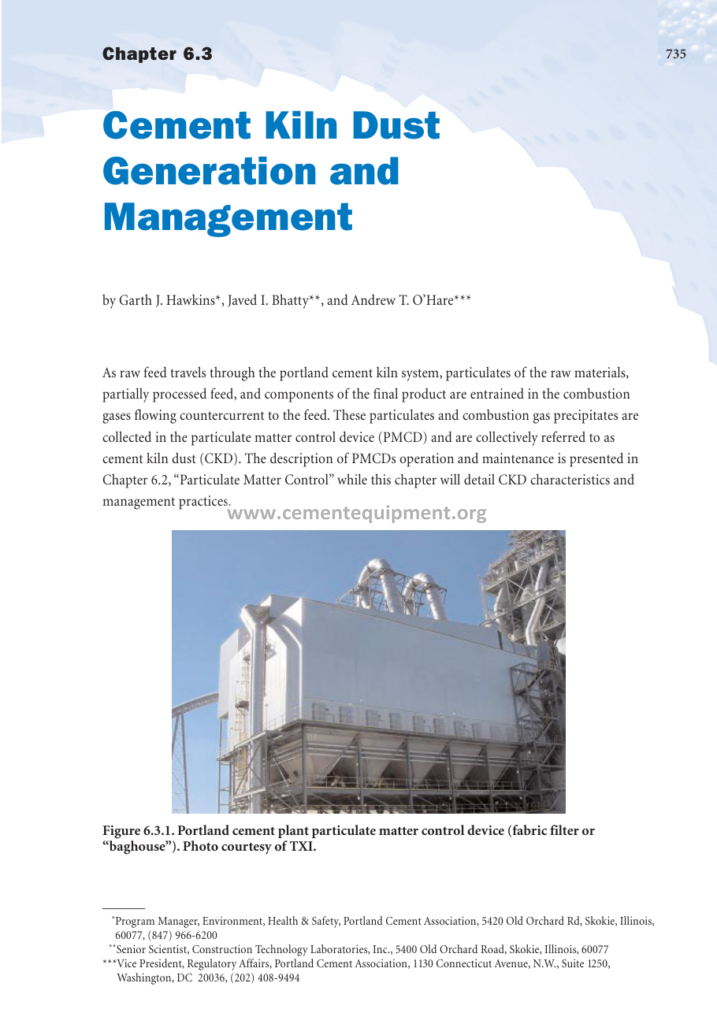
As raw feed travels through the Portland cement kiln system, particulates of the raw materials, partially processed feed, and components of the final product are entrained in the combustion gases that flow countercurrent to the feed. These particulates, together with combustion gas precipitates, are collected in the particulate matter control device and are collectively referred to as cement kiln dust (CKD). Dust is generated at every stage of cement manufacture, from quarrying and crushing to grinding, packing, and dispatch, and its management is simultaneously an environmental compliance issue, a raw material conservation issue, and an occupational health issue. Modern plants collect dust at 10-20 mg/Nm3 emission levels and return the vast majority of the collected material to the process, but the physical and chemical characteristics of the dust, particularly its alkali, sulfate, and chloride content, determine whether it can be recycled or must be removed from the process and disposed of or beneficially used. This article provides a complete technical treatment of dust generation in cement plants, the characteristics of cement kiln dust, collection and recycling systems, disposal and beneficial use options, regulatory requirements, and the operating practices that keep dust under control at every point of the plant.
Sources of Dust Generation Across the Cement Plant
Dust generation in a cement plant follows a predictable pattern that mirrors the process flow. In the quarry, drilling, blasting, loading, and haulage generate dust at the face and along roads. Crushing and screening generate dust at the feed hoppers, crusher discharge, and transfer points. Raw material and clinker storage generate dust from stacker and reclaimer operation and from wind erosion of stockpile surfaces. Conveying systems generate dust at every transfer point where material changes direction, speed, or containment. The mills, the kiln system, and the cement dispatch systems generate both process dust, which is entrained in exhaust gases, and fugitive dust from leaks and spillage.
Two fundamentally different dust categories exist. Process dust is the particulate matter carried in a confined gas stream to a collection device, where it is measured, collected, and either recycled or discarded. Fugitive dust is the particulate matter that escapes process containment and enters the plant environment or the atmosphere directly. The distinction matters because the control tools differ: process dust is managed with baghouses, electrostatic precipitators, and cyclones, while fugitive dust is managed with enclosure, hooding, extraction, suppression, and housekeeping. A plant can have an exemplary stack emission record and still be a dusty plant if its fugitive control is neglected.
Mechanisms of Dust Entrainment in the Kiln System
Inside the kiln system, dust generation follows the gas flow from the flame to the stack. In the rotary kiln itself, the tumbling bed of feed releases fine particles into the combustion gas; the gas velocity, which can reach several meters per second in the kiln inlet zone, carries them upward through the preheater. In the cyclones, the gas expands and slows, and a large fraction of the coarse particles drops out and returns to the kiln feed. The remaining fine particles continue up the preheater stages, and by the time the gas leaves the top cyclone, its dust load depends on the cyclone efficiency, typically 85-95 percent per stage, and on the fines content of the feed.
Three additional mechanisms add to the dust load. First, volatile compounds, mainly alkali sulfates and chlorides, vaporize in the burning zone and recondense as fine fume on the cooler dust surfaces, creating sub-micron particles that escape cyclone collection and reach the filter. Second, calcination itself generates fines: as limestone decomposes, the resulting lime particles are porous and friable, increasing the fines inventory. Third, the kiln gas flow rate varies with the kiln-mill mode and fuel moisture, and higher gas velocities entrain more dust. The net result is that kiln exhaust gas typically carries a dust load of 20 to 80 g/Nm3 at the preheater exit, which the collection device must reduce to 10-20 mg/Nm3.
Quantities of Cement Kiln Dust Generated
The quantity of CKD generated depends strongly on the process configuration. Wet-process kilns, long dry kilns, and kilns without efficient preheater cyclones generate the largest amounts, because the gas path is longer, the gas velocities are higher, and cyclone collection is absent or limited. Older wet kilns were reported to produce CKD at rates of 10 to 20 percent of kiln feed, and in extreme cases higher. Modern preheater/precalciner kilns with efficient cyclone stages and dust recycling produce far less net dust, often below 5 percent of feed, and the term CKD in these plants refers mainly to the dust that must be purged because its chemistry cannot be recycled.
For a 5000 t/d clinker plant, even a modest 2 percent net dust rate represents 100 tonnes per day of material that must be recycled or managed, so dust handling is not a minor logistics issue. The design of the dust return system, its transport, storage, and metering, is an engineering task in its own right, and plants typically install dedicated pneumatic or mechanical systems to return collected dust to the kiln feed or to the raw mill.
Physical and Chemical Characteristics of CKD
Cement kiln dust is a fine, dry, highly alkaline material whose characteristics vary with the raw materials, fuels, process type, and collection point. Particle sizes range from sub-micron fume to 100 microns, with the mean typically in the range of 5 to 30 microns. The specific surface area is high, which gives CKD its reactive character in soil stabilization and other beneficial uses. The alkalinity is dominated by free lime and calcium oxide, and the pH of a CKD-water slurry typically exceeds 11, sometimes approaching 12.5.
Chemically, CKD is a partially calcined mixture. The oxide composition shown in the table below is typical, but the critical variables for management are the soluble alkali, chloride, and sulfate contents, because these compounds determine whether the dust can be recycled without causing kiln operating problems such as alkali chloride cycles, coating formation, and preheater blockages.
| Component | Preheater kiln dust (%) | Long dry kiln dust (%) | Wet kiln dust (%) |
|---|---|---|---|
| CaO total | 35 – 55 | 40 – 55 | 35 – 50 |
| SiO2 | 10 – 15 | 10 – 16 | 10 – 18 |
| Al2O3 | 3 – 6 | 3 – 6 | 3 – 7 |
| Fe2O3 | 1.5 – 5 | 2 – 5 | 2 – 6 |
| SO3 | 2 – 9 | 2 – 8 | 1 – 6 |
| K2O | 2 – 7 | 1 – 6 | 0.5 – 4 |
| Na2O | 0.3 – 2 | 0.2 – 1.5 | 0.2 – 1 |
| MgO | 0.5 – 2.5 | 1 – 3 | 1 – 3 |
| Cl | 0.1 – 1.5 | 0.1 – 2 | 0.1 – 0.8 |
| Free lime | 5 – 30 | 10 – 30 | 5 – 25 |
| Loss on ignition | 5 – 25 | 5 – 20 | 10 – 30 |
Dust Generation Differences by Process Type
Process selection determines the dust problem a plant will face. Wet-process kilns, still operating in some regions, use a slurry feed that suppresses dust in the feed end, but the long kiln and the high gas moisture create conditions that complicate dust collection, and the overall heat consumption is far higher. Long dry kilns entrain dust over the full kiln length without cyclone pre-collection, so they generate the highest dust loads to the collection device. Preheater kilns benefit from cyclone collection at each stage, and precalciner kilns can return collected dust through the calciner where the hot conditions partly re-calcine it.
For each process type, the dust return strategy differs. Wet kilns historically returned dust as slurry with the feed. Long dry kilns return dust to the kiln feed or to the raw mill. Preheater and precalciner kilns return dust to the raw mill or inject it into the kiln riser or calciner, where it is heated and calcined again. The choice is governed by the dust chemistry: dust high in chlorine, for example, should not be fed to the riser where chloride cycles and blockages occur, but may be acceptable in the raw mill where the cycle is broken.
Volatile Cycles and Dust Chemistry
The most important management constraint on CKD is the volatile recirculation cycle. Potassium, sodium, chlorine, and sulfur partially volatilize in the burning zone, condense on the cooler dust in the preheater, and return to the kiln with the feed, building internal concentrations that can be three to five times the input level. These cycles have a decisive effect on dust management because every recycle path concentrates the volatile elements until the dust must be purged or the process must deal with the consequences: coating rings in the kiln, build-ups in the preheater and riser, and degraded clinker quality from excessive alkali and sulfur.
The two principal purge paths are the kiln bypass and the CKD purge. The bypass extracts a portion of kiln exit gas, typically 3-10 percent, collects its dust, and removes it from the process, which is the standard tool for plants on high-chloride raw materials or fuels. The CKD purge is the controlled removal of collected dust from the system. The decision of how much dust to purge is an economic balance: recycle value as raw material and fuel value against the kiln operating penalties and clinker quality effects of the recirculated volatile load. Modern plants manage this with process models that track alkali, sulfur, and chloride balances around the kiln system.
Dust Collection Systems in the Kiln Area
The kiln dust collection system is the heart of dust management. Gas leaving the top cyclone or preheater carries the final dust load to the collection device, and the design of this device determines both the stack emission and the quality of the dust returned to the process. Fabric filters have become the standard because they achieve 10 mg/Nm3 and below regardless of dust resistivity. Electrostatic precipitators remain in service at older plants, operating with the constraints described in the air pollution control context: sensitivity to dust resistivity in the 150-250°C range and CO interlocks that shut down collection during combustion upsets.
The collection system also includes the auxiliary vents that are necessary for operational safety: preheater tower vents, kiln inlet seals, the clinker cooler vent, and the bypass dust collector. Each of these streams has its own dust characteristics and its own return or disposal path. In a well-instrumented plant, the total dust balance around the kiln system is monitored continuously, and the operators know at any time how much dust is being collected, recycled, and purged.
Fugitive Dust Management
Fugitive dust is the dust that never reaches a collection device, and it is the dust that neighbors see and regulators measure at the boundary. The main fugitive sources are crushing and screening plants, conveyor transfer points, storage and reclaim operations, the packing and loading station, and vehicle traffic. The management hierarchy is source reduction, containment, extraction, and suppression.
- Source reduction: design chutes to keep material on the belt center, install impact idlers at loading points, and size screens to minimize degradation.
- Containment: fully enclose crushers, screens, and transfer points; install skirt boards and dust curtains; cover conveyors where wind exposure is significant.
- Extraction: connect enclosures to hoods and ducts that pull dusty air to a small dust collector, maintaining slight negative pressure inside the enclosure.
- Suppression: use water sprays at crushers and stockpiles, foam systems at transfer points, and chemical dust suppressants on haul roads and storage surfaces.
- Housekeeping: sweep and vacuum roads and platforms, clean spillage promptly, and prevent dust accumulation on structures.
Each fugitive source needs a specific solution, and the effectiveness of the program is measured with boundary dust deposition gauges, ambient PM monitoring, and visual inspections. The environmental benefit of fugitive control is matched by a maintenance benefit: dust on equipment is an abrasive and a fire risk, and dust on roads and walkways is a safety hazard.
CKD Recycling and Reuse
Recycling collected dust to the process is the preferred management option wherever the chemistry allows. The recycling paths are the raw mill, the kiln feed, the calciner, and the cement mill. Dust returned through the raw mill is dried, ground, and blended with the raw material, which dilutes its volatile content and makes it acceptable for kiln feed. Dust injected into the calciner or riser returns to the burning zone quickly and can contribute its free lime content to the clinker reaction. Dust added to the cement mill is used only where its alkali and chloride content is low enough to meet cement standards, because alkalis affect the setting time, strength development, and durability of concrete.
The economic value of recycling is substantial: the dust is a raw material that was already purchased, transported, and partially processed, and every tonne recycled avoids the cost of disposal. The technical constraint is the chemistry, and the practical tool is the volatile balance: the plant monitors potassium, sodium, sulfur, and chlorine in feed, fuel, dust, and clinker, and the difference between what enters and what leaves is managed through purge rates and bypass operation.
CKD Disposal Practices
Dust that cannot be recycled because of high chloride, alkali, or other regulated constituents must be disposed of or beneficially used. The disposal options are constrained by the alkaline nature of CKD, which reacts with water and can generate high-pH leachate, and by the presence of leachable chromium in some dust. Engineered landfills with impermeable liners and leachate collection are the standard approach where beneficial use is not feasible. In some regions, CKD is stored in dedicated on-site disposal areas with permanent covers and groundwater monitoring, and in others it is blended into quarry voids and restored.
Disposal carries real costs, both direct (transport, containment, monitoring, long-term liability) and regulatory (permits for waste handling and reporting obligations). These costs are the driver for maximizing recycle and beneficial use, and they explain why modern plant design emphasizes minimizing net dust generation in the first place through efficient cyclones, stable operation, and volatile management.
Beneficial Use of Cement Kiln Dust
Because CKD is fine, dry, and highly alkaline, it has well-established beneficial use applications that convert a waste stream into a product. The largest uses are soil stabilization, wastewater treatment, and agricultural liming, with smaller uses in synthetic aggregate production, mineral wool manufacture, and mine reclamation.
| Application | Mechanism | Typical CKD dosage |
|---|---|---|
| Soil stabilization | Free lime pozzolanic reaction improves bearing capacity and moisture resistance | 3 – 15% by dry soil mass |
| Wastewater treatment | Alkaline pH adjustment and coagulation; phosphorus and metal precipitation | Determined by influent acidity |
| Agricultural liming | Neutralizes soil acidity; supplies calcium, potassium, and sulfur | 1 – 5 t/ha depending on soil pH |
| Synthetic aggregate | Binder for pelletized aggregate with cement or lime | 5 – 30% of pellet mix |
| Mine and quarry reclamation | Acid mine drainage neutralization and surface stabilization | Site-specific |
Beneficial use requires the dust to meet product-specific quality criteria, and it requires the plant to manage the supply chain professionally: consistent chemistry, dust-free transport, proper documentation, and end-user technical support. The regulatory treatment of CKD use varies by jurisdiction; where the use is recognized as a product rather than a waste, the plant avoids disposal liability, and the environmental benefit is real because the alkaline material replaces other industrial products with their own footprints.
Health and Safety Aspects of Dust Handling
CKD handling presents specific health and safety hazards that the management program must address. The dust is alkaline and can cause skin and eye irritation on contact, particularly when moistened; workers handling CKD wear protective clothing, gloves, and eye protection. Inhalation of dust, especially in confined areas such as hoppers and silos, is controlled with ventilation, local extraction, and respiratory protection where necessary. The respirable fraction is treated under the plant’s silica and dust exposure program, and exposure limits such as the ACGIH values of 10 mg/m3 total and 4 mg/m3 respirable dust apply to cement plant dust generally.
The process safety hazards are equally specific. Dust accumulations in ducts and hoppers are a fire and explosion risk when organic content is present, and dust handling equipment is designed with explosion vents, isolation valves, and CO monitoring where applicable. Entry into dust silos and hoppers is a confined space operation with its own permit procedure, and the dust itself, being fluidized and free-flowing, can engulf a person within seconds. The dust management program is therefore inseparable from the plant’s confined space, lockout, and housekeeping programs.
Monitoring and Performance Indicators
A dust management program needs measurements. The process side is monitored continuously: stack dust concentration on the main collectors, pressure drop across filters, hopper levels, and the quantities of dust returned and purged. The fugitive side is monitored with boundary dust deposition gauges, ambient PM monitors, and scheduled inspections of transfer points, roads, and housekeeping standards. The health side is monitored with personal dust sampling and the plant’s industrial hygiene program.
The management indicators that matter are the net CKD rate as a percentage of clinker production, the recycle rate, the purge rate, the stack emission concentrations against permit limits, and the number of fugitive emission events or complaints per period. These indicators are reviewed regularly in the environmental management system, and trends are used to trigger maintenance, process adjustment, or capital investment. A rising net dust rate, for example, typically signals cyclone wear, feed moisture changes, or volatile cycle build-up, and it is treated as an early warning rather than a report item.
Dust Return System Design
Returning collected dust to the process is a continuous, high-rate operation that demands engineering attention. On a 5000 t/d precalciner line, the fabric filter may collect several hundred tonnes of dust per day from kiln gas alone, and the return system must move this material reliably through a system that also carries the auxiliary dust streams from the cooler, the raw mill vent, and the bypass. The standard designs are mechanical conveying, usually screw conveyors and bucket elevators, and pneumatic conveying, which uses air to fluidize and transport the dust through pipes. Pneumatic systems dominate for long-distance, multi-drop applications because they are fully enclosed and flexible, but they consume compressed air and can wear rapidly at bends when the dust is abrasive.
The critical design considerations are material properties, system reliability, and surge capacity. Dust that is hot, moist, or high in free lime can build up in screw flights and block pneumatic lines, so the system must be sized for the worst-case dust and fitted with clean-out access at every horizontal run. Reliability is engineered through redundancy in the critical legs, level switches and rotation monitors on screws, and flow indicators on pneumatic lines, because a blocked return line rapidly forces the plant either to divert dust to disposal or to stop the collector. Surge capacity is provided by the hoppers and a buffer silo that decouples the continuous collector discharge from the batch-like process of returning dust, for example to the raw mill during its operating windows. Finally, dust return points are chosen for chemistry and energy: return to the calciner recovers the free lime and heat of the dust, return to the raw mill dilutes volatile elements, and the bypass dust, with its high chloride content, is typically the first candidate for purge rather than return.
Case Example: Dust Balance on a Modern Precalciner Line
To make the numbers concrete, consider a 5000 t/d precalciner line with a six-stage preheater and a fabric filter on the kiln-raw mill system. With a clinker production of 5000 t/d and a feed-to-clinker ratio of 1.6, the plant grinds and feeds about 8000 t/d of raw material. The gas system moves roughly 700,000 Nm3/h through the filter, with a dust load of 40 g/Nm3 entering the filter, which corresponds to about 28 t/h of dust arriving at the filter, roughly 670 t/d. With an outlet dust concentration of 10 mg/Nm3, the stack carries away only 170 kg/d, so the filter collects essentially the entire dust load and returns it to the process.
Of the 670 t/d collected, about 600 t/d returns through the raw mill with the normal feed cycle, about 50 t/d is injected into the calciner to recover its free lime, and the remainder, perhaps 20 t/d, must be purged because its chloride and alkali content would otherwise build the internal cycle above the operating limit. The purge stream goes to the CKD silo for beneficial use or disposal. This example illustrates the defining characteristics of modern dust management: a recycle rate of more than 97 percent, a stack emission below 0.1 percent of the incoming dust load, and a small, controlled purge that is the deliberate instrument of volatile balance management rather than an uncontrolled waste stream.
Economics of Dust Management
Dust management economics favor collection and recycling overwhelmingly. The value of the returned dust is the raw material cost it replaces, typically several dollars per tonne, multiplied by hundreds of tonnes per day, which on a 5000 t/d line can represent a six-figure annual saving. The alternative, disposal, carries transport, landfill, and long-term liability costs that are typically two to five times higher per tonne than the cost of recycling, and the stack emission itself, if uncontrolled, exposes the plant to fines, production curtailments, and reputation damage that can be far more expensive than the equipment.
The investment case follows from these figures. A fabric filter on the kiln line, with its auxiliaries, is a major capital item, but it returns value through recovered dust, avoided disposal, and permit compliance over a 20-year life. The same logic applies to the smaller collectors on the mill vents and transfer points: each one recovers product-grade dust and prevents fugitive losses. The management conclusion is simple and robust: dust collection and recycling equipment is not an environmental cost center but a process asset, and plants that treat it as such operate both cleaner and more profitably.
Frequently Asked Questions
What is cement kiln dust (CKD)?
CKD is the fine alkaline particulate material collected from kiln exhaust gases and auxiliary kiln system vents. It consists of entrained raw feed, partially calcined material, clinker dust, and condensed volatile salts, and its composition reflects the raw materials, fuels, and process configuration.
How much dust does a cement plant generate?
Generation depends on process type. Wet and long dry kilns historically generated 10-20 percent of kiln feed as dust; modern preheater/precalciner kilns with efficient cyclones and recycling generate net CKD rates often below 5 percent of clinker.
Why can’t all dust be returned to the kiln?
Because dust concentrates volatile compounds, especially potassium, sodium, chlorine, and sulfur. Recycling them creates internal cycles that cause kiln coatings, preheater blockages, and clinker quality problems, so part of the dust must be purged or processed through the bypass to control the volatile balance.
What are the main uses for CKD that cannot be recycled?
Soil stabilization, wastewater treatment, agricultural liming, synthetic aggregate production, and mine reclamation are the established beneficial uses. Where no use is feasible, CKD is disposed of in engineered landfills with leachate controls.
What emission limits apply to kiln dust?
Modern permits require 10-20 mg/Nm3 on the kiln stack, with fabric filter plants typically achieving 5-10 mg/Nm3. Fugitive dust is managed through boundary deposition limits and good housekeeping rather than stack limits.
Is cement kiln dust hazardous?
CKD is alkaline and irritant: it can cause skin and eye burns when moistened and respiratory irritation when inhaled. It is managed under dust and silica exposure programs with occupational exposure limits, protective equipment, and confined space procedures for entry into dust systems.
How does the kiln-mill mode affect dust management?
When the raw mill runs on kiln gas, it cools and scrubs the gas, absorbs SO2 and mercury, and returns dust through the mill where it is blended with feed. Emissions and dust chemistry differ measurably between mill-on and mill-off modes, and operating procedures are designed around these modes.
Summary
Dust generation is inherent to cement manufacture, but its management is a solved engineering problem when approached systematically. The sources are known and enumerable: quarrying, crushing, conveying, storage, grinding, pyroprocessing, and dispatch each contribute process dust and fugitive dust in predictable proportions. The characteristics of cement kiln dust are measurable and manageable: a fine, alkaline material whose recycle value is determined by its free lime and volatile contents. The control toolbox is complete: high-efficiency cyclones and filters that take the kiln gas from tens of grams to tens of milligrams per normal cubic meter, closed conveying and storage systems that contain fugitive dust, and recycling, purging, and beneficial use systems that give the collected material its best economic and environmental fate. What separates excellent dust management from poor dust management is the same discipline that separates excellent plants generally: accurate mass balances, continuous monitoring, operating procedures that respect the chemistry of the volatile cycles, and housekeeping standards that are enforced. This article has provided the complete technical framework for that discipline.
Get this cement file + the full 931-file package
$249.99 — one-time purchase, instant download, lifetime access
This file is part of the Complete Cement Technical Package (931 files) available from cementequipment.org. Respective rights holders; library copy for the licensed single user.