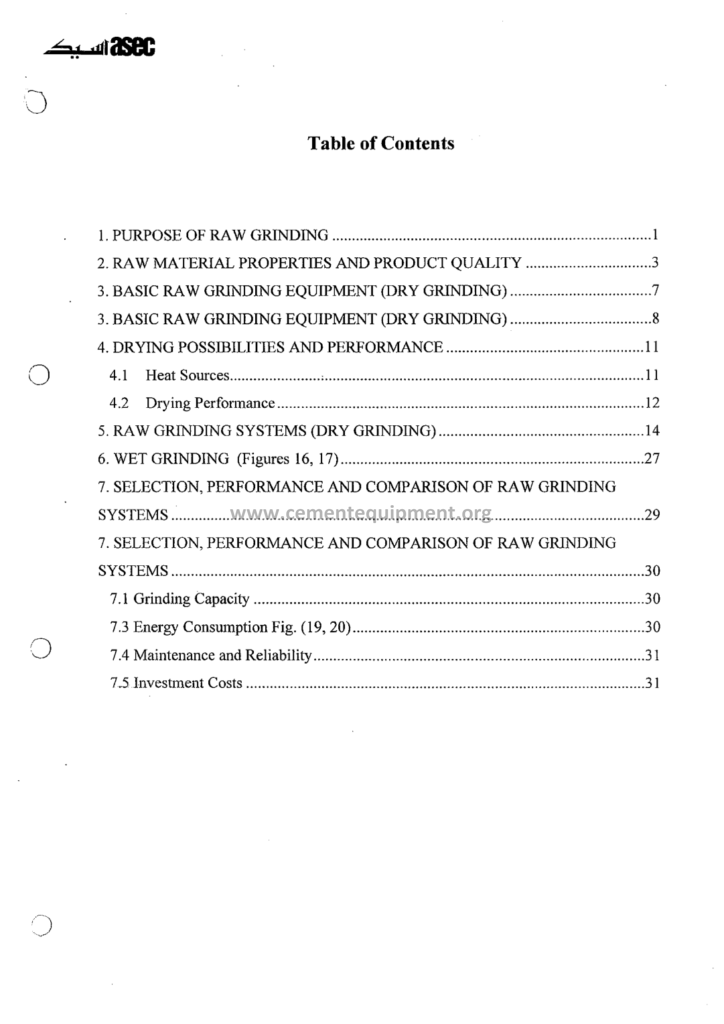
Raw Grinding Systems: Complete Technical Guide
The raw grinding systems are the first mechanical kingdom of the dry-process cement plant: the place where the crushed quarry stone becomes the fine powder called the raw meal: the powder that the kiln feeds on: the systems that must answer the chemistry, the fineness, the moisture and the throughput all at once: when the plant engineers plan the day, the raw mill is the machine they watch the most: it grinds the limestone, the clay, the sand and the iron source, dries the moisture of the quarry, and blends the four components into the one homogenous stream that the kiln section requires: this is the complete guide to those systems, taken from the files of the Complete Cement Technical Package.
The Complete Cement Technical Package (931 files, including the training presentations, the Excel calculators and the reference books: $249.99 one-time: instant download via the PayPal payment) covers the entire raw process line: the crushers, the mills, the drying, the separation, the silos and the control loops: this article is the reading guide that walks the RAW GRINDING SYSTEMS file, chapter by chapter, with the practical details that the operators and the engineers use on shift: the reader, whether fresh graduate or veteran superintendent, finds here the map and the landmarks of the raw grinding territory.
The raw grinding occupies the middle of the process chain: the chemicals of the mix were fixed by the quarry and the proportioning; the clinker formation will be decided in the kiln: the raw mill is the bottleneck where the two meet: feed it too coarse and the kiln chemistry staggers; over-grind it and the electricity bill doubles; wet the feed and the mill collapses into coating; dry it too much and the dust losses climb: the old operator law holds: the raw mill runs the kiln, and the kiln runs the plant: this guide gives the whole picture: the circuits, the machines, the numbers and the daily attitudes that keep raw grinding green.
1. The Role of Raw Grinding in the Cement Process
The raw grinding system receives the prepared raw materials from the crushing and the storage: the limestone at 0 to 80 millimetres, the clay, the silica sand and the corrective materials, and it must deliver a fine, uniform, dry powder with the exact chemistry that the kiln demands: the numbers are the language of the mill:
- The fineness target: the raw meal residue is generally fixed at 10 to 14% retained on the 90 micron sieve and 0.5 to 1.5% on the 200 micron sieve for the standard kiln systems; the preheater and the calciner tolerate the coarser residues, but the long kilns kept finer;
- The moisture target: the raw meal leaves the mill at less than 1% moisture, ideally 0.2 to 0.5%, because the remaining water steals the heat in the preheater and the kiln;
- The chemistry target: the mill must preserve the homogeneity of the raw mix, keeping the limestone factor and the silica ratio inside the small control windows, because the kiln reactions are the sensitive;
- The throughput target: the raw mill capacity must cover the kiln consumption with the margin for the stoppages, the maintenance and the variations of the trialability;
Five quality parameters are coded in the raw meal: the fineness, the moisture, the homogeneity, the chemistry and the temperature: each one connects to a kiln behavior: the coarse particles of the calcium carbonate residue raise the free lime of the clinker, the moisture loads the preheater fan, the scattered chemistry shifts the LSF of the hour and disturbs the burnability, and the hot meal entering the silo cakes: the raw mill planner therefore writes the recipe as a vector, not a number: the RAW GRINDING SYSTEMS file of the package leads the reader through the vector with the control charts and the practiced limits for each kiln generation, from the wet long kiln to the precalciner tower with the inline raw mill.
The plant of the family also governs the raw mill operation by the chemistry feedback: the X-ray analyzer of the feed probes the elements at the belt, the proportioning adjusts the four feeders every few minutes, and the mill merely delivers the mixture: the raw grinding system is thus the executor of the chemistry law that the quarry and the blenders declare: three rules come out of the practice: keep the mill feed as constant as the silo allows, keep the fineness steady even if it costs a little throughput, and keep the moisture of the discharge as low as the drying permits: the file repeats these lines at every chapter, and the guides of the package repeat them at every plant audit.
2. The Grinding Drying Process: One System, Two Duties
Unlike the finish mill of the cement, the raw mill also works as a dryer: the quarry materials arrive with 2 to 20% moisture, and the modern raw grinding combines the two operations in a single apparatus: the gas from the kiln or from a hot gas source flows through the mill and carries the water away, while the grinding tools fully reduce the particles: this coupling is the trademark of the raw grinding systems:
- The direct system (raw exhaust gas): the kiln-waste gases, typically from the preheater tower, pass directly through the mill, giving the heat of the kernel without any additional source: the most energy-efficient option, but the drying is limited to the quantity of kiln gas, which varies with the kiln load and the heat input;
- The direct-fired auxiliary system (hot gas generator): a dedicated hot gas generator adds the heat when the kiln gases and the waste heat are not available: the plant fires the coal, the gas or the oil briefly to top the drying while the mill runs during the kiln maintenance or the startup;
- The cyclone system (the pre-drying): the hot gas joins the feed in a pre-drying chamber or a flash, evaporating the moisture in the seconds before the coarse grinding: the temperature gradients shorten and the mill skims the efficiency;
The temperature of the raw mixture matters as much as the gas flow: the lime of the wet materials can stop the mill, the hot plaster can glaze the grinding tools, and the discharge temperature of the dried meal must stay below about 100 degrees Celsius at the mouth, the feared operators: the RAW GRINDING SYSTEMS file documents the temperature windows of the common systems so the shift keeps the mill between the sticky limit and the hot limit: the drying, the grinding and the ventilation are the inseparable trio of the raw mill daily work.
3. The Main Systems: the Ball Mill, the Roller Press, the Vertical Roller Mill
Three machine families dominate the modern raw grinding plant, and the file described each of them in depth with the drawings and the data:
- The two-compartment tube mill: the classic solution, a long rotating drum with the steel media: the coarse compartment with the lifting liners breaks the feed, the fine compartment with the classifying liners winishes the product: the bucket elevator closes the emergency, and it could be fed hot gas: the veterans of the industry know its robustness, and its price is the power: 20-28 kWh per ton of the raw meal;
- The roller mill (VRM): the modern architecture: a flat grinding table rotated by the motor and rolls pressed hydraulically on the bed: the gas issues upward and carries the fine particles to the dynamic classier: the same machine dries, grinds, clasps and conveys: the specific energy drops to 15-22 kWh/t and the drying capability reaches the scale of the large gas volumes: the industry chose it for the raw drying duty from the 1980s onward;
- The ball mill with the dryer chamber and the side-by-side, the combination circuits: the dryer installed in the first chamber, the ball mill completes the fine stage: the plan used where the moisture is mar along with the hard grinding;
- The high pressure grinding roll (HRPG): the pair of powered rollers presses the material between them at 150-200 bars, making the bed comminution that yields the two could be of the finished size: the press needs the companion mill to finish the fine product, and the pair forms the HPGR+ball circuits of the high capacity plants;
The choice between the families is the engineering question the file spends a long chapter on: the initial investment, the power consumption, the drying capacity, the feed size the mill can swallow, the sensitivity to the abrasivity and the moisture: no universal winner exists, the answer is the table that the file gives under the raw conditions of each plant: the engineers of the package compare the capital and the life-cycle cost with the Excel tool included.
4. The Grinding Media and the Wear of the Raw Ball Mills
Where the ball mill runs, the metal costs the real money: the grinding balls and the liners of the raw mill are the consumable, and the file documents the entire practice of the media management:
- The ball specification: the forged and the cast balls of the high-chromium steel, or the forged steel with the surface work, sized from 15 to 100 millimeters for the different chambers; the density of the charge between 29 and 33% of the mill volume in the two-chamber systems;
- The loading: the initial charge follows the average feed size and the target fineness, compensated by the trimming cascades: the monotone pieces are topped weekly, the classified balls monthly, the total ball inventory of 20 minutes;
- The wear: the chromium and the hardness decide the wear rate: a raw mill grinding the 2-5 mm abrasive feeds loses from 20 to 90 grams of the steel per ton of the meal ground, the numbers matter when 3,000,000 tons a year passes through the cylinder;
- The liners: the S-wave, the classifying plate liners and the lifting grids direct the mill mechanics: the wrong liner turns the mill into a roaring dullard, the right liner tunes the energy to the break: the file of the package includes the charts of the liner profile vs the product, plus the lifetime of the plate;
- The ball sorting: the end-of-life step: the mill is reduced, the full charge sorted by the diameter on the sieve baskets, the smalls recycled to the small producers, the fresh steel re-loaded: the operation of the ball sorting is a three-day outage, and the planner wants the top condition of the charge when the mill comes back;
The media economics deserve the numbers: the balls and the liners of a 400-ton-per-hour raw mill in full use are roughly one to two million dollars a year, so even a half-gram improvement per ton, delivered by the correct classification of the media and the correct alloy, factors in the hundreds of thousands: the file shows the calculation, the tools and the sampling procedure that turn the grinding media into a controlled practice, not an act of faith.
The two-compartment mill deserves one further note: the grinding media grading inside the barrel divides the work: the first compartment holds the lifting liners and the large media (70-100 mm) that break the 20-30 mm feed down to about 3 mm; the second compartment holds the small media (15-40 mm) that refines the material to the residue target: the partition diaphragm between the chambers levels the material and blocks the coarse at the gate: the energy splits 60/40 in the typical raw duty, and the modern plants add the classifying liners that lift the larger balls to the feed side of the second compartment automatically: the file gives the table of the liner pairs, the diaphragm slot widths and the ball gradings for the raw services, so the mill mechanic can match the internals to the exact feed of the quarry.
5. The Discharge: from the Mouth to the Separator
The mill never finishes a raw meal in one pass at the target: the design uses the classification: the mill grinds, the system washes the meal and returns the oversize: the two classic arrangements of the raw grinding circuits:
- The open circuit: the whole mill product goes directly to the silo: simple hardware, but the overgrinding that wastes the energy and the undersized distribution; today appears in the small or in the combination, as the self-limiter;
- The closed circuit: the mill product lifts to a classifier, where the oversize returns to the mill and the fines enter the dust collection: the ball mill closed with the modern R-Seatt classifier returns 150 to 250% of the feed as the circulating load: the flowsheets and the stages are the heart of the energy efficiency;
The selection efficiency and the bypass of the bad classifiers are the core measurable of the circuit: the file of the raw grinding shows the sharpness and the bypass of the typical separator of the raw, about 30-45% of the particles of the material at the specified cut size: the design changes the shape of the product curve and the kiln’s dissolving behavior: the same raw, the same fineness, but a different distribution, and the kiln’s clinker temperature differs: the file concludes the chapter with a steering rule: treat the closed-circuit classifier of the raw as a process instrument, not just a bolt-on gate.
6. The Moisture and Drying Engineering Inside the Mill
Drying is exactly the invisible co-worker of the raw grinding system: the water of the feed must leave with the gas, the physics is the water balance of the mill:
- The entry moisture: the limestone seldom exceeds 5%, but the marl and clay layers reach 15-20% after the rain season, and the feed hoppers quanto the wasted the wet at the metal;
- The gas velocity: the gas carrier holds the water vapor as the exhaust; in a 4.6×13 m mill with 400,000 m³/h, the few meters per second sweep the mill and the fine powder with them, so the drying gas doubles as the conveying of the finished meal to the separators;
- The heat economics: the limestone, the mill and the kiln gases deliver, in a 900°C preheater tower, the whole drying at no cost: when the mill idles but the kiln burns, the plant sends the gas straight to the bag filter at a lower grade than the mill: the negotiation of the heat flow is the daily puzzle;
- The clogged risks: the feed high in the sodium lowers the mill throughput under the sign of the stopping the mill with the baked cake in the inlet and the gas, the scraped out by hand: the anti-stick reliefs, the exit hoppers and the hourly root: all covered in the RAW GRINDING SYSTEMS file chapters on the drubbing and the maintenance;
The practical rule of the file: the drying level is the lever to the throughput, because the wet feed of 5% to 10% reduces the production rate by 10-25%, and the moisture even steers the power: the wetter the feed, the more the energy that the mill must transfer to the water instead of the grinding: the operator dose the water in the morning target, the humidity forecast and the gas pattern, which is precisely the control skill that the package training drills.
7. The Classifiers of the Raw Meal: Lifting the Efficiency
The separator, called also the classifier or the air separator, is the unit the raw grinding system lives by: the file devotes chapters to its families over the decades:
- The first-generation (the three-head type): the rotating cage inside the static sack, with the feed dropping through the fresh; the tailings drop back into the mill, the fine travels with the air: power-hungry with the constant fan, but simple to own;
- The second-generation (the static cup with the two circulation points): the improvement, with the return air and the improved distribution of the loading, lowering the bypass to 50-25%;
- The high efficiency separator (the third generation): the vertical cage with the open rotor and the dense rows of the blades, the feed from the top via a static vane ring, the fines lifted by the air, the coarse flung down: the bypass down, the sharpness up to 80-70% at the separating diameter of 60-90 micrometers;
The classifier of the raw mill does not only grade the product: it sets the specific surface of the meal that the kiln needs, and the custody of the fineness at the correct grain: the sharp and the guard: the high speed OTS is a standard of the modern flowsheet, along with the cyclones and the dust filter, everything in the closed loops: the file shows the drawings of the three generations and the fans of use, so the engineer can find the era of his machine at a glance in the chapter.
8. The Gas System and the Dust Collection of the Raw Grinding
No raw grinding exists without the dust: the fines are the product, and the product is the dust: the whole gas loop is the classification of the mill, the collection of the meal and the compliance of the stack:
- The mill fan: the big root of the system, the fan creates exactly the negative pressure that keeps the dust in the hood: from the mill to the cyclones to the baghouse: the airflow of the raw mill typically 2.2 to 3.0 Nm³ per k7, and the departure of the volume signals the pressure drop jams;
- The cyclone group: the first three cuts of the classification separate 80-95% of the dust as the fine baked meal that needs no cleaning: the product that the mill simply catches in the cyclone factory;
- The bag filter: the trident filter of the final: emission standards require the dust below 20-50 mg/Nm³ and the modern bags of PTFE/P84 handle the 200-260 °C gas with the raw meals: the pressure drop of the bags is the heartbeat of the filter watch, 10-25 mbar normal, the cleaning pulses when the bag beads;
- The by-pass cold gas: when the mill is down the kiln needs the after, the gas vents via the bypass line direct to the filter: the plants turn the flow, and the raw grinding’s noisy performance must — the craft is in the valve;
The filter and the mill of the raw are one integrated dry bulk: the operator who reads the filter sees the mill: the spikes of the pressure loss show the mechanical clog, the melting of the product, the fan regulating the outlet temperature, the false air creeping: the RAW GRINDING SYSTEMS file includes the entire troubleshooting matrix of the bag house under the raw service, the does and the don’t, and the waterless data of a real plant: the engineer of the package learns the loops by the numbers.
9. Raw Mills of the Large Scale: the Process Tables and the Energy
The specific numbers of the raw grinding systems vary the plant: the following table, mirrored from the file’s reference charts, is what the estimators open when the new flow is evaluated at the economic survey:
| Raw grinding system | Specific energy kWh/t (meal) | Moisture removal capacity | Maintenance overhead |
|---|---|---|---|
| Ball mill, open circuit, old style | 26–34 | Low (dryer chamber) | High (media + liners) |
| Ball mill, closed circuit, 2nd class separator | 20–26 | Low–medium | High |
| Vertical roller mill (VRM) | 15–22 | High (gas sweeps) | Medium (wear parts + table) |
| High-pressure grinding roll + ball mill (HPGR combi) | 14–20 | Low–medium | High on rollers, low on mill |
| VRM + dryer feet (“semi-finish”) | 13–18 | Very high | Medium–high |
The table begins with the story of the plant, translated into money: the energy cost of the raw grinding at the world average of the cement plant is 20 to 30% of the whole plant electricity, and the raw meal quality belongs to the controlling share of the mill energy decisions: the trio of the classifier efficiency, the feed size from the crusher, the moisture burden and the ball charge guards the megawatts that today’s operators trim: the file’s Excel energy sheet makes the balance visible in moments.
10. The Process Control: the Loops that Steady the Raw Grind
The raw mill of the modern plant is controlled by loops, not by prayers: the file devotes the chapter to the instrumentation of the automation system, the copies of the sensible and the behavior of the algorithms:
- The recirculation by weighfeeders: the belt scales and the weight batch wheels the feed into the mill: the total feed is maintained by the simple PID on the load cells, the drift protected by the redundancy strips;
- The mill differential (the grinding pressure or the tonnes): the voltage on the motor, the fill level, the pressure difference across the mill indicate the rod charge; the VRM loops use the distributors, kW and the pressure of the bed as the knobs: the automation then pairs the material with the airflow to keep the smooth bed;
- The gas interlocks: the oxygen in the mill outlet is gas-watched for the CO and the coal, alarm at the set levels, and the inline analyzer of the high cut routes: the safety is silent, the stability is closed: the loops of the mill are tuple against the torch and the dust explosion of the coaly raw;
- The fineness control: the rapid sieve and the particle measurement values surface as the target: the closed loop adjusts the separator for the VRM (the table, the blades or the speed) to drift the residue back to the window over the hours;
- The remote and the cascade: the central control room (CCR) holds the whole, and the raw mill library is chained to the kiln: when the kiln buffers the dips, the raw meal silo empties and the raw grind ramps on: the cascaded setpoints are the heart of the plant-wide coordination;
The control chapter is written for the operators of the automation: the strategies, the tuning, the disturbance rejection, the emergency: the plant that applies the file’s logic pushes the raw grind PA starts 90%+ of the time under the varying raw and the weather: the guide, the tuning pages and the startup/shutdown scripts of the package turn the night shift into a live rehearsal.
11. The Maintenance of the Raw Grinding: Strategies and the Stoppage
The best raw grind is the one that never starves the kiln reducer: planned maintenance is the rubber of the harmony: the chapter in the file orders the intervals:
- The daily rounds: the lubrication (the reduction gear, the girth, the under painting the pump), the temperature of the bearings, the leak of the sealing, the noise of the gear, the inspection of the liners at the hatch;
- The weekly checks: the weights of the balls, the dynamism of the fan, the cleaning the filter, the check of the weighfeed scalers’ belt errors, the inspection of the classifier blades & the elbow erosion;
- The monthly stops: the doors into the mill, the visual of the liners and the media ball: the wear pattern of the lifters teaches the load lines, the stable allocation fo the media: the discharge gate and the lifter plate predict the change schedule of 6-12 months;
- The annual/gapped stops: the full inventory of the balls, the sorting (if done at site), the replacement of the liners, the regrinding the tables and the tyres of the VRM, the alignment of the drive train (the girth and the pinion the wear), and the check of the foundation bolts’
The stop of a big plant raw mill is 40% of the fixed maintenance that the plant can budget: the pause planning with the ball tops the file: the training shows the sequence of the drainage, the isolation, the LOTO, the mill’s roll to the parking position and the mixer lighting: the fires: the maintenance and the safety belong in the same sentence in this industry: the file’s chapter on the gas purging and the entry permits is a mandatory read for every mechanic who climbs inside the mill.
12. The Troubleshooting of the Raw Grind: the Symptom & the Cure
No rounded raw grinding chapter omits the failure work: the file carries a long matrix of the field-observed faults; the sample lines, the causes and the corrections:
- The mill under load (the grinding rate falls): the cause: the balls worn or sorted wrongly / the feed size too coarse or the fan running fast: the cure: the campaign of the sorting, the ratio retrim, the crusher gap and the fan curve;
- The product coarse (the residual high 90 μm): the air velocity low, the separator worn, the inlet feed humped or the mill blinded the rim: the triage: the kill the wear, the reblade, the cleanliness, the circuit targeted;
- The mill temperature high: the drying run dry, the heat of the wear, the production stack: the gas reduction, the water spray, the fan increase, the defense of the product against the dehydration of the gypsum (a finish mill affair but the raw still runs under 70 °C);
- The vibration of the VRM: the bed uneven (the feed gusts, the rock platforms), the worn tyres and the damper distortions: the feed smooth, the height and the plenum data, the tables;
- The filter pressure high: the bags loaded (the moisture/wet segregation), the ratio off, the cleaning weakened: vent by the pulsing manual, the bays replaced at the stop: the winter sand, the cold, the acid from the fuels: the filter of the raw bears them;
- The high energy: the over-grind from the wrong target, the bypass of the classifier: measure the kWh/t by the hour, compare to the file’s table, recover the fineness: the kWh – kilos of the department meet the accounts;
The matrices in the file are the accumulated print of the operators’ decade: the grinder solves them by the checklist, not by the memory, and the symptom photo plates train the new eyes: the troubleshooting of the raw, honestly, is 80% the diagnosis and 20% the wrenching.
13. Raw Grinding & the Kiln Feed: the Silos and their Storage
The low-crowned raw comes out of the mill as a flowing dust that heals the similarities: the storage of the useful 24-48 hours before the kiln: the file’s final process chapter covers the beds: the homogenizing silo family, the continuity used for the raw meal:
- The axial flow silo: the air slides placed at the cone: the powder flows down, the air passes the bottom to aerate: the rotating plow distributes the layers: the simpler, the stream-saver, with the mosque blend factor;
- The conical duct silos: the pneumatic readings (the fluidity) along the base and the radial channels: the successive thin layers mix the chemistry in one breath; the standard capacity 3,000-10,000 tons, the blending factor 3-6;
- The continuous homogenizing: the meal enters from above, the different levels slide, the extraction underneath and the recombination of the drawn and the fresh feed: the live stock that steadies the hour by hour swing of the quarry after the mill.
The feeding of the silo and the survivability of the recipe depend on the legal: the LSF windows, the ALM and the SF: the file: the silos blend the chemistry, and the raw mill keeps the recipe: the plant with the closed-loop on the kiln chemistry fed back to the raw proportion she corrects the high axis in hours: the complete of the heart of the plants: covered fully in the package’s raw process.
14. The Wet Process, the Special Variants and the Road to Practice
Not every plant grinds the raw dry, and the file does not forget the wet world: the long history of the industry began with the wet grinding, where the raw materials were slurried with water to 30-40% moisture and the kiln evaporated the water with enormous fuel: the wet plants are now a small fraction of the world capacity, but they still operate where the raw material is naturally wet, the slurry transport is cheap and the fuel is available: their raw grinding systems have their own rules:
- The wet ball mill: a single-compartment mill with no drying and no gas sweep, the slurry at 60-70% solids leaves the mill directly to the slurry basins: the specific energy is a third higher than the dry, the media costs are lower because the suspension cushions the wear, and the limestone attracts the clay into the slurry naturally: the control axis is the slurry density and the viscosity, not the residue of the dry sieve;
- The slurry basins: the wet process blends the chemistry by the rotating rakes in the washing basins, an hour by hour correction that the dry plants replaced with the silos: the residence is measured in the full days, and the homogeneity, the strength of the wet circuits, is excellent;
- The semi-dry process (the Lepol grate): the middle path: the raw meal nodulized with the water in the pelletizer and fed to the grate preheater: the grinding is dry with the same vertical or ball mills as the dry plants, and the moisture joins at the nodulizer, not in the mill: the plant engineers treat the grinding and the nodulizing as two systems with one boundary;
- The moist granules: wherever the filter cake enters the preheater (the filter-press based plants), the raw mill dries only partially and the cake completes the moisture in the tower: the drying split changes the setpoint of the mill gas and the pump lines of the file’s balance sheet adapt;
The wet legacy also gave the industry its vocabulary: the slurry basins, the filter presses, the spray towers, the wet grinding theory: the RAW GRINDING SYSTEMS file explains the wet theory of the grinding (the viscosity classes, the dispersants, the solids of the slurry) because the same physics reappears in the modern roller presses and the fines handling: the dry-plant engineer who skips this chapter misses the roots of the grinding theory and the self-evident rule of the wet: always keep the slurry flowing: the crust of a drying slurry stops the plant like no bearing failure can.
The road to practice: the raw grinding systems are the first pressure dome of the cement plant: where the energy is consumed, the dust is produced, the material is dried, the chemistry is set, and the economy of the whole chain is seeded: the engineer who masters the raw mill controls the first third of the plant’s energy bill, the caliber of the kiln feed and the daily output security: the file trains exactly that master.
The Complete Cement Technical Package (931 files, $249.99 one-time, instant download) includes this RAW GRINDING SYSTEMS guide and the family of the raw process textbooks, the Excel energy calculators, the separator tool, the process control slides and the troubleshooting material that surround the meal: open the package, download the chapter, stand by your raw mill with the numbers in your hand: the cement knowledge, the edge: the raw grind, mastered: the package, yours.
The Frequently Asked Questions
Why does the raw meal require the residue of the 90 micron sieve at 10–15%?
The kiln chemistry is not the particle distribution game: the coarser particles dissolve too slowly in the melt and form the free lime: the classic target of 10-15% on the 90 micron sieve keeps the clinker inside the lime window; the modern preheater line can ride to 18-20% plus the 200 micron control, but the product must be controlled: the file’s chapter on the fineness explains the compromise for each company and each kiln type.
Can the raw mill run with the direct kiln gas at night?
Yes, and the plants of the world pull the waste-heat route by day: the trouble is the kiln warms differently, the gas flow drops or rises, and the mill must stay dry: the plant runs the gas by the control room and the preheater conditions: when the kiln gas balance allows, the whole drying comes at no fuel cost: the file’s drying chapter has the gas balance tables for every mill type and every season.
What is the first sign of the wear of the vertical mill tyres?
The power draw drifts from its pole, the table and the tyres grooved, the residue climbs, the metal liters bounce in the separator and the vibration whips through the body: the mill’s most robust warning is the pressure of the hydraulics per the feed rate: the wear points peel the given: the file’s the table keeps the tread depth and the schedule for the re-surfacing and the replacement.
The raw mill shuts down often on the high CO; why?
The CO gas at the outlet is the sign of an incomplete combustion or a hot spot in the feed, or the coal inclined materials holding a fire: the interlock shuts at a fixed percentage for the protection: the causes: the mining of the coal-bearing shale, the high sulfur fuel, the injured or the blocked sample line, or the type of coal in the dryer: the millpersons walk the feed, the hot spots and the analyzer calibration.
Does the package include the Excel of the raw mill energy and the air flows?
The Complete Cement Technical Package includes the raw grinding calculators: the air balance, the drying capacity, the separator bypass, the kWh/t report: the inputs of the plant, the outputs of the design: the tools follow the same formulas the file teaches, so the results connect the theory to the live plant data.
Why must the raw meal moisture be below 1%?
Every 1% of the water in the meal must be evaporated, steals the preheater heat, carries the combustion product losses and disturb the kiln thermal or the vulcan: the fines and the silo themselves coat, the flow collapses and the kiln pulsates: the raw mills draw the moisture out of the stone: the rest is the exactness: the file half the good practice of the kiln feed.
Get this Raw Grinding Systems file + the full 931-file package
$249.99 — one-time purchase, instant download, lifetime access
This file is part of the Complete Cement Technical Package (931 files) available from cementequipment.org. Respective rights holders; library copy for the licensed single user.