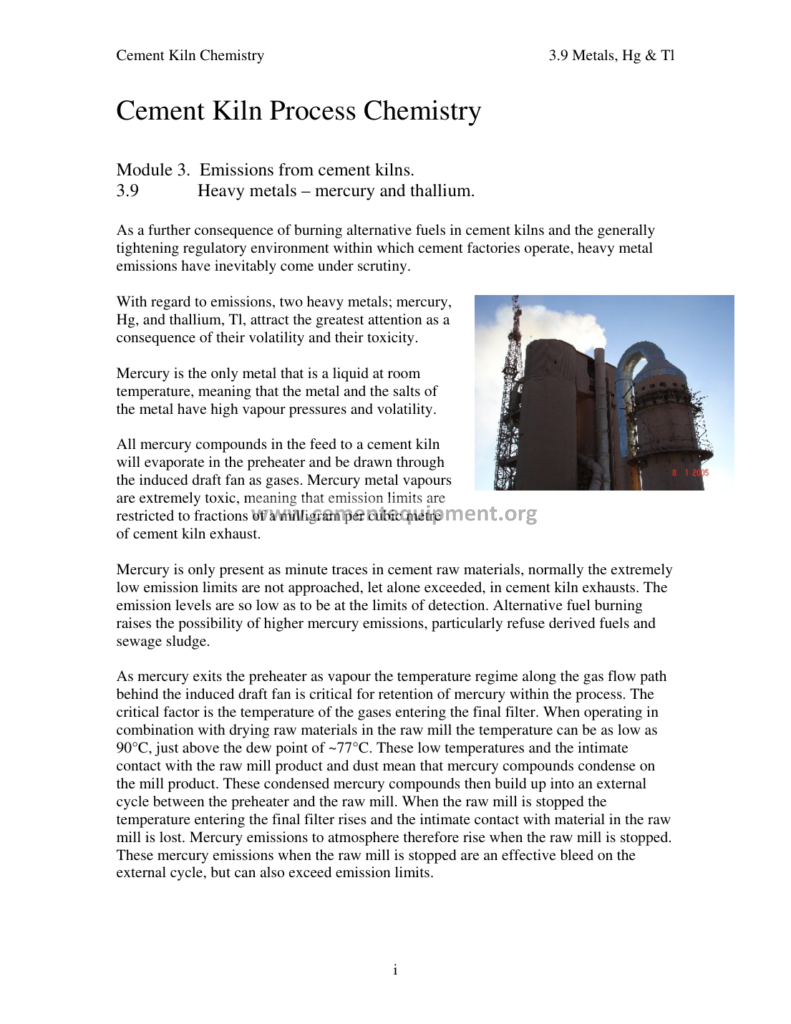
Kc Metals Hg And Tl: Complete Technical Guide
Module 3.9 teaches the chemistry of the small concentrations that the permits watch the closest: the trace metals of the cement kiln enter with the raw materials, the fossil fuels and the alternative fuels, and their fate is decided by their volatility at the kiln temperatures: the mercury and the thallium vaporize almost completely in the burning zone and cycle with the gas and the dust, the cadmium, the lead and the zinc vaporize partially and condense onto the fine dust in the cool sections, and the arsenic, the chromium, the cobalt, the nickel and the vanadium stay with the clinker: the module teaches the volatility classes and the partitioning chemistry, the mercury cycle with its elemental and its oxidized forms and the reason the elemental mercury escapes the dust collection, the thallium’s condensation behavior and its dust-bound fate, the emission pathways and the measurement, the 0.05 milligram limits of the waste co-incineration frame, and the control toolbox of the activated carbon injection, the wet scrubbing and the dust bleed strategies, closing with the plant practice of the fuel screening and the mass balance discipline that the metals demand.
The Complete Cement Technical Package (931 files including the books, the courses, the Excel tools and the presentations: $249.99 one-time: instant download via the PayPal payment) includes this course module with the metal balance sheets, the mercury monitoring notes and the dust management checklists: the same package that carries the raw material assessment books, the alternative fuel documents and the environmental analysis files: this article walks the module: the reader finishes it able to classify any trace element by its volatility behavior, to build the metal mass balance of the plant, to explain the mercury escape to the engineers and the authorities, and to design the activated carbon, the scrubber and the dust bleed responses that the permit demands.
The style of the module is the style of the course: the numbers first, the mechanisms second, the plant practice third: the metal story is the story of the small concentrations with the large half-lives, and the module keeps the partition ledger visible throughout, because the metals of the cement kiln are decided by the boiling chemistry, the dust collection and the input ledger, and the plant that manages the three manages the metals.
1. The Trace Metal Inventory: The Inputs of the Small Concentrations
The module opens with the inputs, the ledger of the metals that the permits will count in the milligrams:
- The raw material metals: the limestones, the clays and the additives carry the trace metals of their geology: the lead and the zinc of the mineralized limestone deposits, the arsenic of the pyritic zones, the chromium and the nickel of the ultramafic rocks, the cadmium of the zinc ores, and the mercury of the carbon-bearing layers, the geological fingerprint that the quarry exploration maps before the mining;
- The fuel metals: the fossil fuels carry their shares: the vanadium and the nickel of the petcoke and the heavy fuels, the mercury of the coals, and the trace chromium and the lead of the ashes, with the fuel analyses adding the metals to the purchasing specifications;
- The alternative fuel metals: the waste-derived fuels concentrate the metals of the industrial society: the lead and the zinc of the coatings and the plastics, the chromium and the nickel of the leather and the metal residues, the cadmium of the batteries and the sludges, and the mercury of the laboratory and the industrial wastes, the metals that make the waste fuel handling a metal management discipline;
- The magnitude scale: the metal inputs run in the small concentrations: the ordinary plants see the lead and the zinc in the tens to the hundreds of milligrams per kilogram of the clinker, the cadmium in the single digits, the mercury in the fractions of a milligram per tonne, the trace scale that the module keeps visible because the limits of the section 10 live at the same order;
- The input control logic: the module teaches the input-control logic that runs through the whole module: the metals that the quarry and the fuel yard admit are the metals that the plant must partition, so the raw material selection, the fuel specifications and the alternative fuel screening are the first instruments of the metal control, the same three-door discipline that the module 3.1 taught for the whole pollutant family;
The inventory gives the module its starting ledger: the trace metals enter with the stones, the fuels and the wastes, each with its geological or its industrial fingerprint, and the reader learns to read the input analyses as the metal forecast of the plant, the forecast that the volatility chemistry of the next sections will turn into the emission prediction.
2. The Volatility Classes: The Master Key of the Metal Chemistry
The fate of every metal is decided by its vapor pressure at the kiln temperatures, and the module teaches the classification:
- The three classes: the trace elements of the kiln sort into the three families by their volatility: the volatile elements of the mercury and the thallium that vaporize almost completely in the burning zone, the semi-volatile elements of the cadmium, the lead and the zinc that vaporize partially and condense in the cool sections, and the low-volatility elements of the arsenic, the beryllium, the chromium, the cobalt, the copper, the nickel and the vanadium that remain largely in the clinker;
- The volatility mechanism: the classification follows the boiling and the decomposition chemistry: the mercury metal and its compounds evaporate below the 400 degrees, the thallium oxide and the chloride sublimate at the moderate temperatures, the lead and the cadmium oxides and the chlorides vaporize at the 800 to 1,100 degree ranges of the burning zone, and the refractory oxides of the chromium and the nickel stay with the melt chemistry;
- The chlorine and the compound effects: the chloride chemistry shifts the volatility: the metal chlorides are far more volatile than the oxides, so the chlorine-rich gas paths of the alternative fuel plants volatilize the lead, the cadmium and the zinc more strongly, the interaction that the module teaches with the chloride cycle of the module 1;
- The condensation and the recycle: the semi-volatile metals vaporize in the burning zone, condense onto the dust when the gas cools below their condensation temperatures in the preheater, and return with the dust into the kiln, the cycle that concentrates the semi-volatile metals in the circulating dust, the cycle behavior that the module teaches as the key of the metal management;
- The destination split: the classification decides the destinations: the low-volatile metals leave with the clinker, the semi-volatile split between the dust bleeds and the clinker, and the volatile mercury and the thallium reach the dust, the by-products and the gas, the destination map that the following sections will quantify for each family;
The volatility classification is the master key of the whole module: one glance at the boiling chemistry of an element tells the engineer whether it will leave with the clinker, the dust or the gas, and the reader learns to apply the classification to every metal of the periodic table that the input analyses report, the habit that gives the module its predictive power.
3. The Semi-Volatile Metals: The Cadmium, the Lead and the Zinc Cycles
The middle family carries the largest input masses, and the module teaches their cycling chemistry:
- The vaporization in the burning zone: the lead and the cadmium compounds vaporize in the 1,200 to 1,500 degree burning zone: the oxide and the chloride forms enter the gas, and the zinc follows at the higher temperature end, the vaporization shares of the order of 50 to 90 percent for the lead and the cadmium in the chlorine-bearing atmospheres;
- The condensation in the tower: the vapor condenses when the gas cools: the lead and the cadmium condense predominantly between the 700 and the 500 degrees, coating the dust surfaces of the lower and the middle preheater stages with the fine metal-rich layers, the condensation that the module teaches with the same temperature-window thinking as the dioxin module 3.4;
- The enrichment pattern: the condensation concentrates the metals in the fine fractions: the coarse dust of the lower stages carries the low enrichment and the fine cyclone dust of the upper stages the high, with the enrichment factors of the lead and the cadmium of the order of 2 to 10 times the raw meal levels, the pattern that the dust sampling and the cyclone management follow;
- The recycle and the bleed: the condensed metals return with the dust into the kiln and the calciner: the recirculated semi-volatile metals re-vaporize and re-condense, building the internal cycle, and the plant breaks the cycle by bleeding the metal-rich dust out of the system, the dust bleed being the semi-volatile metals’ only true removal route besides the clinker;
- The clinker share: the fraction of the lead and the zinc that the clinker melt absorbs leaves with the product: the clinker captures the order of 40 to 70 percent of the lead and the zinc inputs in the ordinary plants, with the balance carried by the dust bleeds and the stack, the split that the metal balance of the section 11 quantifies for the plant;
The semi-volatile family gives the module its middle chapter: the cadmium, the lead and the zinc vaporize, condense, enrich and recycle, and the reader learns to read the dust analyses of the tower as the metal enrichment map and the dust bleed as the removal valve, the two views that the operating practice of the plant applies to the middle metals every day.
4. The Low-Volatility Metals: The Arsenic, the Chromium, the Nickel and the Vanadium
The refractory family stays with the product, and the module teaches the least dramatic but still regulated metals:
- The clinker incorporation: the low-volatility metals largely remain in the solid: the chromium, the nickel, the vanadium, the cobalt and the beryllium partition into the clinker melt and the mineral phases at the burning zone temperatures, leaving with the product as the trace constituents of the clinker, the incorporation that the quality department sees in the clinker analyses;
- The arsenic exception: the arsenic behaves at the edge: the arsenic oxide vaporizes partially at the burning conditions, condenses in the tower and enriches the dust, so the arsenic sits between the classes in the cement practice, and the module teaches the reader to treat the arsenic as the semi-volatile in the moderate-temperature ranges with its analyses to confirm the plant’s own split;
- The pathway to the stack: the low-volatility metals reach the stack mainly as the fine dust: the portion that aerosolizes with the dust enters the gas stream and is captured by the dust collection, so the stack emission of the refractory metals scales with the dust collection efficiency of the plant, the connection that makes the filter performance the metals’ emission control;
- The fuel sourcing effects: the low-volatility metals follow the fuel choices: the vanadium and the nickel of the petcoke enter the clinker and can color the special products, and the module teaches the sourcing specifications that the niche questions, the white clinker and the special cements, impose on the fuel selection;
- The measurement consequence: the low-volatility metals are measured in the stack as the sum of the particulate and the vapor shares: the sampling trains collect the dust-bound metals with the filter and the vapor shares with the impingers, the split accounting that the section 8 will teach with the pathways, the discipline that keeps the arsenic-style metals honest in the reports;
The low-volatility family completes the classification with its quiet majority: most of the trace metals of the kiln end in the clinker and the cement, where they belong to the product chemistry rather than the emission debate, and the reader learns to recognize the refractory family at a glance, to flag the arsenic-style edge cases and to connect the stack metals of this family directly to the dust collection performance of the plant.
5. The Mercury Chemistry: The Elemental and the Oxidized Forms
The most discussed trace metal of the cement kiln has the most complex chemistry, and the module teaches the mercury behavior:
- The total volatility: the mercury is the most volatile element of the kiln system: the mercury metal boils at 357 degrees and its compounds decompose at the low temperatures, so the mercury entering the burning zone vaporizes completely, and the module teaches the reader to treat the mercury as the eternal traveler of the gas path;
- The two forms: the gas-phase mercury rides in the two oxidation states: the elemental mercury vapor, the Hg0, that defies the chemical capture, and the oxidized mercury, the Hg2+, that forms by the reactions with the chlorine, the oxygen and the surfaces and that behaves as the water-soluble and the dust-capturable species;
- The oxidation chemistry: the elemental mercury oxidizes through the reactions with the chlorine atoms and the hydrogen chloride at the moderate temperatures, and the catalytic dust surfaces accelerate the oxidation, so the chlorine content of the fuel and the raw material and the dust residence decide the oxidized share, the share that the control the equipment can catch;
- The phase distribution: the oxidized mercury condenses and adsorbs onto the dust and the surfaces in the cool sections, so the distribution of the mercury between the vapor and the particle phases shifts with the temperature, the dust surface and the residence, the distribution that the module teaches the reader to sample rather than to assume;
- The fate asymmetry: the fate asymmetry decides the emission: the oxidized mercury falls with the dust into the collection and the recycle, while the elemental mercury vapor sails through the bag filters and the precipitators, so the stack mercury emission is written by the share of the element that remains elemental at the stack conditions, the asymmetry that explains why the mercury escapes where the other metals are captured;
The mercury chemistry is the heart of the module: the element’s two forms, its oxidation chemistry and its capture asymmetry explain the mercury’s unique escape behavior, and the reader learns the elemental-versus-oxidized ledger as the key of the mercury story, the ledger that the measurement and the control sections will operate on.
6. The Mercury Cycle in the Kiln System: The Evaporation and the Re-capture
The mercury does not simply pass through: it cycles, and the module teaches the cycle:
- The evaporation in the hot zones: the mercury of the raw meal and the fuels vaporizes in the burning zone and the calciner, the gas carries the vapor out of the kiln, and the module teaches the near-total volatilization of the mercury inputs in the hot gas path;
- The condensation and the adsorption in the tower: the gas cools through the preheater: the oxidized share condenses and adsorbs onto the meal and the dust, returning with the material into the kiln, where it re-vaporizes, the internal mercury cycle that subjects the mercury input to the repeated evaporation and re-capture circuits;
- The cycle concentration: the cycling concentrates the mercury in the circulating streams: the mercury content of the preheater dust can run several times the input levels, and the module teaches the reader to read the mercury analyses of the process samples as the cycle thermometer, the rising values signaling the growing internal load;
- The equilibrium escape: the cycle holds an equilibrium: the re-evaporated share that escapes the condensation in the cool sections leaves the system with the gas, so the stack mercury emission is the overflow of the internal cycle, the balance between the vaporization on the one hand and the condensation, the adsorption and the dust bleeds on the other;
- The measurement of the cycle: the cycle is measured by the dedicated sampling: the mercury analyses of the raw meal, the kiln inlet dust, the preheater dust, the filter dust and the stack gas, the five-point profile that the module teaches as the mercury balance’s skeleton, the profile that locates the cycle’s strengths and the bleed opportunities;
The mercury cycle section gives the module its system view: the mercury is not an input-output species but a circulating one, and the reader learns to see the kiln and the preheater as the mercury reactor with the reflux, the reactor whose overflow is the stack emission and whose management is the dust bleed and the capture equipment of the later sections.
7. The Thallium: The Volatile Condensation Story
The second volatile element has its own chemistry, and the module teaches the thallium behavior:
- The volatility: the thallium volatilizes in the burning zone, its compounds, the chloride and the oxide, sublimating at the moderate temperatures, so the thallium behaves as the volatile species of the classification, entering the gas with the mercury family;
- The condensation behavior: the thallium condenses from the gas at the higher temperatures than the mercury: the thallium compounds deposit in the middle parts of the preheater and on the kiln inlet surfaces, so the thallium enriches the kiln dust and the preheater deposits rather than reaching the stack in the vapor form, the condensation pattern that the module teaches as the thallium’s signature;
- The enrichment extremes: the thallium enrichment in the circulating dust can reach the extreme levels: the enrichment factors of the thallium in the kiln dust run the orders of magnitude higher than the input concentrations, making the kiln dust the thallium repository of the plant, and the module teaches the reader to treat the thallium-enriched dust as the material of the dedicated handling and disposal;
- The stack share: the stack thallium emission rides on the fine dust and the condensed aerosols: the well-collected plants emit the thallium in the fractions of the milligram per normal cubic meter, and the module teaches the coupling of the thallium emission to the dust collection and the gas temperature discipline;
- The measurement and the reporting: the thallium is measured with the other metals in the stack sampling and is reported in the permitted group with the cadmium: the cadmium-plus-thallium sum of the section 10, the reporting pair that the module teaches the reader to carry in the same column of the emission report;
The thallium section completes the volatile family: the thallium travels with the mercury but condenses earlier, enriching the dust instead of escaping the vapor, and the reader learns to read the thallium as the dust-side volatile element, the element whose management is the dust handling and the bleed discipline rather than the vapor capture, the distinction that the plant practice of the section 12 applies.
8. The Emission Pathways: The Gas, the Dust and the Measurement
The metals leave the stack through the specific pathways, and the module teaches the routes and their sampling:
- The particle pathway: the majority of the stack metals travel as the fine particles: the metals condensed and adsorbed on the sub-micron dust fractions that the gas carries to the filter, and the stack emission of the particle pathway equals the metal content of the escaped dust, the reason the dust collection efficiency of the order of 99.9 percent is the metal control’s first instrument;
- The vapor pathway: the elemental mercury and the volatile traces travel as the true vapor: the elemental mercury resists the condensation and the filtration, the vapor pathway that the filters cannot touch, and the module teaches the reader to attribute the stack mercury between the particle and the vapor pathways with the speciation sampling;
- The sampling trains: the stack metal measurement runs the standard sampling trains: the isokinetic probe and the filter capture the particle metals, the impinger trains and the adsorption sections capture the vapor mercury, and the laboratory analysis by the atomic absorption or the ICP quantifies the individual metals with the detection limits in the microgram ranges;
- The mercury monitoring: the mercury gets the continuous attention: the modern plants run the continuous mercury monitors at the stack with the cold-vapor atomic absorption analyzers, the instruments that follow the mercury trend hour by hour, complementing the periodic manual campaigns of the other metals;
- The reporting units and the conditions: the metal concentrations are reported in the milligrams per normal cubic meter at the reference conditions, with the vapor and the particle shares summed for the compliance comparison, and the module teaches the reporting arithmetic that the section 10 limits are read against;
The emission pathways give the module its measurement map: the particle pathway with its dust-coupled metals, the vapor pathway with its elemental mercury, and the sampling trains that separate the two, and the reader learns to read the stack metal numbers as the sums of the two routes, the attribution that decides which control, the dust collection or the vapor capture, the plant must strengthen.
9. The Measurement Practice: The Balances and the Campaigns
The metals demand the mass balance culture, and the module teaches the measurement program:
- The metal balance structure: the monthly and the quarterly metal balances account the inputs and the outputs: the raw material, the fuel and the alternative fuel inputs against the clinker, the dust bleeds, the by-products and the measured stack emissions, the six-stream ledger that the module teaches with the sampling plan for each stream;
- The closure discipline: the metal balance closure validates the measurements: the closures of the lead and the zinc within the 80 to 120 percent bands in the well-run plants, the mercury closures the more irregular with its cycling, and the closure residuals exposing the unmeasured streams and the analytical gaps, the discipline that the module teaches as the metals’ evidence culture;
- The sampling frequencies: the metals are measured on the strategic cadences: the raw material and the fuel samples with every delivery, the clinker and the dust with the daily quality work, the stack metals with the quarterly or the half-yearly campaigns, and the mercury with the continuous monitors where the permit demands, the cadence that the section 12 develops into the plant program;
- The congener and the speciation work: the hexavalent chromium and the mercury speciation require the dedicated analytical routes: the hexavalent chromium determination of the cement and the dust for the product and the occupational questions, and the elemental-versus-oxidized mercury speciation for the capture engineering, the specialized work that the module assigns to the accredited laboratories;
- The data integration: the metal data integrate with the process trends: the mercury cycle rises with the alternative fuel loads, the cadmium and the lead enrich with the chloride cycles, and the module teaches the correlation practice that turns the metal databases into the operating intelligence of the plant;
The measurement practice gives the module its numbers: the six-stream balances, the closure bands and the sampling cadences convert the metal chemistry into the documented ledger, and the reader leaves the section able to run the metal measurements of a plant with the same rigor that the course has taught for the gas emissions, the rigor that the permit audits and the public debates both reward.
10. The Limits: The 0.05 Milligrams and the Regulatory Frame
The trace metals meet the law at the milligram level, and the module teaches the limit landscape:
- The waste co-incineration values: the European frame that the waste co-processing plants hold sets the metals limits: the mercury at 0.05 milligrams per normal cubic meter, the cadmium plus the thallium at 0.05, and the sum of the other metals, the antimony, the arsenic, the lead, the chromium, the cobalt, the copper, the manganese, the nickel and the vanadium, at 0.5 milligrams, the values of the waste incineration family applied to the co-incineration cement kilns;
- The cement-sector reality: the cement kilns burning only the fossil fuels operate under the BAT conclusions and the regional frames with the metals levels of the same order: the ordinary well-run plants measure their stack metals in the fractions of the milligram, well below the 0.05 and the 0.5 limits, and the module teaches the reader to read the own permit table rather than the generic values;
- The American frame: the United States cement rule carries its mercury limit in the load-based units: the federal MACT mercury value of the order of tens of pounds per million tons of the clinker, converted to the concentration equivalents in the fractions of the milligram per normal cubic meter, the frame that the module teaches with the conversion practice;
- The compliance strategy: the compliance against the metal limits is won by the margins: the ordinary plants run at a fraction of the limits, the margin protecting against the fuel changes and the cycle variations, and the module teaches the margin-demonstration practice of the regular campaigns and the quarterly trend reviews;
- The exceedance response: the exceedances trace to the identifiable causes: the mercury rises with the mercury-bearing alternative fuels and the cycle upsets, the cadmium and the lead with the chloride-rich wastes, and the module teaches the response ladder of the section 12, the inputs, the bleeds and the capture systems, that returns the plant into the compliance;
The limit landscape fixes the metal targets: the 0.05 milligrams of the mercury and the cadmium-plus-thallium and the 0.5 of the metals sum are the numbers that the input screening, the dust bleeds and the capture equipment serve, and the reader leaves the section knowing the legal frame of the metals as precisely as the chemistry of their formation.
11. The Activated Carbon Injection: The Mercury Capture Chemistry
The vapor pathway meets its dedicated control, and the module teaches the carbon chemistry:
- The adsorption principle: the activated carbon presents the vast internal surface of the order of 1,000 square meters per gram: the mercury vapor adsorbs onto the carbon surfaces by the physical and the chemical binding, and the injected carbon carries the mercury to the filter with the dust, the same technology family as the dioxin control of the module 3.4;
- The halogenated carbon: the oxidized mercury captures efficiently on the plain carbon, while the elemental mercury needs the promoted surfaces: the halogen-impregnated carbons, the brominated and the chlorinated grades, oxidize and bind the elemental mercury, the promotion that lifts the capture of the vapor pathway to the 70 to 95 percent ranges;
- The injection operation: the carbon is injected into the gas path upstream of the bag filter at the rates of the order of tens to hundreds of milligrams per normal cubic meter: the carbon mixes, adsorbs during the duct dwell, and is collected on the bags, where the carbon layer continues the adsorption duty, the injection practice shared with the dioxin control of the previous module;
- The performance numbers: the carbon injection plus the filtration removes the mercury with the efficiencies of the order of 50 to 95 percent depending on the gas temperature, the speciation and the carbon dose: the plants with the low elemental shares reach the upper band, and the module teaches the reader to evaluate the expected removal from the plant’s own speciation data;
- The operating trade-offs: the carbon injection adds the operational costs: the carbon price, the dust load and the handling of the mercury-laden filter dust that must leave the process rather than the recycle, and the module teaches the economics against the mercury limit, the dose optimization and the dust disposal routes that the mercury plant runs;
The carbon section gives the module its vapor-capture instrument: the adsorption chemistry of the promoted carbon catches the elemental mercury that the filters cannot, and the reader learns the dose, the speciation dependence and the handling economics of the carbon route, the instrument that carries the mercury-troubled plants into the 0.05 milligram compliance.
12. The Wet Scrubbing and the Comprehensive Metal Controls
Beyond the carbon, the metals answer to the wet-end and the system-level controls, and the module teaches the full toolbox:
- The mercury wet scrubbing: the wet scrubbers of the module 3.7 carry the metals duty: the oxidized mercury dissolves into the slurry and is stabilized by the precipitating reagents, the precipitants binding the dissolved mercury into the insoluble compounds that the wastewater treatment removes, the wet route that the plants with the deep mercury cuts install;
- The dust bleed strategy: the semi-volatile metals answer to the dust bleeds: the metal-rich dust is extracted from the system at the cyclone and the filter points, reducing the cycle concentrations and the enrichment, and the module teaches the bleed placement, the ratios and the disposal that write the lead and the cadmium balances of the plant;
- The bypass and the cycle management: the kiln gas bypass and the tower management shape the cycle: the bypass of the alkali and the chloride cycles of the module 1 extracts the volatile-rich gas and the dust shares, and the reader learns to see the bypass as the metal valve as well, the system levers that the metal plant holds;
- The temperature management: the gas temperature discipline steers the condensation: the quench and the filter temperature choices set where the metals condense and how the dust and the vapor split, and the module teaches the temperature-logic of the metals that the modules 3.4 and 3.8 have taught for the dioxins and the plumes;
- The integrated strategy: the comprehensive metal control is the combination: the input screening on the one hand, the cycle and the bleed management in the middle, and the carbon and the scrubber capture at the end, the integrated strategy that the module presents as the plant-level answer to the metal chemistry of the first nine sections;
The comprehensive controls complete the module’s toolbox: the metals of the kiln answer to the input, the cycle, the bleed and the capture instruments together, and the reader leaves the section able to compose the plant’s metal strategy from the screening through the dust management to the carbon and the scrubber equipment, the composition skill that the final practice section will run as the daily program.
13. The Plant Practice: The Metal Management Program
The module closes with the operating program that holds the metals inside their numbers:
- The input screening routine: the raw material and the fuel deliveries are screened against the metal specifications: the high-mercury coal lots, the lead-rich waste fractions and the cadmium-bearing sludges are flagged and proportioned with the doses that the balance accepts, the routine that keeps the metal inputs inside the plant’s handling capacity;
- The cycle and the balance cadence: the monthly metal balances and the quarterly cycle reviews follow the section 9 structure: the dust and the clinker analyses, the bleed records and the stack campaigns, the cadence that turns the metal data into the trend charts that the operating and the quality teams both read;
- The equipment care: the carbon injection systems, the scrubbers and the dust handling follow their maintenance: the carbon feed calibration, the scrubber slurry control and the bleed conveying, the care that holds the removal numbers of the sections 11 and 12 at their design performance;
- The limit response: the rising metal values trigger the response ladder: the input screening intensifies, the bleed rates raise, the carbon dose increases, and the investigations follow the cycle and the condensation traces, the ladder that the module teaches as the written protocol of the metal-troubled day;
- The reporting and the improvement cycle: the metal reports join the emission summaries: the stack campaign results, the exceedance analyses, the balance closures and the equipment upgrade priorities, the cycle that keeps the metal story of the plant documented, predictable and continuously improved, the discipline that closes the module 3.9 with the same evidence culture as the whole course;
The plant practice converts the module into the running program: the metals of the cement kiln are managed by the input screening, the cycle and the balance cadence, the equipment care and the limit response, and the reader who runs the program holds the trace metal story of the plant, from the quarry and the fuel yard through the cycles and the bleeds to the stack, inside the numbers of the balance and the permit.
The Frequently Asked Questions
Why does the mercury escape the dust collection while the other metals do not?
Because the mercury rides in the two forms: the oxidized mercury condenses and is captured with the dust, while the elemental mercury vapor resists the condensation and the filtration entirely, so the stack mercury emission is written by the elemental share at the stack conditions, the share that depends on the chlorine chemistry, the temperatures and the dust surfaces of the plant.
Which metals of the cement kiln end up in the clinker rather than in the emissions?
The low-volatility family: the chromium, the nickel, the vanadium, the cobalt and the beryllium partition into the clinker melt and the mineral phases at the burning temperatures and leave with the product, while the semi-volatile lead, the zinc and the cadmium split between the clinker and the dust, and the volatile mercury and the thallium ride the gas and the dust paths.
What are the metal limits of the cement kilns co-processing the wastes?
The European frame sets the mercury at 0.05 milligrams per normal cubic meter, the cadmium plus the thallium at 0.05 and the sum of the other metals at 0.5 milligrams, with the American mercury rule expressed in the load-based units of the order of tens of pounds per million tons of clinker, and the ordinary well-run plants measuring well below the values.
How does the activated carbon remove the elemental mercury?
Through the promoted adsorption: the halogen-impregnated carbon grades oxidize and bind the elemental mercury on their internal surfaces of the order of 1,000 square meters per gram, and the injected carbon carries the mercury to the bag filter with the dust, achieving the elemental-mercury removals of the order of 50 to 95 percent depending on the dose and the speciation.
Why does the thallium concentrate in the kiln dust?
Because the thallium volatilizes in the burning zone but condenses at the higher temperatures than the mercury: its compounds deposit in the middle preheater and on the kiln inlet, enriching the circulating dust by the orders of magnitude above the input levels, which is why the thallium-enriched dust requires the dedicated handling and the bleed management.
How can the plant lower its metal emissions without the new equipment?
Through the input and the cycle management: the raw material and the fuel screening admit fewer metals, the dust bleed extracts the metal-rich fractions and lowers the cycle enrichments, and the stable temperatures and the chlorine control shift the speciation toward the captured forms, the measures that write the metal baseline before the carbon and the scrubber equipment are considered.
The module 3.9 has taught the complete trace metal chemistry of the cement kiln: the input ledger of the raw materials, the fuels and the wastes, the volatility classes that decide the fate of every element, the semi-volatile cycles of the lead, the cadmium and the zinc, the clinker-bound low-volatility family, the mercury’s elemental and oxidized forms with its cycle and its escape, the thallium’s condensation, the emission pathways and the measurement, the 0.05 milligram limits and the activated carbon, the scrubber and the dust bleed controls, and the reader leaves able to classify, balance, measure and manage the metals of any plant with the same precision that the module has taught throughout.
The Complete Cement Technical Package includes this course with the metal balance sheets, the mercury monitoring notes and the dust management checklists: the one-time 249.99: the instant download: the metals module carries the small concentrations with the large regulatory weight, and the reader now owns the full instrument set, the volatility classes, the cycle logic, the carbon and the scrubber numbers, that keeps the 0.05 milligram columns of the report inside the permit.
The module closes with the operating truth of the metal chemistry: the trace metals of the kiln are decided by the boiling temperatures, the chlorine and the dust, the inputs that the quarry and the fuel yard admit, the cycles that the tower and the dust manage, and the elemental mercury that only the chemistry controls, so the plant that reads its own metal balance holds the small-concentration story of its emissions in its own hands.
The reading plan for the engineer: run the monthly metal balance, keep the cycle and the enrichment charts current, screen the fuel and the waste deliveries against the metal specifications, and schedule the stack campaigns and the mercury monitoring against the permit cadence, because the metal story of the module 3.9 is measured in the milligrams and managed by the balance, and the reader now knows both.
Get this kiln chemistry file + the full 931-file package
$249.99 — one-time purchase, instant download, lifetime access
This file is part of the Complete Cement Technical Package (931 files) available from cementequipment.org. Respective rights holders; library copy for the licensed single user.