Kiln Chemistry Course 3: Plumes Module
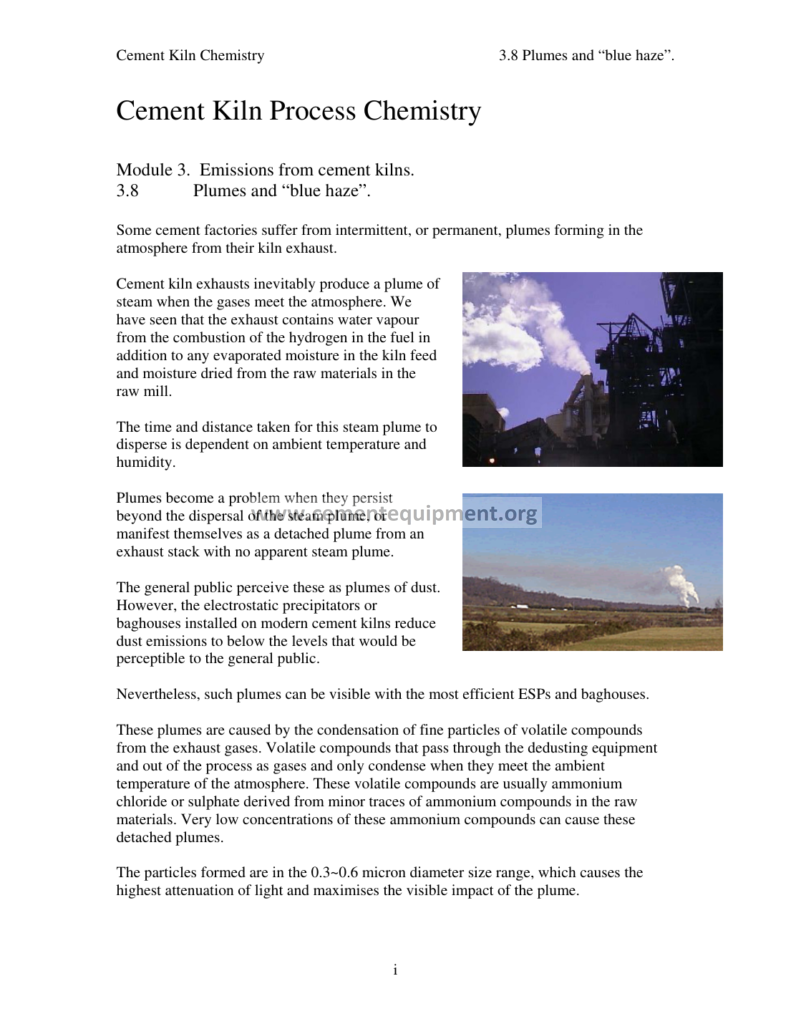
Module 3.8 teaches the physics and the chemistry of what the neighbors see: the visible plume of the cement kiln stack is the meeting point of the flue gas physics and the atmospheric optics: the white plume that condenses from the water vapor in the cold and the humid air, the blue plume that the sulfur trioxide and the ammonia slip build into the sub-micron sulfate aerosols, the brown tint that the nitrogen dioxide adds under the sun, and the grey and the black casts of the dust and the soot events, each with its own formation chemistry, its opacity numbers and its mitigation path: the module teaches the condensation and the nucleation physics of the white plume, the Rayleigh and the Mie scattering optics that give the plumes their colors, the opacity measurement of the Method 9 and the in-stack monitors with the 10 to 20 percent limits, the Gaussian dispersion and the plume rise of the stack design, and the mitigation toolbox that takes the visible plume from the neighborhood complaint to the invisible compliance, closing with the honest message that the visible plume is not always the pollutant mass and the pollutant mass is not always visible.
The Complete Cement Technical Package (931 files including the books, the courses, the Excel tools and the presentations: $249.99 one-time: instant download via the PayPal payment) includes this course module with the plume observation checklists, the opacity calculation tools and the dispersion reference sheets: the same package that carries the gas analysis and the combustion books, the fan and the stack engineering files and the environmental documents: this article walks the module: the reader finishes it able to identify the plume chemistry from its color and its weather, to run the opacity observations and to correlate them with the process, to explain the condensation and the scattering physics to the neighborhood and the inspectors, and to compose the mitigation strategy that the plume type and the permit together demand.
The style of the module is the style of the course: the numbers first, the mechanisms second, the plant practice third: the plume story is the story of the light and the water, the sulfur and the ammonia meeting in the boundary layer between the stack and the sky, and the module keeps the physics visible throughout, because the plume debate is won by the honest physics, not by the moods.
1. What the Plume Is: The Visible Signature of the Stack
The module opens by defining the object of the study, the visible signature that the stack writes on the sky:
- The plume definition: the plume is the visible body of the stack gas as it enters the atmosphere and mixes with the air: the gas itself is largely invisible, and the visibility comes from the particles: the condensed water droplets, the dust, the salt aerosols and the soot that scatter and absorb the light, so the plume is the particle physics of the emissions made visible;
- The plume families: the plumes of the cement kiln sort into the classic families: the white steam plume of the condensed water vapor, the blue and the brown plumes of the sub-micron sulfate and the nitrogen dioxide chemistry, the grey plume of the dust, and the black plume of the soot and the upset events, each family with its own chemistry and its own optics;
- The visibility and the mass disconnect: the module teaches the first honest lesson: the visibility of a plume does not measure its pollutant mass, because a kilogram of the condensed water vapor is highly visible and harmless while the invisible gases of the permit can carry the real loads, and the reverse, the visible black smoke of the upset can be small in mass and large in impact, so the engineer keeps the two accounts separate;
- The perception reality: the plume is the public face of the plant: the neighbors read the plume as the pollution meter, the inspectors read it as the compliance motor, and the module teaches the reader to read the plume with the same trained eye that both audiences use, because the plume observation is the oldest emission monitoring instrument of the industry;
- The modern tool view: the modern plants add the cameras, the opacity monitors and the meteorological stations to the trained eye: the digital plume observations, the video archives and the opacity telemetry document the visible emissions with the dates and the times, the modern evidence chain that the module presents alongside the classical methods;
The definition frames the module: the plume is the particle optics of the emission system, the visible layer between the stack and the atmosphere, and the reader learns to see it as the physics and the chemistry to be explained rather than the impression to be managed, the frame that every later section of the module applies.
2. The Water Vapor Plume: The White Cloud of the Condensation
The most common cement plume is the white one, and the module teaches the water chemistry behind it:
- The water vapor load: the flue gas of the cement kiln carries the water vapor of the combustion and the raw material moisture: the water shares of the order of 5 to 15 percent by volume of the gas, the exact figure set by the fuel hydrogen, the raw material moisture and the gas cleaning additions;
- The saturation and the dew point: the vapor stays invisible while the gas is warm: the stack gas leaves at the 90 to 150 degrees of the filter and the stack sections, well above its water dew point, and the vapor condenses only when the gas cools below the dew point during the mixing with the cold ambient air;
- The condensation in the plume: the mixing with the cold air cools the gas below its dew point: the vapor condenses into the fine water droplets of the 1 to 20 microns, the droplets that scatter the light and give the plume its white appearance, the same physics as the breath fog of the cold winter morning;
- The weather dependence: the white plume appears when the ambient air is cold and humid: the deep winter mornings with the near-saturated air produce the long, dense white plumes and the summer dry days almost none, so the visible plume of the plant is as much a weather report as an emission report, the lesson the module teaches with the dew point arithmetic;
- The harmless chemistry: the white plume is condensed water: its chemistry carries the dissolved traces of the sulfates and the chlorides, the dissolved salts of the order of the parts per million, but its mass is the water, and the module teaches the reader the honest distinction between the water plume of the winter morning and the pollutant plumes of the following sections;
The white plume section gives the module its most common subject: the condensed water vapor that the neighbors see on the cold mornings is the atmospheric optics of the ordinary humidity, and the reader learns the dew point and the cooling physics that decide its appearance, the physics that the mitigation section will use to reduce the visibility without changing the mass of the emissions at all.
3. The Plume Optics: The Nucleation and the Light Scattering
The colors of the plumes come from the particle sizes and the light, and the module teaches the optics:
- The nucleation physics: the condensation does not start from nothing: the vapor needs the nuclei, the particles and the ions around which the droplets grow, so the dust of the gas provides the condensation nuclei and the plume droplet formation rides on the particle load, the coupling that makes the cleaner gas produce the finer and the less visible droplets;
- The Rayleigh scattering: the particles much smaller than the wavelength of the light scatter the blue light more than the red: the blue sky and the blue plumes both come from the Rayleigh mechanism, and the sub-micron aerosol plumes of the sulfate chemistry appear blueish, the optics that the section 5 will use;
- The Mie scattering: the particles of the size comparable to the light wavelength, the water droplets of the 1 to 20 microns, scatter all the colors evenly: the white appearance of the fog and the steam plumes comes from the Mie scattering of the micron-sized droplets, the optics of the white plume of the section 2;
- The absorption and the extinction: the black and the grey casts come from the light absorption: the soot and the dark dust absorb the light across the spectrum, darkening the plume behind them, and the total obscuration, the extinction, is the sum of the scattering and the absorption that the opacity monitors of the section 4 measure;
- The color reading practice: the module teaches the color-reading discipline: the white plume in the cold weather means the water condensation, the bluish tint means the sub-micron sulfates, the brown tint means the NO2 under the sun, and the grey means the dust, the color sequence that the trained observer reads against the light background of the sky;
The optics section gives the reader the eyes of the module: the particle sizes decide the colors through the Rayleigh and the Mie scattering, the nuclei decide the droplet growth, and the absorption decides the darkness, so the plume appearance is the readable book of the particle size distribution of the emissions, and the reader learns to read the colors with the physics rather than the impressions.
4. The Opacity Measurement: The Numbers of the Visibility
The plume visibility meets the measurement, and the module teaches the opacity practice:
- The definition of the opacity: the opacity is the percent of the light that the plume blocks: zero percent is the clear sky and one hundred percent the total obstruction, and the classic measurements hold the plume opacities below the 10 to 20 percent limits depending on the jurisdiction and the equipment;
- The Method 9 observation: the classical American method trains the certified observers: the plume is viewed against the sky at the prescribed angles and times, the opacity is estimated in the six-minute blocks by the trained eye, and the readings are documented with the time, the location and the sky background, the method that the inspectors and the industry share;
- The in-stack monitors: the modern plants add the transmissometers and the light-scattering monitors in the stack: the 5 to 10 percent in-stack opacity readings correlate with the visible plume through the dilution and the condensation corrections, and the module teaches the correlation limits: the in-stack opacity measures the dust of the clean stack gas while the plume opacity adds the condensed droplet layers;
- The limits and the compliance: the opacity permits run the 10 to 20 percent values for the cement kilns with the continuous monitoring, with the startup and the upset exceptions with the time limits, and the module teaches the averaging and the exceedance arithmetic that the plants apply to the opacity telemetry;
- The measurement honesty: the module teaches the honest limits of the opacity: the moisture plumes of the section 2 can read as the opacity without the dust, and the clean white plumes can obscure the true low-dust state, so the plants correlate the opacity with the dust measurements and the meteorological data, the correlation that separates the water from the pollutants in the reports;
The measurement section gives the module its numbers: the opacity percent, the Method 9 blocks and the in-stack monitors write the visible emissions into the permit language, and the reader learns to run the observations, to read the telemetry and to explain the difference between the water plume and the dust plume in the language of the light.
5. The Blue and the Brown Plumes: The Sulfate and the NO2 Chemistry
The colored plumes carry the chemistry of the pollutants, and the module teaches their mechanisms:
- The blue plume of the sulfate aerosols: the sulfur trioxide of the module 3.7 condenses with the water into the sulfuric acid mist, and the acid mist neutralizes partly with the ammonia slip of the module 3.6 into the ammonium sulfate and the ammonium bisulfate: the sub-micron aerosol products scatter the blue light through the Rayleigh mechanism, the blue haze that the sulfur-plus-ammonia chemistry paints onto the sky;
- The conditions of the blue plume: the blue plume appears where the SO3 and the ammonia meet in the cooling gas: the plants with the SNCR the ammonia slip, the high-sulfur fuels and the moderate gas temperatures are the blue-plume candidates, and the module teaches the reader to read the blue tint as the SO3 and the slip chemistry rather than as the dust;
- The brown plume of the nitrogen dioxide: the nitrogen dioxide absorbs the blue-green light: the NO2 of the gas and the NO oxidized in the plume under the sunlight give the brownish tint, the smog color of the urban chemistry, and the module teaches the NO2 plume optics that the photochemistry of the module 3.5 produces;
- The grey and the black casts: the grey plume of the dust events and the black plume of the soot and the upset combustion complete the color family: the grey readings of the 20 percent plus opacities during the filter failures and the black streaks of the incomplete combustion of the module 3.3, the casts that the color-reading discipline of the section 3 classifies;
- The diagnostic value: the plume color is the first diagnostic of the plant’s chemistry: the blue haze triggers the SO3 and the slip audits, the brown tint the NOx and the oxidant studies, and the grey the filter investigations, the diagnostic chain that the module teaches as the operating value of the trained eye;
The color chemistry section converts the plume into the diagnostic instrument: the blue, the brown, the grey and the black plumes each carry the signature of a specific chemistry of the modules 3.5 to 3.7, and the reader learns to read the stack colors as the first screening of the emission system, the instrument that runs without any analyzer and fails without any warning.
6. The Plume and the Atmospheric Dispersion: The Weather Side
The plume leaves the stack into the moving atmosphere, and the module teaches the dispersion physics:
- The wind advection: the wind carries the plume downwind and dilutes it: the wind speed of the order of 2 to 10 meters per second at the stack levels spreads the plume over the kilometers, and the dispersion models compute the ground-level concentrations that the dilution produces, the Gaussian plume model of the air quality engineering;
- The atmospheric stability: the vertical mixing of the atmosphere depends on the stability: the unstable sunny conditions mix the plume down rapidly, the neutral overcast conditions dilute it steadily, and the stable night and inversion conditions hold the plume flat and concentrated, the stability classes that the dispersion calculations carry;
- The temperature inversions: the winter inversions cap the plume near the ground: the stable layer traps the emissions, the ground-level concentrations rise, and the visible plume extends flat and long, the conditions that the plants watch with the meteorological stations and the permit limit the operations under;
- The plume rise and the stack design: the plume rises above the stack by its momentum and its buoyancy: the exit velocity of the order of 15 to 30 meters per second and the gas heat carry the plume upward, and the stack height of the 60 to 120 meters of the large plants places the emission far above the neighborhood, the design numbers that the section 8 develops;
- The downwash and the building effects: the stack gas can be drawn into the wake of the buildings and the terrain: the downwash behind the plant structures brings the plume to the ground near the fences, and the module teaches the stack placement and the exit velocity practice that avoid the wake capture;
The dispersion section gives the plate’s journey its atmospheric law: the wind, the stability, the inversions and the stack design decide where the plume goes and how diluted it arrives, and the reader learns to read the weather report as the dispersion exposure forecast, the forecast that the plants use to plan the operations and to answer the neighborhood questions about the visible plume of the cold mornings.
7. The Plume Rise and the Stack Engineering
The stack itself is the first dispersion instrument, and the module teaches the stack design numbers:
- The exit velocity: the flue gas exits the stack at the design velocity of the order of 15 to 25 meters per second: the velocity gives the plume its momentum rise and resists the downwash, and the fan and the duct system of the plant delivers the pressure that the velocity demands, the numbers that the stack and the fan engineers share;
- The buoyancy rise: the warm gas is lighter than the air: the buoyancy flux of the 90 to 150 degree stack gas carries the plume upward by the tens of meters beyond the stack top, the rise that the dispersion models compute with the heat content and the wind;
- The stack height: the stack of the cement plant runs the order of 60 to 120 meters: the height multiplies the dispersion distance, and the module teaches the stack-height logic: the taller stack dilutes the ground-level concentrations at the price of the construction and the maintenance, the compromise that the dispersion modeling and the air quality standards settle;
- The material and the acid resistance: the stack internals carry the acid service of the module 3.7: the sulfuric acid condensation and the chloride attack dictate the brick linings, the fiberglass and the coated steel designs, and the module teaches the stack material engineering that the corrosion ledger of the sulfur chemistry demands;
- The monitoring hardware on the stack: the stack top carries the sampling platforms, the CEMS probes and the meteorological sensors: the measurement discipline of the module 3.1 and the plume observation of the section 4 meet on the stack, the physical address of the whole emission story of the part 3;
The stack engineering section completes the hardware frame: the exit velocity, the buoyancy, the height and the acid-resistant materials are the designed instruments of the plume control, and the reader learns to see the stack as the dispersion device that the modules 3.1 to 3.7 fill with their measured streams, the device that delivers the emissions to the atmosphere on the design terms.
8. The Interface with the Emission Monitoring: Opacity, Dust and the CEMS
The plume and the analyzer readings meet at the reporting, and the module teaches the correlation discipline:
- The opacity versus the dust: the in-stack opacity monitors correlate with the dust concentration of the clean gas, but the visible plume opacity adds the water and the aerosol layers, so the module teaches the calibration correlation: the opacity readings against the gravimetric dust samples under the stable conditions, with the water-plume corrections applied before the comparisons;
- The plume and the CEMS channels: the color chemistry of the section 5 correlates with the analyzer channels: the blue haze with the SO3 and the ammonia, the brown tint with the NO2, and the grey with the dust, so the plants keep the plume observations, the process events and the CEMS trends on the same log, the correlation that answers the neighbors’ questions with the analyzer data;
- The cameras and the archives: the digital plume cameras record the continuous visible record: the archive with the time stamps, the weather data and the process logs provides the evidence chain that the inspectors and the complaints both use, and the module teaches the archive practice as the modern replacement of the remember-what-the-plume-looked-like debate;
- The incident correlation: the upset events of the plant write their plume signatures: the coating-fall spikes, the filter failures and the startup windows appear as the grey and the black casts, and the module teaches the plants to correlate every visible event with the process log and the analyzer trends, the correlation that converts the complaint into the documented incident;
- The reporting integration: the opacity and the plume data join the CEMS in the monthly reports: the opacity exceedances, the visible event logs and the meteorological summaries, the reporting frame in which the visible emissions of the plant live alongside the mass emissions of the analyzers;
The interface section unifies the two measurement worlds of the module: the visible plume and the analyzer numbers describe the same stack, and the reader learns to carry the two languages together, the trained eye and the CEMS telemetry, the correlation that makes the plume observation the oldest and the analyzer the newest instruments of the same environmental story.
9. The Mitigation of the White Plume: The Dehumidification and the Reheating
The white plume logistics is the most common neighborhood question, and the module teaches its mitigation:
- The principle: the white plume forms only when the gas cools below its dew point during the mixing, so the visible condensation is reduced by lowering the moisture content or raising the gas temperature above the mixing dew point, the two routes that the plants implement;
- The flue gas dehumidification: the gas-cooling and the condensation trains remove the water from the saturated gas: the flue gas desulfurization scrubbers of the module 3.7 cool and condense the moisture, and the cooled, drier gas mixes without the re-condensation, the combination that the wet-scrubber plants enjoy as a plume benefit;
- The reheating: the dried and the cleaned gas is reheated above its saturation temperature: the reheaters of the induction and the heat-exchange types raise the 50 to 70 degree saturated gas to the 80 to 100 plus degrees, so the mixing with the cold air stays above the condensation threshold, the plume-suppression that the gas cleaning plants of the power world engineered;
- The cement-plant economics: the cement flue gas reaches the stack at the 90 to 150 degrees without the wet scrubbers, so the white plume remains mostly a winter optics question: the plants weigh the dehumidification and the reheating investments against the winter visibility, and the module teaches the honest cost view: the white water plume is the harmless optics, and the deep investments wait for the cases where the permits or the neighborhood force the question;
- The transparent alternative: the module presents the transparent alternative: the education of the neighborhood with the dew point physics, the documented water-only chemistry of the winter plume, and the camera archives that show the identical plumes on the days without the process changes, the communication instrument that often serves the case better than the millions of the dehumidification equipment;
The white plume mitigation gives the module its logistics section: the condensation optics of the water vapor can be engineered away with the dehumidification and the reheating where the cost is justified, and the reader learns to distinguish the harmless water optics from the pollutant chemistry, the distinction that the neighborhood questions and the mitigation budgets both live on.
10. The Mitigation of the Blue and the Colored Plumes: The Chemistry Control
The colored plumes answer only to the chemistry, and the module teaches their mitigation:
- The SO3 control: the blue haze scales with the sulfur trioxide of the gas: the SO3 reductions come from the low-sulfur fuels, the alkali capture in the process, and the wet scrubbing that removes the trioxide with the dioxide, and the module teaches the SO3 ledger as the first lever of the blue plume;
- The ammonia slip control: the blue haze needs the ammonia of the module 3.6: the SNCR and the SCR dosing tightened to the slip minima, the slip target of the order of 5 milligrams and below, and the temperature windows held inside their bands, the ammonia lever that pairs with the sulfur lever in the blue plume chemistry;
- The acid mist and the aerosol capture: the sub-micron acid mist defies the conventional dust collection: the wet scrubbers and the wet electrostatic precipitators catch the condensed acid and the sulfate aerosols, the end-of-pipe instruments that the plants with the persistent blue plumes install;
- The NO2 mitigation: the brown tints follow the NOx chemistry of the module 3.6: the NOx abatement ladder lowers the formation and the NO2 share with it, and the module teaches the reader to read the brown tint as the NOx reminder rather than as a separate pollutant;
- The composite practice: the colored plume mitigation is the composite of the pollutant controls: the sulfur, the ammonia and the nitrogen ledgers of the modules 3.6 and 3.7 pulled together, and the module closes the mitigation section with the design point: the plume colors are the visible meter of the process chemistry, and the chemistry controls of the course are the plume controls, the identity that the whole part 3 has taught;
The color mitigation section ties the plume module back into the whole course: the blue and the brown plumes dissolve where the sulfur, the ammonia and the NOx chemistries of the previous modules are controlled, and the reader learns that the visible colors are not a separate abatement problem but the visible face of the chemistry that the modules 3.5 to 3.7 have already taught, the integration that gives the plume module its place in the course.
11. The Neighborhood and the Perception: The Plume as the Public Interface
The module places the plume in the social reality of the plant, the interface where the physics meets the perception:
- The perception asymmetry: the visible plume of the cold morning is perceived as the pollution regardless of its chemistry: the neighbor trusts the eye over the permit, and the module teaches the plants to take the perception seriously without surrendering the physics, the dual duty of the honest communication;
- The communication practice: the plants answer the plume questions with the evidence: the camera archives matched to the weather data, the dew point explanations and the CEMS records, the transparent communication that converts the mystery into the physics, the practice that the module teaches with the example materials;
- The odor partnership: the plume carries the odor chemistry of the module 3.3: the organic traces and the ammonia of the slips travel with the visible body, and the odor complaints pair with the plume visibility in the neighborhood relations, the partnership that the plants manage with the odor monitoring and the process discipline;
- The regulatory attention: the visible plume triggers the regulatory attention regardless of the analyzer compliance: the opacity limits, the complaint responses and the inspectio visits follow the visible events, so the module teaches the plants to treat the plume prevention as the compliance prevention, the operational discipline of the visible emissions;
- The honest communication frame: the module closes the perception section with the message of the course: the plant that explains the white winter plume with the dew point and the blue haze with the sulfur chemistry owns its story, and the plant that hides behind the compliance numbers loses it, so the plume is the school of the public honesty that the whole part 3 has taught;
The perception section completes the social half of the module: the plume is where the physics of the course meets the eyes of the neighborhood, and the reader learns the dual discipline: the engineering of the visible emissions on the one hand and the transparent communication of the physics on the other, the pair that keeps the plant’s social license alive on the cold winter mornings.
12. The Plume and the Wider Air Quality Chemistry
The module closes in the atmospheric frame, the chemistry that the plume joins after it leaves the camera:
- The secondary aerosol formation: the sulfur dioxide, the nitrogen oxides and the organics of the plume continue their chemistry in the atmosphere: the oxidation into the sulfate and the nitrate aerosols over the hours and the days, the secondary particulate matter that the air quality models attribute to the plant beyond its primary dust, and the module teaches the honest accounting: the plume is the local visible part of the regional aerosol chemistry;
- The photochemistry: the nitrogen oxides and the volatile organics of the modules 3.3 and 3.5 drive the ozone chemistry of the region: the reactions of the sunlight form the photochemical oxidants, and the module places the plant’s contributions in the regional ozone budgets that the air quality plans manage;
- The visibility at the region scale: the regional haze of the industrial areas carries the combined sulfate and nitrate aerosols of many sources, and the cement plume is the local chapter of the regional visibility story, the scale that the module teaches the reader to keep honest in the site-versus-region debates;
- The climate interface: the aerosols carry the climate interactions: the sulfate particles scatter the sunlight and cool, the black carbon warms, and the water of the plume evaporates, the mixed radiative story that the module summarizes without the drama, the one-paragraph climate view that the complete engineer should hold;
- The monitoring partnership: the module closes with the monitoring practice of the wider air quality: the ambient stations, the regional models and the plant’s CEMS together write the regional narrative, and the reader leaves the module able to place the plant’s plume inside that narrative with the same numbers and the same honesty that the whole part 3 has practiced in every module;
The atmospheric frame gives the module its final scale: the plume of the kiln is the visible child of the regional aerosol and the photochemistry that the emissions join, and the reader completes the module 3.8 able to see the stack as the point where the plant’s chemistry meets the atmosphere’s chemistry, the boundary that the whole emission course has taught from the module 3.1 to this closing view of the sky.
The Frequently Asked Questions
Is the white plume of the cement kiln a pollution?
Not by the chemistry: the white plume of the cold and the humid days is the condensed water vapor of the flue gas, the same condensation as the winter breath fog, and its mass is the water with the dissolved salt traces in the parts per million: the visibility of the water plume and the mass of the pollutants are two different accounts that the module teaches the reader to keep separate.
Why is the cement plume sometimes blue?
Because the sulfur trioxide of the gas condenses into the sub-micron sulfuric acid mist that neutralizes with the ammonia slip of the NOx control into the ammonium sulfate aerosols: the sub-micron particles scatter the blue light through the Rayleigh mechanism, the same optics as the blue sky, so the blue tint reads as the sulfur-plus-ammonia chemistry rather than the dust.
How is the opacity of the plume measured?
By the certified Method 9 observations where the trained observer estimates the percent light-blocking of the plume in the six-minute blocks against the sky, and by the in-stack transmissometers that measure the clean gas opacity, with the limits of the order of 10 to 20 percent and the water-plume corrections applied before the comparisons.
Can the white plume be eliminated?
Yes, at a price: the dehumidification of the flue gas followed by the reheating above the mixing dew point removes the condensation, the route that the wet-scrubber plants achieve as a side benefit, while the cement plants without the scrubbers weigh the investment against the winter visibility, often choosing the transparent communication of the dew point physics over the millions of the equipment.
Does the opacity reading measure the same as the dust analyzer?
Only approximately: the in-stack opacity correlates with the clean-gas dust at the calibrated conditions, while the visible plume opacity adds the condensed water droplets and the aerosol layers, so the plants calibrate the correlation under the stable conditions and correct for the water plans, keeping the two measurement stories separate in the reports.
What should the plant do when the plume turns grey or black?
Respond as to an incident: the grey and the black casts signal the dust or the soot events of the filter failures, the coating falls and the incomplete combustion, so the plant stabilizes the process, investigates the filter and the combustion systems, documents the event with the camera archive and the CEMS trends, and reports the corrective actions with the same discipline as any exceedance.
The module 3.8 has taught the complete visible plume story of the cement kiln: the water vapor condensation of the white winter plumes, the Rayleigh and the Mie optics of the colors, the sulfate and the ammonia chemistry of the blue haze, the opacity measurement of the 10 to 20 percent limits, the dispersion and the stack engineering of the atmospheric journey, and the mitigation toolbox from the dehumidification to the chemistry controls, the reader leaves able to read the plume colors, to run the opacity practice, to explain the physics to the neighborhood and to compose the mitigation that each plume family demands, with the honest central lesson that the visible plume and the pollutant mass are two accounts of the same stack.
The Complete Cement Technical Package includes this course with the plume observation checklists, the opacity calculation tools and the dispersion reference sheets: the one-time 249.99: the instant download: the plume module is the public face of the emission course, and the reader now owns the physics, the optics and the mitigation numbers that answer the neighborhood and the inspectors alike, the dew point, the Rayleigh scattering and the 10 to 20 percent opacity all in hand.
The module closes with the message of the sky: the plume is the visible boundary where the plant’s chemistry meets the atmosphere’s chemistry, the white water of the cold morning, the blue sulfate haze and the grey dust casts each telling its own story, and the plant that reads the colors with the trained eye, documents them with the cameras and explains them with the physics holds its public story in its own hands.
The reading plan for the engineer: keep the plume camera archive running, correlate the visible events with the process and the analyzer logs, and manage the SO3 and the ammonia ledgers of the previous modules, because the visible plume of the module 3.8 is the meter that the sky hangs in front of the plant, and the reader now knows how to read it.
Get this kiln chemistry file + the full 931-file package
$249.99 — one-time purchase, instant download, lifetime access
This file is part of the Complete Cement Technical Package (931 files) available from cementequipment.org. Respective rights holders; library copy for the licensed single user.