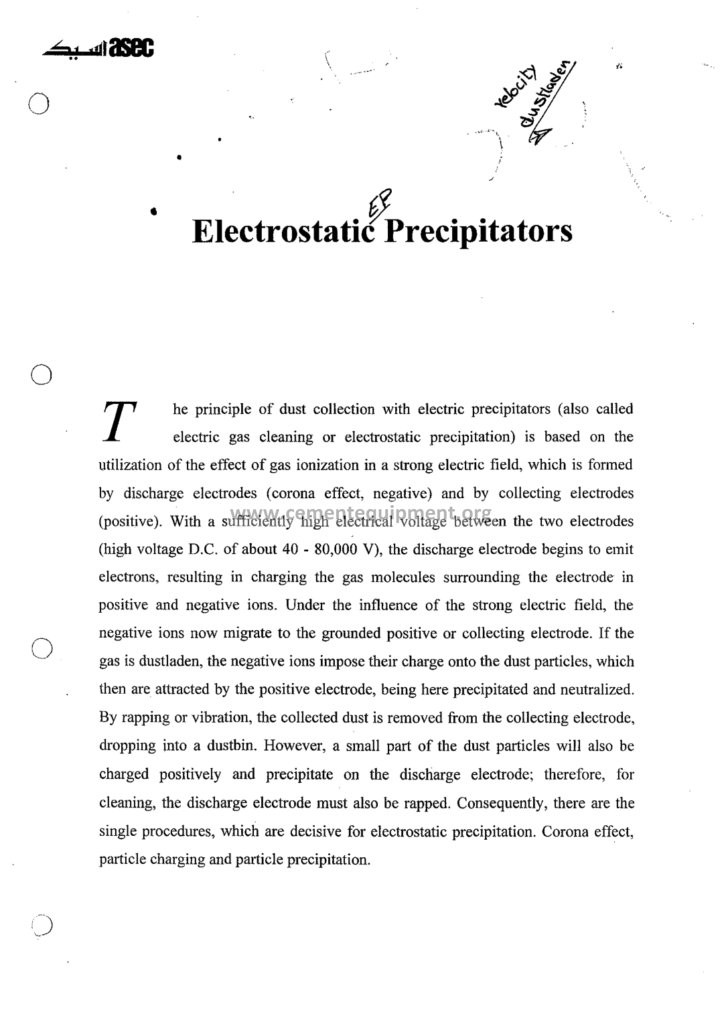
Electrostatic Precipitators: Complete Technical Guide
The electrostatic precipitator (ESP) is the classical workhorse of the cement plant dust collection: the device that cleans the process gases by the electrical charging of the dust particles and their attraction to the collecting plates: the kiln and the raw mill exhaust, the clinker cooler air and the cement mill vent pass through the ESPs of the older fleet and the modern installations alike: the ESP collects the dust at the efficiencies above 99.9 percent without the pressure drop of the fabric filters.
The Complete Cement Technical Package (931 files including the books, the courses, the Excel tools and the presentations: $249.99 one-time: instant download via the PayPal payment) includes this electrostatic precipitator guide with the design calculations, the operating manuals and the maintenance programs: this article walks the file: the physics of the corona, the electrodes, the high voltage, the rapping, the gas conditioning and the plant applications: the reader closes the page with the complete electrical dust collection knowledge.
The ESP is a marvel of the applied physics: the dirtiest gas of the plant passes between the electrodes and emerges almost clean, because the invisible electrons do the filtering work: this page is organized so the theory comes first, the hardware second, the operation third and the maintenance last: the file follows the same order: the process engineer, the electrician and the maintenance mechanic each find the level that serves them.
1. The Role of the ESP in the Cement Plant: Where the Precipitators Serve
The electrostatic precipitator cleans the largest gas flows of the cement process, and its applications map the dust sources of the plant:
- The kiln and the raw mill exhaust: the main dedusting of the process: the preheater exhaust gases with the dust concentrations of 30 to 80 grams per cubic meter, the gas volumes of the large plants beyond one million cubic meters per hour: the ESP of the kiln line is the biggest dust collector of the plant: the collected dust returns to the process and the cleaned gas goes to the stack;
- The clinker cooler: the cooling air of the grate cooler carries the fine clinker dust: the cooler ESP or the filter treats the large air flows with the high temperatures: the collected dust is the raw material of the finish grinding: the cooler dedusting protects the environment of the plant and recovers the product;
- The cement mill vent: the mill ventilation with the fine cement dust: the cement mills of the older plants run the ESPs and the newer installations the bag filters: the collected cement returns directly to the product: the mill vent dedusting is also the temperature control of the mill;
- The satellite applications: the coal mill dedusting, the packer house and the crusher dedusting in the older designs: the smaller ESPs of the plant periphery: the modern plants extended the bag filter technology to most of these points, while the kiln lines keep the ESPs where the gas characteristics suit them;
The ESP of the kiln line treats the dust-laden gases at the temperatures of 150 to 350 °C before the gases reach the stack: its reliability defines the emissions compliance of the whole plant: the dust collected by the ESP is a process raw material worth recovering, not only a waste stream: the file of the package opens with the application map and the gas flows of the precipitator duties.
2. The Principle of the Corona Discharge: The Physics of the Cleaning
The cleaning power of the ESP comes from the corona discharge: the electrical phenomenon that charges the dust particles in the gas stream:
- The corona formation: the high voltage of 30 to 100 kilovolts applied to the discharge electrodes creates the strong electric field near their surfaces: at the field strength above the breakdown limit of the gas, the air molecules near the electrode ionize: the ionization zone, the visible bluish glow of the corona, surrounds the discharge electrodes: the corona sheath is the factory of the charging;
- The negative corona: the industrial ESPs operate with the negative polarity, where the electrode is the cathode and the electrons travel towards the collecting plates: the negative corona is more stable and sustains the higher voltages than the positive corona: the negative operation is the standard of the industrial dust collection, while the positive corona serves the air cleaning of the occupied spaces;
- The ionization products: the corona produces the free electrons and the positive ions: the electrons attach to the dust particles and charge them negatively: the particles become the small charged bodies that the electric field can move: the charging of the particle population is the first step of the collection;
- The self-limiting nature: the charging of the particles consumes the ion flow and the space charge of the dust cloud reduces the field strength: the precipitation operates with the corona current that adapts to the dust load: the modern power supplies control the system at the maximum stable corona: the physics of the corona defines the limits of the process;
The corona is the invisible engine of the ESP: without the stable discharge the precipitator is only a box with the plates: the art of the ESP operation is the maintenance of the corona under the changing gas conditions of the plant: the file explains the corona physics with the voltage-current curves and the typical operating points of the cement kiln gases.
3. The Charging and the Migration of the Particles: From the Corona to the Plate
The journey of the dust particle through the precipitator has the defined physical stages that the designer calculates:
- The field charging: the dominant mechanism for the particles above one micrometer: the ions driven by the electric field bombard the particle until the saturation charge is reached: the saturation charge is proportional to the square of the particle diameter and the field strength: the large particles charge quickly and heavily;
- The diffusion charging: the mechanism for the particles below one micrometer: the random thermal motion of the ions deposits the charge on the particle without the field guidance: the submicron particles charge by the diffusion, and the fine dust of the cement gases owes much of its cleaning to this mechanism;
- The migration velocity: the terminal velocity of the charged particle moving towards the collecting plate under the electric field and against the gas drag: the migration velocity of the cement dust lies typically between 5 and 15 centimeters per second: the migration velocity is the central parameter of the ESP design: the wetherill and the modern equations of the efficiency all depend on it;
- The collection: the particle arrives at the plate and adheres with the electrostatic and the adhesive forces: the dust layer builds on the plate until the rapping releases it: the collected layer must remain electrically conductive enough to discharge the incoming charge: the layer resistance is the dust resistivity story of the ESP;
The physics of the charging and the migration determines the collection performance: the particle size distribution of the cement dust, the gas temperature and the humidity all influence the charging rates: the file documents the charging equations, the migration velocity tables of the cement dusts and the worked calculations that convert the gas data into the precipitation performance.
4. The Electrode Geometries: The Discharge Wires and the Collecting Plates
The mechanical heart of the ESP is the electrode system: the discharge electrodes that create the corona and the collecting plates that receive the dust:
- The discharge electrodes: the wires or the rigid frames of the high-voltage system: the wire electrodes of the classical designs with the weights and the aligning frames: the rigid mast electrodes of the modern designs with the better corona distribution and the higher stability: the discharge electrodes carry the full high voltage and must resist the mechanical and the electrical stresses;
- The corona characteristics: the geometry of the discharge electrode determines the corona onset voltage and the current distribution: the barbed and the twisted wires enhance the corona activity: the electrode selection is the electrical design decision of the precipitator: the right electrode maximizes the corona at the moderate voltage;
- The collecting plates: the flat steel plates of 2 to 4 millimeters thickness arranged in the parallel channels: the plate spacing of 300 to 500 millimeters between the plates: the plate height of the large precipitators reaches 12 to 15 meters: the plates capture the particles and drain the collected layer to the hoppers;
- The gas passages: the electrostatic and the mechanical fields of the plate system: the collection area of the ESP is expressed in square meters of the plate surface: the total collecting area is the currency of the precipitation capacity: the larger the area, the higher the efficiency and the cost: the design balances the area against the required performance;
The electrode geometry defines the physical capacity of the precipitator: the discharge electrodes, the plate spacing and the collecting area are fixed at the design stage and cannot be stretched beyond their margins: the file documents the electrode systems with the dimensional tables and the corona data of the typical designs: the mechanical configuration of the ESP is its destiny.
5. The High-Voltage Supply: The Transformer-Rectifier Sets and the Controls
The power of the corona is delivered by the high-voltage equipment that the ESP electricians know intimately:
- The transformer-rectifier (TR) sets: the step-up transformers and the silicon rectifiers that convert the plant voltage into the 30 to 100 kilovolt DC of the discharge electrodes: the TR set of the modern precipitator is the compact unit mounted on the roof of the casing, the classical designs used the separate transformer rooms: the rating of the TR set follows the field current demand of the ESP section;
- The high-voltage components: the bus ducts, the insulators and the support bushings that carry the voltage into the casing: the insulator cleanliness is the discipline of the high-voltage department: the dirty insulators flash over at the reduced voltage: the insulator heating and the purge air protect the ceramic surfaces;
- The voltage control: the automatic voltage control systems that operate the TR set at the maximum safe operating point: the spark detection and the recovery: the modern controllers with the automatic voltage limit (AVL), the spark rate optimization and the current limits: the control system adapts the precipitation to the mill start and the gas changes: the latest controllers include the optimization for the corona power versus the re-entrainment losses;
- The field structure: the large ESPs are divided into the electrical fields in the series: the inlet and the outlet fields with the different duties: the first field collects the coarse dust load, the later fields polish the fine particles: the fields are energized separately and controlled individually: the sectionalization improves the availability and the maintainability of the precipitator;
The high-voltage system is the nervous system of the ESP: the stable corona, the spark management and the insulator discipline determine the achieved efficiency: the file documents the TR set selection, the control modes and the high-voltage safety procedures: the electricians of the plant run the precipitator from the control cabinets and the maintenance platforms of the TR sets.
6. The Rapping Systems: The Cleaning of the Plates and the Electrodes
The collected dust must be removed from the plates continuously, and the rapping systems perform the cleaning duty of the ESP:
- The plate rapping: the periodic hammering of the collecting plates by the rapping hammers: the impact shakes the dust layer from the plates into the hoppers: the rapping intensity and the frequency are tuned per field: the inlet fields rap often with the heavy blows because the coarse dust accumulates fast, and the outlet fields rap rarely with the gentle blows to keep the fine layer in place: the rapping cycle is the operating software of the ESP maintenance;
- The rappers of the modern designs: the pneumatic and the electromagnetic impac systems of the older plants versus the motor-driven hammer mechanisms: the individual and the group rapping of the plates: the rapper force is adjustable to the dust adhesion of the field: the modern rapping control sequences the impacts to avoid the simultaneous rapping clouds;
- The discharge electrode rapping: the corona electrodes also collect the dust and the deposit faults: the rapping device of the frame electrodes shakes the deposits off the discharge elements: the clean electrodes sustain the stable corona: the discharge rapping is lighter than the plate rapping and serves the electrical stability of the field;
- The re-entrainment problem: the dust that falls from the plates is caught by the gas flow instead of the hopper: the re-entrainment reduces the efficiency and shows in the outlet dust peaks after the rapping: the rapping timing against the gas flow, the low gas velocities and the smooth plate surfaces minimize the re-entrainment: the fine dust of the outlet fields is the most sensitive to the rapping losses;
The rapping is the mechanical cleaning of the precipitation process: the wrong rapping schedule costs the efficiency as surely as the wrong voltage: the file documents the rapper types, the tuning procedures and the re-entrainment countermeasures with the practical field data: the cleaning cycles of the ESP deserve the same attention as its electrical settings.
7. The Gas Distribution and the Duct System: The Uniformity of the Flow
The precipitation efficiency depends on the uniform gas flow through the electrode channels, and the gas distribution equipment shapes that uniformity:
- The inlet ducting: the gas enters the ESP from the kiln or the mill system with the velocity profile of the flow: the wide and the angled ducts distribute the gas across the full cross-section of the casing: the transition sections from the round duct to the rectangular casing are the gas mechanical elements of the design;
- The distribution screens: the perforated plates and the diffuser screens at the inlet and the outlet of the casing: the screens spread the gas evenly across all the channels and smooth the turbulence: the uniformity of the velocity within plus-minus 15 percent of the mean is the classical design target: the screens are the first maintenance suspects when the outlet dust rises unevenly: the clogged distribution screens starve the outer fields and overload the inner channels;
- The gas velocities: the design velocity of the gas through the collecting field runs between 0.8 and 1.5 meters per second: the high velocities re-entrain the collected dust and reduce the precipitation time; the low velocities demand the larger casings: the velocity choice is the economic compromise of the design;
- The by-pass and the short-circuit flows: the gas that slips between the compartments and the leak paths that bypass the fields: the dust-laden leaks flow short the precipitation and degrade the overall efficiency: the sealing of the internal passages is checked in the performance investigations: the flow modeling with the scale models and the modern CFD guides the design of the large casings;
The gas distribution quality decides how much of the theoretical plate area actually works: the field model studies of the ESP industry showed that the uneven flow halves the effective efficiency of the mistreated designs: the file documents the distribution design, the testing of the velocity profiles and the corrective measures of the existing plants: the uniform flow is the quiet prerequisite of the precipitation.
8. The Dust Resistivity and the Gas Conditioning: The Chemistry of the Collection
The precipitation performance is governed by the electrical resistivity of the collected dust, the material property that the cement industry manages every day:
- The resistivity definition: the electrical resistance of the dust layer measured in ohm-centimeters: the resistivity of the cement kiln dust spans the huge range from 10^4 to 10^12 ohm-cm depending on the temperature, the humidity and the chemistry: the resistivity is the central parameter of the ESP behavior;
- The ideal window: the precipitation works best at the resistivities between 10^8 and 10^10 ohm-cm: below 10^8 the collected particles discharge too fast and the re-entrainment increases: above 10^10 the layer holds the charge and the back-corona ignites: the back corona is the sparking inside the dust layer that suppresses the collecting field: the plants condition the gases to stay inside the window;
- The temperature effect: the resistivity of the cement dust typically peaks at the temperatures around 150 to 200 °C where the surface conduction falls: above the peak the volume conduction of the layer decreases the resistivity: the temperature of the ESP inlet is therefore the tuning knob of the process: the hot and the cold operations of the kiln line change the precipitation character completely;
- The conditioning: the water injection of the conditioning tower and the steam injection that lower the gas temperature and raise the humidity: the sulfur trioxide conditioning of the famous classical practice that modified the surface conduction: the conditioning adjustments recover the efficiency of the resistant dusts: the conditioning tower of the kiln line is the moisture management element of the ESP network;
The resistivity story explains many phenomena of the ESP practice: the cold start difficulties, the kiln operation changes and the seasonal effects all travel through the dust resistance: the file devotes complete chapters to the resistivity measurement, the conditioning options and the case histories of the resistant dust problems in the cement plants: the chemistry of the collected layer is as important as the physics of the corona.
9. The Efficiency of the Collection: The Equations and the Design Parameters
The performance of the precipitator is quantified by the classical efficiency equations that the designer uses:
- The Deutsch equation: the fundamental efficiency law of the precipitation: the collection efficiency is exponential in the ratio of the collecting area to the gas flow, multiplied by the migration velocity: the equation with the area per unit flow (the specific collecting area, SCA): the Deutsch formula is the first estimate of every ESP design;
- The modified equations: the Deutsch with the modified constants and the sectionalized forms that fit the real precipitators better: the penetration correction factors for the non-uniform flows and the rapping losses: the modern design practice applies the empirical factors to the Deutsch base;
- The specific collecting area: the square meters of the collecting plate per cubic meter per second of the gas flow: the SCA of the cement kiln ESPs runs typically between 25 and 50 square meters per cubic meter per second: the required SCA follows the dust resistivity and the emission target: the design curves of the industry relate the SCA to the achieved emissions;
- The aspect ratio: the length of the collecting field relative to its height: the aspect ratios above 1.0 to 2.0 reduce the re-entrainment and the vertical flow effects: the modern designs use the higher aspect ratios for the fine dust applications: the geometry of the field is the second design parameter of the efficiency;
The efficiency equations convert the emissions target of the plant into the physical dimensions of the precipitator: the required 50 milligram per cubic meter of the modern limits demands the larger SCA than the historical 150 milligram practice: the file explains the equations, the design curves and the worked sizing examples of the kiln line ESPs: the mathematics of the efficiency is the language between the environment and the construction budget.
10. The Operations of the ESP in the Plant: The Daily Regime of the Precipitator
The plant operation of the ESP is a daily dialogue between the kiln process and the corona control:
- The startup sequence: the gas flow established before the high voltage: the corona switched on after the temperatures stabilize: the gradual energization of the fields from the inlet to the outlet: the startup discipline prevents the corrosion and the electrical overload of the cold casing: the dew point management of the startup is the first protection of the plates: the corrosion of the cold casing plates is the classic enemy of the idled precipitators;
- The online optimization: the section voltages watched against the sparks: the currents balanced across the fields: the rapping sequences adjusted to the dust load: the operators read the precipitation performance through the current values: the declining currents announce the electrode fouling and the coming rapping problems;
- The process interaction: the mill starts and stops change the gas flow and the dust load: the ESP controllers follow the changes automatically: the high-voltage trips during the process disturbances demand the operator responses: the process-ESP interface is the operating knowledge of the control room crew;
- The shutdown procedure: the de-energization before the gas stoppage, the purge of the corrosive gases and the inspection window of the shutdown: the shutdown inspections catch the electrode damages and the hopper blockages for the next start;
The daily operation of the ESP is the interplay of the electrical disciplines and the process awareness: the well-operated precipitator holds its efficiency through the start-stop cycles and the fuel changes: the file documents the operating procedures, the interlocks and the control room practices of the cement plant precipitators: the operators of the plant run the files of the ESP on the shift handover.
11. The Maintenance of the ESP: The Campaigns and the Failure Modes
The maintenance of the precipitator is the mechanical and the electrical calendar that protects the collection performance:
- The routine inspections: the internal inspections of the casing at the shutdowns: the discharge electrode alignment, the plate straightness, the rapper mechanisms and the hopper conditions: the checklists of the internal inspection are the standard documents of the maintenance: the bent electrodes and the warped plates are the first findings of the neglected casings;
- The high-voltage failures: the insulator flashovers, the bus duct insulation breakdowns and the rectifier faults: the symptoms are the tripping fields and the low currents: the electrical maintenance of the TR sets follows the manufacturer service program: the spare insulator and the control cards are the standard stock of the electric shop;
- The mechanical failures: the rapper mechanism wear, the broken electrode wires of the wire-type designs and the hopper clogs: the wire breakages short the field and demand the immediate attention: the rigid electrode designs reduced the wire failure problem of the classical units;
- The performance degradation: the gradually rising outlet emissions with the constant process conditions: the root causes are searched in the rapping, the gas distribution, the resistivity and the electrode conditions: the performance tests with the section-by-section isolation identify the weak field: the corrective campaigns restore the efficiency of the aging units;
The maintenance of the ESP is the largest cost item of the electrical department after the drives: the file carries the inspection checklists, the failure analysis tables and the refurbishment programs of the aging precipitators: the disciplined maintenance keeps the aging units within the limits and postpones the filter replacement investments.
12. The ESP against the Bag Filter: The Comparison of the Technologies
The cement industry dust collection runs on the two parallel technologies, and the choice between them is a living debate of the plant investments:
| Parameter | ESP | Bag filter |
|---|---|---|
| Pressure drop | Low, 100–300 Pa | High, 800–1500 Pa |
| Outlet emissions | 10–30 mg/m3 achievable | Below 5–10 mg/m3 typical |
| Sensitivity | Dust resistivity and chemistry | Gas temperature and moisture |
| Energy consumption | High-voltage power, moderate total | Fan power of the pressure drop |
| Maintenance | Electrodes, rappers, insulators | Filter bags and cleaning valves |
| Fire and spark resistance | Good in the high-voltage regime | Bag fire risk with the hot sparks |
The modern installations of the kiln lines increasingly choose the bag filters where the emission limits drop below the ESP comfort zone, while the existing ESPs are upgraded with the conditioning and the control improvements to stay in compliance: the gas temperature of the kiln line favors the ESP at the hot startups and the bag filters at the high performance demands: the file compares the technologies with the life-cycle costs and the decision matrices of the plant upgrades: the choice is the engineering of the specific plant, not the fashion of the decade.
13. The Often Asked Questions
Why does the ESP need the high voltage?
The high voltage creates the corona discharge that charges the dust particles: the free electrons of the corona attach to the particles and the electric field then drives the charged particles to the collecting plates: without the corona there is no charging and the ESP behaves as an empty box: the 30 to 100 kilovolts are the working voltage of the modern precipitators.
What is the back corona and why is it dangerous for the precipitation?
The back corona is the electrical breakdown inside the collected dust layer of the high-resistivity dusts: the sparks ignite within the layer, the local field collapses and the collected dust is re-entrained: the result is the falling efficiency with the rising power consumption: the conditioning of the gas to control the resistivity is the standard countermeasure of the back corona.
Can the ESP of the kiln line handle the wet kiln conditions?
The wet and the dew-point conditions are the danger zone of the ESP: the condensation corrodes the plates and the short-circuiting of the wet dust kills the corona: the plants protect the ESPs with the operating temperature regimes above the dew point, the casing insulation and the startup procedures: the modern conditioning systems manage the humidity without approaching the dew point.
How is the efficiency of the ESP measured in the plant?
By the dust concentration measurements of the inlet and the outlet ducts: the manual isokinetic sampling and the continuous particulate monitors of the stack: the efficiency is the ratio of the collected dust to the inlet dust: the plant records the emissions continuously against the limits of the permit.
What causes the sudden efficiency drop of a stable ESP?
The classic causes are the broken discharge electrode shorting the field, the failed rapper leaving the plates loaded, the insulator flashover from the dust and the process changes of the temperature or the humidity: the diagnosis starts with the field currents and the section voltages visible from the control room, followed by the internal inspection at the next shutdown.
Is the file of the package only for the electrical engineers?
No: the guide is written for the whole team of the dedusting department: the process engineers find the gas conditioning and the operation chapters, the mechanical staff the rapping and the maintenance programs, and the electrical staff the high-voltage chapters: the file serves the training of the shift operators as well as the design review of the projects.
14. Conclusion
The electrostatic precipitator is the classical instrument of the cement plant environmental engineering: the corona that charges, the plates that collect, the rappers that clean and the conditioning that keeps the chemistry right: the ESP of the kiln line cleans the largest gas flows of the plant at the high efficiencies and returns the valuable dust to the process: the theory, the hardware and the operation form the complete discipline that this guide documents: the electrical precipitation remains the essential knowledge of the dedusting engineer, whether the plant runs the ESP or has replaced it with the filters: the science of the corona is the permanent foundation of the air cleaning of the industry.
The Complete Cement Technical Package includes this electrostatic precipitator guide with the design calculations, the operating manuals and the maintenance programs: the one-time 249.99: the instant download: the 931 files of the library of cement: the electrical cleaning of the plant, documented from the corona to the stack: the knowledge of the package, the clean air of the plant.
Get this Electrostatic Precipitators file + the full 931-file package
$249.99 — one-time purchase, instant download, lifetime access
This file is part of the Complete Cement Technical Package (931 files) available from cementequipment.org. Respective rights holders; library copy for the licensed single user.