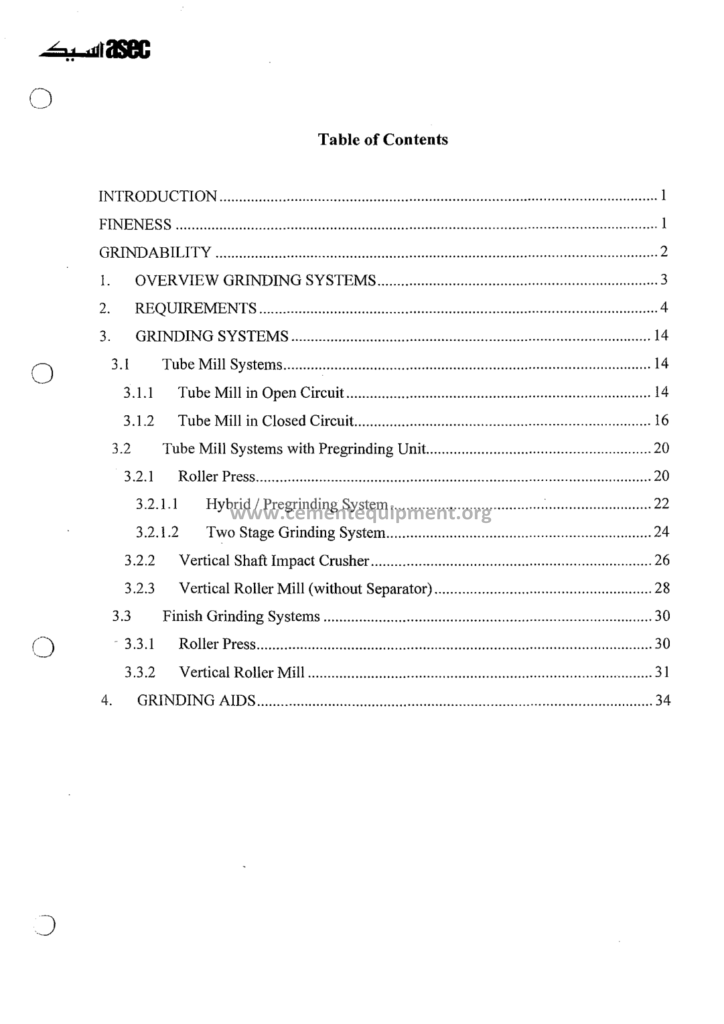
Cement Grinding Systems: Complete Technical Guide
Cement grinding systems, part 2 continues the technology map where the first part ended: the part 2 is the second half of the grinding knowledge: the closed circuits with the separators, the vertical roller mills, the high-pressure grinding rolls and the systems that combine them: the finish grinding is the last process stage and the largest single consumer of the electrical energy of the plant: the choices made in the grinding department decide the product quality, the power bill and the profitability of the dispatch.
The Complete Cement Technical Package (931 files including the books, the courses, the Excel tools and the presentations: $249.99 one-time: instant download via the PayPal payment) includes this grinding systems guide with the circuit diagrams, the dimensioning tables and the operating instructions: this article walks the file: the circuit architecture, the separator technology, the vertical mills, the HPGR systems and the practical optimization: the reader leaves with the complete map of the modern finish grinding.
Part 1 of the grinding series established the basics: the ball mill behavior, the comminution laws and the media theory: this part 2 moves to the systems: how the mills are arranged in the circuits, how the classification is executed and how the modern plants grind the cement at the lower specific power: the file follows the same progression, and the reader of both parts holds the complete grinding technology of the cement industry.
1. The Circuit Design: Open versus Closed, and the Logic of the Choice
The grinding circuit is the architecture around the mill, and the choice between the open and the closed arrangement shapes every downstream number:
- The open circuit: the material passes the mill once to the product fineness: the simple flow, the low capital, but the over-grinding in the long mill and the difficulty of the narrow particle size distribution: it survives in the small plants and the simple products:
- The closed circuit: the mill product goes to the separator, the finished fraction leaves and the coarse fraction returns to the mill: the separator reclassifies, the mill grinds only the oversized and the circulating load runs 100% to 300% of the fresh feed:
- The benefits of the closed circuit: the narrower size distribution, the higher throughput at the same power, the better control of the Blaine and the lower temperature of the mill: the closed circuit is the standard of the modern finish grinding:
- The circulating load: the ratio of the return to the fresh feed: the optimum sits typically between 150% and 250% for the ball mill circuits: the too-low load starves the classification, the too-high load loads the mill with the fines that cushion the balls:
The circuit choice is the first decision of the grinding design: the file compares the open and the closed concepts with the power, the capital and the product quality columns, and the modern rule is clear: the stainless product of the closed circuit nearly always earns its separator.
| Feature | Open circuit | Closed circuit |
|---|---|---|
| Capital cost | Lower | +8-15% (separator) |
| Specific power | Higher (over-grinding) | Lower by 10-20% |
| Particle size spread | Wide | Narrow |
| Fineness control | By mill only | By separator setting |
| Mill temperature | Higher | Lower (more ventilation) |
2. The Ball Mill in the Closed Circuit: The Compartments and the Internal Equipment
The ball mill remains the workhorse of the finish grinding even in the age of the vertical mills:
- The two-compartment mill: the standard design: the first compartment with the lifting liners and the large balls (60 to 100 mm) breaks the clinker from the 25 to 30 mm feed, the second compartment with the classifying liners and the small balls (15 to 40 mm) grinds the fine range: the diaphragm between the compartments controls the material level:
- The media grading: the optimum ball charge depends on the feed size, the material hardness and the product target: the media filling of 28% to 35% of the mill volume and the 25 to 35% of the compartment voids as the practical window:
- The mill speed: the operating speed of 70% to 80% of the critical speed: the critical speed of the mill diameter is the classical 42.3 divided by the square root of the internal diameter in meters: the cataracting of the large balls in the first compartment and the cascading in the second follow the speed setting:
- The power draw: the installed power of the finish mills across the industry runs 3,000 to 8,000 kW for the 4.2 to 5.6 meter mills, at the specific loading of 10 to 14 kW per cubic meter of the mill volume:
The ball mill is a simple machine with a complicated interior: the liner profile, the ball grading, the diaphragm slots and the ventilation interact continuously with the feed quality: the file devotes the full chapter to the tuning of these internals, because the 5 to 15% of the power that separates the well-tuned mill from the neglected one is the margin of the plant.
3. The High-Efficiency Separators: The Classification that Makes the Circuit
The separator is the brain of the closed circuit: the modern high-efficiency (third generation) separators have transformed the finish grinding:
- The operating principle: the feed drops into the dispersing plate of the rotating cage; the air stream carries the fine particles through the cage vanes to the cyclone collectors; the coarse particles fall back to the mill: the rotor speed and the air flow set the cut size:
- The performance numbers: the high-efficiency separators reach the sharpness (Tromp curve slope) that the first-generation separators could not: the bypass of 5% to 15% against the 30% to 50% of the old machines, and the recirculation of the fine material reduced to the minimum:
- The control parameters: the rotor speed (the fineness dial), the air flows (primary, secondary and tertiary), the feed rate and the casing pressure: the separator adjusts the Blaine in seconds against the hours of the mill change:
- The Tromp curve: the classification efficiency curve of the separator: the fish-hook of the modern machines and the cut size d50: the file teaches the reading of the Tromp curve as the diagnostic instrument of the circuit:
The selection of a high-efficiency separator is the highest-return project of the existing grinding circuit: the replacement of the first-generation separator raises the mill output by 15% to 30% at the same power and the same fineness: the payback of the project runs under two years at the realistic energy prices, and the file documents the calculation.
4. The Vertical Roller Mill: The Modern Finish Grinding Alternative
The vertical roller mill (VRM) has conquered the raw grinding and now grinds the finish cement in the growing share of the world’s plants:
- The principle: the material is ground between the rotating table and the stationary or floating rollers, carried by the table’s centrifugal force: the ground material is lifted by the air stream into the internal classifier: the mill grinds, dries and classifies in one machine:
- The power advantage: the VRM saves 20% to 30% of the specific power against the conventional ball mill circuit: the finish grinding with the VRM runs 22 to 30 kWh/t at the 3,500 Blaine against the 30 to 40 of the ball mill circuit:
- The temperature control: the VRM operates with the higher material-to-air ratio and the lighter venting: the cement temperature is controlled by the water injection and the mill settings: the VRM grinds the warm clinker without the classical cooler duty of the ball mill:
- The product characteristics: the VRM cement shows the different particle size distribution: the narrower spread and the higher proportion of the fines give the different water demand and the different strength development, and the concrete technologists evaluate the VRM cement on its own merits:
- The vibration control: the mill operation balances the grinding pressure, the table dam ring height and the feed rate to keep the machine smooth: the vibration trips protect the rollers and the table:
The VRM decision is a systems decision: the power saving against the capital cost, the drying capability against the ball mill flexibility and the product characteristics against the market acceptance: the file compares the VRM and the ball mill on the full scorecard and documents the recent installations with their operating data.
5. The High-Pressure Grinding Rolls: The Pre-Grinding and the Hybrid Circuits
The high-pressure grinding roll (HPGR, the roller press) grinds the material in the compacted bed between the counter-rotating rolls at the pressures of 50 to 200 MPa:
- The principle: the feed enters the gap, the roll pressure fractures the particles against each other: the microcracks weaken the particles for the downstream mill: the product leaves as the flake, and the edge material and the flakes return to the press in the circulating loop:
- The energy efficiency: the HPGR comminution consumes 20% to 40% less energy than the ball mill for the same size reduction, because the breakage in the confined bed uses the energy efficiently:
- The circuit arrangements: the pre-grinding (press before the ball mill), the HPGR in the closed circuit with the ball mill in the finish stage, and the fully combined grinding systems: the press profile and the ball mill profile are tuned together:
- The product effect: the pre-ground feed reduces the ball mill work and raises the circuit capacity by 30% to 50% at the same product fineness: the cement from the hybrid circuit carries the characteristics of the mixed grinding:
- The operating costs: the wear of the roll surfaces (the studded tungsten carbide tyres) dominates the maintenance: the wear cost per ton of the press can exceed the media cost of the ball mill, and the tyre life of 5,000 to 15,000 hours decides the economics:
The HPGR systems are the growth technology of the finish grinding: the plants modernize the existing ball mills with the press in front and gain the capacity at the fraction of the new-mill capital: the file details the press circuit design, the material flow and the economic evaluation of the hybrid projects.
6. The Combined and the Novel Circuits: The Mill Combinations of the Modern Plants
The modern grinding departments combine the machines in the flowsheets that the file documents diagram by diagram:
- The ball mill with the HPGR pre-grinder: the most common modernization: the press opens the clinker and the ball mill finishes: the capacities of the existing mill lines rise by 30% to 60%:
- The twin ball mills with the shared separator: the arrangement of the large grinding stations: the two mills feed one classification group, balancing the utilization:
- The VRM and the ball mill in the series: the VRM as the pre-grinder with the ball mill finishing gives the flexibility of the product range at the hybrid power profile: the arrangement serves the markets demanding the ball-mill type cement:
- The vertical roller mills in the compound grinding: the single VRM grinding the clinker, the slag and the limestone additions in the interground blends: the drying and the grinding of the slag demand the VRM’s high temperature capacity:
The flowsheet selection is the engineering heart of the grinding project: each combination carries its power profile, its product fingerprint and its capital figure: the file presents the comparative matrix of the six principal configurations with the published operating ranges, so the designer compares the systems on the same page.
7. The Grinding Aids: The Chemistry that Buys the Productivity
The grinding aids are the small doses (200 to 1000 grams per ton) that change the economics of the mills:
- The mechanism: the glycol-based and the amine-based aids adsorb on the fresh fracture surfaces, reduce the particle re-agglomeration and the coating of the media and compensate the electrostatic charging of the fine cement:
- The benefits: the output gain of 5% to 15% at the same fineness, the reduction of the coating and the improved flow of the cement: the aids also act as the strength enhancers in the modern formulations:
- The dosing practice: the liquid aids are sprayed on the mill feed at the controlled rates: the dosing optimization follows the mill output and the quality targets: the aids cost 0.2 to 0.8 US dollars per ton of the cement and return the multiples in the mill capacity:
- The compatibility: the aids must be compatible with the cement chemistry and the admixtures of the concrete: the trials run in the concrete laboratory before the plant adoption: the file presents the evaluation protocol of the aids:
The grinding aid is the cheapest optimization lever of the grinding department: the trial of the new aid is a two-week project with the measurable output: the aids are the interface where the chemistry serves the mechanics, and the file treats them with the seriousness of the modern practice.
8. The Power Economics of the Finish Grinding: The Kilowatt-Hour Budget
The electrical energy of the finish grinding is the largest single block of the plant’s power consumption:
| Grinding system | Specific power, kWh/t (Blaine 3,500-3,800) |
|---|---|
| Ball mill, open circuit | 38-48 |
| Ball mill, closed circuit, 2nd gen separator | 32-42 |
| Ball mill, closed circuit, high-efficiency separator | 30-38 |
| Ball mill + HPGR pre-grinding | 24-32 |
| Vertical roller mill | 22-30 |
| HPGR finish grinding (combined) | 20-28 |
- The fineness law: the power rises sharply with the Blaine: from 3,200 to 4,000 cm2/g the specific energy increases by roughly 40% to 60%: the premium fineness products cost the premium power:
- The clinker factor: the grinding of the interground additions is cheaper than the clinker: the blended cements at the 65% clinker factor grind at the lower specific power per ton of the cement:
- The auxiliary consumption: the separator fans, the mill ventilation and the conveying add 25% to 40% to the direct mill power: the total grinding station consumption is the number the electricity bill sees:
- The demand management: the start of the mills at the shift changes and the coincidence of the grinding and the packing peaks cost the demand penalties: the operating schedule is a tariff engineering exercise:
The power budget of the grinding is the language of the modernization case: the plant of 2 million tons saving 8 kWh/t saves 16 million kilowatt-hours per year: the file provides the full calculation template of the grinding power economics for the project and the daily operations.
9. The Product Quality Control of the Grinding: Fineness, Particles and Strength
The grinding department is the last quality gate of the cement plant, and the controls are the daily discipline:
- The Blaine test: the air permeability fineness of the cement (the Blaine number in cm2/g) is the primary process control: the target bands of the plant are enforced with the hourly samples:
- The sieve residues: the 45-micron residue (R45) as the coarseness control: the residue targets of 2% to 12% depending on the cement type: the residue and the Blaine together describe the grinding state:
- The particle size distribution: the laser particle size analyzers report the full distribution and the uniformity coefficient: the modern cements are specified on the distribution, with the d50 and the spread as the process targets:
- The strength control: the mortar strength tests at 2, 7 and 28 days verify the product performance: the short-term controls (the 1-day strengths and the heat of hydration) accelerate the feedback to the mill operators:
- The cement temperature: the temperature of the cement at the mill outlet above 110 to 120 degrees degrades the setting quality and the gypsum performance: the temperature is a quality parameter, not only a process one:
The quality control of the grinding closes the loop between the mill settings and the concrete performance: the particle size distribution replaces the single number of the fineness as the modern control instrument, and the file documents the sampling, the testing and the interpretation of each result.
10. The Optimization Methodology: The Systematic Tuning of the Circuit
The grinding optimization is not the guesswork but the systematic method, and the file lays the full procedure:
- The baseline audit: the measured throughput, the power, the fineness, the temperature and the circulating load of the circuit as the reference state: the plant cannot optimize the circuit it does not measure:
- The variables of the experiment: the ball charge and its grading, the liner condition, the separator speed and air flows, the feed rate and the moisture: one variable at a time, with the sufficient runtime for the circuit to reach the steady state:
- The response measurement: the throughput, the specific power, the residue, the Blaine and the strength of the samples: the responses recorded at the same product quality: the comparisons made at the equal fineness:
- The separator tuning: the rotor speed and the secondary air adjust the cut size and the bypass: the Tromp curve before and after the change quantifies the effect:
- The media audit: the periodic inspection of the charge and the top-up of the media: the worn balls reduce the throughput and the liner life: the charge analysis of the mill stops is the scheduled weekly discipline of the grinding plants:
The optimization campaign of the file runs over the weeks and produces the permanent improvements of 5% to 20% in the throughput at the same quality: the lessons are written as the standard operating procedures of the plant: the grinding optimization is not a project but a way of running the department.
11. The Maintenance of the Grinding Systems: The Wear Mapping
The grinding equipment is the most wear-intensive machinery of the plant, and its maintenance is the economics in the physical form:
- The liners: the life of the shell liners runs 10,000 to 30,000 hours depending on the hardness of the feed: the wear progress measured at the stops and the replacement planned in the annual shutdown:
- The media: the media consumption of 100 to 300 grams per ton for the finish grinding and the loss profile across the compartment: the top-up policy keeps the charge efficiency: the sorting of the balls at the liner change is the capital-free capacity recovery:
- The separators: the wear of the rotor and the deflector plates, the balancing of the rotating cage and the checking of the air seals: the unbalanced rotor is the vibration disaster waiting for the shutdown:
- The VRM key components: the roller tyres and the table segments wear against each other: the rebuild or the replacement at the wear limits: the hydraulic accumulators and the seals of the grinding pressure system:
- The HPGR tyres: the studded surfaces with the local failures and the edge wear: the tyre rotation and the rebuilding extend the life: the pressing of the metal debris is the catastrophic-mode protection:
The wear mapping of the grinding department is the planning instrument: the measured wear rates, the projected lives and the spare inventories convert the maintenance from the crisis mode to the schedule mode: the file provides the wear recording templates of each machine family.
12. The Sampling and the Performance Testing of the Grinding Circuits
The grinding circuit is optimized on its measurements, and the sampling and the testing program of the file is the instrument of the grinding engineer:
- The circuit sampling points: the fresh feed, the separator feed, the separator fines, the separator return and the mill discharge: the complete survey of the circuit (the flows and the fineness at every point) defines the material balance and the separator performance: the file provides the survey procedure and the data sheets:
- The Tromp curve from the survey: the partition curve of the separator built from the residue values of the feed, the fines and the return: the cut size, the bypass and the sharpness readings diagnose the classification: the before-and-after curves of the changes quantify the improvements:
- The material balance reconciliation: the measured flows adjusted to close the balance of the circuit: the reconciled circulating load and the separator efficiency are the reliable numbers of the audit: the reconciliation discipline catches the scale errors:
- The performance indices: the specific power per ton of the fresh feed, the specific power per unit of the fineness and the efficiency comparisons against the baseline: the index history of the circuit is the plant’s own reference library: the file includes the performance index spreadsheets:
The sampling and the testing program makes the circuit visible: the plant that surveys its mills quarterly knows the separator bypass, the media state and the circulation reality, and the knowledge converts the vague troubles into the specific fixes: the file’s survey program is the permanent instrument of the grinding optimization, and the engineers who run it never guess.
13. The Modernization Projects of the Grinding Department: The Case Logic
The grinding modernization is the most frequent capital project of the existing plants, and the file walks the project logic from the audit to the handover:
- The project portfolio: the separator replacement, the HPGR addition, the mill internals modernization, the drive retrofits and the grinding aid systems: each project with its capacity gain, its power saving and its payback: the file ranks the projects of the typical plant:
- The market demand check: the modernization targets the capacity or the efficiency or the product quality: the project definition depends on the market: the plant with the unmet demand raises the capacity, the plant with the high fuel bills saves the power:
- The execution phases: the audit baseline, the engineering, the procurement, the installation in the scheduled shutdown window and the commissioning: the phased execution keeps the plant producing during the project: the file documents the shutdown window planning:
- The verification after the project: the performance test against the guarantee values: the throughput, the specific power and the fineness measured by the acceptance procedure: the guarantee settlement of the contractor follows the verified numbers: the file provides the acceptance test protocol:
The modernization case of the file is the template of the grinding investments: the payback-driven portfolio, the careful execution and the verified results: the grinding department of the modernizing plants gains the capacity at the fraction of the greenfield capital, and the engineers who argue the projects on the data win the management’s support: the modernization knowledge completes the grinding systems of part 2.
14. The Grinding of the Special Materials: The Slag, the Pozzolans and the Blends
The blended cements of the modern market add the grinding of the supplementary materials to the department’s tasks, and each material grinds differently:
- The slag grinding: the granulated blast-furnace slag is the hardest of the additions: the work index of 15 to 20 kWh/t against the clinker’s 13 to 16: the slag also dries from the 8% to 15% moisture: the vertical roller mills dominate the slag grinding with the hot gas drying, and the blended products reach the 30% to 80% slag contents:
- The pozzolans and the fillers: the natural pozzolans and the limestone filler grind more softly than the clinker: their intergrinding with the clinker shares the mill load: the separate grinding and the blending after the mills give the exact recipe control: the file compares the intergrinding and the separate grinding of the blends:
- The product control of the blends: the fineness distribution of the blended cements and the strength development: the additively designed recipes meet the EN 197 and the ASTM specifications: the small dosage systems and the blender machines of the mixing stations:
- The cement plant as the blending hub: the modern plants receive the slag and the fly ash from the neighboring industries and convert them into the low-clinker cements: the grinding and the blending of the additions are the environmental and the economic core of the modern cement portfolio:
The special material grinding extends the systems knowledge to the full product portfolio: the slag, the pozzolans and the fillers arrive with their grindabilities, moistures and economics, and the department balances the product mix against the mill capacity: the file covers the material-specific grinding and the blending technology of the modern cement plant.
15. The Commissioning and the Performance Guarantees of the Grinding Systems
The new grinding installation is proven on the commissioning and the performance tests, and the file covers the acceptance discipline of the grinding projects:
- The commissioning sequence: the dry and the wet commissioning, the empty runs, the load build-up and the steady operation: the commissioning of the grinding equipment follows the vendor sequence with the checks of the alignment, the lubrication, the cooling and the safety systems: the file provides the commissioning checklists of the mills and the separators:
- The performance test protocol: the guaranteed values (the throughput at the reference fineness, the specific power, the fineness distribution and the noise and the vibration limits) verified by the acceptance test: the test conditions (the material work index, the feed size, the moisture) are defined in the contract: the file documents the preparation and the execution of the performance tests:
- The guarantee settlement: the measured results against the guarantee values: the underperformance triggers the corrective measures and the adjustment of the contract: the guarantee settlement is the commercial conclusion of the project: the file guides the performance claim documentation:
- The handover and the warranty: the documentation, the spare parts and the training handover: the warranty period of the grinding equipment runs 12 to 24 months: the warranty claims process and the maintenance contracts: the complete project lifecycle of the grinding systems closes at the handover:
The commissioning chapter is the evidence-based conclusion of the grinding knowledge: the systems of part 1 and part 2 are realized in the installed plants, and the acceptance tests verify the theory against the reality: the engineer who runs the commissioning and the performance tests closes the project with the numbers, and the file’s protocols ensure the numbers tell the truth: the grinding systems knowledge of the package, complete from the work index to the accepted installation.
16. The Frequently Asked Questions
Which grinding system is the most efficient for the finish cement?
The vertical roller mill and the HPGR-based circuits consume the lowest specific power, 20% to 30% below the conventional ball mill: the choice for a plant depends on the capital, the product requirements and the existing equipment: the efficiency ranking never decides alone.
Why does the cement from the ball mill differ from the VRM cement?
The grinding mechanisms give the different particle size distributions: the ball mill cement has the wider spread with the more uniform particle shapes, the VRM cement the narrower spread and the higher fines: the water demand and the early strength differ accordingly, and the concrete market judges the difference: many markets still specify the ball-mill type characteristics.
What is the circulating load in the closed circuit?
The circulating load is the ratio of the separator return to the fresh feed: typical optimum values run 150% to 250% for the ball mill circuits: the plant optimizes it by the separator settings and the mill conditions, and the modern plants measure it with the belt scales and the weigh feeders.
Do the grinding aids affect the concrete quality?
The modern aids are tested for the full concrete compatibility: they improve the mill performance and the cement flow without the negative effects when the dosage is correct: the overdosing can affect the setting and the air content, which is why the aid trials always verify the concrete performance.
Does the file include the dimensioning tools of the circuits?
The Complete Cement Technical Package includes the Excel tools of the grinding: the mill dimensioning, the separator selection and the power calculation templates: the 931 files of the package include the design spreadsheets alongside the books and the courses.
How much power does the finish grinding take of the plant total?
The finish grinding consumes about 35% to 45% of the total electrical energy of the dry process plant: the raw grinding takes 20% to 25%, and the rest goes to the kiln system fans, the conveying, the packing and the auxiliaries: the grinding is the single largest block, and its modernization moves the whole electricity bill.
17. Conclusion
The cement grinding systems, part 2, complete the technology map of the finish grinding: the closed circuits with the high-efficiency classification, the vertical roller mills, the HPGR presses and the systems that combine them: the power of the finish grinding is the power of the plant’s margin: the engineer who masters the circuit options and the tuning methodology delivers the savings that the boardroom sees: the grinding is the last stage, the biggest energy bill and the final quality gate of the cement plant: the systems knowledge of the package turns the grinding department into the profit center it can be.
The Complete Cement Technical Package includes this grinding systems guide with the circuit diagrams, the dimensioning tables and the operating instructions of the modern systems: one-time 249.99: instant download: the library of the cement professional: the 931 files of the package cover the grinding from the work index to the dispatch, the complete chain of the knowledge.
Get this cement grinding file + the full 931-file package
$249.99 — one-time purchase, instant download, lifetime access
This file is part of the Complete Cement Technical Package (931 files) available from cementequipment.org. Respective rights holders; library copy for the licensed single user.