Kiln Mechanical behavior
CLICK HERE TO DOWNLOAD MOST IMPORTANT INTERNAL MANUALS , EXCEL CALCULATION SHEETS & REFERENCE BOOKS FOR ENGINEER WHO WORK AT LAFARGE HOLCIM , FL , CEMEX
Thermal Expansion
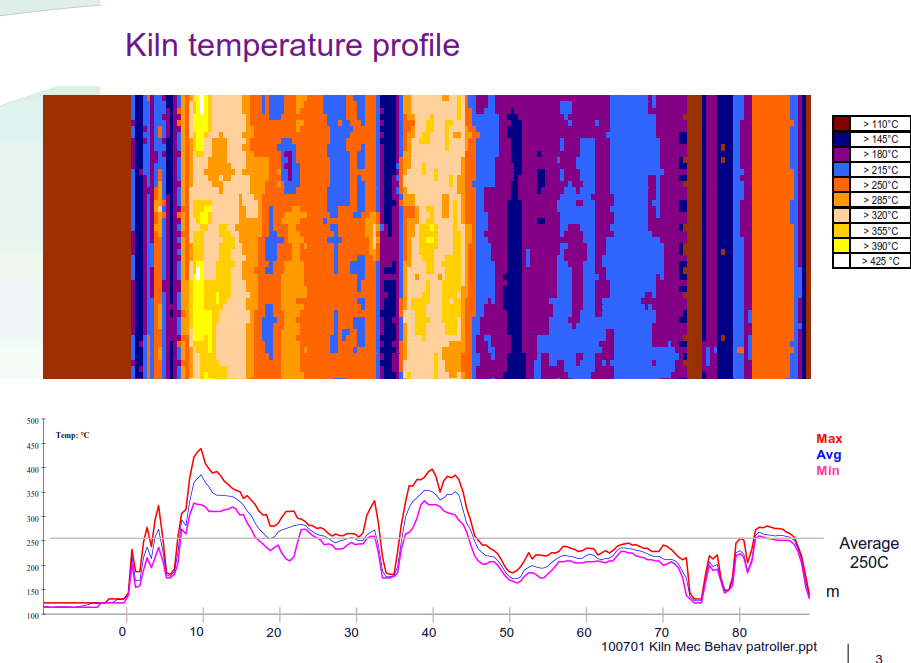
How to evaluate Expansion?
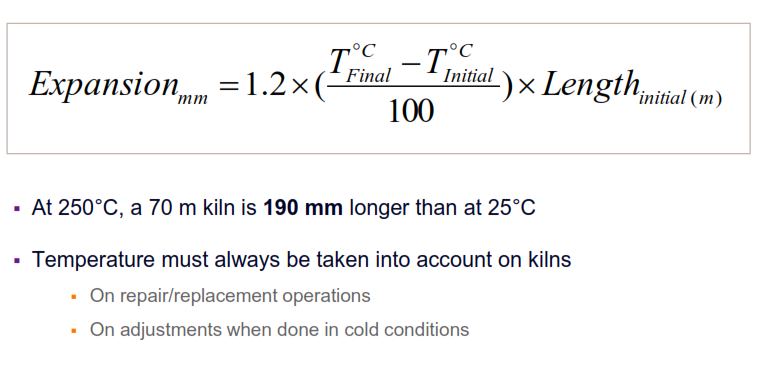
Thermal Expansion effects on the shell
Shrinkage of the shell into the tyre
Under tyre shell temperature is greater than tyre average temp.
- In normal operation
- .. and more in start-up phase
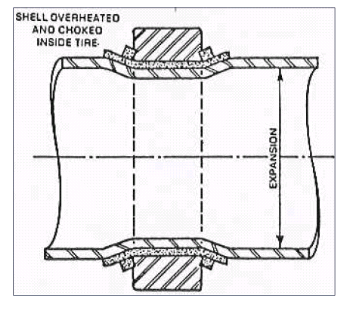
High risk to shrink the shell at start-up
- too quick preheating
- too small cold clearance value
Consequences
- Shell will be deformed permanently
- Will possibly lose some bricks
- Will probably have some problems of fixation
- Will lead to potential shell cracks in the future
Thermal bending
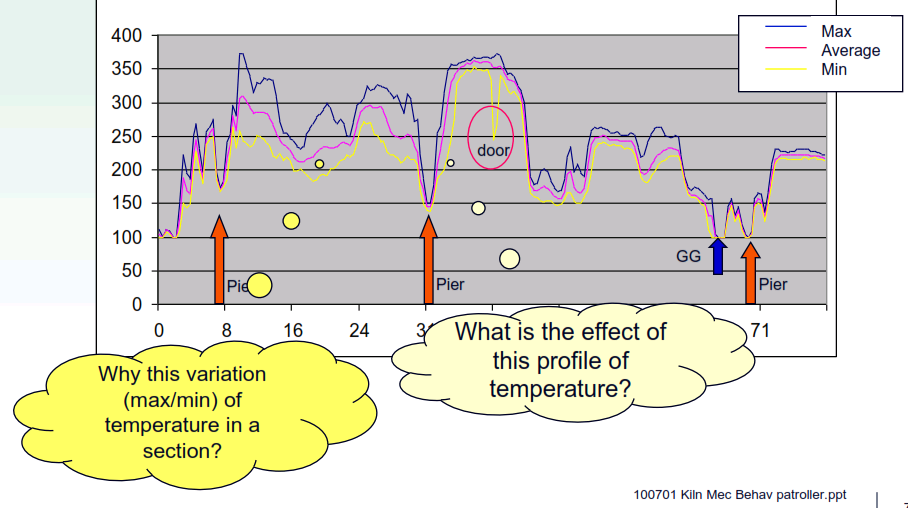
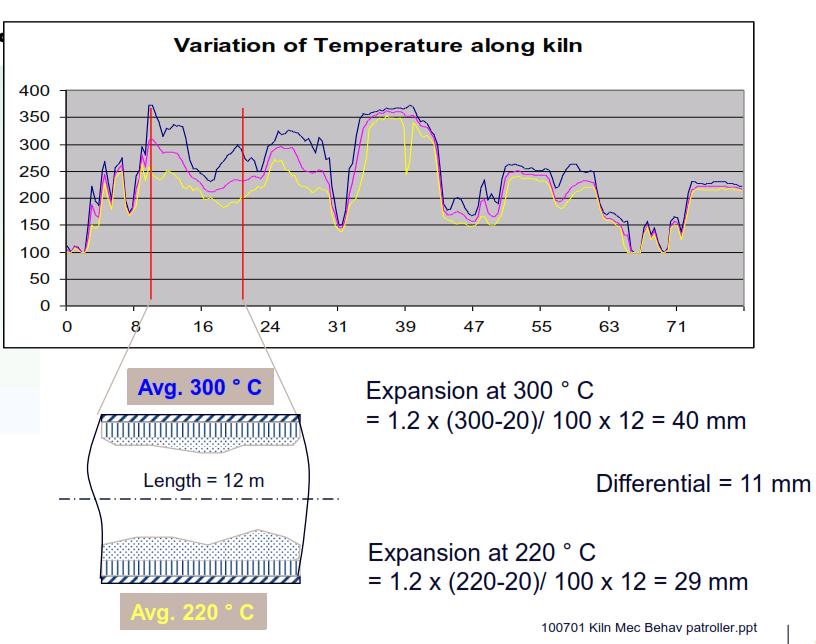
Variation of Temperature along kiln
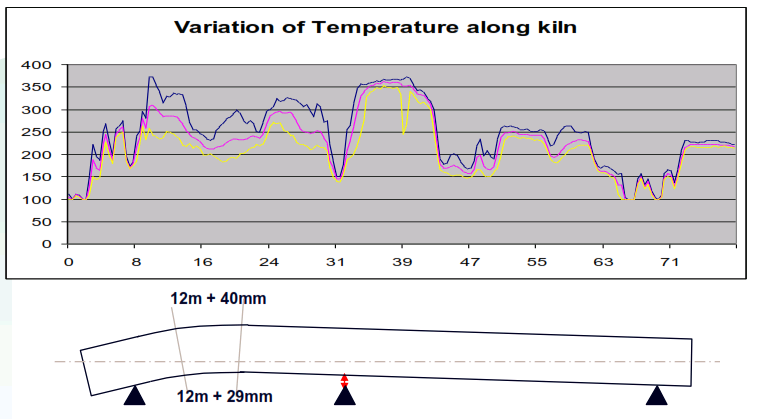
Due to the mass of the kiln, there is still a contact on each pier
- .. but load is lighter at central pier and higher at the other one
- .. and opposite after half a rotation !
If the thermal bending is very high some tyres could even not touch the rollers!
Thermal bending causes
A defect in coating can lead
- To different temperatures on the same section
- Then to differential expansion
- Then to kiln thermal bending
When the kiln is not properly rotated
- During start-up
- During kiln stoppage
When the kiln is not rotated after one incident
- Importance of barring drive!
Thermal bending corrective actions
Modify process parameters
- to get proper equal coating
Barring drive always to be ready to operate
If too late, shell replacement: Figuil (Cameroon) Example
- Production incident, no barring during 10 min.
- Tropical rain (which cools only top of shell)
- Kiln bent forever (tyre/roller clearance 25mm)
- Need for cut or shell replacement
Thermal Expansion effects
Girth-gear root clearance increase
- Girth-gear fixed on the shell
- Example of a 3-pier 4.6 m diameter kiln with pre-heater: Root clearance increases about 6 mm
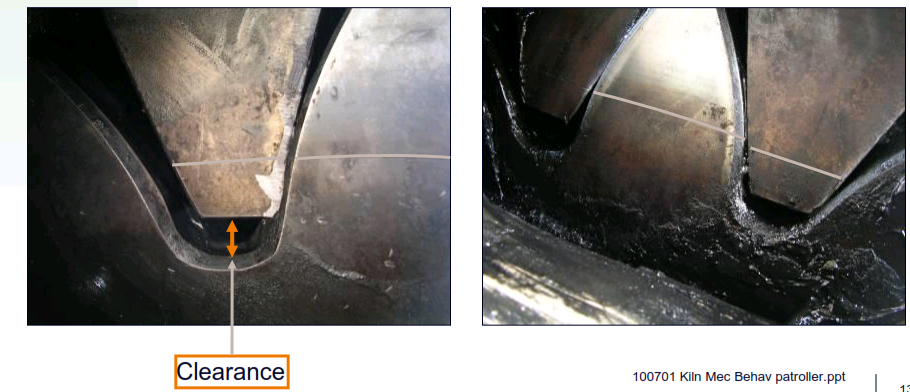
Kiln roller bearing
- Kilns are generally rotating on roller shaft with liners
- Few roller bearings because
- very high loads and low rotating speed
- expensive to design and use
Are there any limits?
- Yes, there is a limit of pressure on a liner
- Special mode of friction, low speed, negative influence
Kiln roller bearing liner Temperature
-Depends on friction -> related to rotation
- Most of the torque used to lift the material inside the kiln / Very little converted to heat through the shaft/liner contact
- Torque liner about Torque motor x (0.03 to 0.05)
-Depends on the load -> related to
- Design. (FLS, POLYSIUS, CLE, FCB using approx. same design limit)
- Quality of geometry and lubrication
- Alignment of kiln tires
- Shell axis deformation (permanent or thermal)
-Shell axis deformation (permanent or thermal)
Expansion effect on Kiln bearing liner
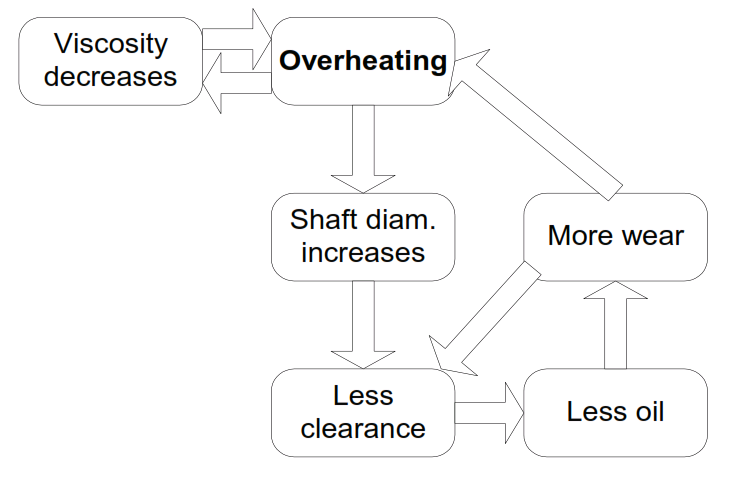
-When the kiln starts, tyre will heat the roller, then the shaft
-After 48 hrs, the shaft diameter will be bigger but the liner support will remain cool (water cooling)
-The expansion of the shaft will reduce the oil film thickness… and the contact will increase
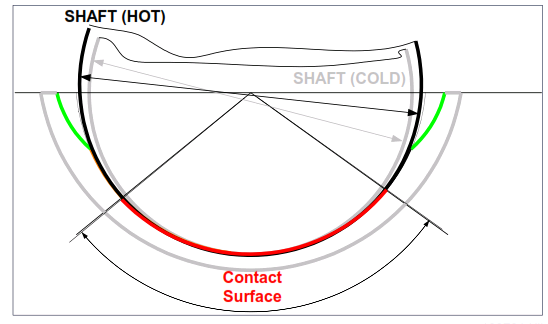
Kiln bearing liner overheating cycle
Kiln bearing liner -> Emergency procedures
Best method = Oil re-circulation with cooling and cleaning
Small units available on the market with installation on request
In case of small problem, putting the kiln on barring can save you!
Time to decrease shaft temperature, get proper viscosity back, come out of the vicious cycle
Cool by air roller flank to limit kiln heat transmission to shaft
Oil usage
The best oil cannot solve contact pattern problems
Very thick oil or synthetic oil cannot solve too low clearance between shaft and liner
Check if this synthetic oil can be mixed with mineral
Check if this synthetic oil does not chemically attack any bearing part
put the highest viscosity you can, assuming the real viscosity will drop very quickly because of temperature (oil viscosity diagram versus temperature must be known)
Kiln bearing liner -> Musn’t
Fan cooling: dangerous on bearing
Housing open = Dust contamination = Be careful!
Are you sure you are cooling the shaft or the housing? (think of expansion)
Cool the roller flank with water
Water on roller is dangerous
Permanent application or heat shock leads to spalling
Use grease or molycot is forbidden very dangerous
can block the oil pocket, preventing any oil from entering to lubricate liner and shaft
Expansion Conclusion
-Heat is a very important parameter for kiln shell
-Attention should be always given to temperatures
- Maximum temperature
- But also differential
-Mechanical staff must take extreme care in case of kiln thermal bending
Mechanical crankshaft
Kiln Misalignment
-As an example on 3 piers, a mechanical bend is one tube which is deformed so the 2nd section is rotating when sections 1 and 3 are perfectly set-up in line
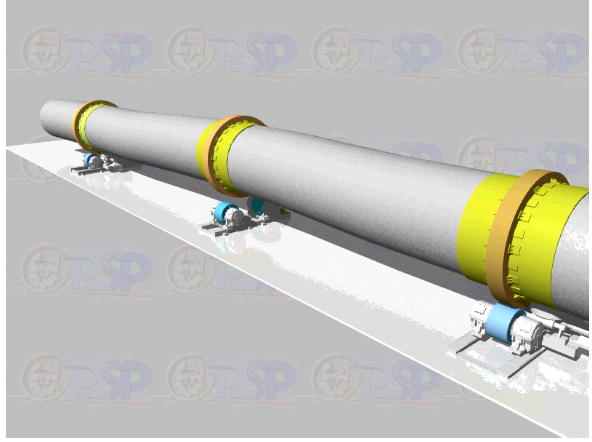
Wrong Kiln Alignment
Wrong alignment of shell at erection due to
Subcontractor’s lack of know-how
Deformed new or old shells
Not properly chosen shells to be replaced
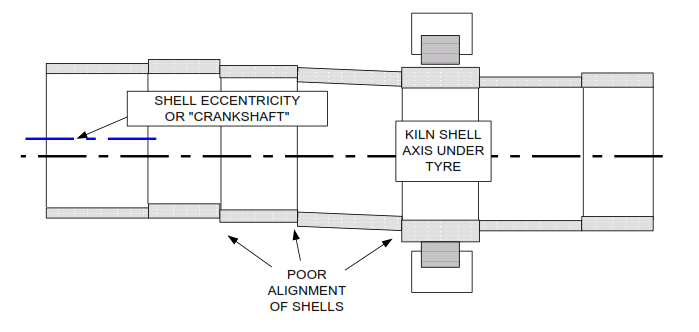
Wrong Kiln Alignment effects
On a poorly aligned 3-station kiln, tire 2 too high by about 10 mm Overload = 8 t/mm x 10 mm = 80 t (TC calculation)
Permanent load supported by this tire = 80 t higher than normal
Possible problems (depending on design safety coefficient) on
Bearing liners overheating
Tyre (wear, holes, crack, …)
Rollers (wear, holes, crack, …)
Shaft crack
Brick failures
- Too high load => too high ovality => problem of bricks
Frame cracks Shell cracks
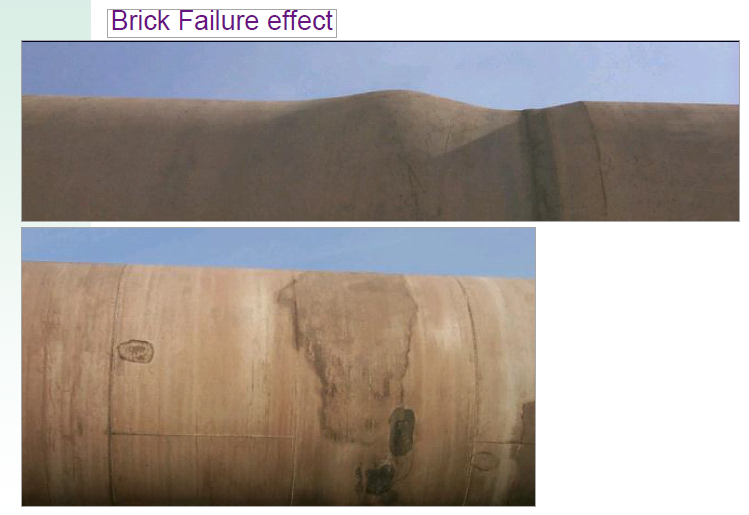
Brick Failure
If not followed by stoppage (major cause)
Too long run with missing bricks / Too high temperature on the shell with bricks
Some indicators
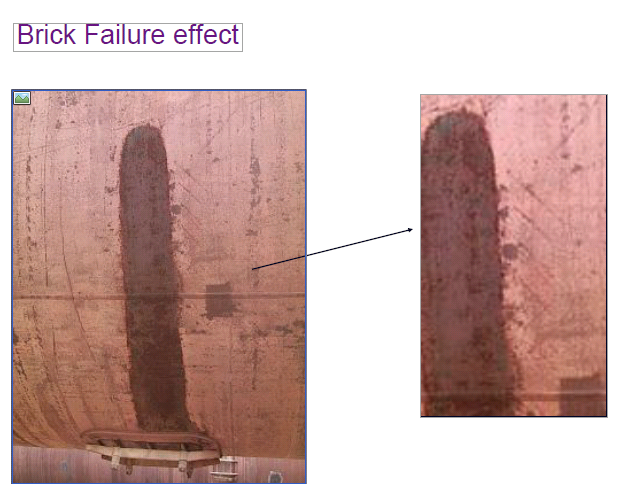
If the circumference of hot-spot is > 90° of the total, it becomes dangerous for the kiln shape, otherwise it will create only local deformations (but still bad)
Axial hot-spots are less dangerous than radial
If not followed by stoppage (major cause)
Too long run with missing bricks / Too high temperature on the shell with bricks
Some indicators
If the circumference of hot-spot is > 90° of the total, it becomes dangerous for the kiln shape, otherwise it will create only local deformations (but still bad)
Axial hot-spots are less dangerous than radial
Brick Failure effect
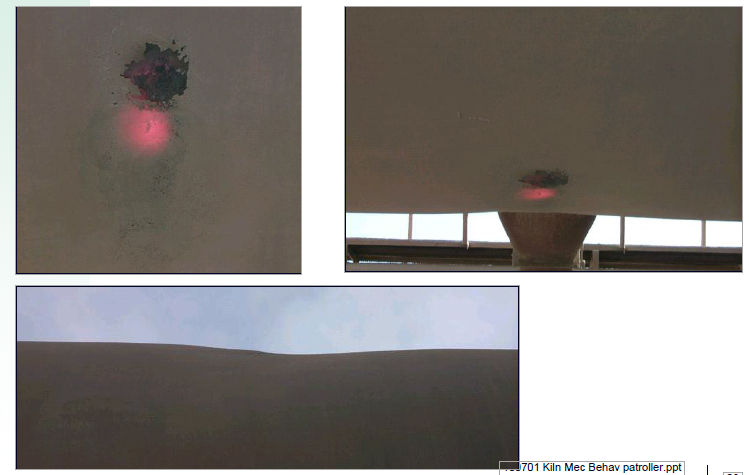
Mechanical crankshaft without visual indications
Possible
Since kilns are generally very flexible, you may have a crankshaft but as the kiln deforms during rotation, the deformation is not visible
Sometimes kilns are affected by several crankshafts in opposite phases
How to check there is a crankshaft?
-By looking for
- Periodical noise at the speed of kiln rotation
- Periodical motor amperage fluctuation
- Periodical deflection of roller shaft
-If you see a significant radial run-out on kiln seals or on the shell between two piers
-IMPORTANT : To detect a potential problem you must wait for 5 or 6 rotations!!!
Dear sir
I am instrument technical 12 year experience in cement plant. ( i need the jobs )
Neelsing