Gas Volume Conversion in Cement Plants
Gas volumes in a cement plant must be compared on the same pressure, temperature and moisture basis. A flow measured in an operating duct at elevated temperature is not directly comparable with a value stated as Nm³/h or another standard-volume basis. The basic correction follows the ideal-gas relationship, using absolute pressure and absolute temperature.
| Conversion | Engineering form | Use it for |
|---|---|---|
| Actual → standard volume | Vstd = Vact × (Pact/Pstd) × (Tstd/Tact) | Normalizing kiln, cooler, mill or filter gas flow to a common reference basis. |
| Standard → actual volume | Vact = Vstd × (Pstd/Pact) × (Tact/Tstd) | Estimating real duct flow, velocity and equipment loading at operating conditions. |
Important: temperatures must be in kelvin (or another absolute scale), pressures must be absolute, and wet/dry gas basis must be handled consistently. If a specification is on a dry basis, correct for water vapour separately rather than mixing wet and dry flow values.
These conversions matter when checking cement-plant process fans, reviewing fuel and combustion formulas, interpreting kiln exhaust-gas measurements, or validating air-flow data used in process calculations. For wider calculation tools, use the free cement engineering calculators.
Need the books, formula references and Excel calculation tools used in day-to-day cement engineering? See the $99 Engineering Essentials package.
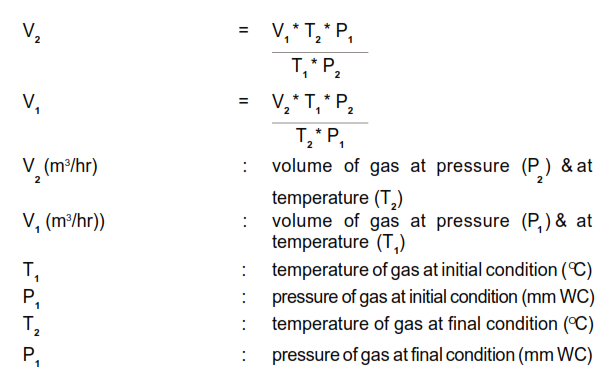
Volume changes of gas
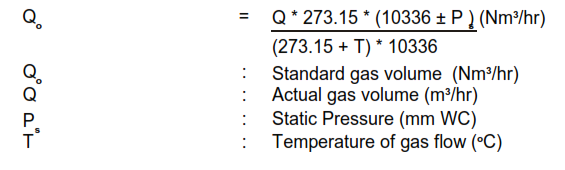
Conversion of actual gas volume to standard gas volume
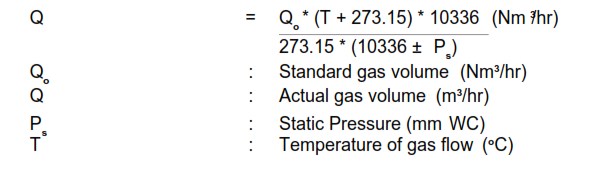
Conversion of standard gas volume to actual gas volume
Plant-Side Checks Before Using a Gas-Volume Result
- Confirm the reference basis. Record the stated standard temperature and pressure instead of assuming one convention.
- Use absolute values. Convert gauge pressure to absolute pressure and Celsius to kelvin before applying the gas-law correction.
- Check wet versus dry gas. Moisture changes the reported dry-gas volume and concentration basis.
- Keep units consistent. Do not mix Pa with bar, °C with K, or m³/h with Nm³/h inside the same equation.
- Sanity-check the result. For the same mass of gas, a hotter operating stream normally occupies a larger actual volume than its normalized volume.
Where These Conversions Affect Cement-Plant Decisions
| System | Why normalization matters |
|---|---|
| Kiln / preheater exhaust | Comparing gas-flow measurements, false-air investigations and process balances on a common basis. |
| Bag filter / ESP | Translating standard flow data into actual volumetric loading and duct velocity at operating temperature. |
| ID, raw-mill and cooler fans | Checking whether quoted flow and measured field flow refer to the same density and reference conditions. |
| Combustion calculations | Keeping air, flue-gas and fuel-related volume figures on a consistent basis before comparing ratios. |
For the chemistry behind clinker phases and cement composition, use the dedicated cement chemical composition guide. This page intentionally stays focused on physical-chemistry and gas-volume calculations.
Next step: keep practical books, formula references and calculation sheets available offline with the $99 Engineering Essentials package.
hey thanks for sharing
very good article keep up the good work