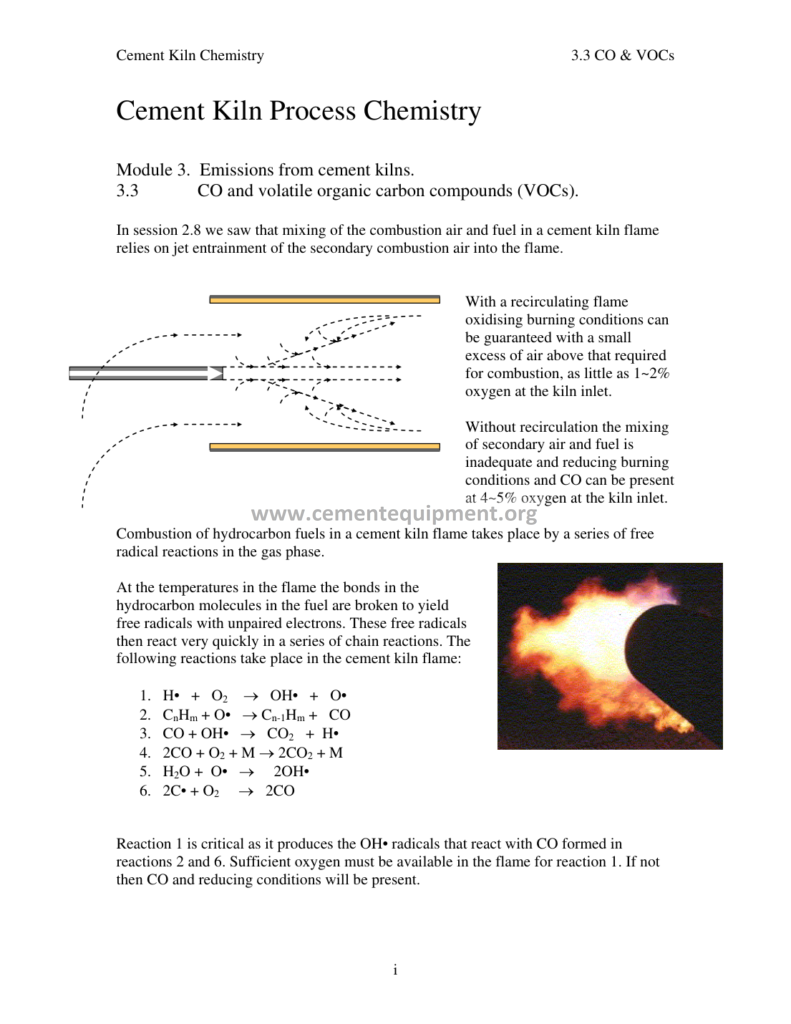
Kc Co And Vocs: Complete Technical Guide
Module 3.3 teaches the two carbon signatures of the imperfect combustion: the carbon monoxide that the flame and the process upsets leave unburned, and the volatile organic compounds that the fuels bring into the gas path before the thermal destruction claims them: the module opens with the combustion chemistry that makes the CO and the organic species, walks the sources through the plant from the flame core to the bypass ducts and the cold starts, teaches the destruction window of the 850 degrees, the 2 seconds and the oxygen availability that the kiln and the calciner provide, explains the FID and the TOC measurement discipline with its units and its conversions, fixes the limits of the order of 10 milligrams per normal cubic meter that the co-incineration permits enforce, and closes with the operating practice that keeps the two carbon families low, because the same tuning that burns the CO completely burns the organics with it.
The Complete Cement Technical Package (931 files including the books, the courses, the Excel tools and the presentations: $249.99 one-time: instant download via the PayPal payment) includes this course module with the gas analysis guides, the combustion tuning sheets and the CEMS checklists: the same package that carries the practical gas analysis books, the combustion and the emission files and the waste fuel handling documents: this article walks the module: the reader finishes it able to read the CO trend as the process health meter, to explain where the organic molecules of the alternative fuels go, to operate the FID and the TOC measurements with the right units, and to run the kiln so that the two pollutants stay at the levels that the permits and the neighbors accept.
The style of the module is the style of the course: the numbers first, the mechanisms second, the plant practice third: the CO and the VOC story is the story of the unburned carbon, the small residue of the combustion chemistry that the same operating window either destroys completely or releases in the peaks, and the module keeps the two species together because their chemistry, their sources and their cures overlap so completely.
1. The Carbon Monoxide Molecule: The Chemistry of the Unfinished Combustion
The module opens with the molecule that the flame usually finishes, and the chemistry of its creation:
- The combustion sequence: the carbon of the fuel burns through the intermediate stage: the carbon reacts first to the carbon monoxide, CO plus one half of the oxygen forming CO2 only in the second step, so the CO is the normal intermediate of every flame, present in the hot reaction zone and disappearing where the oxygen and the temperature complete the oxidation;
- The incomplete combustion equation: where the oxygen, the temperature or the time runs short, the second step stalls and the CO leaves the flame unoxidized: the carbon monoxide in the kiln exit gas is the direct measure of the combustion completion, and its formation route, the carbon plus the limited oxygen, is the same route that the soot and the smoke share;
- The energy message of the CO: the CO oxidation carries heat: the complete oxidation of one mole of the carbon monoxide to the dioxide releases of the order of 283 kilojoules, so every percent of the CO in the exit gas represents the lost combustion energy and the raised heat consumption, the double penalty of the incomplete burning;
- The high-temperature back-reaction: at the flame temperatures above about 1,800 degrees the carbon dioxide itself dissociates partially back into the CO and the oxygen, so the hot flame cores always contain a thermodynamic CO, a fraction that re-oxidizes during the cooling if the oxygen and the residence time allow, and the module notes the balance between the fast quench of the flame and the CO burnout;
- The measurement meaning: the CO concentration in the kiln exit gas of the order of 100 to 500 milligrams per normal cubic meter in the normal operation, rising into the thousands during the upsets, is therefore not a pollutant incident but the running score of the combustion quality, and the module fixes the reading habit from the first section: the CO trend is the process thermometer of the burning;
The molecule’s chemistry sets the tone of the whole module: the CO is the harmless-looking but diagnostically precious product of the incomplete combustion, and the reader learns to read it not as a nuisance of the permit but as the voice of the flame, because where the CO rises the organics follow and the energy wastes with them.
2. The Burnout Chemistry: How the Flame Completes the Oxidation
The module teaches the conditions that finish the CO oxidation, because the same conditions finish the organics:
- The oxidation reaction: the burnout proceeds by the recombination of the carbon monoxide with the oxygen radicals, the CO plus the hydroxyl radical forming the CO2 and the hydrogen, and the carbon monoxide plus the oxygen forming the dioxide and the oxygen radical, the chain chemistry that runs fast above the 700 to 800 degrees and stalls in the cooler gas;
- The three kinetic keys: the burnout rate depends on the temperature, the oxygen availability and the mixing: the high flame temperature accelerates the oxidation exponentially, the excess oxygen above the stoichiometric demand supplies the oxidant, and the turbulence brings the oxidant to the CO, so the burner design and the combustion air tuning are the instruments of the complete combustion;
- The residence time gift: the kiln provides the rare luxury of the long residence: the gas spends the order of 2 to 5 seconds in the kiln at the temperatures above 1,000 degrees, the time window that both completes the CO burnout and destroys the organic molecules of the next sections, the gift of the cement process that the waste incinerators envy;
- The oxygen starvation cases: the burnout fails where the oxygen runs short: the reducing conditions of the kiln inlet that the operators sometimes run to protect the coating, the fuel-rich pockets of the calciner, and the moments when the combustion air lags the fuel feed, each creating the CO spikes that the analyzers report within the seconds to the minutes;
- The quench cases: the burnout also fails where the cooling outruns the chemistry: the cold spots of the tower, the dilution by the false air and the bypass gas paths that drop the temperature below the oxidation threshold, leaving the CO and the organics stranded in the cooled gas on their way to the filter;
The burnout chemistry is the positive half of the section 1: the module now tells the reader what the flame needs to finish its work, and every abatement measure of the later sections, the oxygen control, the flame tuning, the stable feed, is ultimately a measure that serves the two oxidation keys of the temperature and the oxygen inside the available residence time.
3. The Sources of the CO in the Cement Plant: The Upset Ledger
Beyond the steady-state combustion, the CO peaks come from the identifiable events, and the module teaches the source ledger:
- The process upsets: the coating falls and the flushing of the kiln material, the feed interruptions and the fuel surges disturb the fuel-to-air ratio and the heat release, and each major upset writes its CO spike into the analyzer record, with the peaks of the order of 1,000 to 5,000 milligrams per normal cubic meter lasting the minutes to the hours;
- The startup and the shutdown: the cold starts with the unheated kiln, the reduced feed and the oil or the gas auxiliary firing release the highest CO of the month: the flame at the low temperature, the cold walls and the unstable combustion produce the prolonged peaks, the reason the permits often exempt the startup windows with the time limits and the reporting duties;
- The flame quality events: the burner damage, the fuel quality changes, the atomizing or the dispersion air failures, and the alternative fuel feeding upsets distort the flame shape, and the distorted flame leaves the streaks of the unburned carbon that the kiln exit analyzer catches;
- The bypass and the duct paths: the kiln gas bypass that protects the tower from the alkalis and the chlorides diverts a share of the hot gas around the process: the bypassed gas, if quenched or diluted, preserves the CO and the organics of the kiln exit, and the module teaches the plants to account for the bypass share in the stack CO;
- The steady-state baseline: the healthy kiln shows the CO baseline of the order of 50 to 300 milligrams per normal cubic meter at the kiln exit in the stable operation, and the module fixes the diagnostic reading: the rising baseline with the stable oxygen signals the flame degradation, the falling baseline the combustion improvement, and the spike with the returning baseline the passing upset;
The source ledger turns the CO record into the event log: each peak maps to an operational cause, and the module trains the reader to correlate the CO trend against the feed, the fuel, the coating alarms and the startup log, the correlation discipline that turns the analyzer from the report item into the diagnostic tool of the burning section.
4. The CO as the Safety Signal: The Explosion Protection Interface
The CO interacts with the dust collection safety in a way that the module treats before the measurement:
- The flammability envelope: the carbon monoxide burns in the air within the concentration band of roughly 12 to 74 percent, and in the dust-laden gas the CO, the combustible dust and the oxygen form the explosive mixture that the electrostatic precipitators and the baghouses must never see;
- The CO interlock: the precipitator controls trip the high voltage when the CO concentration exceeds the setpoint, typically of the order of 1 to 2 percent in the gas path, de-energizing the collection plates before the spark can ignite the mixture, and the baghouse operations interlock the dampers and the feeds on the same signal;
- The protective consequences: the tripped precipitator means the reduced dust collection and the elevated dust emissions until the CO clears, so the plant pays for the CO excursions in the dust column as well as in the energy, the double reason that the CO discipline is the operating law of the kiln-filter section;
- The monitoring redundancy: the CO interlocks demand the reliable analyzers with the fast response and the regular validation, because the false trips cost the production and the missed trips cost the plant, and the module teaches the dual analyzer configurations and the calibration discipline that the safety instrumented function requires;
- The CO and the reducing atmosphere: the persistent reducing conditions that protect the refractory also favor the sulfate reduction and the alkali volatilization of the earlier modules, and the module notes the chemical family: the same low-oxygen operation that raises the CO changes the sulfur and the alkali chemistry of the whole system, so the CO control is the sentinel of the wider chemical balance;
The safety interface gives the CO its institutional weight: the analyzer is not only the environmental instrument but the protection relay of the dust collection, and the reader of the module learns to treat the CO setpoints with the respect that the safety interlocks command, because the same percentage that the permit tolerates the process cannot ignore.
5. The Measurement of the CO: The Analyzers and the Units
The CO number is only as good as the instrument, and the module teaches the measurement practice:
- The analyzer technologies: the plant CO measurements use the nondispersive infrared absorption at the carbon monoxide band, the in-situ probe versions that measure directly in the duct and the extractive versions that condition and dry the sample, with the electrochemical and the laser-based analyzers completing the instrument family of the modern CEMS;
- The unit conversions: the analyzers report the volume fraction in parts per million, and the conversion to the mass concentration multiplies the parts per million by the molecular mass and divides by the molar volume: for the CO with the molecular mass 28, the factor is of the order of 1.25 milligrams per normal cubic meter per part per million, and the module teaches the conversion by hand because the reporting errors live in the units;
- The sampling locations: the CO for the combustion control is measured at the kiln exit with the short response time, and the CO for the reporting at the stack behind the filter, with the two locations telling the two stories: the process condition upstream and the permit compliance downstream;
- The response time discipline: the combustion-control CO needs the response of the order of seconds to the minute, so the extractive systems run the heated sample lines and the fast pumps, and the module teaches the line lengths, the flow rates and the purge cycles that keep the response believable;
- The validation routine: the CO analyzers are validated against the zero and the span gases of the certified concentration, on the weekly and the quarterly schedules, and the module teaches the audit trail: the calibration records, the response time tests and the drift history that the inspectors and the quality systems both read;
The measurement section fixes the language of the module: the parts per million and the milligrams per normal cubic meter, the kiln exit and the stack locations, the infrared and the laser technologies, and the calibration discipline, so the reader from here on reads every CO number with the knowledge of what the instrument actually saw and where.
6. The CO in the Reporting and the Limits
The CO enters the permits and the reporting in several ways, and the module teaches the regulatory face:
- The combustion quality indicator: the CO is rarely limited as a straight emission limit value of the cement permit: instead it appears as the quality indicator of the combustion and the destruction conditions, with the operating permits and the BAT references quoting the normal operating ranges of the order of 100 to 500 milligrams per normal cubic meter;
- The destruction guarantee role: where the plant co-processes the waste fuels, the CO and the gas temperature jointly prove the destruction conditions of the waste incineration rules: the combustion gas reaching the 850 degrees with the two seconds residence and the adequate oxygen, the conditions that the modules 3.3 and 3.4 share, and the CO monitoring backs the proof;
- The spike handling: the permits treat the CO peaks with the averaging rules: the ten-minute, the half-hour and the daily averages smooth the spikes, and the module teaches the averaging arithmetic and the exceedance accounting that the reporting department runs when the coating falls or the start-up passes;
- The carbon monoxide as the greenhouse gas: beyond the local air regulation, the CO carries the climate significance: its warming effect per unit mass is on the order of three times that of the CO2 over the century horizon, so the incomplete combustion of a percentage point of the fuel carbon adds a disproportionate warming footprint on top of the energy waste;
- The comparison discipline: the module closes the regulatory section with the honest note: the CO figures of the different plants are comparable only at the same reference conditions of the dry gas, the normal cubic meter and the reference oxygen, the discipline that the whole course applies to every concentration it quotes;
The reporting face of the CO shows the reader the double bookkeeping: the CO is at once the environmental minor and the combustion major, the small mass flow in the emission report and the large operating signal in the process control room, and the plant that understands the duality reports the numbers and runs the process with the same instrument.
7. The Volatile Organic Compounds: The Chemistry of the Fuel-Borne Carbon
The second carbon family of the module arrives with the fuel and the waste streams, and the module teaches the VOC chemistry:
- The compound family: the volatile organic compounds are the carbon compounds that evaporate at the ambient and the process temperatures: the alkanes and the alkenes of the solvents and the fuels, the aromatic hydrocarbons of the benzene, the toluene and the xylene family, the oxygenated compounds of the aldehydes, the ketones and the alcohols, and the chlorinated species of the waste chemistry;
- The measurement definition: the permits measure the organic content as the total organic carbon, the TOC, or the total hydrocarbon concentration, the THC, reported in the carbon mass units: the FID analyzer of the section 10 counts the carbon atoms of every molecule it ionizes, so the limits are written in the language of the carbon rather than of the individual compounds;
- The sources in the cement process: the organics enter with the alternative fuels: the solvents and the degreasers of the industrial wastes, the plastics and the polymers, the tires and the rubber, the biomass tars and the sewage sludge organics, and they enter also with the raw materials in the rare carbon-bearing deposits and with the process additives;
- The fate map: each organic molecule that enters the system either evaporates in the preheater and the feeding points, is destroyed in the hot zones, or escapes with the dust and the condensates: the module teaches the fate map before the destruction chemistry, because the control levers differ for the three fates;
- The odor and the plume relevance: the escaped organics color the emissions beyond the mass limits: the solvent odors in the neighborhood, the condensable organic mists in the plumes of the module 3.8, and the photochemical reactivity in the atmosphere, so the VOC control is the neighborhood-relations issue as much as the permit issue;
The compound family defines the enemy: the volatile organics are a legion of individual molecules with the common property of the carbon backbone and the volatility, and the module teaches the reader to think in the two aggregates that the measurement and the permits use, the TOC and the THC, while keeping the individual culprits in mind for the odor and the plume questions.
8. The VOC Sources in the Plant: The Feeding Points and the Cold Paths
The organic story is written at the feeding and the temperature boundaries, and the module teaches the source inventory:
- The fuel feeding points: the alternative fuel feeding to the calciner and the kiln inlet delivers the organics straight into the hot gas: the well-designed feeders and the air-locked introductions minimize the evaporation before the hot zone, while the sloppy feeding chutes and the coarse fuel fractions flash the volatiles into the preheater gas where the temperatures fall below the destruction window;
- The waste storage and the handling: the stored waste fuels, the sewage sludge and the biomass evaporate their volatiles in the stockpiles, the hoppers and the transfer points, and the module teaches the ventilation and the capture of the handling areas, because the fugitive organics reach the environment without ever passing the stack;
- The raw material organics: the carbon-bearing raw materials, the contaminated soils and the industrial by-products burned in the kiln release their organic content during the preheating, with the release temperature profile of the compounds setting the stage at which the evaporation happens and the chance the hot zone has to catch the molecules;
- The cold gas paths: the bypass ducts, the conditioning towers, the mills that dry with the kiln gas and the filter housings carry the gas at the temperatures below the destruction threshold, and any organic that the hot zone missed or the feed point bypassed sails through these cold paths into the stack;
- The startup residues: the cold plants with the cold ducts and the filters below the dew point accumulate the organic condensates during the starts, and the first hot gases of the startup re-evaporate the residues in a burst, the classic reason the startup TOC peaks follow the CO peaks of the section 3;
The source inventory maps the organic battlefields: the feeding points, the storage and the cold paths, and the module fixes the mental image of the organic journey, from the waste pile through the feeder and the hot zone to the destruction or the escape, with the plant controlling the journey at every station where the temperature falls short of the destruction window.
9. The Destruction Chemistry: The 850 Degrees, the 2 Seconds and the 6 Percent Oxygen
The kiln’s organic destruction duty rests on the famous operating rule, and the module teaches its chemistry:
- The destruction conditions: the complete destruction of the organic molecules requires the gas temperature of at least 850 degrees Celsius, the residence time of at least 2 seconds at that temperature, and the oxygen availability above about 6 percent, the international rule of the waste combustion that the cement kiln and the calciner meet in their design;
- The kinetics of the destruction: the organic molecules crack and oxidize through the radical chain reactions: the hydrocarbon radicals react with the oxygen and the hydroxyl radicals into the intermediates and finally into the carbon dioxide and the water, with the reaction rates rising steeply with the temperature, so the 850 degree threshold with the 2 seconds destroys the ordinary organics by several orders of magnitude;
- The kiln and the calciner geometry: the precalciner kiln places the destruction duty on the calciner vessel: the fuel and the waste feed burn in the 850 to 900 degree gas of the calciner with the turbulent residence of 2 to 4 seconds, and the kiln itself provides the 1,200 to 1,500 degree flame zone, the two chambers covering the destruction duty from both sides;
- The destruction efficiency numbers: the well-operated kiln and calciner destroy the volatile organics with the efficiency of the order of 99.9 percent and higher: the stack TOC of the normal operation runs in the single-digit milligrams per normal cubic meter against the tens of kilograms of the organic inputs, the ratio that the module quotes as the plant’s destruction ledger;
- The failure windows: the destruction guarantee weakens in the identifiable windows: the cold starts, the low-load operation, the oxygen-starved moments and the bypassed gas paths, and the module teaches the operating protocols that close the windows: the minimum feed rates, the auxiliary firing, the oxygen floor and the bypass management that keep the destruction conditions satisfied in every operating phase;
The destruction chemistry is the heart of the module: the cement kiln is one of the few industrial furnaces that meets the international destruction rule by its geometry alone, and the reader leaves the section able to verify the rule in any plant, by the calciner temperature, the gas residence and the oxygen reading, the three numbers that the waste authorities ask for in every audit.
10. The Measurement of the Organics: The FID and the TOC
The organic measurement has its own instruments and its own unit conventions, and the module teaches them:
- The flame ionization detector: the FID measures the organic carbon: the sample gas passes through the hydrogen flame, the carbon atoms ionize, and the ion current is proportional to the carbon concentration, giving the total hydrocarbon reading that the plants and the permits use;
- The carbon-based units: the FID response is calibrated against the propane, and the result is reported as the carbon mass, the total organic carbon in milligrams of carbon per normal cubic meter: the unit conversion from the volume fraction to the mass applies the carbon molar mass of 12 and the molar volume of 22.41 liters, so 1 part per million by volume as the carbon-equivalent weighs of the order of 0.54 milligrams per normal cubic meter;
- The sample conditioning: the organic analyzers run on the filtered, heated sample: the heavy and the condensable organics would otherwise drop out of the gas in the sampling line, and the module teaches the heated filters, the transfer line temperatures above the dew point and the probe purges that keep the sample representative;
- The measurement locations: the TOC for the destruction verification is measured at the stack behind the filter, and the plants additionally sample the preheater gas during the development work, because the difference between the two locations tells the destruction performance and the condensation losses apart;
- The validation and the artifacts: the FID responds to the methane and the propane in the same way but unevenly to the heavy chlorinated species, so the module teaches the calibration gases, the response factor checks and the interference notes that keep the TOC number honest across the fuel changes;
The measurement section equips the reader with the organic counting instrument: the TOC in milligrams of carbon is the universal language of the organic permits, the FID is its instrument, and the heated sampling train its discipline, so the plant numbers are comparable with the numbers of the waste incineration world that shares the same FID and the same units.
11. The Limits and the Reporting of the Organic Compounds
The organic concentrations meet the law at the stack, and the module teaches the limit landscape:
- The co-incineration limit: the plants that co-process the waste fuels in the European frame hold the total organic carbon limit of 10 milligrams per normal cubic meter as a daily average, the value inherited from the waste incineration rules and applied to the cement kilns that use the waste as the fuel;
- The normal operation reality: the well-operated kiln runs the stack TOC well below that value: the steady-state readings in the range of 1 to 5 milligrams per normal cubic meter are the typical results of the destruction performance of the section 9, with the peaks appearing only in the startup and the upset windows;
- The BAT references: the best available technique conclusions for the cement industry quote the TOC ranges of the order of 10 milligrams per normal cubic meter as the achievable level with the optimized combustion and the stable operation, and the module teaches the reader to read the BAT documents with the operating percentiles in mind;
- The speciation duties: beyond the aggregate TOC, the permits and the health assessments sometimes demand the individual compound measurement: the benzene, the formaldehyde, the polycyclic aromatics and the chlorinated species by the sampling and the laboratory analysis, with the occupational and the neighborhood assessments drawing on the same data;
- The reporting cycle: the TOC joins the other CEMS channels in the daily, the monthly and the annual reporting: the averages, the exceedances and the operating hours, and the module teaches the reporting structure that keeps the organic column of the emission report as disciplined as the dust and the NOx columns;
The limits convert the organic chemistry into the compliance numbers: the 10 milligrams per normal cubic meter daily average is the target that the destruction window of the section 9 exists to serve, and the reader now carries both the mechanism and the number, able to explain to the inspector exactly why the steady-state TOC runs low and where the rare peaks come from.
12. The Plant Practice: Keeping the CO and the VOC Low in Operation
The module closes its technical teaching with the operating practice that keeps the two carbon families at their lows:
- The oxygen discipline: the kiln exit oxygen of the order of 1.5 to 3.5 percent and the calciner oxygen of 1 to 2.5 percent are the first setpoints of the CO control: the oxygen floor that keeps the burnout chemistry alive while the operators hold the flame shape, and the module teaches the trade between the reducing coating protection and the CO control;
- The feed stability: the stable kiln feed and the stable fuel ratio are the second setpoint family: the feed surges and the coating events are the CO writers of the section 3, so the preheater and the silo discipline of the module 1 return here as the emission instruments, with the automatic kiln control systems that smooth the fluctuations;
- The flame management: the burner adjustments of the primary air, the axial and the swirl settings and the fuel dispersion shape the flame that the burnout needs, and the module teaches the flame inspections, the NOx and the CO correlation charts and the burner maintenance that keep the flame long enough and hot enough;
- The startup protocols: the cold starts follow the written ramp: the auxiliary fuel firing, the feed ramp, the bypass and the filter preheating sequences, with the CO and the TOC monitored during the whole window, and the module teaches the startup checklist that keeps the peaks short and the reporting honest;
- The monitoring integration: the plant control system displays the CO, the O2, the NOx and the temperatures on the same screen, the correlation charts flag the developing problems, and the module closes the practice with the integration lesson: the emission engineer and the kiln operator read the same instruments, because the CO and the VOC are the combustion itself, reported in the language of the permit;
The plant practice turns the module into the shift discipline: the oxygen setpoints, the feed stability, the flame management and the startup protocols are the four legs of the unburned-carbon control, and the reader who runs them keeps the CO in the hundreds of milligrams and the TOC in the single digits, the numbers that the sections 6 and 11 have taught the reader to report.
13. The CO and the VOC in the Wider Environmental Picture
The two carbon families interact with the atmosphere and with the other emissions, and the module places them in the wider frame:
- The atmospheric chemistry: the escaped volatile organics react in the sunlight with the nitrogen oxides into the ozone and the secondary organic aerosols: the photochemical smog chemistry of the urban and the industrial atmospheres, and the module teaches the ozone formation potential that the VOC reduction credits carry in the air quality planning;
- The plume interaction: the organics and the CO travel in the plume of the module 3.8: the condensable organic mists contribute to the visible haze, the odors reach the downwind neighborhoods, and the module links the carbon families to the plume sections so the reader sees the stack as the common delivery point of the whole emission basket;
- The dust partnership: part of the organic carbon leaves the stack adsorbed on the dust particles: the fine dust of the filter carries the condensed organics with it, so the dust collection efficiency of the order of 99.9 percent that the modern baghouses achieve is also an organic emission control, and the module teaches the coupling of the two measurement worlds;
- The health perspective: the individual organic species carry the health assessments: the carcinogenic aromatics and the benzene values that the occupational and the ambient standards watch, and the module teaches the honest framing: the aggregate TOC limit of 10 milligrams protects the neighborhood in the aggregate while the speciated measurements protect it in the detail;
- The energy and the carbon connection: the CO and the VOC are the lost fuel: their carbon either wasted or undermeasured, and the module closes the picture with the triple benefit of the complete combustion: the lower emissions, the lower fuel consumption and the lower carbon footprint, the three accounts that the same burner tuning serves;
The environmental frame rounds out the module: the CO and the VOC are not the isolated molecules of the analyzer but the active participants of the atmospheric chemistry, the plume appearance and the neighborhood complaints, and the reader leaves the module with the full chain: the combustion chemistry that forms them, the operating windows that destroy them, and the environment that receives whatever escapes.
The Frequently Asked Questions
Why does the cement kiln produce the carbon monoxide in the normal operation?
Because the CO is the intermediate of every combustion: the carbon oxidizes first to the CO and then to the CO2, and where the mixing, the temperature or the oxygen falls short of the completion, part of the intermediate leaves unburned, with the healthy kiln running in the 100 to 500 milligrams per normal cubic meter range and the upsets driving the peaks into the thousands.
What happens when the carbon monoxide rises too high in the gas path?
The CO above the setpoints of the order of 1 to 2 percent trips the electrostatic precipitator high voltage, because the CO, the dust and the oxygen form the flammable mixture that the spark gap could ignite: the plant then pays in the reduced dust collection until the combustion recovers, the reason the CO control is an operating law rather than a reporting nicety.
How are the volatile organic compounds measured in the cement plant?
With the flame ionization detector: the sample gas passes through the hydrogen flame, the carbon atoms ionize, and the ion current gives the total hydrocarbon concentration, reported as the total organic carbon in milligrams of carbon per normal cubic meter after the propane calibration, with the heated sampling train keeping the heavy organics in the gas phase.
What is the 850, 2 and 6 rule of the organic destruction?
The destruction of the organic compounds is guaranteed when the combustion gas holds at least 850 degrees Celsius for at least 2 seconds with the oxygen above about 6 percent, the conditions that the kiln and the calciner geometry provide, achieving the destruction efficiencies of the order of 99.9 percent in the normal operation.
Which limit do the permits place on the organic emissions of the cement kiln?
The plants that co-process the waste fuels hold the total organic carbon limit of 10 milligrams per normal cubic meter as the daily average in the European frame, with the well-operated kilns running in the 1 to 5 milligrams range in the steady state and the peaks confined to the startup and the upset windows.
Do the alternative fuels increase the VOC emissions of the kiln?
Only where the handling and the feeding fail: the organics of the waste fuels are destroyed in the hot zones with the 99.9 percent efficiency when the feeding delivers them into the 850 degree window, while the leaks at the storage, the chutes and the cold ducts release the fugitive organics without the stack, so the VOC control of the alternative fuel plant is mostly a feeding and a housekeeping discipline.
The module 3.3 has taught the complete story of the unburned carbon: the CO of the imperfect combustion with its formation chemistry, its burnout kinetics, its upset ledger and its safety interlock, and the volatile organics with their compound family, their feeding-point sources, their 850 degree destruction window, their FID measurement and their 10 milligram limit, and the reader leaves able to read the CO trend as the process health meter and to keep both carbon families at the lows that the sections of this module have quantified.
The Complete Cement Technical Package includes this course with the gas analysis guides, the combustion tuning sheets and the CEMS checklists: the one-time 249.99: the instant download: the carbon monoxide and the organic module is the operating heart of the emission course, and the reader carries its numbers, from the 1.25 milligrams per part per million conversion through the 99.9 percent destruction to the 10 milligrams per normal cubic meter limit, into the control room and the permit discussions alike.
The module closes with the sentence that the kiln operators should remember: the CO and the organic emissions are not the enemies but the messengers of the combustion, the same flame that burns the clinker either completes the oxidation or reports the failure, and the operator who listens to the messengers with the oxygen setpoints, the stable feed and the startup discipline keeps the stack numbers low while the production runs high.
The reading plan for the engineer: watch the kiln exit CO and O2 on the same trend, correlate every peak with the feed and the fuel events, keep the FID and the TOC sampling trains heated and clean, and revisit the destruction window of the section 9 whenever the alternative fuel mix changes, because the organic story of module 3.3 is written fresh with every fuel contract the plant signs.
Get this kiln chemistry file + the full 931-file package
$249.99 — one-time purchase, instant download, lifetime access
This file is part of the Complete Cement Technical Package (931 files) available from cementequipment.org. Respective rights holders; library copy for the licensed single user.