Kiln Chemistry Course 3: Dioxins and Furans
Module 3.4 teaches the most feared trace emissions of the thermal process world, and it teaches them with the precision that the fear demands: the polychlorinated dibenzodioxins and the dibenzofurans, the 210-member family of which 17 congeners carry the toxic significance, form in the cement kiln not in the hot zone but in the cool gas paths, through the precursor condensation routes and the de novo synthesis on the dust surfaces, in the temperature band between about 250 and 450 degrees Celsius where the chlorine, the carbon, the oxygen and the catalytic metals of the fly ash meet: the module teaches the molecular families and the toxicity equivalence arithmetic, the two formation mechanisms with their chemistry and their windows, the destruction side of the 2-3-2 rule that the kiln provides, the quench and the dust collection strategies that freeze the reformation, the activated carbon injection that scrubs the surviving traces, the EN 1948 sampling and the TEQ reporting, the 0.1 nanogram per normal cubic meter limit of the European frame, and the plant practice that keeps the cement kiln one of the cleanest performers of the industrial world on this exact measurement.
The Complete Cement Technical Package (931 files including the books, the courses, the Excel tools and the presentations: $249.99 one-time: instant download via the PayPal payment) includes this course module with the dioxin sampling checklists, the congener calculation sheets and the monitoring plan templates: the same package that carries the combustion and the emission handbooks, the waste co-processing documents and the environmental analysis books: this article walks the module: the reader finishes it able to name the 17 toxic congeners, to compute the TEQ of any congener profile, to explain the de novo window to the operators, to design the quench and the activated carbon response, and to defend the cement kiln’s dioxin record with the numbers instead of the headlines.
The style of the module is the style of the course: the numbers first, the mechanisms second, the plant practice third: the dioxin story is the story of the parts-per-trillion chemistry, measured in the nanograms, limited at the 0.1 and won by the temperature discipline, and the module keeps the scale visible throughout, because the dioxin debate is won and lost on the honest handling of the very small numbers.
1. The Molecular Families: What the Dioxins and the Furans Actually Are
The module opens by naming the molecules precisely, because the popular name covers a large family:
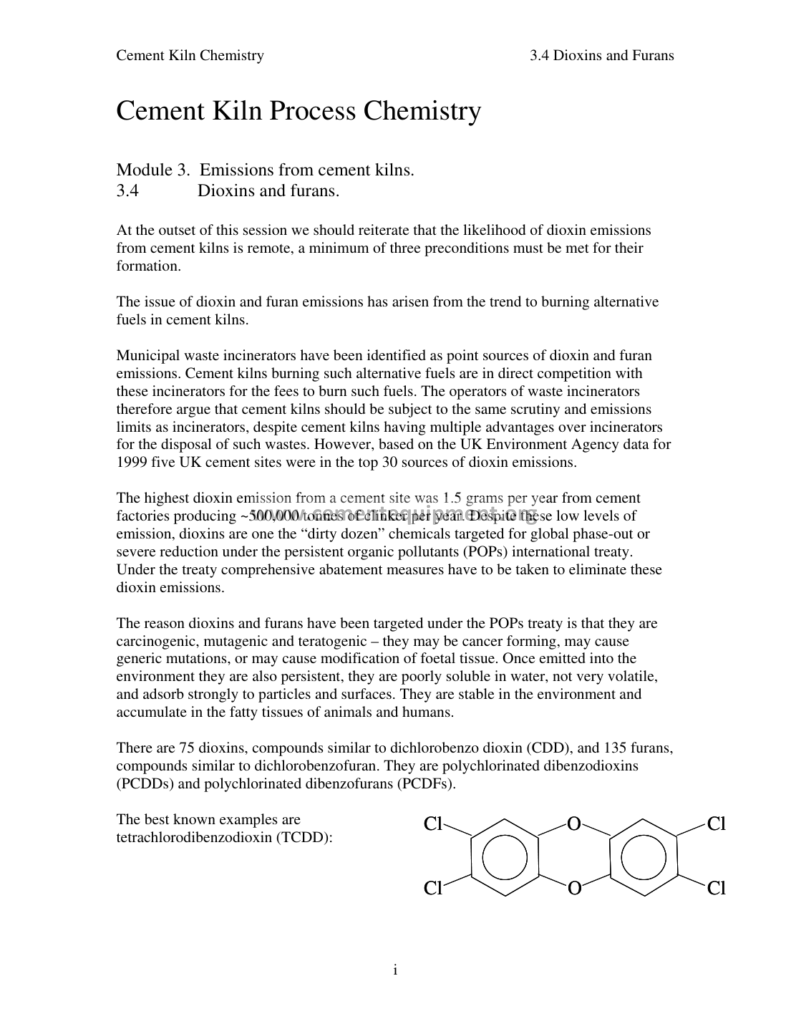
- The two parent rings: the polychlorinated dibenzodioxins, the PCDD, carry the two benzene rings linked by the two oxygen bridges, and the polychlorinated dibenzofurans, the PCDF, carry the two rings linked by one oxygen and one carbon-carbon bond: the two planar families that the chemistry of the combustion and the reformation creates;
- The congener count: the chlorine atoms substitute the ring positions in the patterns: the dioxins count 75 possible congeners, the furans 135, and the 210-member family is the complete population from which the environment and the analytical world pick the relevant members;
- The 17 toxic members: of the 210, exactly 17 congeners carry the recognized toxic significance, the ones with the chlorine at the 2, 3, 7 and 8 positions, the four lateral positions that the toxicological studies associate with the strongest effects, and the module fixes the list: the 7 toxic dioxins and the 10 toxic furans;
- The two most cited: of the 17, the 2,3,7,8-tetrachlorodibenzo-p-dioxin, the TCDD, is the reference member with the toxicity factor of 1, and the 2,3,7,8-tetrachlorodibenzofuran follows at the factor 0.1, the two names that the newspaper headlines and the regulatory documents share;
- The toxicity equivalence arithmetic: because the 17 congeners differ in their potency by orders of magnitude, the reporting converts them into the single number: each congener’s measured concentration multiplies by its toxic equivalence factor, the TEF, and the sum is the toxic equivalent, the TEQ, expressed in the nanograms per normal cubic meter, the unit of the entire dioxin regulation;
The molecular inventory gives the module its language: the dioxins and the furans are not one compound but the 210-member family with the 17 toxic members and the TEQ arithmetic that reduces them to one comparable number, and the reader who masters the family names and the TEQ logic can follow every limit and every measurement of the sections that follow.
2. The Formation Chemistry: The Precursor Route in the Gas Phase
The dioxins are not created in the flame itself, and the module teaches the first formation route:
- The precursor molecules: the dioxin formation starts from the chlorinated aromatic precursors: the chlorophenols and the chlorobenzenes that the imperfect combustion of the chlorine-bearing materials creates, with the chlorophenols the classic building blocks of the dioxin rings;
- The condensation chemistry: the two chlorophenol molecules condense through the ether bond formation and the ring closure into the dibenzodioxin structure, with the chlorine and the oxygen substitution patterns inherited from the reactants, and the furans form through the analogous condensation paths without the second oxygen bridge;
- The gas phase window: the homogeneous precursor reactions proceed in the gas phase in the temperature band of roughly 200 to 400 degrees Celsius, the cool zones of the gas path where the molecules have the time to meet and the temperatures to react, not the hot flame where the same molecules would burn;
- The chlorine source: the chlorine for the chlorination comes from the process inputs: the chloride of the raw materials, the chloride of the fossil and the waste fuels, and the hydrogen chloride that the combustion releases, and the module teaches the chloride balance that the modules 1 and 2 already established, now applied to the molecular chlorination chemistry;
- The survival chain: the precursors themselves arise in the imperfect combustion: the aromatic fragments of the plastic and the solvent molecules that escape the complete oxidation, the soot-adjacent chemistry of the fuel-rich pockets, so the precursor route connects the dioxin risk back to the combustion quality that the module 3.3 taught;
The precursor route shows the reader the first assembly line: the chlorine, the aromatic fragments and the cool gas windows combine to build the dioxin rings step by step, and the module teaches the route so the reader understands why the hot, well-mixed, oxygen-rich combustion of the kiln is the first line of the dioxin defense: the better the combustion, the fewer the precursors.
3. The De Novo Synthesis: The Surface Chemistry of the Fly Ash
The second formation route is the dominant one in the industrial gas paths, and the module teaches its surface chemistry:
- The principle: the de novo synthesis builds the dioxins on the surface of the dust particles: the carbon residues of the incomplete combustion, the carbon char and the soot deposited on the fly ash, react with the oxygen and the chlorine in the presence of the catalytic metals, rebuilding the dioxin rings from the carbon skeleton itself;
- The temperature window: the de novo chemistry runs between about 250 and 450 degrees Celsius with the maximum near 300 to 350: below the window the reactions are too slow, above it the molecules burn as fast as they form, and the module fixes the window as the central number of the dioxin control, because the gas paths of the plants traverse exactly this band;
- The catalytic requirement: the copper compounds, above all the copper chloride, catalyze the de novo synthesis dramatically, with the iron, the zinc and the other transition metals contributing at the lower rates, and the module teaches the catalyst chemistry: the redox cycling of the copper between its valence states that activates the chlorine transfer onto the carbon;
- The oxygen and the carbon requirements: the synthesis needs the residual carbon on the dust, the oxygen of the flue gas and the chlorine: the three ingredients together with the metal catalyst and the temperature window, and the module teaches the five-condition check: carbon, chlorine, oxygen, catalyst, temperature, the pentagon that every dioxin control strategy attacks on at least one side;
- The rate numbers: the de novo synthesis rates on the real fly ash samples measured in the laboratory show the formation in the microgram per kilogram of dust range over the hours of residence in the window, the small but persistent yields that the multi-hour residence of the dust in the tower sections can accumulate;
The de novo mechanism is the heart of the module: the dioxin reformation is a dust-surface chemistry of the cool gas path rather than a flame chemistry, and the reader learns to see the fly ash, the copper and the 300 degree duct sections as the chemical reactor that the plant must either cool fast, filter early or poison with the additives, the three control families of the sections 7 to 9.
4. The Chlorine, the Copper and the Memory Effect: The Enabling Chemistry
The dioxin chemistry runs on the enabling species, and the module teaches the three enablers:
- The chlorine inventory: the chlorine enters with the raw materials, the fuels and the waste streams, and its behavior in the kiln follows the chloride cycle of the module 1: the volatile chloride leaves the burning zone, condenses in the preheater, and concentrates in the dust and the bypass, so the plants with the chloride-rich fuels and the limited bypass carry the higher chlorine availability in exactly the temperature zones where the de novo chemistry wants it;
- The copper inventory: the copper enters with the raw materials and the recycled industrial wastes: the clinker copper content of the ordinary plants runs in the tens of milligrams per kilogram, and the module teaches the correlation: the higher the copper in the dust that recycles through the cool zones, the stronger the catalytic push on the de novo synthesis, the reason the waste-derived fuels with the copper-rich sludges attract the additional monitoring attention;
- The memory effect: the deposits on the walls of the tower and the ducts store the dioxins and their precursors: the layer of the dust and the condensate that grows in the cool sections absorbs the molecules during the high-load phases and re-emits them during the process changes, the startups and the upsets, the “memory effect” that makes the dioxin emissions of a plant follow the operating history, not only the current conditions;
- The operating events: the memory effect explains the measurement surprises: the dioxin stack values that rise after the load changes and the cold starts without any change in the fuel chemistry, and the module teaches the plants to schedule the dioxin measurements in the stable operation and to interpret the peaks with the operating log;
- The dust recycle chain: the recycled kiln dust and the filter dust re-enter the process with their accumulated chlorine, the copper and the dioxin residues, so the dust management of the plant is simultaneously the dioxin inventory management, the connection that the section 11 develops into the operating practice;
The enabling chemistry teaches the reader the second control target: the dioxin risk of a plant is written by its chlorine and its copper balances and its deposit memory long before the molecules form, and the module places the three enablers on the same ledger as the emissions, so the plant manages the dioxins by managing the inputs and the deposits, not only the stack.
5. The Temperature Windows in the Cement Process: Where the Risk Lives
The de novo window sits in specific physical places of the plant, and the module maps them:
- The lower preheater stages: the gas of the top cyclone stages of the five and six stage towers leaves the meal at temperatures of 280 to 400 degrees Celsius, exactly inside the de novo window, and the suspended dust of these stages is the residence-time home of the surface synthesis, the first risk address of the plant;
- The conditioning and the drying sections: the conditioning towers that cool the kiln gas for the raw mill drying and the gas cooling bring the gas through the 400 to 200 degree band, with the water injection adding the moisture, and the module teaches the residence and the deposition of these sections as the second risk address;
- The filter inlet zone: the gas enters the bag filter and the ESP at the 150 to 200 degrees in the modern plants, just below the fast edge of the window, but the dust layer on the bags and the hoppers holds the 250 to 350 degree histories during the operating variations, the third risk address that the filter temperature control manages;
- The bypass ducts: the kiln gas bypasses with their quench chambers cool the 1,000 degree gas by the mixing with the ambient air and the water, and the quench path traverses the window quickly or slowly depending on the design, making the bypass a controlled crossing rather than an uncontrolled dwell;
- The safe zones: the module equally maps the safe territories: the kiln and the calciner gas above 850 degrees where the molecules burn, and the stack sections below 200 degrees where the synthesis has frozen, so the reader sees the plant as the temperature landscape with the window band drawn across it and the control strategy as the traffic plan across that band;
The window map converts the de novo chemistry into the engineering geometry: the dioxin risk of the plant is a set of the addresses where the gas and the dust dwell between 250 and 450 degrees, and the control strategy of the following sections, the fast cooling, the early filtration and the additive injection, is the set of the countermeasures deployed at exactly those addresses.
6. The Destruction Side: The 2-3-2 Rule and the Kiln’s Record
The dioxin story has its destruction half, and the module teaches the combustion-side defense:
- The thermal destruction: the dioxins and the furans are organic molecules, and above about 800 to 850 degrees with the oxygen and the residence time they burn to the carbon dioxide, the water and the hydrogen chloride with the efficiencies exceeding 99.9 percent, so the kiln and the calciner hot zones are the first dioxin destruction devices of the plant;
- The 2-3-2 rule applied: the international rule of the 850 degrees, the 2 seconds and the 6 percent oxygen that the module 3.3 taught for the organics applies identically to the dioxins: the gas path above 850 degrees for the 2 seconds with the oxygen available guarantees the destruction of the entering dioxin molecules and their precursors;
- The kiln’s design advantage: the cement kiln meets the rule by its geometry: the gas residence in the kiln and the calciner at the temperatures above 1,000 degrees lasts the 2 to 5 seconds with the oxygen surplus, the margin over the minimum that the waste incineration plants chase with their afterburners, and the module teaches the reader to quote this margin in every dioxin discussion;
- The destruction and the reformation balance: the balance of the whole dioxin story is the race: the destruction in the hot zone versus the reformation in the cool window, and the module teaches the practical conclusion: the plant that maximizes the destruction completeness and minimizes the cool-zone dwell with the clean dust and the early filtration wins the race, regardless of the small upstream variations;
- The measurement record: the operating record of the industry supports the balance: the well-run cement kilns measure the dioxin stack concentrations well below the 0.1 nanogram limit in the normal operation, often in the low hundredths of the nanogram range, the record that the module quotes as the evidence of the destruction margin and the clean cool paths;
The destruction side completes the dioxin ledger: the same combustion chemistry that the module 3.3 taught for the organics is the dioxin defense, and the reader leaves the section with the two-sided picture: the kiln is simultaneously the formation-risk plant and the destruction champion, and the measured stack numbers decide which side of the ledger the operating history actually delivers.
7. The Quench Strategy: The Fast Cooling Through the Window
The first countermeasure of the cool side is the speed, and the module teaches the quench philosophy:
- The principle: the reformation chemistry needs the residence time in the 250 to 450 degree band: the faster the gas crosses the window, the fewer the de novo reactions complete, and the modern practice aims the gas cooling so that the dwell in the critical band stays in the fractions of a second to the few seconds rather than the minutes;
- The cooling design: the gas leaving the preheater crosses the window on its way to the conditioning and the filtration: the design choices of the direct water sprays, the air dilution and the heat exchange determine the crossing speed, and the module teaches the design trade: the fast crossing versus the energy recovery and the mill drying needs that the same gas serves;
- The quench on the bypass: the bypass quench chambers cool the 1,000 degree gas with the water sprays to below 200 degrees in the shortest practical time, and the module teaches the nozzle design, the droplet sizes and the mixing that achieve the rapid crossing without the wetted-wall deposits;
- The deposition control: the speed of the gas crossing is only half: the dust that deposits on the walls continues its synthesis in the window for the hours, so the quench strategy includes the wall insulation, the smooth gas paths and the soot-blowing or the cleaning schedules that limit the deposit dwell, the module’s bridge between the flow engineering and the surface chemistry;
- The temperature monitoring: the crossing speed is verified by the temperature profile: the thermocouples and the gas temperature measurements along the ducts document the dwell, and the module teaches the monitoring points that prove the quench performance to the operators and the auditors;
The quench strategy is the time-side countermeasure: the reformation is a rate chemistry, and the plant that controls the rate by the controlled crossing of the window shrinks the de novo yields regardless of the chlorine and the carbon present, and the reader learns the engineering habit of seeing every duct section as a reactor whose residence the design and the operation must minimize inside the window.
8. The Dust Collection: The Filter as the Second Reactor Control
The dust is the synthesis surface, so the dust collection is the dioxin control, and the module teaches the filtration strategy:
- The early collection idea: the ideal dioxin control removes the dust before the gas enters the cool window: the hot gas filtration or the early cyclone separation would strip the catalytic surface before the synthesis dwell, and the module teaches the concept and the practical compromise, because the hot filtration of the corrosive, alkali-rich cement gas is technically demanding;
- The temperature management: the conventional filtration at 150 to 200 degrees runs the gas below the fast window, so the final filter collects the dust after the window rather than inside it: the operating discipline then holds the filter temperature safely below the 200 degree edge and avoids the long low-load excursions that let the hopper dust dwell in the warm band;
- The dust layer chemistry: the filter dust layer itself is a potential reactor: the bag surface cake with its carbon, the copper and the chloride sits at the filter temperatures, and the module teaches the practice that keeps the cake inert: the stable temperature below the window, the clean bag replacement and the hopper discharge discipline;
- The collection efficiency link: the dust emission of the order of 5 to 10 milligrams per normal cubic meter that the modern baghouses achieve means the condensed dioxin share traveling on the particles is captured with the same 99.9 percent efficiency, so the particle-phase dioxin control rides on the dust collection performance of the plant;
- The vapor-phase remainder: the dioxins distribute between the particle phase and the vapor phase, and the vapor-phase share at the filter temperatures of 150 to 200 degrees is the part that only the adsorption measures of the section 9 can capture, the module’s bridge to the activated carbon section;
The filtration strategy is the surface-side countermeasure: the module teaches the reader to see the filter not only as the dust machine but as the dioxin partition point, where the particle-phase molecules are captured with the dust and the vapor-phase remainder is handed to the adsorption, and the plant that runs the filter cold and clean runs the dioxin control with it.
9. The Activated Carbon Injection: The Adsorption Scrubber
The vapor-phase remainder meets its dedicated countermeasure, and the module teaches the adsorption practice:
- The principle: the activated carbon presents the vast internal surface, of the order of 1,000 square meters per gram, to the gas, and the dioxin molecules adsorb onto the carbon surfaces by the physical and the chemical binding, so the injected carbon powder carries the dioxins out of the gas into the filter dust;
- The injection system: the powdered activated carbon is metered into the gas duct upstream of the bag filter at the rates of the order of tens to hundreds of milligrams per normal cubic meter depending on the load, the carbon mixes with the gas and the dust, adsorbs the vapor-phase dioxins during the duct dwell, and is collected with the dust on the bags;
- The removal performance: the injection and the filtration combination removes the dioxins with the efficiencies of 90 to 99 percent across the operating range, easily carrying a plant from the elevated concentrations into the compliance zone, and the module teaches the dose-response: the doubling of the carbon rate buys the diminishing returns while the carbon cost and the dust handling rise;
- The operating trade-offs: the carbon injection carries the costs and the consequences: the carbon adds to the collected dust that the plant recycles or disposes, the recycle of the carbon-laden dust back to the kiln must avoid returning the adsorbed dioxins and the carbon to the process, and the module teaches the dust management that keeps the carbon route effective rather than circular;
- The decision logic: not every plant needs the carbon: the plants with the low chlorine, the clean dust and the proven stable temperatures run below the limit without the injection, and the module teaches the decision logic: the measurement campaign establishes the margin, the margin decides the need, and the contingency stockpile of the carbon keeps the response ready for the fuel changes and the upset periods;
The activated carbon section completes the abatement toolbox: the adsorption catches the vapor-phase molecules that the quench and the filtration left behind, and the reader leaves the section able to design the carbon response: the dose, the injection point, the dust handling and the decision criteria, the instruments that keep the stack below the 0.1 nanogram line even in the challenging fuel regimes.
10. The Measurement: The Sampling Trains and the TEQ Arithmetic
The dioxin numbers demand the measurement rigor of the trace analysis, and the module teaches the complete chain:
- The sampling train: the dioxin measurement runs the standard sampling train of the EN 1948 series: the isokinetic probe, the filter for the particle phase, the cooled adsorption section with the resin for the vapor phase, and the condensate collection, the combination that captures the full dioxin load of the gas over the sampling period of the hours;
- The sample preparation: the sampled matrix goes to the laboratory through the extraction, the clean-up columns that remove the interfering matrix, and the fractionation that isolates the dioxin congeners from the rest of the extract, the multi-step preparation where the analytical skill decides the final numbers;
- The congener quantification: the final measurement runs the high-resolution gas chromatography with the high-resolution mass spectrometry, the GC-HRMS, with the isotope dilution: the 13-carbon-labeled internal standards added to the sample before the extraction correct the losses, and the 17 toxic congeners are quantified individually down to the femtogram and the picogram levels;
- The TEQ computation: each measured congener concentration multiplies by its toxic equivalence factor and the 17 products sum into the total TEQ: the module teaches the factor table, the 1.0 of the TCDD, the 0.1 to 0.5 of the furans, the 0.001 to 0.1 of the lesser dioxins, and the reporting conventions of the upper-bound and the lower-bound estimates;
- The measurement strategy: the dioxin measurements are expensive and slow, so the plants run them on the strategic schedules: the quarterly or the half-yearly campaigns in the stable operation, the measurements after the fuel changes and the process modifications, and the targeted sampling during the startup and the upset periods, the plan that the section 12 develops into the plant protocol;
The measurement chain gives the module its evidence culture: the dioxin number is the product of the hours-long sampling, the multi-step preparation and the femtogram-level mass spectrometry, and the reader learns to treat every reported TEQ with the respect and the scrutiny that the trace analysis demands, because the 0.1 nanogram limit lives right at the edge of the measurable world.
11. The Limits: The 0.1 Nanogram TEQ and the Regulatory Landscape
The trace concentrations meet the law at the level of the parts per trillion, and the module teaches the limit landscape:
- The European value: the waste incineration rules that extend to the co-incineration plants set the dioxin and the furan emission limit at 0.1 nanograms TEQ per normal cubic meter as the average over the sampling period, the most famous small number of the European environmental law, referred to the standard conditions and the 10 percent oxygen of the cement frame;
- The cement sector position: the cement kilns that burn only the fossil fuels in the European frame operate under the BAT conclusions with the associated ranges of the order of 0.05 to 0.1 nanograms TEQ, and the module teaches the reader to distinguish the hard limit from the BAT range in the own permit;
- The American frame: the United States cement rule applies the sub-nanogram limits for the dioxins and the furans with the measurement in the TEQ units under the federal MACT standards, and the module presents the transatlantic comparison: the two frames share the sub-nanogram philosophy and differ in the sampling and the averaging details;
- The compliance strategy: the compliance against the 0.1 limit is won by the operating margin: the plants run their normal operation at a fraction of the limit and measure the campaigns to demonstrate the margin, because the limit is an average and the margins absorb the variability of the fuels, the seasons and the loads;
- The exceedance reality: the exceedances, where they occur, trace to the identifiable causes: the startup phases, the filter fires, the bypass malfunctions and the memory-effect releases, and the module teaches the response protocol: the immediate investigation, the corrective measures of the sections 7 to 9 and the re-measurement that returns the plant to the documented compliance;
The limit landscape fixes the target of the whole module: the 0.1 nanogram TEQ per normal cubic meter is the number that the quench, the filtration, the carbon injection and the operating discipline all serve, and the reader now holds the complete chain, from the molecular families through the formation windows and the control technologies to the legal number that the entire industry operates against.
12. The Plant Practice: The Monitoring Plan and the Operating Protocols
The theory converts into the written protocols, and the module teaches the plant practice:
- The monitoring plan: the plant runs its dioxin measurement plan on the documented schedule: the quarterly or the half-yearly campaigns in the stable operation, the baseline measurement after every major fuel or process change, and the confirmatory measurement after every incident, the plan that the permit and the corporate systems audit;
- The operating envelope: the daily operation holds the parameters that the dioxin chemistry obeys: the calciner and the kiln gas temperatures above the destruction floor, the oxygen above the starvation edge, the filter temperatures below the 200 degree ceiling, and the bypass and the quench flows on the design points;
- The input watching: the fuel and the raw material analyses track the chlorine and the copper: the chloride spikes of the new waste fuel contracts and the copper-rich sludge deliveries trigger the extra attention and the optional carbon readiness, the input ledger that the module teaches the plants to keep current;
- The deposit hygiene: the wall deposits of the tower and the ducts follow the inspection and the cleaning schedules: the visual inspections during the outages, the deposit sampling for the dioxin and the precursor content, and the cleaning and the disposal discipline that break the memory effect of the section 4;
- The incident protocol: the filter fires, the long bypass malfunctions and the major upsets follow the written protocol: the stabilization of the process, the immediate risk assessment, the extra measurements, and the corrective and the preventive action records, the evidence trail that the plant presents to the authority with the same discipline as the routine reports;
The plant practice section turns the module into the operating system: the dioxin control of the cement kiln is the sum of the monitoring plan, the operating envelope, the input watching, the deposit hygiene and the incident protocol, and the reader who runs the five routines keeps the plant inside the margins that the sections 6 to 11 have quantified, without the drama that the headlines attach to the subject.
13. The Dioxins in the Wider Environment: The Health, the Food and the Context
The module closes by placing the kiln’s dioxin numbers inside the wider environmental picture:
- The environmental behavior: the dioxins are the persistent organic pollutants: they resist the degradation, accumulate in the soils and the sediments, concentrate up the food chain, and carry the half-lives of the years, the properties that justify the part-per-trillion regulatory attention;
- The exposure pathways: the human exposure arrives mainly through the diet, above all the animal fats, rather than the direct inhalation, and the module teaches the honest framing: the industrial emissions contribute to the background load that the food chain accumulates, so the stack limits serve the long-term dietary protection rather than the acute local effects;
- The sector comparison: the cement kiln’s contribution to the regional dioxin load compares favorably with the older waste burning and the metal processing sources: the modern kilns measure their emissions in the hundredths of the nanogram range against the historical emissions that built the background, and the module teaches the reader to place the plant’s number inside the regional inventory;
- The co-incineration debate: the cement kiln co-processing of the waste attracts the scrutiny precisely because of the dioxin history of the waste incineration, and the module teaches the evidence-based answer: the measured campaigns, the destruction margins of the section 6 and the control systems of the sections 7 to 9 demonstrate the performance that the debate demands in the language of the nanograms;
- The continuous improvement: the module closes the context with the forward view: the dioxin measurements improve, the congener profiles of the cement kilns get published, the BAT ranges tighten toward the 0.05 nanogram level, and the plant that runs the protocols of the section 12 rides the tightening curve without the surprises;
The wider context completes the module: the dioxin story of the cement kiln is the meeting of the parts-per-trillion chemistry, the food-chain accumulation science and the public trust, and the reader leaves the module equipped to carry the plant’s nanogram numbers into that meeting with the mechanism, the measurement and the margin on their side, the same honest evidence that this course has taught for every pollutant of the part 3.
The Frequently Asked Questions
Why are the dioxins measured in the nanograms instead of the milligrams?
Because the toxic congeners are effective at the parts-per-trillion levels: the 0.1 nanogram per normal cubic meter limit equals a fraction of a microgram per cubic meter, and the TEQ arithmetic sums the 17 toxic congeners weighted by their toxic equivalence factors into one comparable number expressed in those nanogram units.
Where in the cement plant do the dioxins actually form?
Not in the hot flame but in the cool gas paths: the de novo synthesis runs on the dust surfaces in the temperature band of about 250 to 450 degrees Celsius, so the risk addresses are the lower preheater stages, the conditioning sections, the filter inlet and the bypass quench paths, wherever the gas and the dust dwell inside that window.
How can the kiln both destroy and create the dioxins?
The destruction happens above 850 degrees: the kiln and the calciner gas at over 1,000 degrees with the 2 to 5 second residence burns the entering dioxins with the 99.9 percent efficiency, while the reformation happens later in the cool window on the dust, so the same plant both destroys in the hot zone and risks the reformation in the cool zone, and the control strategy maximizes the first and minimizes the second.
Does the cement kiln need the activated carbon injection for the dioxins?
Only where the margin demands it: the well-run kilns with the clean dust and the stable temperatures measure below the 0.1 nanogram limit without the carbon, while the plants with the challenging fuels, the elevated chlorine and the copper, or the tightened BAT requirements add the carbon injection at the tens to hundreds of milligrams per normal cubic meter with the 90 to 99 percent removal performance.
How often are the dioxins measured at the cement plant?
On the strategic schedule of the monitoring plan: the quarterly or the half-yearly campaigns in the stable operation, the baseline measurements after the fuel and the process changes, and the confirmatory measurements after the incidents, because each full dioxin measurement runs the hours-long EN 1948 sampling and the high-resolution laboratory analysis.
What is the memory effect of the dioxin chemistry?
The deposits on the tower walls and the ducts absorb the dioxins and the precursors during the normal operation and re-emit them during the process changes, the startups and the upsets: the memory effect makes the stack values follow the operating history, and the plants manage it with the deposit hygiene, the cleaning schedules and the stable operation.
The module 3.4 has taught the complete dioxin and furan story of the cement kiln: the 210-member molecular family with its 17 toxic congeners and its TEQ arithmetic, the precursor and the de novo formation chemistries with their chlorine, the copper and the 250 to 450 degree windows, the 2-3-2 destruction rule and the quench, the filtration and the activated carbon controls, the EN 1948 measurement chain and the 0.1 nanogram limit, and the reader leaves able to name the congeners, compute the TEQ, map the windows, design the response and run the monitoring plan of a plant that measures its dioxin emissions in the hundredths of a nanogram.
The Complete Cement Technical Package includes this course with the dioxin sampling checklists, the congener calculation sheets and the monitoring plan templates: the one-time 249.99: the instant download: the dioxin module carries the most sensitive numbers of the environmental course, and the reader now owns the mechanism-level understanding that separates the professional discussion from the headline noise, the 0.1 nanogram, the de novo window and the destruction margin all in hand.
The module closes with the operating truth of the dioxin discipline: the molecules form in the cool dust, not in the hot flame, they need the chlorine, the copper, the carbon, the oxygen and the time, and the plant that burns completely, cools fast, filters cold and watches its inputs and its deposits keeps the stack in the hundredths of the nanogram range that the record of the industry documents.
The reading plan for the engineer: keep the temperature envelope of the section 5 visible in the control room, run the deposit inspections with every outage, update the chlorine and the copper ledger with every fuel contract, and schedule the next measurement campaign against the operating plan, because the dioxin number of the module 3.4 is measured in the nanograms and earned by the degrees.
Get this kiln chemistry file + the full 931-file package
$249.99 — one-time purchase, instant download, lifetime access
This file is part of the Complete Cement Technical Package (931 files) available from cementequipment.org. Respective rights holders; library copy for the licensed single user.