Kc Co Reduction: Complete Technical Guide
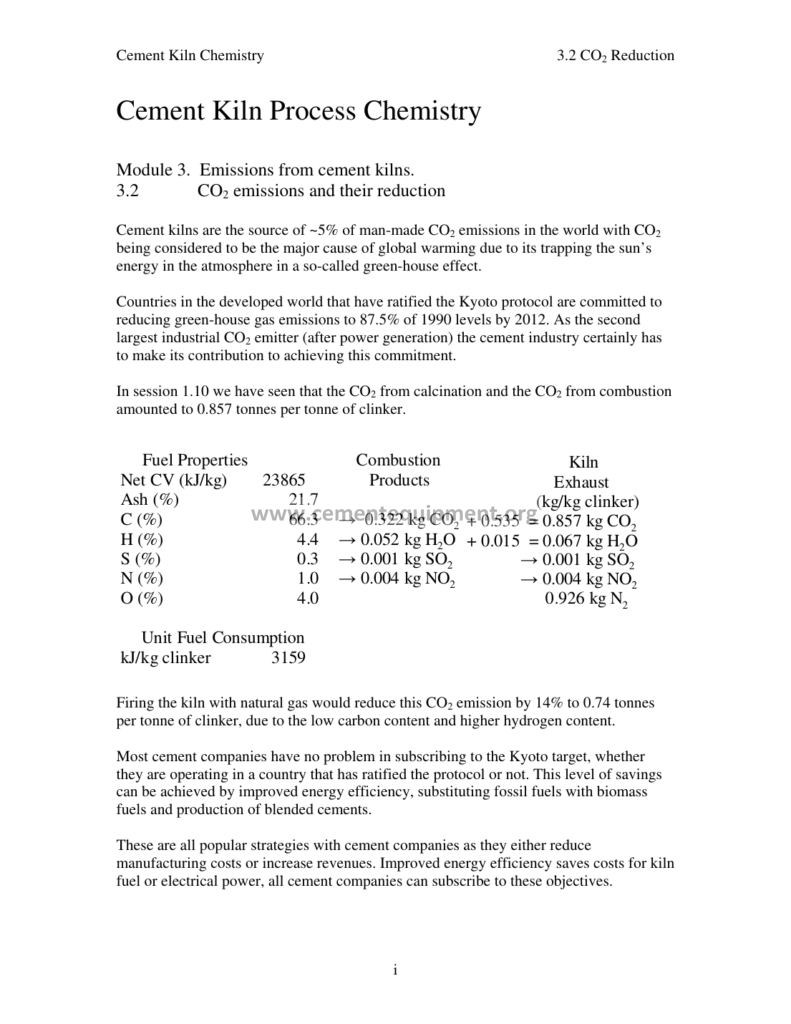
The carbon dioxide is the largest emission of the cement kiln by two orders of magnitude, and module 3.2 teaches the chemistry behind every ton of it: the calcination reaction that releases 44 mass units of CO2 for every 100 of limestone, the combustion chemistry of the fossil fuels, and the four levers that the industry pulls in sequence: the thermal efficiency of the clinker burning, the clinker factor of the cement, the alternative fuel share with its biogenic fraction, and finally the carbon capture technologies that separate the CO2 from the flue gas for storage or use, with the numbers of every lever from the 0.8 to 0.9 tonnes per tonne of clinker starting point through the 3.0 to 3.6 gigajoules of the heat demand to the 90 percent plus capture rates of the modern separation plants.
The Complete Cement Technical Package (931 files including the books, the courses, the Excel tools and the presentations: $249.99 one-time: instant download via the PayPal payment) includes this course module with the CO2 calculation sheets, the energy balance tools and the decarbonization checklists: the same package that carries the heat balance books, the alternative fuel documents and the pure oxygen combustion files: this article walks the module: the reader finishes it able to build the CO2 ledger of any plant, to rank the reduction levers by their real magnitude, and to speak the language of the capture technologies with the honest numbers of their energy penalties and their costs.
The style of the module is the style of the course: the numbers first, the mechanisms second, the plant practice third: the CO2 story is the chemistry of the tons, and the module keeps the arithmetic visible throughout, because the decarbonization of the cement industry is decided by the kilogram balances of the raw meal chemistry and the gigajoule balances of the fuel system long before the capture plants are designed.
1. The Carbon Dioxide Ledger of the Cement Kiln: The Starting Numbers
The module opens with the balance that every reduction discussion starts from:
- The clinker-level emission factor: the production of one tonne of clinker in the modern dry process emits of the order of 0.80 to 0.90 tonnes of carbon dioxide, the sum of the process emission from the calcination and the combustion emission from the fuel, with the variation between the plants driven by the fuel mix, the efficiency and the raw meal carbonate content;
- The two-thirds split: of that total, of the order of 55 to 65 percent comes from the calcination chemistry of the raw meal and 35 to 45 percent from the combustion of the fuels, the split that matters enormously for the reduction strategy, because the combustion share can shrink with the energy and the fuel choices while the process share can only shrink with the chemistry and the capture;
- The cement-level factor: the finished cement carries roughly 0.50 to 0.65 tonnes per tonne depending on its clinker factor: the mineral additions dilute the clinker and its emission with them, and the module fixes the distinction once: the clinker factor is the single most powerful lever the cement producer holds without any kiln change;
- The raw material input arithmetic: the process emission traces to the carbonate content of the raw meal: for the typical raw meal with the 75 to 80 percent carbonate equivalent, the stoichiometric release computes from the 44 over 100 factor of the calcination reaction to the 0.50 to 0.55 tonnes per tonne of clinker, the number that the chemistry fixes and no filter can touch;
- The global scale: the cement industry emits of the order of 2.5 to 2.8 billion tonnes of carbon dioxide per year, about 7 percent of the global energy-related emissions, and the module places the plant-level arithmetic inside that scale so the reader sees why the cement kiln is a first-priority decarbonization target of the global roadmaps;
The ledger is the compass of the module: every reduction lever that follows is measured against the 0.8 to 0.9 starting point, and the reader learns to convert every proposed action into the tonnes per tonne of clinker or cement that the plant can count, because the industry’s decarbonization accounting lives or dies on those two denominators.
2. The Calcination Reaction: The Chemistry of the Process Emission
The largest single source of the cement CO2 is a reaction taught in the first chemistry classes, and the module makes it precise:
- The reaction and its heat: the calcium carbonate decomposes into the calcium oxide and the carbon dioxide, CaCO3 forming CaO plus CO2, at the temperatures above about 700 degrees Celsius with the reaction strongly endothermic, absorbing of the order of 1,780 kilojoules per kilogram of carbonate, the heat that the calciner flame exists to supply;
- The stoichiometric constant: the molecular masses fix the ratio forever: the 100 parts of calcium carbonate yield 56 parts of oxide and 44 parts of carbon dioxide, so the carbonate chemistry of the raw meal determines the process emission directly, with no combustion tuning, no fuel choice and no filter able to change the 44 over 100 arithmetic;
- The magnesium carbonate companion: the dolomite of certain raw materials adds its own reaction: the magnesium carbonate decomposes at the lower temperature and releases its carbon dioxide in the same ratio, and the module notes the double edge: the dolomitic raw meals can lower the required burning temperature while their carbonate still counts in the emission ledger;
- The kiln journey of the carbonate: the decarbonation begins in the preheater string at the 700 to 800 degree stages and completes in the calciner and the kiln inlet: the modern precalciner kiln performs of the order of 85 to 95 percent of the calcination in the calciner vessel, and the module links the calcination degree distribution to the temperature profile that the emissions and the burning zones share;
- The unavoidable share: the calculus is unavoidable: any clinker from the limestone chemistry releases its 0.50 to 0.55 tonnes of process CO2, and the only true avoidances are producing with less carbonate per tonne of clinker (a raw mix question with its own quality limits), using the non-carbonate calcium sources such as the slags, or capturing the released stream before the stack;
The calcination chemistry is the backbone of the whole CO2 story: the 44 over 100 stoichiometry explains why the cement flue gas is so concentrated in CO2, why the efficiency levers can only touch part of the emission, and why the capture technologies of the later sections are not an option but the inevitable endgame of the deep decarbonization.
3. The Combustion Carbon Dioxide and the Fuel Chemistry
The fuel side of the ledger is written by the carbon and the hydrogen of the energy carriers, and the module teaches the combustion arithmetic:
- The combustion reaction family: the carbon of the coal, the petcoke, the waste fuels and the gases oxidizes to the carbon dioxide with the 44 over 12 mass ratio of the carbon atom, and the hydrogen oxidizes to the water vapor: the fuel emission therefore follows the carbon content of the fuel, with the petcoke at the top and the natural gas at the bottom of the specific intensity;
- The fuel emission factors: the module quotes the specific intensities that the plants use in the fuel ledger: the coal of the order of 90 to 100 kilograms of CO2 per gigajoule, the petcoke of about 100 to 110, the natural gas of about 55 to 60, the waste-derived fuels somewhere between the plastic-rich 100 and the biomass-lean 40, and the biomass itself at the chemically zero net balance;
- The heat demand that the fuel serves: the modern dry process needs of the order of 3.0 to 3.6 gigajoules of thermal energy per tonne of clinker, of which the calcination absorbs roughly two-thirds and the clinker burning and the drying the rest, so the fuel emission computes as the product of the heat demand and the fuel factor: the arithmetic of the energy lever that the section 4 develops;
- The biogenic exception: the carbon in the biomass fraction of the alternative fuels is the short-cycle carbon that the plants counted as the carbon newly fixed from the atmosphere, so the biomass share of the fuel mix appears in the reporting carbon inventories as the neutral fraction, and the module teaches the distinction between the fossil and the biogenic carbon in the fuel analysis;
- The electric substitution horizon: the newest fuel option replaces the combustion chemistry entirely: the electrified heating of the calcination with the renewable electricity removes the combustion CO2 from the kiln balance at the plant gate, the “kiln electrification” developments that the module presents as the frontier option with the higher operating costs and the scaling questions;
The combustion arithmetic gives the fuel lever its numbers: every percentage point of the heat demand saved or shifted to the lower-carbon carrier moves the combustion CO2 share correspondingly, and the module teaches the fuel ledger as the daily-instrument of the energy engineer, the sheet where the alternating fuel prices and the emission intensities meet.
4. The Thermal Efficiency Levers: Less Heat, Less Carbon
The first reduction lever asks the kiln to burn less, and the module teaches the efficiency toolbox with its magnitudes:
- The specific heat benchmark: the well-run modern kiln with the six stage preheater, the in-line calciner and the efficient cooler operates in the 3.0 to 3.4 gigajoules per tonne clinker range, while the older or the poorly-run plants burn 3.6 to 4.2, and the module fixes the energy saving potential of the order of 15 to 25 percent between the poor and the best practice;
- The preheater and the calciner stages: the calcination heat recovery grows with the preheater stages: the four stage tower recovers less than the six stage, each additional stage trading the pressure drop and the fan power against the gas-to-meal heat exchange, and the retrofit of the old towers is the classic efficiency project with the payback of a few years;
- The cooler recovery: the grate cooler returns the secondary and the tertiary air heat to the kiln and the calciner: the modern grate coolers recover the order of 65 to 75 percent of the clinker heat, and the module teaches the readings: the cooler exhaust temperature, the secondary air temperature and the false air of the kiln hood that eat the recovery silently;
- The combustion and the process discipline: the operating side of the efficiency: the stable feed and the stable flame, the minimized false air that the oxygen readings expose, the properly dressed refractory that insulates, and the optimization of the kiln speed and the filling that keep the clinker quality at the minimum heat, the discipline that the modules 1 and 2 taught with the daily charts;
- The electrical counterpart: the fans, the mills and the conveyors carry the electrical share of the carbon ledger, translated through the grid intensity, and the module includes the electrical efficiency: the high-efficiency fans, the variable speed drives and the waste heat power generation that the newer plants integrate;
The efficiency lever converts the combustion discipline into the tonnes: the plant that moves from 3.6 to 3.2 gigajoules with the coal-like fuel cuts of the order of 10 percent of its combustion CO2, a win that costs no chemistry, no capture and no market disruption, and the module positions the efficiency as the first and the cheapest rung of the ladder that the sections 7 to 11 continue.
5. The Clinker Factor: The Chemistry of the Dilution
The second lever changes the product instead of the process, and the module teaches the clinker factor arithmetic:
- The definition and the power: the clinker factor is the mass of the clinker in a tonne of cement: the ordinary Portland cement sits near 0.95, the blended cements between 0.60 and 0.85, and every 10 percentage points of the factor reduction cuts the cement-level CO2 by roughly 8 to 9 percent, because the added materials carry almost no process emission;
- The addition portfolio: the mineral additions that replace the clinker come from the industrial co-products: the blast furnace slag with its latent hydraulic activity, the fly ash of the coal power, the natural and the calcined pozzolans, the limestone filler and the silica fume, each with its own availability and its own contribution to the cement performance;
- The chemistry constraints: the factor falls only as far as the hydration chemistry allows: the additions dilute the C3S and the C2S that build the strength, so the clinker strength development, the fineness and the sulfate balance must carry the compensation, and the module teaches the trade: the factor reduction is a quality engineering problem as much as an emission one;
- The performance engineering: the modern cement engineering pushes the factor with the optimized particle size distribution, the alkali and the sulfate tuning, the interground limestone that activates the aluminate hydration, and the ternary blends that combine the slag, the ash and the limestone, the practice that the concrete industry accepts within its own standards;
- The market limit: the lever’s ceiling is the market: the factor can go only where the concrete standards, the customer specifications and the local availability of the additions allow, and the module presents the realistic factor evolution from the 0.95 of the 1990s toward the 0.65 to 0.75 territory of the future European market under the cement standards that now permit the higher addition levels;
The clinker factor is the lever that works without the kiln: the module shows that the largest short-to-mid term CO2 reduction of many plants comes not from the capture but from the cement formulation, and the reader learns to compute the blended cement emission factor per tonne of cement and to defend the formulation change with both the quality tests and the carbon accounting.
6. The Alternative Fuels and the Biogenic Share
The fuel yard becomes a carbon lever when the waste-derived and the biomass fuels enter, and the module teaches the alternative fuel chemistry:
- The substitution rate ladder: the thermal substitution rate, the share of the heat from the alternative fuels, climbs from the 10 to 20 percent of the basic waste fuels toward the 70 to 90 percent of the advanced plants: the leadingEuropean operations exceed 70 percent substitution, and the module fixes the modern benchmark of a well-developed fuel strategy above 50 percent;
- The fossil fraction within the waste: the waste-derived fuels carry both the fossil and the biogenic carbon: the plastics and the synthetic textiles are fossil, the paper, the wood, the sewage sludge and the biomass fractions are short-cycle, so the net emission credit depends on the biogenic share of the blend, and the plants track the biogenic share by the fuel analyses and the waste stream audits;
- The combustion challenges: the alternative fuels bring the chemistry of their own: the chlorine of the PVC and the salt residues, the sulfur and the heavy metals of the sludges, the alkalies of the biomass ashes, and the module reminds the reader of the modules 1 and 2 lessons: the chloride and the alkali cycles, the coating risks and the bypass needs that the alternative fuel strategy must carry alongside the carbon credit;
- The heating value management: the waste fuels burn with the 8 to 25 megajoules per kilogram against the coal’s 25 to 30, so the feeding systems, the drying and the point of introduction must match the fuel to the temperature demand, with the coarse plastic-rich fuels to the kiln flame and the fine, dry, homogeneous fuels to the calciner;
- The negative emission horizon: the biomass share creates the possibility of the net-negative combustion: where the biogenic carbon dominates the fuel and the capture plants of the later sections remove the combustion CO2, the combination delivers the bio-energy with the carbon capture, the BECCS concept that the module presents as the only track toward the net-negative cement production;
The alternative fuel lever rewrites the fuel door of the ledger: the same heat demand served by the waste and the biomass instead of the coal cuts the fossil combustion CO2 in proportion to the substitution and the biogenic content, and the module teaches the reader to build the blended fuel ledger with the fossil and the biogenic lanes separated, the discipline that the carbon accounting protocols now require.
7. The Post-Combustion Capture: The Chemistry of the Amine Scrubbing
The first capture family works on the flue gas as it is, and the module teaches the post-combustion separation chemistry:
- The principle: the flue gas after the dedusting and the desulfurization meets a chemical solvent, typically the aqueous amines led by the monoethanolamine, the solvent absorbs the carbon dioxide at the moderate temperatures, the rich solvent is pumped to the stripper, and the heat reverses the reaction to release the concentrated CO2 and to regenerate the lean solvent for the next cycle;
- The absorption chemistry: the amine reacts with the CO2 through the carbamate formation and the acid-base equilibria in the water: the absorption is exothermic and favored by the cooler temperatures of the 40 to 60 degrees, the stripping endothermic and favored by the 110 to 120 degrees, the temperature swing that drives the cyclic capture;
- The cement flue gas advantage: the cement flue gas arrives with the 20 to 30 percent CO2 concentration of the section 1, three to five times richer than the coal power flue gas, so the capture unit treats less gas per tonne of CO2, the reason the cement plants are considered the early commercial targets of the post-combustion capture;
- The numbers of the process: the full-scale amine units achieve the capture rates of 85 to 95 percent and the product purity above 99 percent, the energy penalty is the reboiler heat of the order of 3 to 4 gigajoules per tonne of CO2 captured that the CO2 compression adds on top, and the total cost lands in the range of 60 to 120 euros per tonne of avoided CO2 depending on the scale, the energy price and the gas composition;
- The solvent management: the solvent degrades with the oxygen and the heat, the NOx and the SO2 of the flue gas must be scrubbed to the low levels before the absorber to protect the solvent, and the module teaches the pre-treatment train, the reclaiming and the make-up of the solvent that the operating cost and the ammonia and the nitrosamine emissions depend on;
The post-combustion chemistry is the retrofitable workhorse of the capture family: it bolts onto the existing kiln without changing the clinker process, it handles the flue gas that the plant already makes, and its numbers, the 85 to 95 percent capture, the 3 to 4 gigajoule penalty and the tens-of-euros cost, give the reader the benchmark against which the other capture concepts of the following sections are judged.
8. The Oxyfuel Capture: The Chemistry of the Recycled Gas
The second capture family changes the combustion before the capture, and the module teaches the oxyfuel concept:
- The principle: the kiln and the calciner burn with the nearly pure oxygen instead of the air, the nitrogen leaves the system at the oxygen plant, and the flue gas concentrates in the carbon dioxide, the water and the oxygen surplus, so the capture becomes mainly a purification rather than a separation;
- The oxygen production: the oxygen comes from the air separation units, the cryogenic plants of the large scale or the adsorption and the membrane units at the pilot scale, with the power demand of the order of 200 to 250 kilowatt-hours per tonne of oxygen, the electrical penalty that the oxyfuel concept pays instead of the thermal reboiler penalty of the amines;
- The kiln chemistry adjustment: the oxyfired kiln changes its flame: the gas volumes shrink roughly 25 to 35 percent, the CO2-rich atmosphere shifts the calcination equilibrium to the higher required decomposition temperatures, and the plant recirculates part of the flue gas to carry the heat and to shape the flame, the adjustments that the module teaches with the burner and the gas path consequences;
- The capture stream quality: the oxyfuel flue gas holds the 80 to 90 percent CO2 after the water condensation, and the purification unit removes the oxygen, the nitrogen and the argon to yield the transport-grade stream: the combination delivers the overall capture rates of 90 to 95 percent of the process and the combustion carbon combined;
- The status and the numbers: the oxyfuel is demonstrated at the full commercial scale on the cement kilns in the first projects of the 2020s: the process adds of the order of 2 to 3 gigajoules equivalent of energy per tonne of clinker through the oxygen and the power, and the module presents the oxyfuel as the zero-change-to-clinker-chemistry option that the new kiln lines will increasingly specify;
The oxyfuel chemistry swaps the energy penalty from the solvent to the air separation: the plant keeps the clinker process untouched, concentrates the CO2 by the combustion design itself, and the reader leaves the section able to compare the oxyfuel’s power-based penalty and the high capture ratio against the amine’s heat-based penalty, the comparison table that the module 3.10 will close.
9. The Direct Separation: The Chemistry of the Electrified Calcination
The third capture family attacks the process emission at its source, and the module teaches the direct separation concept:
- The principle: the direct separation heats the calcination without the contact with the combustion gas: the reaction chamber is a separate vessel heated electrically or by the indirect firing, the carbonate decomposes inside it, and the released CO2 exits as the pure undiluted stream that needs only the cooling, the compression and the dehydration before the transport;
- The electrified reactor: the electric kiln concept heats the meal by the electrical resistance, the microwave or the plasma pathways, with the calcination temperature supplied without any fossil combustion: the process CO2 stream leaves pure, the combustion CO2 disappears from the plant, and the emissions move to the grid electricity that the renewable energy decarbonizes;
- The indirect-fired twin: an intermediate version keeps the fuel but separates the streams: the heat is transferred through the walls or the heat exchange surfaces into the calcination chamber, so the fuel flue gas and the process CO2 flow in the separate lanes, and the capture saves the post-combustion unit for the dilute fuel stream;
- The system consequences: the direct separation changes the whole architecture: the calciner heat balance, the heat recovery, the gas recirculation and the kiln chemistry must be redesigned, and the module teaches the solid-carrying, the hot-gas transfer and the clinker quality questions that the pilot plants of the sector are answering;
- The status and the numbers: the concept stands at the pilot and the first commercial-demonstration stage of the 2020s: the expected process CO2 capture approaches 95 to 98 percent of the calcination carbon with the near-pure product, the electricity demand becomes the dominant operating cost, and the module presents the direct separation as the long-horizon option that couples with the renewable electricity the most elegantly;
The direct separation chemistry dissolves the hardest problem of the cement capture: instead of separating the CO2 from the 90 percent of the nitrogen, it prevents the dilution entirely, and the reader finishes the section understanding why the electrified and the indirect-fired calciners are the design frontier that every kiln vendor’s next generation is built around.
10. The Calcium Looping and the Mineral Carbonation Routes
The final capture family reuses the chemistry of the limestone itself, and the module teaches the looping and the mineralization concepts:
- The calcium looping principle: the scheme runs the reverse of the calcination: the flue gas contacts a bed of the calcium oxide or the calcium hydroxide at the 600 to 700 degrees, the carbon dioxide re-absorbs into the calcium carbonate, and the spent sorbent is re-calcined in the dedicated oxyfuel calciner, releasing the pure CO2 while the regenerated oxide returns to the loop;
- The sorbent chemistry: the looping relies on the reversibility of the CaCO3 and CaO equilibrium, the same reaction family of the section 2, with the sorbent decay from the sintering and the attrition handled by the purge and the make-up streams, and the cement plant conveniently recycles its own carbonate chemistry into the capture device;
- The performance numbers: the looping units reach the capture rates of the order of 85 to 95 percent with the two solid loops circulating, the energy penalty appears mostly in the calciner re-firing of the spent sorbent, and the coupling with the cement kiln that reuses the deactivated purge as the raw meal makes the concept uniquely suited to the cement industry;
- The mineral carbonation family: the second route fixes the CO2 chemically into the solid carbonates: the carbonation of the concrete demolition fines, the steel slags and the natural silicate minerals converts the dilute CO2 streams into the stable minerals, and the fast carbonation of the fresh concrete products, the “CO2 curing” of the blocks and the masonry, stores a meaningful fraction per product unit;
- The honesty of the accounting: the module teaches the accounting caution: the mineralization routes store small amounts relative to the kiln’s output, the CO2-cured blocks storing on the order of tens of kilograms per tonne of concrete, and the claims of the carbon neutrality must be checked against the full product lifecycle, the discipline that the whole module practices in every section;
The looping and the mineralization return the module to the calcium chemistry where it started: the same carbonate reaction that creates the process emission serves the capture and the storage, and the reader learns to see the CO2 problem of the cement kiln as the mirror of its raw meal chemistry, a problem that the industry is learning to solve with the stone itself.
11. The Numbers of the Sector Roadmaps: Where the Reduction Must Come From
The kiln-level levers scale into the sector numbers, and the module teaches the roadmap arithmetic that frames the industry debate:
- The global reduction record: the cement industry cut its specific CO2 per tonne of cement by roughly 20 percent between 1990 and 2020 through the efficiency, the clinker factor and the alternative fuels, while the total emissions still grew with the volume, and the module fixes the lesson: the intensity levers alone cannot offset the demand growth;
- The 2050 target structure: the net zero scenario of the cement sector for 2050 distributes the reduction across the levers in the typical proportions: the efficiency and the clinker factor delivering the order of 25 to 35 percent of the cut, the alternative fuels and the innovative chemistries similar shares, and the carbon capture with the storage and the use carrying the remaining roughly 40 to 50 percent that no other lever can reach;
- The capture scale required: the deep scenarios call for the order of 300 to 400 million tonnes of CO2 captured per year from the cement industry by 2050, against the near-zero today, meaning the construction of thousands of large capture trains, and the module presents the scale so the reader feels the industrial program behind the chemistry;
- The economic frame: the carbon pricing of the European emissions trading system and the border carbon adjustment mechanisms monetize the captured ton: the allowance prices in the order of 50 to 100 euros per tonne in the 2020s meet the capture costs of the sections 7 to 10, and the module teaches the economic crossover logic: when the price of the CO2 exceeds the cost of the avoided CO2, the capture pays;
- The honest sequencing: the roadmap message of the module: no single lever carries the sector, the short-term levers (the efficiency, the factor, the fuels) move first because they are cheap and available, and the capture moves second because it is expensive but indispensable, and the plant that keeps the short-term ladders climbing while it builds the capture projects follows the sequence that every serious roadmap plots;
The roadmap numbers make the reader see the shape of the industry’s next decades: the decarbonization of the cement kiln is not one technology race but the coordinated deployment of the four lever families, and the module’s contribution is the honest quantification of each, so the engineer can argue with the executives, the regulators and the public with the tonnes and the euros rather than the slogans.
12. The Plant Practice: The CO2 Ledger, the Monitoring and the Reporting
The theory converts into the monthly sheet, and the module teaches the carbon accounting practice of the plant:
- The ledger structure: the plant CO2 ledger computes the monthly emissions from the production side: the clinker tons times the calcination factor of the carbonate analyses, the fuel tons times their measured carbon contents, and the purchased electricity times the grid intensity, the three lanes that the official protocols of the emissions trading prescribe;
- The measurement reality: the carbon content of the raw meal, the clinker and each fuel comes from the laboratory: the loss on ignition and the carbonate titrations for the solids, the elemental carbon and the biogenic share analyses for the fuels, and the module teaches the sampling frequencies and the mass balance closure that keep the ledger believable;
- The product carbon footprint: the cement-level reporting divides the production emissions plus the upstream contributed shares by the cement tons sold, with the additions credited at their own low factors, and the module teaches the calculation for the product portfolio, the number that the customers and the green public procurement increasingly demand;
- The continuous improvement routine: the quarterly decarbonization review watches the sector of the ledger: the specific heat trend against the 3.0 to 3.6 band, the clinker factor against the cement recipe changes, the substitution rate and the biogenic share against the fuel purchases, and the capture project milestones against the economic crossover of the section 11;
- The verification interface: the reported numbers meet the independent verification: the emissions trading verifiers audit the meter readings, the analyses and the calculation sheets, and the module closes the practice with the evidence discipline that the verifier expects, the same discipline that the whole course teaches for every measured number of the plant;
The plant practice makes the CO2 a daily currency of the operation: the ledger converts the chemistry of the module into the monthly verified numbers, the footprint converts the numbers into the commercial story, and the engineer that runs the sheet holds the same instrument that the finance department, the regulator and the customer each read in their own language.
13. The Costs and the Energy Penalties: The Honest Comparison
The module refuses the marketing shortcuts and teaches the cost and the energy trade-offs of the levers:
- The lever cost ladder: the efficiency projects cost tens of euros per tonne of avoided CO2, the clinker factor and the fuels often save money or break even, and the capture technologies cost the tens to the hundreds, so the module ranks the levers by the cost per avoided tonne and teaches the reader to apply the same ranking to any proposed project;
- The energy penalty accounting: every capture route pays an energy price: the post-combustion pays the reboiler heat of 3 to 4 gigajoules per tonne captured, the oxyfuel pays the oxygen power of the order of 200 kilowatt-hours per tonne of oxygen, and the electric calcination pays the electricity that replaces the fuel, and the module teaches the comparison in the common unit of the total primary energy;
- The availability and the scale factors: the capture plants cut their specific costs with the scale: the 0.5 million tonnes per year capture trains of the large kiln lines run cheaper per tonne than the small pilot units, and the module presents the scale curve so the reader understands why the first full-scale projects cluster on the largest and the most efficient kiln lines;
- The retrofit versus the new-build: the post-combustion suits the retrofit of the existing plants where the kiln keeps running, the oxyfuel suits the new kiln lines with the oxygen plant and the gas recirculation designed in, and the direct separation suits the new electrical plants, and the module teaches the decision factors: the remaining kiln lifetime, the energy price, the CO2 prices and the site logistics of the storage or the use;
- The storage and the use reality: the captured CO2 must go somewhere: the geological storage in the depleted fields and the saline aquifers of the CO2 hub projects, the use in the chemicals and the fuels, or the mineralization of the section 10, and the module closes the comparison with the sober note: the capture is the necessary half and the storage and the use infrastructure is the equally necessary other half of the capture value chain;
The cost comparison gives the reader the decision instrument of the module: every lever now has its tonnes, its euros and its energy, and the plant’s decarbonization plan becomes a portfolio problem: the cheap ladders climb now, the expensive capture climbs when the carbon price and the infrastructure meet, and the honest engineer presents the portfolio rather than the single miracle.
14. The Roadmap for the Plant: The Sequence of the Actions
The module closes with the action sequence that any plant can walk:
- The first year: build the CO2 ledger of the section 12, close the energy and the mass balances, fix the false air and the heat losses, and take the efficiency projects off the shelf, the actions that pay for themselves within the years;
- The second and the third years: restructure the fuel portfolio toward the higher substitution and the biogenic content, develop the clinker factor reduction with the quality department, qualify the additions and the ternary recipes, and document the footprint certificates;
- The capture project phase: screen the site for the capture options: the flue gas volume, the CO2 concentration, the energy supplies, the storage and the transport corridors, and pre-select the post-combustion or the oxyfuel concept with the engineering study and the cost estimate of the section 13;
- The financial framing: align the project with the carbon price forecasts, the subsidy programs and the customer contracts that pay for the green cement, and the module teaches the business case structure that places the capture cost against the green premium revenue;
- The learning loops: measure the results of every step against the ledger, revise the plan with the actual costs and the prices, and keep the long horizon, because the decarbonization of the cement kiln is the multi-decade program that the section 11 roadmap describes and this module has prepared the reader to run;
The roadmap converts the module into the program: the CO2 reduction of the cement kiln is the sum of the disciplined chemistry, the honest accounting and the timed investment, and the reader who closes module 3.2 walks away with the complete ladder, from the 44 over 100 stoichiometry of the calcination through the efficiency, the factor and the fuel levers to the 90 percent captures, the 60 to 120 euro costs and the 2050 roadmap that the sector now executes.
The Frequently Asked Questions
Why cannot the cement plant simply use less limestone to avoid the process CO2?
Because the calcium oxide is the chemical skeleton of the clinker: the modern clinker contains about 60 to 67 percent CaO, and the only practical calcium sources are the carbonates, so the raw meal chemistry fixes the process emission at the 0.50 to 0.55 tonnes per tonne of clinker, with the alternatives like the slags or the non-carbonate sources usable only at the margins of the recipe.
How much CO2 can the clinker factor reduction realistically remove?
Each 10 percentage points of the clinker factor cut reduce the cement-level emission by roughly 8 to 9 percent: moving a portfolio from 0.95 toward 0.75 through the slag, the fly ash and the limestone additions cuts the product footprint by the order of 20 percent, with the chemistry of the strength development and the sulfate balance carrying the quality load.
What is the actual difference between the post-combustion and the oxyfuel capture?
The post-combustion separates the CO2 from the normal flue gas with the chemical solvents, achieving the 85 to 95 percent capture with the reboiler energy penalty of 3 to 4 gigajoules per tonne, while the oxyfuel burns with the pure oxygen, concentrates the CO2 in the combustion itself and pays instead the power of the air separation, with both achieving the similar capture and the different penalty currencies.
Does the biomass in the alternative fuels really reduce the net CO2?
Yes, within the accounting: the biogenic carbon is the carbon fixed from the atmosphere in the recent growth cycle, so the combustion of the biomass fraction returns it without adding to the fossil stock, and the plants separate the fossil and the biogenic carbon in the fuel analyses, with the biogenic combustion becoming net-negative only when combined with the carbon capture.
How much does the carbon capture cost per tonne of CO2 in the cement plant?
The honest range of the current projects is of the order of 60 to 120 euros per tonne of captured CO2 for the post-combustion and the similar bands for the oxyfuel, falling with the scale and the energy prices, against the carbon prices of the order of 50 to 100 euros per tonne in the European trading system, the gap that the subsidy programs and the green premiums close.
Which reduction lever should the plant implement first?
The cheap and the available levers: the thermal efficiency with the 15 to 25 percent energy potential, the clinker factor through the additions, and the alternative fuel substitution with its biogenic share, all implementable within the years, while the capture technologies of the 85 to 95 percent rates ride behind the carbon prices, the storage corridors and the green market contracts.
The module 3.2 has taught the complete CO2 reduction ladder of the cement kiln: the calcination chemistry that fixes the half-tonne of the process carbon, the combustion arithmetic of the fuel door, the efficiency, the factor and the fuel levers that cut the first third, and the capture families of the amine, the oxyfuel, the direct separation and the looping that cut the rest, each with its chemistry, its energy penalty and its cost, so the reader leaves able to build the ledger, rank the levers and price the capture of any plant.
The Complete Cement Technical Package includes this course with the CO2 calculation sheets, the energy balance tools and the decarbonization checklists: the one-time 249.99: the instant download: the carbon dioxide module is the environmental centerpiece of the kiln chemistry course, and the reader carries its numbers, from the 44 over 100 stoichiometry to the 90 percent captures, into the permit, the boardroom and the public debate with equal confidence.
The module closes with the operating truth of the cement decarbonization: no filter removes the calcination carbon, no fuel choice removes the process chemistry, and no efficiency alone closes the target, so the plant run is a portfolio: the short-term ladders of the energy and the formulation climb first, and the capture projects follow with the prices and the infrastructure, the sequence that this module has taught in the language of the tonnes, the gigajoules and the euros.
The reading plan for the engineer: build the monthly CO2 ledger, run the quarterly decarbonization review with the specific heat, the clinker factor and the substitution rate on the chart, and revisit the capture sections whenever the carbon price, the storage corridor or the project budget changes, because the CO2 chemistry of module 3.2 is the fixed arithmetic against which the whole industry debates its future.
Get this kiln chemistry file + the full 931-file package
$249.99 — one-time purchase, instant download, lifetime access
This file is part of the Complete Cement Technical Package (931 files) available from cementequipment.org. Respective rights holders; library copy for the licensed single user.