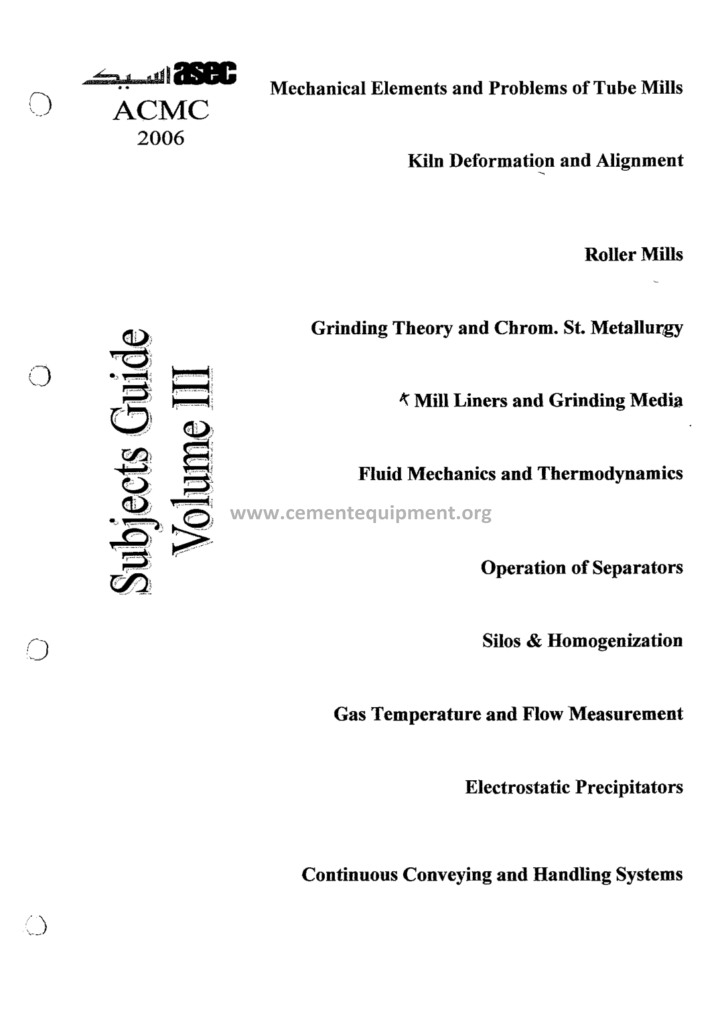
Cement Course Volume 3: Subjects Guide
The third volume of the cement course series concentrates on the thermochemical heart of the plant: the pyroprocessing line from the preheater to the cooler, the combustion of the fuels, the refractory protection of the vessel and the heat balances that measure the efficiency of the burning. The subjects guide of this volume gives the reader the index, the dependency map and the reading order of the chapters, so the engineer who opens the volume for reference can find the subject without reading the whole course.
1. The Structure of Volume 3: The Chapters and Their Flag
The volume is organized in the logical chain of the burning: the feed preparation ends where the pyroprocess begins, and every chapter of the third volume sits on the one before it:
- The preheater and the calciner: the suspension stages, the gas-solid heat exchange, the calcination degree at the kiln inlet: the entry chapter of the volume;
- The rotary kiln: the shell, the internals, the drive, the support, the flame and the clinker bed: the central subject of the whole course;
- The cooler: the grate systems, the air recovery, the clinker quality effect: the closing step of the burning line;
- The fuels: the coal, the petcoke, the alternative fuels: the combustion chemistry and the fuel preparation;
- The refractories: the brick types, the lining installation, the wear mechanisms and the relining practice;
- The thermal economy: the heat balance of the kiln line, the specific heat consumption, the losses and the recovery;
The chapters speak the same engineering language as the previous volumes: the same tables, the same units, the same logical numbering that allows the reader to move between the subjects of the pyroprocess without friction.
2. The Preheater Chapters: The Suspension Heat Exchange
The volume opens the pyroprocess with the tower: the modern kiln line preheats the raw meal in the five or six suspension stages, each cyclone a countercurrent heat exchanger of gas and dust:
- The stage temperatures: the typical profile of the five-stage tower: the gas from the kiln at about 1050°C entering the lowest stage, leaving the top cyclone at 290-330°C, and the meal leaving the lowest stage at 820-850°C, partially calcined: the temperature ladder is the thermal map of the tower;
- The calcination degree: the modern calciner completes 85-95% of the calcination before the kiln inlet, so the rotary kiln performs mostly the clinkering: the preheater chapters explain the calciner aerodynamics, the fuel split between kiln and calciner, and the temperature control of the exit gas;
- The cyclone efficiency: the collection efficiency of the stages (typically 92-97% per stage with the proper geometry) and the recirculation of the dust in the kiln gas: the separation losses cost heat and coating;
- The blockages and the build-ups: the alkali and the sulfate cycles, the jamming of the cyclones, the cleaning jets and the stable operation windows: the practical knowledge of the tower crew;
The preheater chapters of the volume give the complete equipment picture: the cyclone diameters, the dip tube lengths, the pressure drops per stage and the fan sizing that closes the tower design.
3. The Kiln Chapters: The Vessel and the Process Inside
The central chapters of the volume cover the rotary kiln itself, and their richness reflects the importance of the vessel in the cement economy:
- The mechanical design: the kiln shell dimensions (the diameter to length ratios, the typical 3.5-4.0 m diameter by 50-65 m length for the modern lines), the slope of 3.5-4%, the rotational speed of 3.0-4.2 rpm, the drive arrangements and the multiple support piers;
- The process zones: the chain section or the inlet zone, the calcination zone, the transition zone, the burning zone and the outlet zone: each zone has its temperatures, its coating behavior and its refractory grade: the volume marks the zones on the longitudinal section of the vessel;
- The flame and the burning zone: the flame shape, the held flame length, the primary air ratio, the burner types (multichannel burners of the modern lines): the flame decides the coating stability of the burning zone;
- The shell monitoring: the shell temperature scanning, the infrared cameras along the vessel, the hot spots and the refractory condition: the predictive knowledge of the lining life;
The kiln chapters describe the operation through the parameters the operator watches: the kiln feed, the fuel rate, the burning zone temperature, the free lime of the clinker, the O2 and the CO of the exit gas: the process control of the vessel is the practice of the whole volume.
4. The Cooler Chapters: The Recovery of the Clinker Heat
The cooler is the thermal partner of the kiln: the chapters of the volume cover the grate coolers with the attention their heat recovery deserves:
- The cooler types: the reciprocating grate coolers and the modern cross-bar coolers, the grate area sizing (the cooling rate of 20-40 t/h per m2 for the modern machines), the fans per compartment and the bed heights;
- The heat recovery: the secondary air to the kiln at 900-1100°C representing 10-25% of the clinker heat, the tertiary air to the calciner, and the vented excess air: the cooler efficiency and the specific heat loss of 80-130 kcal/kg in the modern coolers;
- The clinker quality link: the cooling rate affects the alite crystal size and the cement quality: the handbook explains the fast cooling of the clinker and the grindability consequences;
- The operating problems: the snowmen formations, the fallen clinker sealing, the grate plate wear and the compartment pressure control: the troubleshooting of the cooler is a major section of the chapters;
The cooler completion closes the pyroprocess line: the chapters connect the cooler recovery to the kiln flame, the calciner and the fuel consumption, so the reader sees the line as one thermal system rather than separate machines.
5. The Fuel Chapters: From the Coal to the Alternative Fuels
The fuel chapters of the volume treat the energy source of the clinkering with the completeness of a dedicated handbook:
- The solid fuels: the coal properties (the calorific value, the volatile matter, the ash composition, the moisture), the coal grinding and drying, the firing systems of the kiln and the calciner;
- The petroleum coke: the petcoke characteristics (the low volatile, the high calorific value, the high sulfur), the special grinding requirements and the combustion behavior in the calciner;
- The alternative fuels: the tires, the refuse-derived fuel, the solvents, the meat and bone meal: the substitution rates, the feeding points, the emission constraints and the thermal substitution economics;
- The combustion tuning: the flame envelope, the combustion completeness, the CO and the NOx minimization: the chapters give the burner settings for the fuel slate of the plant;
The fuel economy of the plant is written in these chapters: the specific heat consumption of the modern line of 700-800 kcal/kg clinker depends more on the fuel preparation and the combustion control than on any other single variable, and the volume says so with numbers.
6. The Refractory Chapters: The Armor of the Burning Line
The refractory is the sacrificial protection of the kiln and the tower, and the volume treats the subject with the practical depth of the lining engineer:
- The brick families: the magnesia-spinel bricks of the burning zone, the basic bricks of the transition zones, the alumino-silicate bricks of the upper zones, the insulating layers behind the working lining: the selection logic of each zone;
- The installation: the ring methods of the kiln lining, the expansion allowances, the monolithic castables of the tower and the nose rings, the anchors and the curing: the quality of the installation decides the campaign life;
- The wear mechanisms: the chemical attack of the alkalis and the sulfates, the thermal cycling, the mechanical loads of the ovality, the spalling and the erosion: the chapters correlate the wear to the process and the brick grade;
- The relining practice: the campaign planning, the brick inventory, the cold repairs and the hot repairs, the shell scanning before the reline to find the deformation: the economics of the refractory cost per ton;
The refractory chapters close with the life data of the typical campaigns: 8-15 months for the burning zone, 12-24 months for the transitions, several years for the upper zones, and the maintenance consequences of each campaign end.
7. The Thermal Economy Chapters: The Balance of the Line
The last subject group of the volume is the energy audit of the pyroprocess, expressed in the classical heat balance of the kiln line:
- The heat inputs: the combustion heat of the fuel, the sensible heat of the preheated meal, the heat of the combustion air: the input side of the balance;
- The heat outputs: the clinker formation heat (theoretical about 1750 kJ/kg), the sensible heat of the clinker leaving the cooler, the exhaust gas losses, the shell losses, the dust losses and the radiation: the output side;
- The balance workbook: the excel-style tables of the volume walk the reader through the calculation of the specific heat consumption, the cooler losses of 80-130 kcal/kg and the exhaust losses proportional to the excess air;
- The improvement levers: the reduction of the exhaust losses by the lower excess air, the cooler efficiency, the shell insulation, the alternative fuels: each lever quantified in the saved kcal/kg;
The thermal economy chapters make the reader able to audit his own line: the heat balance is the language in which the plant and the kiln supplier discuss the performance, and the volume teaches the language with worked examples.
8. The Volume 3 in the Package: The Position in the Series
Volume 3 assumes the raw materials and the grinding volumes and feeds the quality and the control volumes that follow:
- The dependency map: the Volume 1 subjects (the cement chemistry and the process introduction) are the preparation for the kiln chapters; the grinding volumes (the raw grinding and the cement grinding) complete the material preparation side; the kiln control and the process control volumes build on the parameter knowledge of the Volume 3;
- The reading order: the preheater, then the kiln, then the cooler, then the fuels, then the refractories, then the thermal economy: the natural order the chapters of the volume follow;
- The reference use: the subjects guide gives the engineer the fast path to any specific chapter: the index by subject, by equipment and by parameter: the triage of the reference reader;
The position of the volume in the package is the same as the position of the pyroprocess in the plant: between the preparation and the finish, holding the energy of the whole production: the engineer who masters the volume understands the cost and the quality of the clinker, the two pillars of the cement business.
9. The Frequently Asked Questions
Q: Do I need the previous volumes to use the Volume 3 chapters?
A: The pyroprocess can be studied alone, but the chapters assume the raw material chemistry (Volume 1), and the references to the raw grinding appear in the preheater chapters: the package reading order removes the friction.
Q: Which chapter should the maintenance engineer read first?
A: The refractory chapters and the mechanical kiln chapters: the maintenance practice of the vessel is concentrated there, and the thermal economy chapters add the cost context of the maintenance decisions.
Q: Is the alternative fuels subject covered in depth?
A: Yes: the fuel chapters give the preparation, the feeding and the combustion tuning of the main alternative fuels, with the substitution economics and the emission limits.
Q: What is the typical kiln exit gas temperature the volume works with?
A: The modern five-stage lines run the exit gas at 290-330°C, and the volume uses that range through all the balance examples: the older three-stage lines appear in the comparison tables.
Q: How is the heat balance useful for the plant today?
A: The balance is the audit instrument: the plant measures its own losses against the reference values of the volume, prioritizes the improvement levers and quantifies the saved fuel: the payback arithmetic follows directly.
10. The Closing Words of the Guide
The subjects guide is the index, and the chapters are the knowledge: the engineer who follows the map of the volume through the plant will see the pyroprocess with the map in his head: the tower, the vessel, the cooler, the fuel and the armor forming one thermal system: the same system the heat balance measures and the operation controls. The remaining volumes of the package continue the journey into the finish grinding and the quality control, and the guide of the third volume will be the landmark of that journey.
11. The Pressure and the Flow Instruments of the Tower
The preheater chapters of the volume carry the instrumentation of the tower in the detail the crew needs:
- The pressure drops: each cyclone stage holds its pressure drop (typically 4-8 mbar per stage) and the tower total of 30-50 mbar: the rising drop of a stage announces the blockage building, the falling drop the cyclone wear or the gas short-cut: the ID fan headroom of the line absorbs the shifts;
- The flow measurements: the kiln feed rate by the weighfeeders, the fuel rate by the loss-in-weight systems of the coal, the gas flows by the annubar arrays at the cooler and the tower: the flow data of the volume are the raw numbers of every balance:
- The temperature instruments: the thermocouples at the stage outlets and the gas analyzer probes at the tower exit: the maintenance of the probes (cleaning, the calibration) is a discipline the chapters describe with the weekly schedule;
The instruments of the tower connect the process to the control room, and the volume’s instrument chapters ensure the reader knows what each number means and how the number can lie: the dirty probe, the leaking flange, the drift of the calibration.
12. The Kiln Feed Chemistry and the Clinker Quality Control
The pyroprocess chapters look back at the feed and forward at the clinker:
- The feed modules: the lime saturation factor of 92-98, the silica module of 2.2-2.8, the alumina module of 1.3-1.7 for the gray Portland clinker: the volume reviews the module arithmetic and the kiln’s response to their shifts;
- The free lime analysis: the quick free lime titration of the clinker samples every shift: the free lime below 2% for the regular Portland, the rising free lime with the feed or the temperature drift: the prime quality signal of the burning line;
- The clinker microscopic check: the alite and the belite microscopy of the polished clinker sections, the alite crystal size vs the cooling rate, the porosity of the clinker: the course includes the microscopy chapter with the photographs and the interpretation notes;
The quality chapters tie the burning parameters to the shipped cement: the burning zone temperature and the residence decide the phases, the phases decide the strength, and the volume keeps the reader on that chain of cause and effect with the tables of the quality reports.
13. The Comparison of the Modern Lines: The Parameters at the Glance
The volume closes the technical body with the comparison table of the line generations:
| Parameter | Classical wet or long dry line | Modern five-stage precalciner line |
|---|---|---|
| Specific heat consumption | 1,000-1,300 kcal/kg | 700-800 kcal/kg |
| Kiln exit gas temperature | 900-1,000°C | 290-330°C |
| Calcination at the kiln inlet | 10-40% | 85-95% |
| Production per 4 m kiln | 1,500-2,000 tpd | 4,000-5,000 tpd |
| NOx typical | 800-1,200 mg/Nm3 | 400-800 mg/Nm3 |
| Cooler loss | 150-180 kcal/kg | 80-130 kcal/kg |
The comparison is the summary of the volume’s teaching: the reader sees where the industry is going and why the modernizations of the older lines (the calciner addition, the cooler upgrade, the burner replacement) follow the chapters of the course.
14. The Frequently Asked Questions
Q: How is the calcination degree measured on the running line?
A: By the sampling of the meal at the kiln inlet and the ignition-loss analysis: the loss drops from the 34-36% of the raw meal to the 5-8% at the inlet of the precalciner line: the difference is the calcination.
Q: What is the shell scanning frequency recommended by the volume?
A: The continuous scanning with the infrared line scanners is the modern standard, the weekly data reviews and the alarm thresholds for the hot spots: the volume covers the scanning installation and the alarm philosophy.
Q: Why does the free lime rise when the flame shortens excessively?
A> The flame too short releases the heat near the nose, the burning zone temperature profile shifts, the clinker spends the time at the lower temperature, and the alite formation slows: the free lime is the witness of the flame position.
Q: Does the volume cover the wet process lines?
A: The comparison chapters include the wet lines for the measurement of the dry process advantage, but the main body of the volume follows the dry suspension preheater lines, the technology of the modern industry.
Q: What preparation does the reader need for the heat balance chapters?
A> The feed and the fuel flow readings, the gas temperatures and the compositions of the line, and the clinker production of the day: the volume’s balance workbook then walks the calculation step by step.
15. The Closing
The third volume of the course builds the burning line from the tower to the balance, and this guide has shown the reader the map of that building: the preheater chapters for the heat exchange, the kiln chapters for the vessel and the flame, the cooler for the recovery, the balance for the arithmetic and the maintenance for the campaigns. The engineer who works the volume through will be able to audit the pyroprocess of any plant, to argue the modernization priorities with the numbers, and to run the burning line with the understanding that the flame is the instrument, the balance is the scoreboard and the campaigns are the proof.
16. The Kiln Alignment: The Condition of the Vessel Axis
The alignment of the kiln axis is the mechanical prerequisite of the burning process: the sagging shell, the worn rollers and the misaligned axis disturb the rotation, the ovality and the lining:
- The alignment meaning: the kiln shell must rotate around the ideal straight axis through the support piers: the deviations of the axis from the straight line of a few millimeters disturb the load distribution of the rollers and the tires, accelerate the wear and increase the shell ovality under the load;
- The measurement: the optical surveys with the theodolite or the laser systems measure the axis at each support, the shell profile by the mechanical or the laser gauging, and the ovality at the rings: the volume gives the survey frequency (annual to biannual) and the acceptance criteria;
- The corrections: the roller positions adjusted vertically and horizontally, the shims and the screws of the support pedestals, the re-measurement after the adjustment: the campaign of the alignment is the week of the mechanical crew, done during the planned stops;
The alignment chapters complete the mechanical body of the volume: the vessel that rotates straight wears its rollers evenly, holds its shell round, and protects its lining: the process engineer ignores the geometry at the cost of the campaigns.
17. The Chain Sections and the Internals of the Older Kilns
The historical kilns of the wet and the long dry lines used the internals that the modern preheater lines no longer need, and the volume records them for the completeness:
- The chains: the curtains of the chains in the inlet zone (the chain systems of the wet kilns) increased the heat exchange and wiped the moisture: the modern lines keep the chains only in the special drying applications: the volume describes the chain arrangements for the legacy plants;
- The lifting flights and the crosses: the internals that lifted and cascaded the material through the gas: the increased residence of the heat exchange: the crosses and the tumblers of the older vessels appear in the volume as the historical chapter:
- The heat exchange inserts: the refractory shapes of the inlet zone forming the heat exchange surfaces: the newer designs of the preheater kilns use the plain inlet zones with the gas ducts instead;
The internals chapters are the heritage of the course: many plants still run the older vessels, and the volume gives their crews the knowledge the modern chapters do not cover: the completeness of the package is its value.
18. The Sustainability of the Burning Line: The Kiln and the Environment
The final chapter of the volume places the burning line in the environmental context of the modern cement industry:
- The emission inventory of the kiln: the dust (the ESP and the bag filters of the tower), the NOx (the SNCR and the burner design), the SO2 (the scrubbing where the fuels bring the sulfur), the CO2 (the calcination and the combustion: the line emits about 0.8-0.9 t CO2 per t clinker, half from the raw material and half from the fuel);
- The energy and the CO2 levers: the lower specific heat consumption directly reduces the fuel CO2, the alternative fuels replace the fossil carbon, the CO2 capture concepts (the oxyfuel and the amine scrubbing) appear in the volume as the future chapters of the industry;
- The water and the byproducts: the kiln byproducts (the bypass dust, the exhaust dust) returned to the process or used in the applications, the water management of the cooling systems: the environmental practice is the licence of the plant;
The sustainability chapter closes the volume with the current question: the burning line is the biggest emitter of the plant, and the volume explains that the same engineering that reduces the specific calories reduces the emissions: the thermal economy and the climate performance of the cement kiln are the same subject, and the third volume teaches both.
19. The Frequently Asked Questions of the Reading
Q: What are the typical stage temperatures of the three-stage versus the five-stage tower?
A> The three-stage tower exhausts at 400-450°C and the five-stage at 290-330°C: the additional stages exchange more heat and lower the gas loss at the cost of the tower height and the fan power: the choice follows the fuel and the moisture of the raw material.
Q: How long is the retention time of the material in the kiln?
A> The material passes through the modern kiln in 20-45 minutes depending on the speed, the slope and the fill: the gas passes in seconds: the retention numbers of the volume support the balance and the process discussions.
Q: What is the normal bed depth of the modern grate cooler?
A> The modern grate coolers run the bed at 500-800 mm, decreasing toward the outlet, with the compartment pressures and the grate speeds adapted to the clinker flow: the volume describes the bed control methods.
Q: How are the alkalis recirculated in the tower?
A> The alkalis evaporate in the burning zone, condense on the meal in the upper stages and return with it to the kiln: the cycles cause the build-ups and the blockages: the volume explains the bypass valves that limit the circulation.
Q: Why is the tertiary air duct placed across the tower?
A> The tertiary air is taken from the cooler and carried to the calciner through the duct that passes beside or through the preheater tower: the route recovers the heat and regulates the calciner oxygen, at the cost of the pressure losses the fan must cover.
20. The Final Content of the Guide
The subjects guide of the third volume closes with the reading plan: the chapters of the preheater, the kiln, the flame, the cooler, the fuels, the refractories, the balance and the maintenance are to be read in that order, with the exercises done by hand, then repeated after the year with the plant data of the reader: the volume is the study program of the pyroprocess, and the study is the way the engineers of the industry were trained and still train today.
Get this Vol.3 subjects guide + the full 931-file package
$249.99 — one-time purchase, instant download, lifetime access
This file is part of the Complete Cement Technical Package (931 files) available from cementequipment.org. Respective rights holders; library copy for the licensed single user.