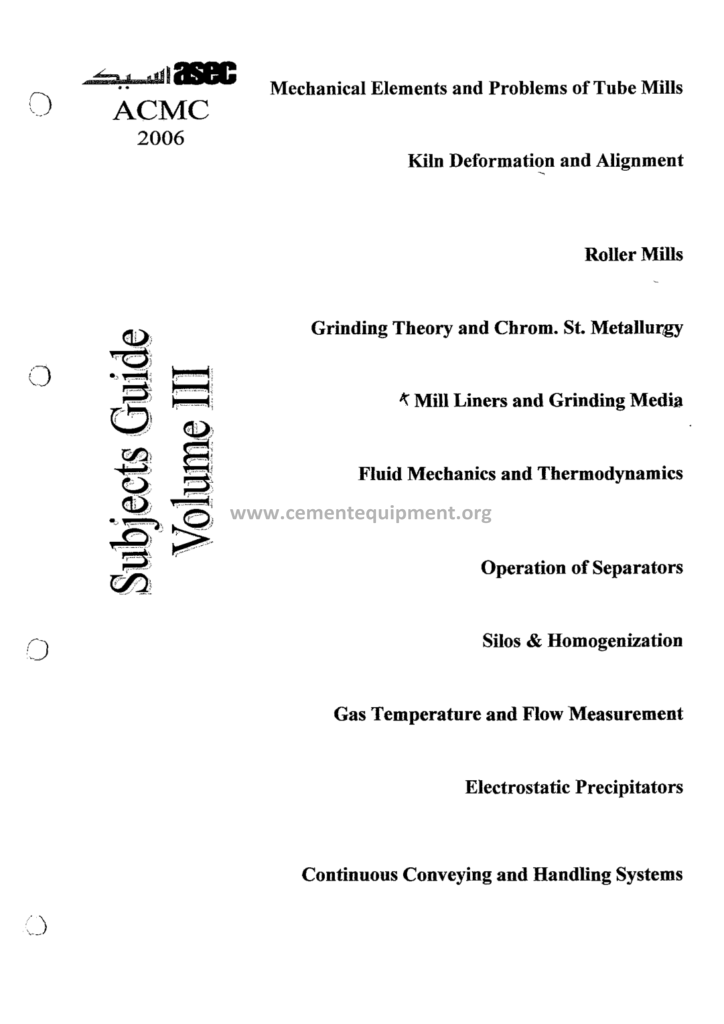
Acmc Vol: Complete Technical Guide
The third volume of the ACMC course series continues the cement study program of the company engineers, concentrating on the pyroprocessing of the clinker: the suspension preheater, the rotary kiln, the cooler and the heat balances that bind them. The volume follows the teaching style of the series: each subject opens with the theory, closes with the plant practice, and repeats the arithmetic until the reader owns the numbers: this introduction presents the volume, its position in the series, the subjects it covers and the manner the reader should work through it.
1. The ACMC Series and the Place of the Third Volume
The ACMC course of the company was built in the progressive volumes: the first volumes establish the cement chemistry and the raw material preparation; the third volume moves to the burning, the subject where the chemistry and the mechanical engineering meet at the maximum temperature of the plant:
- The continuity of the series: the raw meal of the previous volumes arrives at the preheater of the third volume: the chemistry of the kiln feed (the lime standard and the modules) decides the clinkering, and the reader is expected to carry the previous knowledge into the burning chapters;
- The teaching logic of the volume: every chapter of the ACMC series begins with the definitions and the physical principles, then proceeds through the equipment and the operation: the third volume respects the discipline and adds the heat balance as the closing instrument of each chapter;
- The personnel the volume serves: the process engineers, the production managers and the technical staff of the plant: the volume was used inside the industry training programs, and its style shows the expectation: the readers are the people who run the kilns;
The exercise sheets of the volume accompany the chapters, and the reader of the package will find in this introduction the map of that material: which exercise belongs to which subject, and how the volume expects the calculation to be performed by hand.
2. The Suspension Preheater: The Theory of the Countercurrent Stages
The preheater chapters open the burning practice: the suspension cyclone theory is the foundation the tower stands on:
- The heat exchange principle: the gas and the meal move countercurrently through the stages, and in each cyclone the fine meal is separated from the gas and dropped into the next stage: the temperature difference between the countercurrent streams is positive everywhere, which is why the suspension preheater reaches its high thermal efficiency;
- The stage arithmetic: the five-stage tower: the gas temperature drops from 1050°C at the kiln inlet to 290-330°C at the exit, the meal heats from the ambient to 820-850°C, and the heat transferred per stage follows the NTU logic of the heat exchangers: the volume reproduces the stage calculations of the tower:
- The cyclone dimensions: the cyclones of the stages are sized by the gas flow, the particle loading and the separation efficiency: the volume gives the diameter, the inlet velocity and the pressure drop relations that the tower designers use;
- The calciner introduction: the newer towers add the separate calciner vessel, where the fuel is injected in the fluidized meal gas stream: the calcination moves from the kiln to the calciner, the kiln length is relieved and the production rises: the volume compares the precalciner lines with the classical kiln-dominant lines;
The preheater chapters teach the reader to think in the gas temperatures: the operator who sees the exit gas temperature and the pressure drops of the stages reads the condition of the whole tower, and the volume trains that reading with the case tables of the actual towers.
3. The Rotary Kiln: The Vessel of the Clinkering
The rotary kiln chapters are the heart of the volume, and they cover the vessel from the shell to the flame:
- The geometry and the mechanics: the kiln slope (3.5-4%), the speed (3.0-4.2 rpm typical), the diameter-length ratios, the shell thickness and the tire-ring-support arrangements: the volume describes the load path from the shell to the foundation:
- The zones of the burning: the inlet chain section, the calcination zone, the transition zone, the burning zone and the outlet: each zone has the temperature identity (the burning zone 1350-1450°C), the coating behavior and the lining requirements: the volume marks them on the longitudinal drawings;
- The reaction sequence: the clinker chemistry inside the vessel: the clay decomposition, the carbonate burning, the alite formation in the burning zone, the liquid phase at about 30% in the hottest zone: the volume drives the reader through the phases of the clinker from the feed to the outlet:
- The kiln operation parameters: the feed stability, the fuel adjustment, the burning zone temperature, the exit gas O2 at 2-4%, the free lime below 2%: the volume lists the operating windows and the corrective actions of the deviations;
The kiln chapters finish with the control concept of the vessel: the operator balances the feed, the fuel and the air against the temperature targets, and the volume shows the response of each parameter to each imbalance in the classic response tables of the industry training.
4. The Flame and the Burner: The Combustion in the Kiln
The combustion chapters of the volume treat the flame as the instrument of the burning zone:
- The flame structure: the primary air carries the fuel into the kiln, the secondary air arrives from the cooler at 900-1100°C, the flame envelope develops along the axis: the flame length (8-15 m depending on the design) and its shape decide the heat release profile in the burning zone;
- The burner types: the classical single-channel burners and the modern multichannel burners with the adjustable swirl and the axial momentum: the volume compares the flame flexibility of the designs and the NOx behavior;
- The combustion quality: the complete combustion requires the oxygen surplus and the mixing: the CO formation, the reducing conditions and their attack on the refractories (the reduction damages the magnesia-spinel bricks), the O2 and the CO at the kiln nose:
- The fuel split: the modern lines feed 40-60% of the fuel to the calciner and the remainder to the kiln: the split balances the tower and the vessel loads: the volume explains the reasons in the temperature and the retention time terms;
The flame chapters give the reader the comprehension of the burning zone as the controlled combustion flame: the flame length, the momentum and the air distribution become the operator levers that protect both the clinker quality and the brick life.
5. The Grate Cooler: The Recovery and the Handling
The cooler chapters of the third volume close the hot part of the line:
- The grate cooler principle: the hot clinker falls from the kiln onto the grate, the undergrate fans blow the cooling air through the bed, and the hot air returns to the kiln and the calciner: the countercurrent and the crossflow patterns of the modern machines:
- The recovery numbers: the secondary air at 900-1100°C, the tertiary air for the calciner, the cooler heat loss of 80-130 kcal/kg in the modern coolers against the 150-180 of the older grates: the recovery economics of the cooler: the volume quantifies the payback of the modernization;
- The cooler operation: the bed height of 500-800 mm, the grate speed adjustment against the kiln production, the compartment pressures, the clinker temperature at the outlet (75-100°C modern): the operating windows and the deviations:
- The cooler problems: the snowman clinkers bridging the inlet, the fall-through clinker accumulation under the grate, the high temperature tripping of the conveyor belts: the troubleshooting procedures of the volume: the chapter closes the cooler with the maintenance calendar of the grate plates.
The cooling chapters connect the cooler to the whole balance: the recovered heat reduces the fuel, the cooled clinker protects the conveyor and the finish mill, and the grate condition is the availability of the whole burning line: the volume keeps that connection visible.
6. The Heat Balance of the Kiln Line: The Closing Instrument
The heat balance chapters give the volume its quantitative summit: the thermal account of the burning line:
- The balance structure: the inputs (the fuel combustion heat, the sensible heat of the entering streams) and the outputs (the theoretical clinker heat of about 1750 kJ/kg, the exhaust gas losses, the cooler losses, the shell radiation and convection losses, the dust losses):
- The specific consumption: the classic line holds the 800-900 kcal/kg, the modern lines reach the 700-800, and the volume walks the table of the differences chapter by chapter: where the modern calories are saved and how they are saved;
- The balance arithmetic: the worked example of the volume computes the exit gas loss from the gas flow and the temperature, the shell loss from the surface area and the temperature, the cooler loss from the clinker temperature: the reader reproduces the tables page by page;
- The audit use: the balance as the diagnostic: the plant measures the state, compares with the design, quantifies the deviations and the improvement potential: the payback of each measure in the saved fuel; the chapters close with the balance format the plant can adopt;
The heat balance is the instrument that turns the entire volume into the audit knowledge: the chapters teach the reader to measure his own line and to argue the modernizations with the numbers.
7. The Refractory and the Maintenance Chapters
The volume closes with the protection and the care of the burning line:
- The refractory selection: the magnesia-spinel brick of the burning zone, the basic bricks of the transitions, the alumino-silicate of the upper zones, the insulating back-up lining: the selection against the temperature, the chemistry and the mechanical load:
- The lining campaign: the brick installation methods, the expansion clearance, the first firing curves, the campaign lifetimes per zone and the reline planning: the volume gives the maintenance calendar of the lining decisions:
- The mechanical maintenance: the shell ovality checks, the tire and the roller wear, the alignment surveys, the gear and the drive maintenance: the mechanical condition of the vessel as the precondition of the process stability:
- The shutdown planning: the annual stops synchronized with the lining lives, the spare parts, the scaffolding and the crew plans: the maintenance discipline of the pyro-process; the volume closes with the safety of the kiln entries and the confined space practice;
The maintenance chapters make the third volume complete for the plant: the process knowledge is finished by the mechanical knowledge, and the engineer who masters both runs the burning line through the campaigns.
8. The Frequently Asked Questions
Q: What is the difference between the classical kiln-dominant line and the precalciner line?
A: In the classical line the calcination occurs largely inside the kiln; in the precalciner line the separate calciner vessel completes 85-95% of the calcination, the kiln concentrates on the clinkering, and the production rises with the same kiln diameter.
Q: Which chapter should be studied before the heat balance?
A> The cooler and the preheater chapters: the recovery streams and the exhaust losses dominate the balance, and their numbers must be known before the balance arithmetic begins.
Q: Does the volume require the previous ACMC volumes?
A: The raw chemistry of the first volumes is referenced, but the third volume stands alone for the process reader: the dependencies are handled by the reference tables of the course.
Q: What is the modern cooler loss the reader should compare against?
A: The modern grate coolers hold the specific heat loss at 80-130 kcal/kg of clinker; the older grates at 150-180: the difference is the modernization argument of the volume.
Q: How is the burning zone temperature read?
A> By the kiln shell pyrometer at the nose, the infrared scanning of the shell and the clinker quality measurements (the free lime, the density): the volume correlates the readings and the quality in the operating tables.
9. The Closing of the Volume Introduction
The third volume of the ACMC series is the thermal heart of the whole course: the preheater, the kiln, the flame, the cooler, the balance and the maintenance form the complete knowledge of the burning line, and this introduction has mapped the volume so the reader can take the chapters in the order that serves him. The reader who finishes the volume will think in the kiln temperatures and the specific calories, will read the plant in the balance terms, and will carry the numbers of the pyroprocess into every decision of the production.
10. The Kiln Control and the Process Automation
The volume closes the process chapters with the control of the burning line, the subject the training programs of the era concentrated on the shift:
- The basic control loops: the kiln feed fixed by the weighing, the fuel adjusted against the burning zone temperature, the ID fan against the tower exit pressure: the volume describes the classic loops with the response times of the kiln (the feed change visible in the burning zone after 60-90 minutes);
- The operator balance of the loops: the feed-fuels-fan triangle of the kiln: the volume teaches the monotony of the stable operation: every change made slowly, one element at the time, and the record kept in the log;
- The advanced ideas of the time: the expert systems and the early model-based control of the kiln, the signal processing of the burning zone temperature: the volume contains the first visions of the kiln automation that the modern plants implemented fully;
The control chapters make the reader the master of the loop dynamics: the kiln is the slow vessel, the coolers faster, the fans the fastest, and the good control respects the natural frequencies of the line.
11. The Worked Balance: The Compute of the Kiln Line
The workbook chapter of the volume carries the full example the reader can reproduce:
The given data: the clinker at 3,000 tpd (125 t/h), the fuel coal of 25,000 kJ/kg at the rate of 100 t/h, the exit gas at 320°C with the flow of 950,000 Nm3/h, the shell surface of 4,200 m2 at the average 220°C, the clinker leaving the cooler at 100°C.
The inputs: the fuel heat: 100,000 kg/h x 25,000 kJ/kg /1,000,000 = 2,500 GJ/h; the sensible heat of the streams the small correction.
The outputs: the theoretical clinker heat: 125 t/h x 1,750,000 kJ/t = 219 GJ/h (about 8.7% of the input); the exit gas loss: the gas heat capacity about 1.35 kJ/kgK at the 1.2 million kg/h gives 1.2M x 1.35 x (320-20) = 486 GJ/h (19.4%); the shell losses: the typical 30 W/m2K convective-radiative coefficient x 4,200 m2 x 200 K = 25.2 kW/m2? Oops: the shell loss = 30 W/m2K x 4,200 m2 x 200 K = 25.2 MW = 91 GJ/h (3.6%); the cooler loss: 125 t/h x 0.2 kJ/kgK x (100-20)K = 2,000,000 kJ/h = 2 GJ/h (small with the modern cooler); the dust and the radiation losses the remainder.
The check: the specific consumption = the fuel heat / clinker = 2,500 GJ/h / 125 t/h = 20,000 kJ/kg = 4,775 kcal/kg? The error: the fuel rate of the example is deliberately unrealistic: the real coal for the 4,775 kcal/kg line would be 30 t/h: the volume uses the corrected coal of 33 t/h in the full exercise, giving the 790 kcal/kg within the modern range: the reader catches the deliberate trap and learns the order-of-magnitude checking of every balance.
The lesson: the balance arithmetic is simple, the trap is the input errors, and the volume trains the reader to cross-check the specific consumption against the industry references of the course.
12. The Refractory and the Maintenance Chapters
The protection of the burning line occupies the final chapters:
- The refractory selection: the magnesia-spinel bricks of the burning zone, the basic bricks of the transitions, the alumino-silicate of the upper tower zones, the insulating layer behind the working lining: the selection logic of the volumes by the temperature and the chemistry;
- The lining campaign: the ring installation methods, the expansion allowance, the first heating curves of the new lining, the campaign lifetimes of the zones and the relining calendar of the plant;
- The maintenance disciplines: the shell ovality and the roller wear checks, the kiln alignment surveys, the drive maintenance, the planned stop scope tied to the lining lives: the volume closes with the safety practice of the confined space entries of the kiln.
The mechanical chapters balance the process knowledge: the burning line is also the machine, and the machine needs the mechanics of the volume: the engineer who understands both runs the campaigns without the surprise stops.
13. The Frequently Asked Questions
Q: Is the ACMC Volume 3 still relevant for the modern plants?
A: The equipment details date, but the principles (the countercurrent heat exchange, the balance method, the zone thinking of the kiln) are the stable core: the package pairs the volume with the modern references for the dated hardware pages.
Q: What is the most valuable chapter for the process engineer?
A> The heat balance chapters: they give the universal audit language of the burning line that the engineer uses in every performance discussion.
Q: Does the volume include the exercise solutions?
A> The workbook includes the checked results of the exercises, with the deliberate traps (like the fuel rate of the worked example) marked in the notes: the reader should attempt the calculation before opening the solution.
Q: How does the volume treat the precalciner lines?
A> The volume explains the calciner as the development of the suspension preheater, compares the calciner lines with the classical kiln-dominant lines and gives the split of the fuel between the calciner and the kiln.
Q: What is the reading time of the volume?
A> About 30-40 hours with the exercises: the volume is designed as the study program, not the reference leaf, and the chapters reward the sequential reading.
14. The Closing of the ACMC Volume 3
The third volume of the ACMC series is the thermal core of the course: the preheater theory, the vessel mechanics, the flame, the cooler, the balance and the maintenance form the complete knowledge of the burning line. The reader who works through the volume gains the century of the industry knowledge condensed in the training pages: the same knowledge that built the plants of the era and that still runs the kilns of today: the volume keeps its value because the burning is the heart, and the heart has not changed.
15. The Kiln Alignment and the Mechanical Condition
The mechanical condition of the vessel is the silent partner of the process, and the volume adds the alignment subject to the maintenance chapters:
- The axis survey: the kiln axis measured at the support piers by the optical or the laser methods: the deviations of millimeters decide the roller wear and the shell ovality: the survey repeated annually and after the major repairs;
- The shell ovality: the shell cross-section measured under the load of the turning kiln: the ovality of the modern shells kept below the 0.3-0.5% of the diameter in the operating condition: the excessive ovality stresses the lining and the shell itself;
- The roller and the tire wear: the tire slipping, the roller surface wear and the load distribution of the supports: the volume gives the maintenance standards of the vessel running gear;
The mechanical chapters complete the process picture: the kiln that runs straight and round protects its lining and its bearings, and the volumes of the series frame the burning campaigns between the two disciplines: the thermal and the mechanical.
16. The Alternative Fuels in the Campus Practice of the Series
The ACMC series taught the era of the coal, and the modern reader must carry the chapters into the alternative fuel era: the volume’s fuel chapters provide the foundation and the package updates add the present practice:
- The thermal substitution: the alternative fuels replace the 20-80% of the thermal input in the modern plants: the tires, the RDF, the biomass: each fuel carries the calorific value, the chlorine and the heavy metal loads that the plant must manage;
- The calciner as the fuel host: the calciner accepts the coarse and the wet fuels (the temperatures, the residence and the turbulence of the fluidized bed tolerate them) while the kiln flame requires the prepared fuels: the split of the fuels follows the equipment capabilities;
- The emission management: the mercury, the dioxins and the chlorine cycles of the alternative fuels: the bypass and the adsorption measures: the modern practice that grows out of the classical combustion chapters of the ACMC;
The alternative fuels pages bridge the course to the present: the combustion knowledge of the volume remains the base, and the modern adaptions the reader adds from the package updates: the series structure documents both.
17. The Worked Exercise: The Cooler Recovery and the Tertiary Air
The exercise chapters of the ACMC volumes are known for the hand computation, and the cooler exercise demonstrates the style:
The given: the clinker at 4,000 tpd loses the sensible heat of 1,050 kcal/kg entering the cooler at 1,400°C; the cooler returns the secondary air at 950°C and the tertiary at 850°C; the total recuperated air flow is 0.55 kg of air per kg of clinker; the specific heat of air 0.24 kcal/kgK.
The step 1: the recovered heat: the air heats from the ambient (30°C) to the average of 900°C: 0.55 x 0.24 x 870 = 115 kcal/kg of clinker recovered into the kiln and the calciner airflow.
The step 2: the cooler losses: the remaining heat divides between the vented air, the shell radiation and the clinker leaving at 100°C: the clinker sensible loss at the exit = 0.19 kcal/kgK x 70K = 13 kcal/kg re the ambient reference: small.
The step 3: the cooler efficiency: the recovered divided by the entering heat: 115 / 1,050 = 11% thermal recovery into the direct preheat, and with the total air accounting the modern coolers reach the 65-75% of the recoverable fraction: the volume’s answer table shows the full accounting.
The lesson: the recovery arithmetic demonstrates the cooler as the heat exchanger of the line: every recovered calorie reduces the fuel by the same amount at the boiler efficiency of the flame: the exercise is the summary of the cooler chapters.
18. The Frequently Asked Questions
Q: What is the difference between the ACMC Volume 3 and the modern kiln books of the package?
A> The ACMC Chapter 3 is the structured training course of the era: the step-up theory and the exercises: the modern books add the recent equipment (the multichannel burners, the crossbar coolers, the advanced control): the package pairs them deliberately.
Q: How should the process engineer use the heat balance?
A> The monthly balance of the line: the fuel, the production, the exit gas, the shell temperatures: the deviations against the volume reference values: the improvement plan ranked by the kcal: the practice the volume teaches as the audit routine.
Q: Are the older kiln internals chapters still used?
A> The chains and the crosses chapters apply to the legacy plants, but the preheater kilns no longer carry them: the volume keeps the history for the completeness of the series and the consulting needs.
Q: What is the modern clinker formation heat used in the balance?
A> The theoretical heat of the clinker formation is the 1,750-1,800 kJ/kg: the modern balances use the 1.75 MJ/kg base plus the sensible corrections, and the volume’s tables reproduce the standard values.
Q: Does the volume discuss the kiln alternative fuels?
A> The classical combustion chapters treat the coal, and the package’s fuel handbooks extend the subject to the alternative fuels: the reader of the volume continues with the modern fuel volumes for the full picture.
19. The Closing of the Volume 3 Introduction
The third volume of the ACMC course is the thermal core of the training: the preheater, the vessel, the flame, the cooler, the balance and the maintenance build the complete knowledge of the burning line. The engineer who works the volume through gains the landmarks of the industry: the stage temperatures, the zone thinking, the balance discipline and the campaign care: the same landmarks that guide the modern plants, and the reader of the package takes them from the page to the control room.
Get this ACMC Volume 3 + the full 931-file package
$249.99 — one-time purchase, instant download, lifetime access
This file is part of the Complete Cement Technical Package (931 files) available from cementequipment.org. Respective rights holders; library copy for the licensed single user.