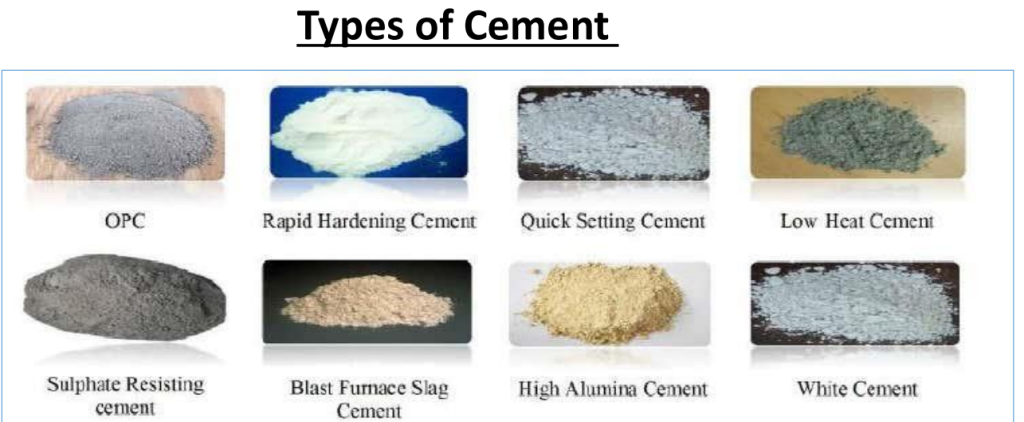
Cement has evolved into various types to meet specific needs and environments, from underwater constructions to high-strength structures.
Start here: The comparison tables below explain cement type, common uses and key distinctions between ASTM and EN families. For plant-side chemistry, continue to clinker and cement composition; this article is free.
Choosing the Right Cement Type
Consider project requirements, exposure conditions, heat development, early-strength demand and the governing standard before selecting a cement.
| Cement type | Best fit |
|---|---|
| OPC / general-purpose | General structural concrete |
| Rapid-hardening | Early strength, precast, fast schedules |
| Sulfate-resistant | Sulfate-bearing soils and waters |
| Low-heat | Mass concrete and thermal-cracking control |
| PPC / pozzolanic | Durability-focused blended cement |
| PSC / slag cement | Durability and aggressive exposure |
For the chemistry behind these choices, see C3S, C2S, C3A and C4AF in cement. For plant calculations and diagnostic work, use the 20 free cement engineering calculators.
Cement Type Selection: Fast Engineering Decision Table
| Project condition | Priority | Cement family to investigate |
|---|---|---|
| Normal structural concrete | Balanced strength and availability | General-purpose Portland or blended cement |
| Fast formwork removal / precast | Early strength | High-early-strength / rapid-hardening cement |
| Mass concrete | Limit thermal cracking | Low/moderate-heat system or suitable SCM blend |
| Sulfate-bearing soil or groundwater | Sulfate resistance | Moderate/high sulfate-resistant cement as exposure requires |
| Freeze-thaw exposure | Durable air-void system | Specify appropriate air entrainment with the concrete system |
Selection rule: do not choose cement from the name alone. Confirm the governing ASTM/EN/local specification, exposure class, required strength development, heat constraints and local availability before ordering.
Cement selection depends on the required strength development, exposure conditions, heat of hydration and the applicable project specification. The 15 examples below include both standardized cement families and specialty products; they are not 15 interchangeable grades or an official count under one standard. Check the actual product certificate and current local requirements before specifying a material.
Types of cement: ASTM and EN classifications at a glance
In ASTM C150/C150M-24, Type I is general-purpose Portland cement, Type II offers moderate sulfate resistance, Type III is for high early strength, and Type V is for high sulfate resistance. The current standard also covers IA, IIA and IIIA air-entraining variants. These designations should not be confused with the EN 197-1 CEM families, which classify cement by main constituents.
| EN 197-1 family | General composition |
|---|---|
| CEM I | Portland cement |
| CEM II | Portland-composite cement (e.g., limestone, slag or pozzolanic constituents) |
| CEM III | Blastfurnace cement |
| CEM IV | Pozzolanic cement |
| CEM V | Composite cement |
An ASTM type and an EN CEM designation are not automatic one-to-one equivalents. Compare certified performance and constituent requirements rather than translating the label alone.
Ordinary Portland Cement (OPC): General-Purpose Construction
Ordinary Portland cement is widely used for general concrete and mortar when no special performance requirement governs. Under ASTM C150, Type I covers general use; under EN 197-1, CEM I denotes Portland cement by composition. Selection still depends on strength class, curing, exposure and project specifications.
Portland Slag / Blastfurnace Cement: Blended-Cement Options
Slag-containing cements combine Portland clinker with ground granulated blastfurnace slag. EN 197-1 distinguishes Portland-slag compositions within CEM II from blastfurnace cement under CEM III. Such blends may improve durability in appropriate exposure conditions, but strength development and sulfate/chloride performance must be checked for the actual mix and application.
Quick Setting Cement: Speed Without Compromise
Quick-setting cement is formulated to shorten setting time, which can be useful for selected urgent repairs or applications where early stiffening is required. Quick setting is not the same as rapid strength gain: formwork removal and loading must be based on verified in-place strength, not initial setting time. Confirm placement time, compatibility, curing and the manufacturer’s technical data before use.
High Alumina Cement: For Extreme Conditions
Calcium aluminate cement, sometimes called high-alumina cement, is used in selected refractory, chemical-resistant and specialist applications. Its hydration products and long-term strength behavior differ from ordinary Portland cement; conversion-related strength reduction can occur under certain conditions. It should not be substituted for structural Portland cement without specialist design review, appropriate testing and compliance with applicable standards.
Colored Cement: Adding Aesthetic Flair
Who said cement has to be gray and boring? Colored cement is here to change that notion. By mixing 5-10% mineral pigments with ordinary cement, colored cement allows for decorative finishes on floors and walls. It’s often used to create stunning visual effects in homes and commercial spaces, from floor finishes to artistic marble imitations. It brings functionality and beauty together, offering a versatile solution for architects and designers.
Air Entraining Cement: A Frost Fighter
Air-entrained concrete contains a controlled system of small, well-distributed air voids that can improve resistance to freeze-thaw cycling, particularly when concrete is exposed to moisture or deicing salts. Air entrainment may improve fresh-concrete workability, but it does not automatically lower the water-to-cementitious-materials ratio and can reduce compressive strength at a given ratio. Specify and verify the required air content, strength, exposure class and mix proportions; air-entraining admixtures are another common route to the required air-void system.
Expansive Cement: No Shrinking, Just Growing
Expansive or shrinkage-compensating cementitious systems are designed to develop controlled early expansion, which can offset part of the subsequent drying shrinkage when properly restrained and cured. They do not eliminate all shrinkage or guarantee crack-free concrete. Applications include selected grouts and shrinkage-compensating slabs, subject to the specified expansion performance, restraint, curing regime and product approval.
Water-Resistant Cementitious Systems: Design for Water Exposure
Water-resisting cementitious systems may use suitable cement, supplementary cementitious materials and waterproofing admixtures, but watertight performance depends on the entire concrete mix, permeability, cracking, joints and curing. Do not rely on a label such as “waterproof cement” to qualify a dam, tank or other water-retaining structure; require the applicable structural and durability design checks.
Rapid Hardening Portland Cement: When Time Is Money
Sometimes, speed is not just an advantage, but a necessity. Rapid hardening Portland cement offers quick strength gains, allowing you to move forward with construction in record time. It’s used in road pavements, precast structures, and other projects that need to carry loads shortly after being poured. This type of cement provides both strength and speed, ensuring that deadlines are met without delays.
Sulphate Resisting Cement: Built for Tough Environments
In certain environments, concrete is under constant attack from sulfates found in soil and water. Sulphate resisting cement is engineered to withstand these harsh conditions, particularly in coastal areas, sewage treatment plants, and pile foundations. By minimizing the amount of calcium aluminate, it resists sulfate attacks that could otherwise degrade concrete over time.
Low Heat Cement: Ideal for Massive Projects
Low-heat cementitious systems can reduce and delay heat generation, helping engineers manage temperature rise and thermal gradients in mass concrete such as large foundations and dams. They do not, by themselves, prevent thermal cracking: placement temperature, section geometry, insulation, curing, restraint and the project thermal-control plan remain important. Strength development and durability must be verified for the specified mix and exposure conditions.
Portland Pozzolana Cement: Sustainable and Affordable
If you’re looking for a cement that balances affordability with sustainability, Portland pozzolana cement (PPC) is the answer. It’s made by adding pozzolanic materials like fly ash to ordinary Portland cement, which not only reduces costs but also makes the cement more environmentally friendly. PPC gains strength over time, making it a durable choice for building construction that will stand the test of time.
White Cement: Aesthetic Elegance
White cement is essentially the same as ordinary Portland cement, except it’s white! The absence of coloring oxides like iron ensures that it maintains its pure color. White cement is often used for decorative purposes, from floor finishes to aesthetic architectural designs. Whether it’s used in interior or exterior projects, its bright appearance adds a touch of elegance to any structure.
Hydrophobic Cement: Built for Wet Climates
When storing cement for long periods in wet or humid conditions, hydrophobic cement is the go-to solution. With the addition of chemicals like petrolatum and soap, this type of cement repels moisture, protecting it from premature hydration. Once mixed with water, the protective coating is removed, and the cement behaves just like ordinary Portland cement.
Oil Well Cement: Built for Deep Depths
Oil well cement is used for one of the most specialized applications in construction—drilling deep into the earth for oil and gas. It must remain pumpable under extreme conditions of temperature and pressure, making it essential for energy exploration. Produced according to strict specifications, oil well cement ensures that the slurry remains fluid until it reaches its destination in the well.
Conclusion
With so many specialized types of cement available, it’s clear that the world of construction is more innovative and exciting than ever. From quick setting cement for underwater repairs to hydrophobic cement for wet climates, each type serves a unique purpose. Whether you’re a builder, engineer, or designer, knowing the right type of cement to use can make all the difference in the success of your project.
Frequently Asked Questions
What is quick setting cement used for?
Quick setting cement is used for urgent repairs, underwater work, and fast-paced urban projects where rapid setting is required.
What are the benefits of high alumina cement?
Calcium aluminate cement can suit selected refractory and chemically aggressive environments. Its long-term strength and conversion behavior require specialist assessment; it is not a direct substitute for ordinary structural Portland cement.
What is colored cement used for?
Colored cement is used to create decorative finishes on floors and walls, offering a versatile solution for architects and designers.
Need deeper cement chemistry, standards and quality references?
The Complete Cement Industry Technical Package contains 931 organized files, including 540 PDFs, 54 Excel calculation files and 37 PowerPoint files, covering cement chemistry, quality, standards, process, maintenance and plant calculations.
One-time price: $249.99. Instant download after payment. Review real previews and the full file inventory before you buy.
Related reference
If you need a deeper technical library, review the Complete Cement Industry Technical Package.
Classification of Cement: ASTM C150, C595, C1157 and EN 197
Answer first: do not treat all cement names as one classification system. ASTM C150 covers Portland cements such as Type I (general use), Type II (moderate sulfate resistance), Type III (high early strength), Type IV (low heat) and Type V (high sulfate resistance), including applicable air-entraining/moderate-heat variants. Blended hydraulic cements belong under ASTM C595, including Type IL (Portland-limestone), IP (Portland-pozzolan), IS (Portland blast-furnace slag) and IT (ternary blended cement). ASTM C1157 instead classifies hydraulic cement by performance, using designations such as GU, HE, MS, HS, MH and LH. EN cement designations use a different family system; confirm the project specification and current locally adopted standard before procurement.
For the underlying phase chemistry, continue to C3S, C2S, C3A and C4AF in cement. For broader composition and cement-family context, see cement composition and types. For production context, use the cement manufacturing process guide, then use the 20 free cement engineering calculators for plant-side calculations.
The classification of cement in table form is the fastest summary:
| ASTM class | Name | Main use |
|---|---|---|
| Type I | General purpose OPC | Roads, slabs, mass, concrete |
| Type II | Moderate sulfate | Drainage, sulfate soil areas |
| Type III | High early strength | Fast schedules, precasting |
| Type IV | Low heat | Mass concrete, dams |
| Type V | High sulfate | Marine, sulfate ground |
| ASTM C595: IL / IP / IS / IT | Portland-limestone / pozzolan / slag / ternary blended hydraulic cements | General and special applications as specified |
The classification of cement families used throughout this site follows that five-type background along with the
blended classes (ASTM C595) detailed in the article on types
of cement. Memorise the table above and the types themselves become trivial.
Get the Complete Cement Technical Package (931 files)
$249.99 — one-time purchase, instant download after payment
See the $249.99 Complete Package →
Browse the full package: 931-file Complete Package