Introduction to Pyroprocessing in Cement Manufacturing
The cement manufacturing process, particularly pyroprocessing, is a complex and high-stakes chemical dance that requires a deep understanding of the underlying chemistry and physics. At the heart of this process is the kiln, a thermal engine where raw minerals are fundamentally restructured at temperatures exceeding 1,300°C. The industry’s pivot toward sustainability has made it essential for operators to maintain a delicate equilibrium between massive energy requirements, the volatile behavior of trace elements, and increasingly stringent environmental mandates.
The Role of Volatiles in Kiln Operations
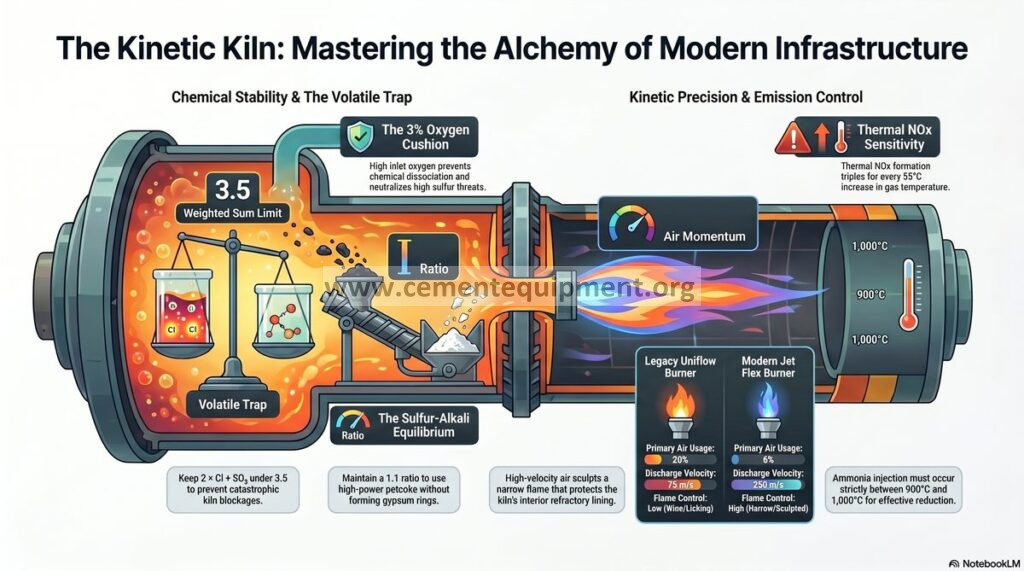
Volatiles, such as Sulfur (S), Chlorine (Cl), Potassium (K), and Sodium (Na), can enter the system in minute quantities but have a disproportionately destructive impact. These elements undergo a cycle of thermal evaporation and condensation, creating a “volatile trap” that can lead to catastrophic cyclone blockages, kiln rings, and deep-seated corrosion. To combat this, strategists utilize bypass circuits to bleed off these concentrations, and engineers rely on a precise weighted sum calculated from wet lab data of the bottom stage material.
The industry “Thumb Rule” for operational stability is defined by the formula: 2 × Cl + SO₃ < 3.5. If this concentration limit is exceeded, the plant moves from "normal cleaning" to a "no operation possible" danger zone, necessitating immediate bypass intervention or intensive maintenance.
The Importance of Kinetic Precision in Kiln Operations
A common misconception is that cement manufacturing is simply a matter of reaching a specific temperature. In reality, the shape and velocity of the heat are the true drivers of performance. Modern burner design has evolved to achieve “more with less,” using only 6% primary air but discharging it at a staggering 250 m/s. This defines “Primary Air Momentum,” which is vital for refractory health and allows operators to sculpt a short, narrow, and strong radiant flame.
High momentum is the key factor for kiln burner performance, and by increasing air velocity from 75 m/s to 250 m/s, modern systems create a stable radiant flame that protects the equipment while maximizing heat transfer to the material charge.
The Challenges of Burning Petroleum Coke
As plants move away from coal to reduce costs, petroleum coke (petcoke) has become the industry’s fuel of choice. However, petcoke offers a high calorific value but is notoriously difficult to ignite due to its low volatile content and high sulfur concentration. Burning petcoke successfully requires a counter-intuitive approach, including finer grinding and the adoption of “Hot Bottom” calciner operations to promote faster combustion.
To stabilize this process, strategists must maintain a specific Sulfur-Alkali ratio of approximately 1.1 and a higher oxygen level—roughly 3% O₂ at the kiln inlet. This oxygen-rich environment is essential to prevent the dissociation of alkali sulfates and effectively neutralize the high sulfur threat.
Nitrogen Oxides Management in Cement Manufacturing
Environmental stewardship centers on the management of Nitrogen Oxides (NOx), which originate from both the nitrogen in the air and the nitrogen in the fuel. The chemistry of Thermal NOx is particularly volatile, and its formation increases 3X for every 55°C increase in gas temperature. To mitigate this, plants utilize Selective Non-Catalytic Reduction (SNCR), injecting an ammonia solution into the post-combustion gas within a strict “Goldilocks Zone” of 900°C to 1,000°C.
By navigating this narrow thermal window, plants can achieve a 35% to 65% reduction in NOx emissions, balancing industrial output with ecological survival.
Conclusion and Next Steps
The evolution of pyroprocessing represents a triumph of industrial ingenuity, and by mastering the weighted sums of volatiles, the physics of flame momentum, and the precision of the SNCR window, the cement industry is reinventing its role in the global economy. To stay ahead of the curve, engineers and operators must prioritize ongoing education and training, leveraging resources like our Cement Technical Package to optimize their operations and reduce their environmental footprint.
For more information on the latest cement industry technologies and best practices, visit https://www.cementequipment.org/ and discover how you can improve your operations and contribute to a more sustainable future.